What you'll learn
- What Great Expectations is about at a “big picture” level.
- How Dickens uses Pip’s story to question class, money and moral worth.
- Why the narrator and structure matter for your exam answers.
- How to turn an overview idea into a clear GCSE argument.
Starting point: what kind of text is Great Expectations?
Great Expectations is a 19th-century novel by Charles Dickens, first serialised between 1860 and 1861. A novel is a long prose fiction text; prose means ordinary written language rather than lines of poetry.
The protagonist — the main character whose life the story follows — is Pip, an orphan who grows up on the Kent marshes before being given the chance to become a London gentleman. At first, this sounds like a story of success. Dickens makes it much more complicated: Pip’s rise in status brings shame, confusion, guilt and painful self-discovery.
Bildungsroman
A bildungsroman is a coming-of-age novel that follows a young protagonist’s development from childhood towards maturity, usually through mistakes, suffering and self-knowledge.
In Great Expectations, Pip’s “education” is not just about manners or money. It is a moral education: he has to learn what truly makes a person valuable.
The central overview idea
Dickens uses Pip’s journey to challenge the belief that wealth and social rank make someone a better person.
Seeing Pip’s growth
- Early in the novel, Pip becomes ashamed after Estella mocks him: “What coarse hands he has! And what thick boots!” The repeated criticism of his body and clothing makes class feel personal and humiliating.
- Later, Pip recognises Joe’s goodness, calling him “this gentle Christian man.” The adjective “gentle” matters because Joe is not socially “gentlemanly”, but he is morally gentle.
- This shows the novel’s coming-of-age pattern: Pip must move from false values — status, polish, wealth — towards truer values like loyalty, kindness and humility.
The title: “great expectations”
The title is one of the best ways into the whole novel. In everyday language, expectations are hopes about the future. In Victorian society, the word could also suggest financial prospects, especially the possibility of inheritance.
So Pip’s “great expectations” are both emotional and financial: he expects to rise in class, become a gentleman and become worthy of Estella. Dickens gradually exposes how dangerous those expectations are.
Irony
Irony is a contrast between what seems to be true and what is actually true, often used by writers to make the reader question appearances.
The title is ironic because Pip’s “great” expectations do not simply make him great. They lead him to neglect people who truly love him, especially Joe and Biddy, and to misunderstand where his fortune comes from.
Interpreting the title
- Start with the obvious meaning: “expectations” suggests Pip’s hopes for wealth, status and love.
- Add the social meaning: in a Victorian world, “expectations” can imply inheritance and a future place among the respectable middle or upper classes.
- Then notice Dickens’s irony: Pip’s expectations look “great”, but they expose his moral weakness and society’s shallow obsession with rank.
The narrator: older Pip looking back
Great Expectations is told by Pip himself. A first-person narrator tells the story using “I”. Pip is also a retrospective narrator, meaning he is telling the story after the events have happened.
Retrospective narration
Retrospective narration means a narrator looks back on earlier events from a later point in life, often with more knowledge, regret or understanding than they had at the time.
This creates two versions of Pip:
- Younger Pip, who experiences fear, shame, ambition and confusion.
- Older Pip, who narrates those experiences with hindsight.
That matters because the reader is encouraged to sympathise with Pip while also judging him. We understand how a frightened child becomes vulnerable to class shame, but we also see how selfish and snobbish he becomes.
Using retrospective narration
- In the opening, Pip explains that his “infant tongue” shortened Philip Pirrip into “Pip.” The adult narrator carefully remembers childish language and identity.
- This creates distance between the child who simply lives through events and the adult who can reflect on their meaning.
- In an essay, you can argue that Dickens makes Pip both sympathetic and flawed: the first-person voice draws us close to him, while hindsight lets us see his mistakes clearly.
The big overview map
A useful way to revise the novel is to keep one guiding question in mind: What makes a true gentleman? Around that question, Dickens connects class, money, crime, guilt, love, loyalty and memory.
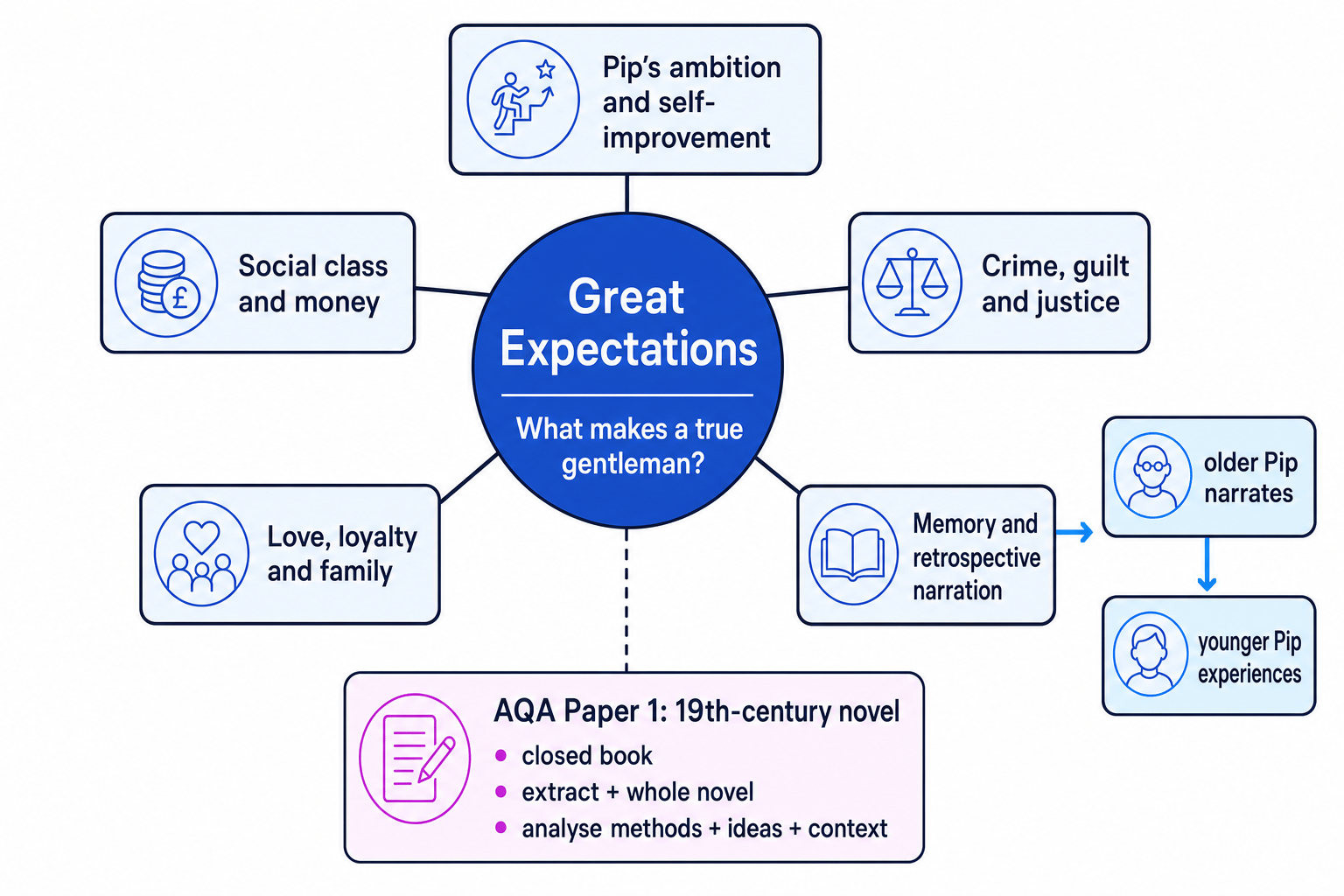
This does not mean every essay should mention every idea. Instead, use the overview map as a way of choosing relevant links. For example, a question on Pip’s ambition can connect to social class, narration and guilt. A question on Magwitch can connect to crime, justice, fatherhood and what it means to be “gentlemanly”.
Think in linked ideas
Strong answers often connect two or three ideas together: for example, class + shame + narration, or crime + loyalty + redemption.
Dickens’s structure: serialisation and suspense
The structure of a text is how it is organised: the order of events, turning points, contrasts, repetitions and endings. Great Expectations was first published in weekly instalments, a process called serialisation.
Serialisation
Serialisation means publishing a story in separate instalments over time rather than all at once.
Serialisation helps explain why Dickens often uses suspense, secrets and dramatic chapter endings. Readers had to wait for the next part, so Dickens keeps them asking questions: Who is Pip’s benefactor? What does Miss Havisham want? Can Pip become a gentleman? Will the past return?
Dickens also uses foreshadowing, which means planting early clues that prepare the reader for later events.
Spotting foreshadowing
- The novel opens with Pip meeting a terrifying escaped convict on the marshes. This immediately links Pip’s childhood with fear, crime and guilt.
- Much later, the truth about Pip’s benefactor makes that opening scene feel newly important rather than random.
- So, if an exam extract comes from early in the novel, you can still link it to the whole text by explaining how Dickens plants ideas that return later.
Retelling the plot
Do not use the overview as a long plot summary. In the exam, you are rewarded for argument and analysis, not for narrating everything that happens.
Context: what you need to know
Context means the social, historical and cultural circumstances that shape a text. For Great Expectations, useful context includes Victorian ideas about class, gentility, crime, punishment, work, family and respectability.
However, context should never feel bolted on. You do not need to write a history essay. You need to show how context helps explain Dickens’s choices.
Gentility
Gentility means the manners, education, appearance and social status associated with being considered a “gentleman” or “lady”.
Victorian society often judged people by accent, clothing, occupation, education and money. Dickens challenges this by making some “respectable” characters morally damaged, while working-class or criminalised characters can show loyalty, tenderness and sacrifice.
Integrating context
- Begin with the literary idea: Pip believes becoming a gentleman will make him more worthy, especially after Estella makes him ashamed of his class.
- Add relevant context: Victorian gentility was often linked to manners, education, income and social appearance.
- Link back to Dickens’s message: by presenting Joe as morally “gentle” despite his low status, Dickens questions whether society’s version of gentility is shallow and unfair.
Context dumping
Avoid sentences like “In Victorian times, class was important” unless you connect them to Dickens’s presentation of a character, setting, method or theme.
What AQA wants you to do
For the 19th-century novel question on AQA Paper 1, you will be given an extract from the text and asked to write about the extract and the novel as a whole. It is closed book, so you need to remember short, accurate quotations.
A high-quality answer usually does three things at once:
- Offers a clear argument about Dickens’s ideas.
- Analyses writer’s methods, such as language, narrative voice, structure, symbolism or contrast.
- Uses relevant context to deepen the interpretation.
A method is a deliberate choice made by the writer to create meaning. For example, Dickens’s first-person retrospective narration is a method; so is his use of setting, repeated imagery, dialogue, names and contrasts between characters.
Turning overview into a thesis
- Suppose the question is about ambition. A basic answer might say: “Pip is ambitious.” That is true, but not yet analytical.
- Add Dickens’s viewpoint: ambition is attractive because it promises escape from shame, but it also damages Pip’s loyalty and judgement.
- Add method: Dickens uses older Pip’s reflective narration to show that Pip now recognises the moral cost of his ambition.
- A stronger thesis would be: “Dickens presents ambition as emotionally powerful but morally dangerous, using Pip’s retrospective narration to expose how the desire for gentility makes him ashamed of the people who love him most.”
A simple overview sentence to remember
If you only remember one sentence, make it this:
Dickens presents Pip’s rise from poverty to gentility as a painful moral journey, showing that true worth comes from loyalty, compassion and self-knowledge rather than money or rank.
In the exam
- Start with a clear thesis about what Dickens suggests across the novel, not just what happens in the extract.
- Analyse the extract closely first, picking out precise words, images or narrative choices.
- Link to the wider novel using short references you know well, such as Pip’s shame, Joe’s goodness or the benefactor revelation.
- Use context only when it sharpens your point about Dickens’s message.
- Keep returning to the question wording so every paragraph feels purposeful.
Check yourself
- What is ironic about the title Great Expectations?
- How does older Pip’s narration affect the way we judge younger Pip?
- Why is Joe important to Dickens’s idea of a “true gentleman”?
