

What you'll learn
- How a strong Animal Farm essay is built for AQA GCSE English Literature.
- How to turn a question into a clear argument, not just a list of points.
- How to analyse Orwell’s methods using short, accurate quotations.
- How to use context without bolting it on awkwardly.
What makes a model essay “model”?
A model essay is not perfect because it uses long words or memorised paragraphs. It is strong because every paragraph answers the question, uses precise evidence, analyses Orwell’s choices, and links back to his wider message.
In Animal Farm, you are usually rewarded for explaining how Orwell presents ideas such as power, corruption, inequality, propaganda, violence, or betrayal.
Line of argument
A line of argument is the main idea that runs through your whole essay. It is your answer to the question, developed across several paragraphs rather than repeated in the same words.
For example, if the question asks about power, your line of argument might be:
Orwell presents power as something that begins with idealistic promises but becomes corrupt when leaders control language, history and violence.
That is stronger than simply saying:
Orwell presents power through Napoleon, Squealer and the dogs.
The second version names relevant things, but it does not yet make an argument.
The basic essay shape
For Animal Farm, a strong essay usually has:
- A short introduction giving your overall argument.
- Three analytical paragraphs, each focused on a different stage, method, or idea.
- A brief conclusion that returns to Orwell’s warning or message.
Analytical paragraph
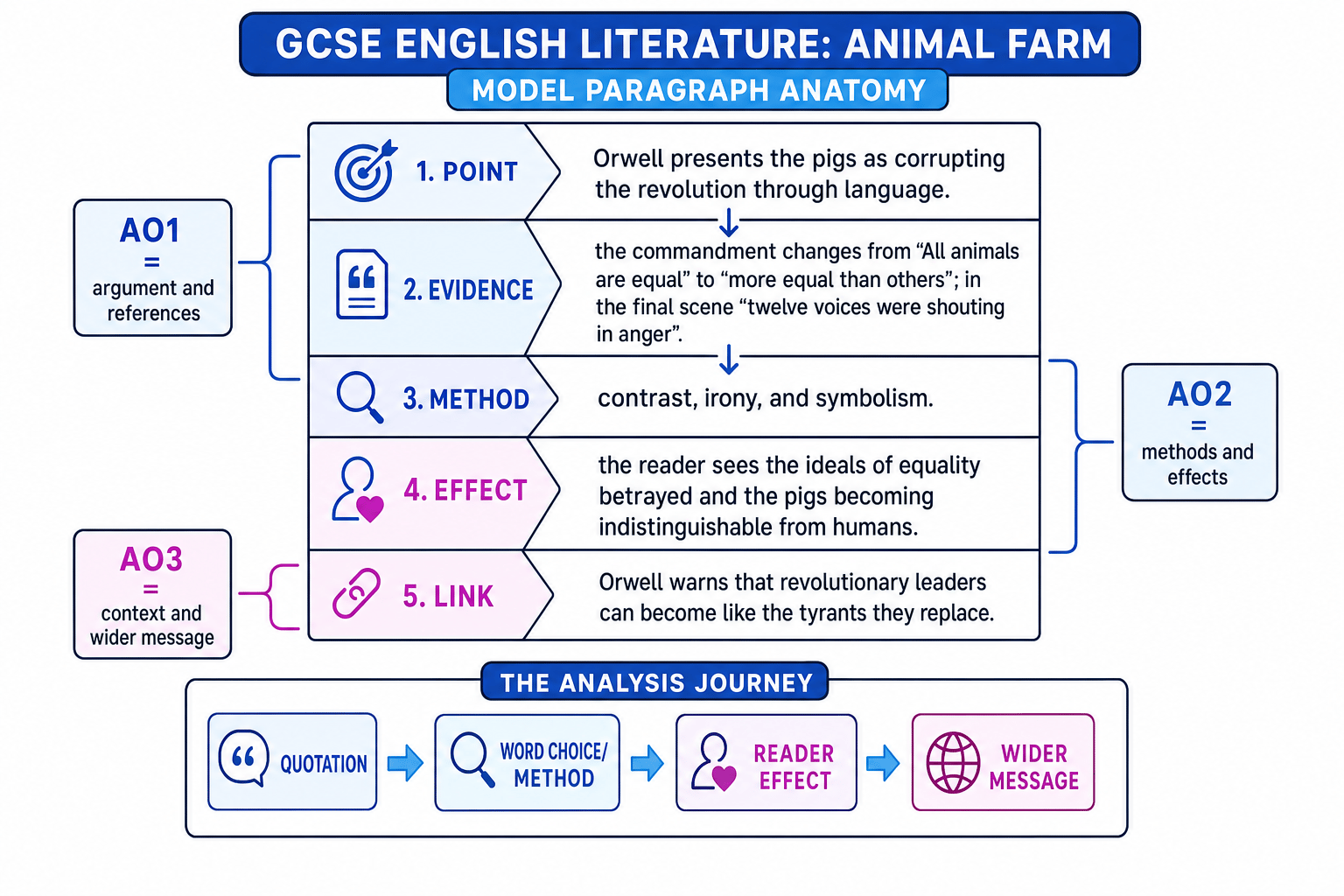
An analytical paragraph explains how a writer creates meaning. It normally includes a point, evidence, analysis of method, effect on the reader, and a link back to the question.
The diagram below shows how one paragraph can move from quotation to method to meaning.
The essay must keep moving
A high-level essay does not just identify a quote and explain it once. It develops: what Orwell shows → how he shows it → why it matters.
Starting with the question
Before writing, you need to turn the question into an argument.
Suppose the question is:
How does Orwell present the corruption of the ideals of Animalism in Animal Farm?
The key word is corruption. That means something originally good is damaged, twisted, or made dishonest. So your essay should show a movement: the animals begin with equality and hope, but the pigs gradually distort those ideals.
Building a thesis from the question
-
Identify the central focus. The question is not just asking about Animalism; it asks about the corruption of Animalism, so the essay needs to track how ideals are betrayed.
-
Choose a clear direction. A strong answer could argue that Orwell presents corruption as gradual: first through unequal leadership, then through manipulation of language, and finally through open resemblance to humans.
-
Turn that direction into a thesis. For example:
“Orwell presents the ideals of Animalism as noble at first, but he shows them being corrupted by the pigs’ control of language, memory and power, until the revolution becomes indistinguishable from the tyranny it replaced.”
Use the wording of the question
If the question says “present”, you should write about Orwell’s choices. If it says “importance”, you should explain why the idea matters to the novella as a whole.
Writing the introduction
Your introduction should be short. You do not need to retell the plot or explain every historical detail.
A good introduction does three things:
- Names Orwell and the focus of the question.
- Gives your overall argument.
- Hints at the wider message of the novella.
Model introduction
Orwell presents the corruption of Animalism as a gradual betrayal of revolutionary hope. At the start of the novella, the animals dream of equality and freedom, but the pigs manipulate those ideals for their own benefit. Through the changing commandments, Squealer’s propaganda and the final image of pigs becoming like men, Orwell warns that revolutions can reproduce the same oppression they claim to destroy.
This is effective because it answers the question immediately. It also gives the essay a clear route: ideals, manipulation, final betrayal.
Using short quotations well
Because the exam is closed book, you should memorise short, flexible quotations. You do not need huge chunks. In fact, shorter quotations are often easier to analyse closely.
Embedded quotation
An embedded quotation is a short quotation fitted smoothly into your own sentence, rather than dropped in as a separate sentence.
For example:
Orwell exposes the betrayal of equality when the commandment changes from “All animals are equal” to “more equal than others”.
This is better than:
A quote is “All animals are equal, but some animals are more equal than others.”
The embedded version is more analytical and more fluent.
Quote dumping
Do not place a quotation into a paragraph and assume it explains itself. After every quotation, ask: what word, contrast, image, or structure is doing the work?
Analysing Orwell’s methods
A method is a technique or choice used by the writer to create meaning. In Animal Farm, important methods include:
- Allegory: a story with a deeper political or moral meaning.
- Satire: writing that criticises people, systems or ideas by making them seem ridiculous, disturbing or hypocritical.
- Symbolism: when a person, object, place or action represents a larger idea.
- Irony: when there is a gap between what is said and what is really meant, or between expectation and reality.
Allegory
An allegory is a narrative in which characters and events represent wider ideas, historical events, or political systems.
In Animal Farm, the farm is not only a farm. It symbolises a society where a revolution promises fairness but creates a new ruling class.
Analysing a changed commandment
-
Choose the precise contrast. The original commandment “All animals are equal” is simple and absolute. The later phrase “more equal than others” changes the meaning completely.
-
Analyse the method. Orwell uses irony because “more equal” is logically contradictory: equality should not have levels. This exposes how language is being twisted.
-
Explain the effect. The reader sees that the pigs no longer even pretend to believe in true equality. The commandment becomes evidence of open hypocrisy.
-
Link to Orwell’s message. Orwell suggests that corrupt leaders can manipulate political language until oppression sounds reasonable.
Model paragraph: language and corruption
Here is a model paragraph on the corruption of Animalism:
Orwell presents the corruption of Animalism through the pigs’ manipulation of the commandments. At first, the principle “All animals are equal” sounds simple, moral and collective, reflecting the animals’ original hope for a fairer society. However, by the end this becomes “All animals are equal, but some animals are more equal than others”. Orwell uses irony in the phrase “more equal”, because equality cannot logically be increased for one group without destroying equality itself. This contradiction shows how completely the pigs have corrupted revolutionary language: they keep the appearance of Animalism while reversing its meaning. The reader is encouraged to distrust political slogans that sound fair but protect privilege. Written after the Russian Revolution and during the rise of Stalinism, the novella warns that leaders can betray socialist ideals by turning them into tools of control.
Notice how the paragraph does not just say “this shows corruption”. It explains exactly how the wording has changed and why that matters.
Bringing in context naturally
Context means the circumstances surrounding a text’s writing and reception. For Animal Farm, the most useful context is Orwell’s criticism of totalitarianism, especially Stalin’s betrayal of revolutionary ideals after the Russian Revolution.
Totalitarianism
Totalitarianism is a political system where the state or ruler seeks total control over public and private life, often using propaganda, fear and violence.
Context should support your interpretation. It should not become a history essay.
Weak context sounds like this:
Orwell wrote this because of Stalin and the Russian Revolution.
Stronger context sounds like this:
Orwell’s presentation of Napoleon’s control reflects his fear that revolutionary leaders like Stalin could replace one form of tyranny with another.
Linking context to analysis
-
Start from the text. Napoleon uses the dogs to enforce his power, so the focus is violence and fear.
-
Connect to Orwell’s concern. This can be linked to Orwell’s criticism of authoritarian leaders who silence opposition rather than debate with it.
-
Keep the context relevant. Instead of giving a long history of the Soviet Union, explain how the context sharpens the point: Orwell warns that political systems become dangerous when leaders are not accountable.
Mini model essay: corruption of Animalism
Below is a shorter model essay. In the exam, your answer would usually be longer, but this shows the quality and direction you are aiming for.
Orwell presents the corruption of Animalism as a gradual process in which noble ideals are twisted into tools of control. At the beginning of the novella, the animals imagine a society based on equality, but the pigs exploit their intelligence and authority until the revolution becomes almost identical to the human tyranny it replaced. Orwell uses this corruption to warn readers about the danger of political leaders who control language, history and violence.
At first, Animalism appears to offer genuine hope. The commandment “All animals are equal” is brief and absolute, suggesting moral clarity and unity. The adjective “all” presents equality as universal, not something reserved for the clever or powerful. However, Orwell structures the novella so that this ideal is slowly undermined. The pigs begin by taking the milk and apples, while claiming this privilege is necessary for the farm’s survival. This early inequality foreshadows the later dictatorship because it shows that the pigs are already separating themselves from the other animals. Orwell therefore presents corruption not as sudden, but as something that begins with small exceptions.
Orwell also presents corruption through the manipulation of language. Squealer repeatedly asks, “Surely, comrades, you do not want Jones back?” The rhetorical question pressures the animals into agreement by making doubt seem dangerous. The word “comrades” creates a false sense of equality, even while Squealer is defending the pigs’ privileges. Orwell uses Squealer as a symbol of propaganda: language designed not to reveal truth, but to control how people think. This reflects Orwell’s wider concern that political language can be used to make lies sound loyal and necessary.
By the ending, the corruption of Animalism is complete. The final commandment declares, “All animals are equal, but some animals are more equal than others.” The phrase “more equal” is ironic because it destroys the very meaning of equality. Orwell then shows the animals looking “from pig to man, and from man to pig”, until it is “impossible to say which was which”. This final structural image completes the circular movement of the novella: the animals have returned to the oppression they rebelled against. Orwell’s message is bleak but powerful: without truth, education and accountability, revolutions can create new tyrants rather than freedom.
What makes this model work?
The model essay works because it keeps returning to the question: corruption of Animalism. Each paragraph adds a new stage:
- Original ideal: equality begins as a hopeful principle.
- Manipulation: language is used to excuse inequality.
- Final betrayal: pigs and humans become indistinguishable.
It also balances the assessment focus. There is a clear argument, short quotations, analysis of Orwell’s methods, and relevant context.
Do not memorise whole essays
You can learn useful phrases and paragraph shapes, but do not memorise a full essay and force it into the exam. If the question changes, a memorised answer can become irrelevant very quickly.
Useful model sentence stems
You can adapt these to many Animal Farm questions:
- Orwell initially presents…
- This changes when…
- The word “…” suggests…
- Orwell uses this contrast to show…
- This would make the reader question…
- Structurally, the novella moves from… to…
- This reflects Orwell’s warning that…
- Therefore, Orwell presents… not simply as…, but as…
Aim for flexible quotations
Quotes such as “All animals are equal”, “I will work harder!”, “Napoleon is always right”, “Surely, comrades”, and “more equal than others” can be used for many different questions.
In the exam
- Spend a few minutes turning the question into a clear line of argument before you start writing.
- Use short quotations and analyse individual words or contrasts, rather than retelling the plot.
- Link context to Orwell’s message only where it helps your argument; do not bolt on historical facts.
Check yourself
- Can you write a one-sentence thesis for a question on power, propaganda, or inequality?
- Can you analyse “more equal than others” without just saying it shows corruption?
- Can you explain Orwell’s context in a way that links directly to the question?
