Welcome to your ultimate guide on crafting high-scoring essays for Great Expectations. In your AQA GCSE English Literature Paper 1, Section B, you will be faced with a closed-book essay question that includes a printed extract from the novel. Your task is to construct a coherent, sophisticated argument that balances a close-up analysis of the extract with a broad exploration of the novel as a whole.
In this guide, we will break down the exact structural blueprint required to satisfy the examiners and walk through a step-by-step model of high-level literary analysis.
What you'll learn
- How to structure your essay to balance the printed extract with the wider novel.
- How to write a sharp, conceptualized thesis statement that answers the prompt directly.
- The step-by-step formula for a high-scoring analytical paragraph (integrating quotes, methods, and social context).
- How to decode an essay prompt and plan a Grade 9 response under timed conditions.
The Anatomy of a GCSE Essay Question
Before you write a single word, you must understand exactly how the examiner evaluates your work. You are assessed on three core assessment objectives (AOs) in this section:
- AO1: Reading, understanding, and responding to the text (your main argument, structure, and supporting quotes).
- AO2: Analysing the language, form, and structure used by Charles Dickens to create meaning (using terms like motif, syntax, imagery, and juxtaposition).
- AO3: Understanding the relationship between the text and its contexts (the social, historical, and cultural climate of Victorian England, and Dickens's moral intentions).
To hit the highest marks, your essay cannot treat these objectives as separate boxes to tick. Instead, they must be woven together seamlessly.
Conceptualized Response
A conceptualized response is an essay that treats the characters and events of Great Expectations not as real people, but as literary constructs designed by Dickens to deliver a specific social, moral, or philosophical message to his Victorian audience.
The "Extract-to-Whole" Strategy
Your exam prompt will ask you to start by looking at a specific extract, and then expand your focus to the rest of the novel. The most successful essays do not split the writing into two isolated halves (e.g., "Part 1: The Extract" and "Part 2: The Whole Book"). Instead, they integrate the two, using the extract as a springboard to explore broader thematic patterns.
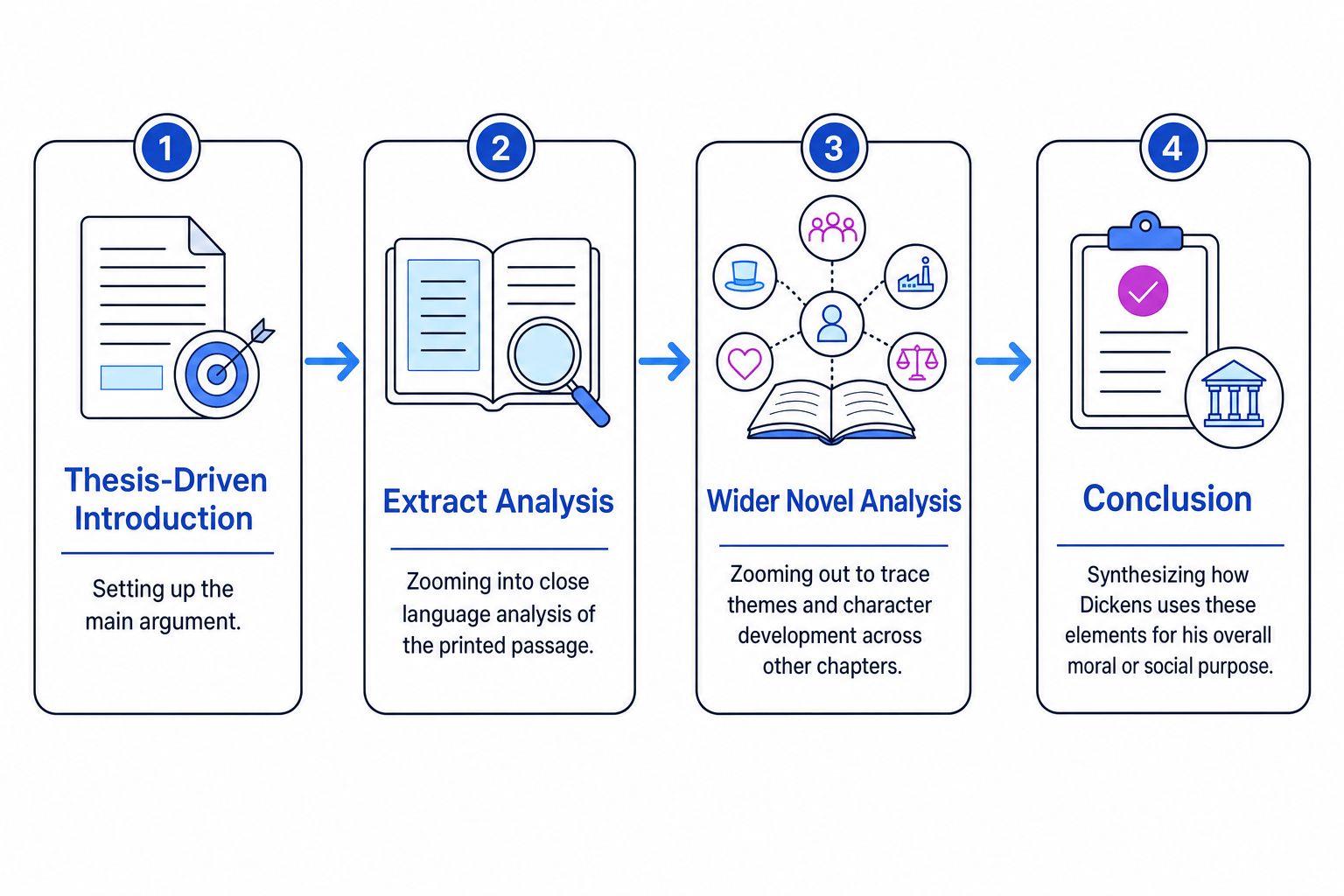
Building Your Analytical Paragraphs
To write a high-scoring paragraph, you should move away from rigid, robotic writing frames (like simple PEEL structures) and adopt a fluid, method-led approach.
Every body paragraph you write should strive to follow this logical trajectory:
- The Thesis-Led Topic Sentence: Start with a conceptual claim. State what Dickens is doing, why he is doing it, and how it relates to the question.
- The Integrated Evidence: Embed a short, precise quotation from the text. Never drop a quote in as a standalone sentence.
- The Micro-Analysis (Methods): Identify a specific literary or structural method used in your quotation and analyze how it works.
- The Structural Zoom-Out: Link this detail back to a structural trend, character arc, or motif elsewhere in the novel.
- The Contextual Driver (Dickens's Intent): Explain why Dickens presented this to his contemporary audience. What Victorian issue (the class system, industrialization, the penal system, moral corruption) is he criticizing?
The Golden Thread
Every paragraph must connect back to your central thesis statement. If you find yourself analyzing a beautiful metaphor that has nothing to do with your core argument, cut it out. Keep your writing tightly focused.
Deep-Dive Walkthrough: Drafting a High-Scoring Paragraph
Let's look at how to put these principles into practice. Suppose you receive an essay prompt on the following topic:
"Explore how Charles Dickens presents Pip's changing attitudes towards social class in Great Expectations."
We will focus on a pivotal scene in Chapter 27, where Joe Gargery visits Pip at his high-society lodgings in London. This chapter perfectly exposes the psychological toll of Pip's snobbery and social ambition.
Developing an analytical paragraph on Pip's snobbery
Here is the step-by-step process of drafting a Grade 9 analytical paragraph.
-
Formulate a thesis-driven topic sentence. Avoid starting with a simple plot description (e.g., "In Chapter 27, Joe visits Pip and Pip feels embarrassed"). Instead, frame the paragraph around Dickens's conceptual purpose. Drafting: "Dickens uses the painful awkwardness of Joe's visit to London in Chapter 27 to expose how Pip’s pursuit of elevated social status has corrupted his capacity for genuine human connection, rendering him a victim of Victorian class anxiety."
-
Integrate a precise, short quotation. Select a memorable phrase from the chapter. In Chapter 27, Pip confesses to the reader: "I had whom I loved in my armless, hearty, honest, easy life." He also admits that if he could have kept Joe away by paying money, he would have done so. Let's use his direct reaction to Joe's arrival: "I knew was Joe; with a sensation of sharp hurt to my boyish pride." Drafting: "As Pip anticipates Joe’s arrival, he confesses to feeling 'a sensation of sharp hurt' to his 'boyish pride', demonstrating that his newfound status has made him view his humble origins as a source of acute shame rather than comfort."
-
Identify the writer's method and analyze its direct effect. Look closely at the language. The phrase "sharp hurt" uses physical pain imagery to describe a psychological state. The noun "pride" underlines his insecurity. Drafting: "Dickens’s choice of the tactile adjective 'sharp' to describe Pip’s internal discomfort highlights how deeply ingrained class consciousness has become in Pip's psyche. It is not merely a social inconvenience, but a physicalized pain, illustrating how Victorian class-snobbery inflicts psychological trauma on those desperate to escape their roots."
-
Connect the extract to a structural motif or event elsewhere in the novel. Compare Pip's attitude here with his attitude at the beginning of the novel, or his eventual redemption. Drafting: "This acute embarrassment stands in stark structural contrast to Pip’s early life at the forge, where Joe was his protector and moral compass. By contrasting the cold, sterile luxury of Pip’s London chambers with the warm, fire-lit security of the forge, Dickens structurally tracks Pip's moral decline as he trades genuine familial warmth for superficial social prestige."
-
Anchor the analysis to Dickens's social purpose (AO3). Why is Dickens writing this? He is criticizing the mid-Victorian obsession with the "self-made gentleman" and the idea that moral worth is tied to social class. Drafting: "Through this poignant interaction, Dickens delivers a scathing critique of the rigid Victorian class hierarchy. By exposing the psychological division created between Pip and his surrogate father, Dickens warns his middle-class readers that the frantic scramble for social mobility often requires the sacrifice of domestic affection and moral integrity—assets that Dickens positions as the true markers of a 'gentleman'."
Feature Spotting
Do not simply label devices (e.g., "Dickens uses a metaphor here..."). Identifying a method gets you very few marks on its own. You must explain how the method creates meaning, and why Dickens chose it to convey his larger social message.
Mastering Your Thesis Statement
A great essay is built on a great thesis statement. Your thesis statement is a 2-to-3 sentence summary of your entire argument, placed at the very end of your introduction. It acts as a roadmap for the examiner, showing them that you have a clear plan and a sophisticated thesis to defend.
The 'Although...' Formula for Thesis Statements
To elevate your thesis, try using a subordinate clause to acknowledge the complexity of the novel before asserting your main argument:
"Although Dickens initially presents Pip's desire for self-improvement as a natural response to his abusive childhood, he ultimately uses Pip's moral deterioration to argue that true gentility is found in quiet, domestic integrity rather than the superficial trappings of high social class."
In the exam
- Spend 5–8 minutes planning: Read the prompt, highlight the keywords, read the extract, select 2–3 key quotations from it, and jot down 3 thematic links to other areas of the novel.
- Draft a conceptual introduction: Start with a broad statement about Dickens's overall purpose regarding the theme, and conclude the paragraph with your thesis statement.
- Move chronologically or thematic-structurally: Aim for 3 substantial body paragraphs. Try organizing them by character arc (e.g., Pip's innocence →\to→ Pip's corruption →\to→ Pip's redemption) to show a deep understanding of the novel's structure.
- Embed your context naturally: Avoid dropping in isolated history facts (like "Dickens worked in a blacking factory"). Instead, explain how Dickens's personal anxieties about class and poverty are reflected in the moral lessons he teaches through Pip's journey.
Check yourself
- Can you explain the difference between a plot-driven paragraph and a conceptualized, method-led paragraph?
- Look at Chapter 27: What structural contrast does Dickens set up between Joe's physical appearance (in his stiff, uncomfortable London clothes) and his natural environment at the forge?
- Write down a thesis statement for an essay exploring the character of Estella. How does she represent the corrupting influence of Miss Havisham's bitter ambitions?
