In your GCSE English Literature exam, you will face a closed-book essay question on Great Expectations. You will be given a prompt focusing on a character, a relationship, or a theme, alongside a short extract from the novel. Your job is to construct a coherent, deep, and beautifully structured argument that addresses both the extract and the novel as a whole.
This guide will teach you how to design a high-scoring essay plan in under ten minutes, ensuring you satisfy every assessment objective without running out of time.
What you'll learn:
- How to formulate a powerful thesis statement that targets Dickens's social and moral intentions.
- How to map a chronological three-part plan that tracks character or thematic development across the novel.
- How to integrate precise evidence, literary methods, and Victorian historical context into every paragraph.
The Power of the Essay Plan
Many students make the mistake of reading the exam prompt and immediately putting pen to paper. Without a plan, essays often become circular, repetitive, or drift into simple plot summary.
A strong essay plan acts as a blueprint. It ensures your writing remains analytical, progressive, and focused on Charles Dickens's craft as a novelist.
Thesis Statement
A thesis statement is a one- or two-sentence summary of your overall argument. It should not merely state a fact; it must express an interpretation of why Dickens wrote the novel, linking the prompt directly to his wider moral and social messages.
For a 19th-century novel like Great Expectations, your essay must show how characters and themes evolve over time. This is because the novel is a Bildungsroman.
Bildungsroman
A Bildungsroman is a literary genre that focuses on the psychological, moral, and social growth of the protagonist from youth to adulthood.
Because Great Expectations tracks Pip’s journey from a young blacksmith's apprentice to a snobbish London gentleman, and finally to a humbled, wiser man, your essay plan should mimic this chronological progression.
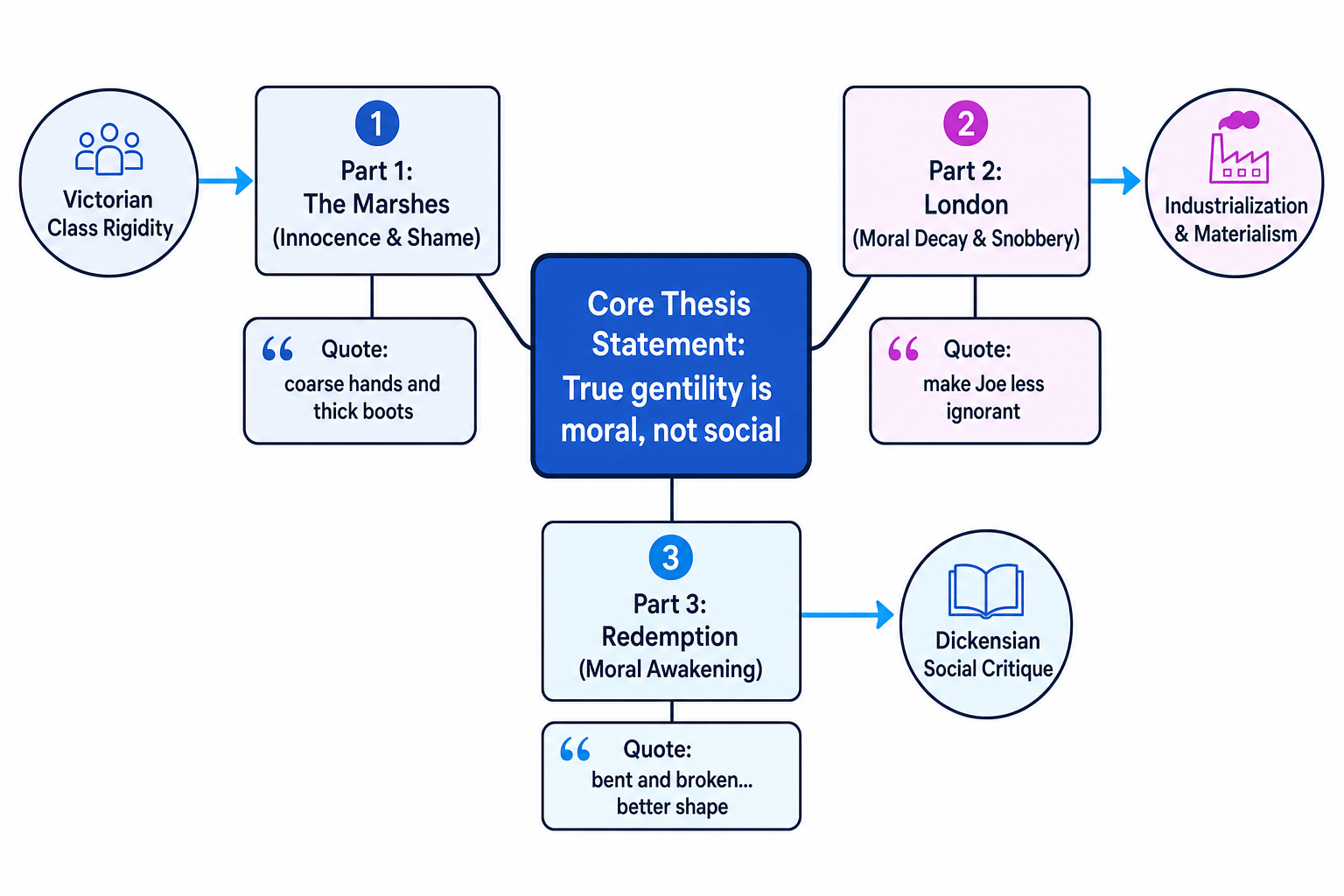
Step-by-Step: The Three-Part Planning Framework
To score highly in AO1 (your response to the text) and AO3 (understanding context and authorial intent), your plan should divide your essay into three main paragraphs, each representing a chronological stage of the novel's development.
- Part 1: The Foundations / The Catalyst (Pip's childhood on the Marshes, his initial innocence, and the sudden spark of ambition/shame).
- Part 2: The Corruption / The Climax (Pip's life in London, his moral decay, his rejection of Joe and Biddy, and the shallow nature of Victorian gentlemanly culture).
- Part 3: The Redemption / The Resolution (The collapse of his expectations, his physical and emotional suffering, and his ultimate realization that true moral worth resides in love and loyalty, not social status).
Dickens's Social Purpose
Dickens did not write Great Expectations simply to entertain. He wrote it as a fierce critique of Victorian class snobbery and the legal system. Your essay plans must always link characters (like Estella, Magwitch, or Joe) back to Dickens's critique of a society that values material wealth over human connection.
Planning an essay on Joe Gargery's role as a moral compass
Here is a step-by-step walkthrough of how to plan an essay based on the prompt: "Starting with the extract, explore how Dickens presents the character of Joe Gargery and his influence on Pip."
-
Formulate the Thesis Statement: Identify Joe's symbolic purpose. Joe is not just a kind blacksmith; he represents pastoral innocence, Christian charity, and the dignity of manual labor.
Drafted Thesis: Dickens presents Joe Gargery as a steadfast moral anchor whose unrefined goodness exposes the shallow, corrosive nature of Pip's social ambitions, ultimately proving that true nobility is defined by character rather than social class.
-
Select Evidence and Methods from the Extract (Paragraph 1): Locate where the extract sits in the novel and pull out key methods. If the extract shows Joe visiting Pip in London (Chapter 27), note Joe's physical discomfort in his formal clothes.
Focus: Joe's mismatch in London high society. Evidence: Joe dropping his hat; calling Pip "Sir". Method: Dickens uses the comic but poignant physical comedy of the dropped hat as a metaphor for Joe’s incompatibility with London’s superficiality.
-
Map the Chronological Arguments for the Rest of the Novel (Paragraphs 2 & 3):
- Paragraph 2 (Pip’s childhood / The Blacksmith's Forge): Establish Joe’s initial role as Pip's protector and moral equal.
- Evidence: Joe and Pip are "equals" who share "pudding". Joe’s simple language.
- Method: Dickens uses the domestic setting of the forge and the warm, sensory imagery of the hearth to symbolize emotional security and moral purity.
- Context: The forge represents the industrial working class, whom Dickens presents with immense dignity, countering Victorian prejudices that associated the poor with moral degeneracy.
- Paragraph 3 (Pip's Redemption / Joe's Unconditional Love): Trace the resolution where Pip falls ill and Joe nurses him back to health.
- Evidence: Joe calls Pip "old chap" again.
- Method: The repetition of the colloquialism "old chap" signals a restoration of their original, uncorrupted bond, symbolizing Pip’s moral rebirth.
- Context: Christian charity and forgiveness. Dickens uses Joe to model the New Testament values of grace and humility, which he felt the hypocritical Victorian church and upper classes had abandoned.
- Paragraph 2 (Pip’s childhood / The Blacksmith's Forge): Establish Joe’s initial role as Pip's protector and moral equal.
Tackling Common Pitfalls
When planning, it is easy to fall into traps that limit your marks. Keep these key warnings and strategies in mind during your practice sessions.
The 'Device-Spotting' Trap
Do not list literary devices in your plan without a clear link to meaning. For example, writing "Dickens uses a metaphor in Chapter 27" is useless. Instead, plan your evidence as a pair: Quote + Method → Effect. Plan to write: "The metaphor of the forge’s fire symbolizes moral warmth, which contrasts with the cold, icy imagery of Satis House."
The Extract-to-Whole-Text Balance
Aim for a roughly 1/3 to 2/3 split. Spend about one-third of your essay analyzing the provided extract in depth (close language analysis of AO2 methods), and two-thirds exploring the rest of the novel (tracking character arcs and thematic development across other chapters).
Ignoring the Author's Hand
Always refer to "Dickens" rather than treating the characters as real people. Write: "Dickens constructs Miss Havisham to represent..." rather than "Miss Havisham is mean because..." This keeps your focus firmly on AO2 (the writer's craft) and AO3 (contextual intentions).
In the exam
- Spend 8–10 minutes planning. Do not skip this step under pressure; a well-planned essay is faster to write and significantly more coherent.
- Deconstruct the prompt. Circle the key theme or character (e.g., "guilt," "ambition," "Estella") and write your thesis statement first at the top of your planning sheet.
- Annotate the extract immediately. Find three rich quotations that feature clear literary techniques (metaphors, sensory language, contrast) and relate directly to your thesis.
- Draft your 3-part plan. Write down your three paragraph headings (Marshes/Beginning, London/Middle, Redemption/End), mapping one key quotation and one Victorian contextual point to each.
- Stick to your plan. Use your plan as a checklist as you write, ticking off each quote and context point to ensure you maintain your pace.
Check yourself
- Can you write a thesis statement in under two minutes that explains how Dickens uses Satis House to symbolize the decay of the Victorian upper class?
- Do you have at least three memorable, short quotes memorized for each of the main characters (Pip, Joe, Estella, Magwitch, Miss Havisham) that you can easily plug into a three-part plan?
- Does your essay plan clearly show a progression in Pip's moral development, or are your three paragraphs simply repeating the same point with different examples?
