

Because your GCSE English Literature exam is closed-book, you cannot take a copy of Animal Farm into the exam room. This means you must memorise key quotations.
However, memorising dozens of long sentences is counterproductive. Instead, you need a bank of high-yield quotations: short, memorable, and rich in literary techniques that can be adapted to answer multiple exam questions, whether the focus is on a specific character, theme, or context.
What you'll learn
- How to select and memorise highly versatile, short quotations.
- How to unpack the language, structure, and form (AO2) of key quotes.
- How to link these quotes to Orwell’s political allegory and intentions (AO3).
- How to build a high-scoring analytical paragraph in your exam essay.
The Anatomy of a High-Yield Quote
A high-yield quote is a short phrase or sentence that acts as a key to unlock major themes and historical contexts. To get the highest marks, you should avoid quoting long blocks of text. Instead, aim to embed micro-quotations (one to three words) directly into your own sentences.
Micro-quotation
A micro-quotation is a highly precise word or short phrase integrated seamlessly into your own analytical sentence, rather than standing alone as a separate sentence.
For example, instead of writing:
Napoleon changes the rules. "No animal shall sleep in a bed with sheets." This shows he is corrupt.
You should write:
Orwell demonstrates Napoleon's growing corruption by structurally altering the Fourth Commandment to include the arbitrary restriction of "with sheets", highlighting how language is manipulated to justify elite privilege.
Quote 1: The Ultimate Paradox
"All animals are equal, but some animals are more equal than others." (Chapter 10)
This is the final, ultimate commandment that replaces the original Seven Commandments on the barn wall. It is the most famous line in the novella and serves as the peak of the pigs' political hypocrisy.
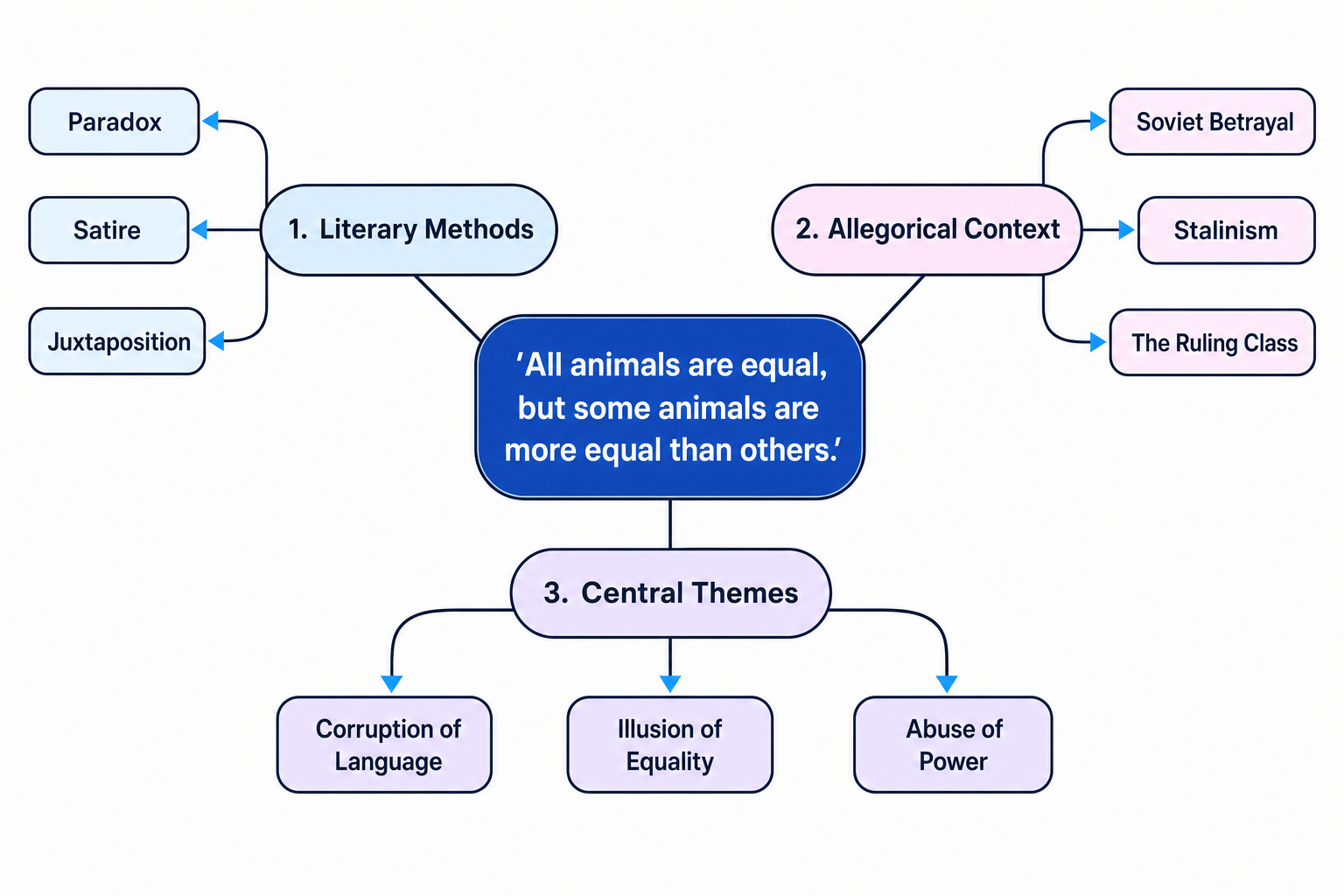
Literary Methods & Analysis
- Paradox / Oxymoron: The phrase "more equal" is a logical impossibility. Equality is an absolute state; you cannot have degrees of it. Orwell uses this semantic contradiction to show how totalitarian regimes use language to mask blatant inequality.
- Syntactic Parallelism: The two halves of the sentence are balanced around the coordinating conjunction "but". This structure mimics the language of genuine political constitutions, giving an absurd, tyrannical decree the false authority of law.
Connection to Context (AO3)
This quote directly satirises the betrayal of the 1917 Russian Revolution under Joseph Stalin. What began as a socialist movement aiming for a classless society devolved into a totalitarian dictatorship where the ruling class (the Bolshevik elite/the pigs) enjoyed massive privileges while claiming they were still "equal" to the working class.
The Corruption of Language
Orwell's primary warning in Animal Farm is that when language is corrupted, thought is corrupted. If the ruling elite can redefine words like "equality," they can control how citizens think and prevent rebellion.
Quote 2: The Simplification of Propaganda
"Four legs good, two legs bad." (Chapter 3)
which later becomes:
"Four legs good, two legs better!" (Chapter 10)
This slogan is originally created by Snowball to simplify the Seven Commandments for the less intelligent animals, particularly the sheep, who cannot memorise the full list.
Literary Methods & Analysis
- Binary Opposition: The stark contrast between "good" and "bad" reduces complex political philosophy (Animalism) to a childish, black-and-white dichotomy.
- Chanting / Auditory Imagery: The sheep repeat this "for hours on end," which acts as a literal barrier to critical thinking. Whenever an animal tries to question Napoleon’s actions, the sheep drown out the debate with their chanting.
- Structural Irony: The corruption of the slogan in Chapter 10, where "bad" is replaced by "better", represents the ultimate betrayal. The pigs have physically transformed into the very oppressors they overthrew, now walking on two legs.
Connection to Context (AO3)
This represents the power of state propaganda in totalitarian regimes, such as the Soviet Union's state-controlled media (Pravda). It shows how governments use simple, repetitive slogans to brainwash the uneducated masses and suppress democratic debate.
Missing the transition
Many students only memorise "Four legs good, two legs bad." To get high marks for structure (AO2), you must discuss the transition of this quote across the novel. Contrasting the original slogan with its final corruption ("two legs better") shows the examiner you are tracking Orwell's structural development of the narrative.
Quote 3: Blind Loyalty and Exploitation
"Napoleon is always right." (Chapter 5)
This is the personal motto adopted by Boxer, the loyal and powerful cart-horse, following the expulsion of Snowball.
Literary Methods & Analysis
- Absolute Adverb: The word "always" leaves no room for doubt, debate, or nuance. It represents the complete surrender of individual critical thought to autocratic authority.
- Tragic Irony: The reader understands that Napoleon is actively exploiting the animals, making Boxer’s absolute trust deeply tragic. Boxer’s reward for this loyalty is eventually being sold to the knacker (the glue factory) when he becomes too weak to work.
Connection to Context (AO3)
Boxer represents the Russian working class (the proletariat). Orwell uses Boxer's blind obedience to show how the loyalty of the working class was weaponised by Stalin to build his regime, only for those very workers to be discarded and betrayed when they were no longer economically useful.
Quote 4: The Cyclical Ending
"The creatures outside looked from pig to man, and from man to pig, and from pig to man again; but already it was impossible to say which was which." (Chapter 10)
This is the final sentence of the novel. It describes the animals looking through the window of the farmhouse as the pigs hold a diplomatic dinner party with the human farmers (led by Mr Pilkington).
Literary Methods & Analysis
- Chiasmus / Circular Syntax: The repetitive, alternating structure ("pig to man... man to pig... pig to man") creates a dizzying, circular rhythm. This mirrors the cyclical structure of the novel itself: Manor Farm has become Animal Farm, only to end up back as Manor Farm under a different set of tyrants.
- Physical Symbolism: The blurring of the physical boundaries between pig and human symbolizes the complete moral collapse of the revolutionary leaders.
Connection to Context (AO3)
This scene allegorises the Tehran Conference of 1943, where Joseph Stalin (Russia), Winston Churchill (UK), and Franklin D. Roosevelt (USA) met to form an alliance. Orwell was deeply critical of this event, viewing it not as a triumph, but as a cynical agreement between rival imperialist powers. The pigs and humans playing cards and cheating each other represents the ruling classes of the East and West exploitatively ruling over their respective working classes.
Analysing the cyclical ending of Animal Farm
Here is how you can build an analytical paragraph using the final quote.
- Contextualise the quote: Locate it structurally and allegorically.
At the climax of the novel's cyclical structure, Orwell describes the final breakdown of the rebellion's original ideals during the card game between the pigs and humans.
- Introduce the quote and identify key literary methods:
He writes that the watching animals "looked from pig to man, and from man to pig... but already it was impossible to say which was which." Orwell utilises a repetitive, alternating syntax to mirror the dizzying, cyclical nature of power.
- Analyse the specific language and effects on the reader (AO2):
The circular phrasing ("pig to man... man to pig") structurally mimics the physical transition of the pigs into humans, demonstrating how the revolutionary leaders have become indistinguishable from the previous oppressor, Mr Jones. The adjective "impossible" emphasizes the total betrayal of the animals' hopes, leaving the reader with a profound sense of disillusionment.
- Link to Orwell's overall satirical message and context (AO3):
Through this transformation, Orwell allegorically critiques the 1943 Tehran Conference, warning his contemporary audience that totalitarian regimes, whether capitalist or communist, are fundamentally identical in their exploitation of the working classes.
In the exam
- Be selective: Do not use more than two or three words in a single quotation if possible. Integrate them directly into the flow of your sentence.
- Track changes: For top marks, show how a quote or slogan evolves over the course of the novel (e.g., the changing commandments on the barn wall).
- Anchor your analysis in Orwell’s voice: Remember that Animal Farm is a satire. Always explain why Orwell chose to use these words to warn his readers about totalitarianism and the manipulation of truth.
Check yourself
- Which specific word in the final commandment creates a logical paradox, and what does this show about the pigs' control?
- How does Boxer’s motto "Napoleon is always right" change your understanding of the tragedy of the working class (the proletariat)?
- What historical event is allegorised in the final scene of the novel where the pigs and humans look indistinguishable?
