In the GCSE English Literature exam, you are assessed on your ability to construct a cohesive, evidence-based argument. Because the exam is closed-book, you must memorize key quotations. This guide does not just give you a list of phrases to memorise; it teaches you how to select, unpack, and write about the most powerful, versatile words in Great Expectations.
What you'll learn
- How to select and memorise highly versatile "micro-quotations" for the exam.
- How to perform close-word analysis (AO2) to uncover Dickens' underlying messages.
- How to link specific textual evidence to broader Victorian contexts and thematic concerns (AO3).
The Art of the Micro-Quotation
Many students struggle because they try to memorise long sentences. In the exam room, under pressure, long quotes are easily forgotten or misquoted. Instead, you should focus on memorising short, high-impact phrases.
Micro-quotation
A micro-quotation is a short, highly focused word or phrase (typically two to five words) that contains a powerful literary method or key thematic word, making it easy to remember and highly adaptable to different essay questions.
By using micro-quotations, you can seamlessly embed your evidence directly into your own sentences. This keeps your writing fluid, precise, and highly analytical.
Quality over Quantity
The examiner is not testing how much of the novel you can memorise; they are testing how deeply you can analyse what you quote. A single three-word phrase analysed with depth and contextual awareness will always score higher than a long, unanalysed block of text.
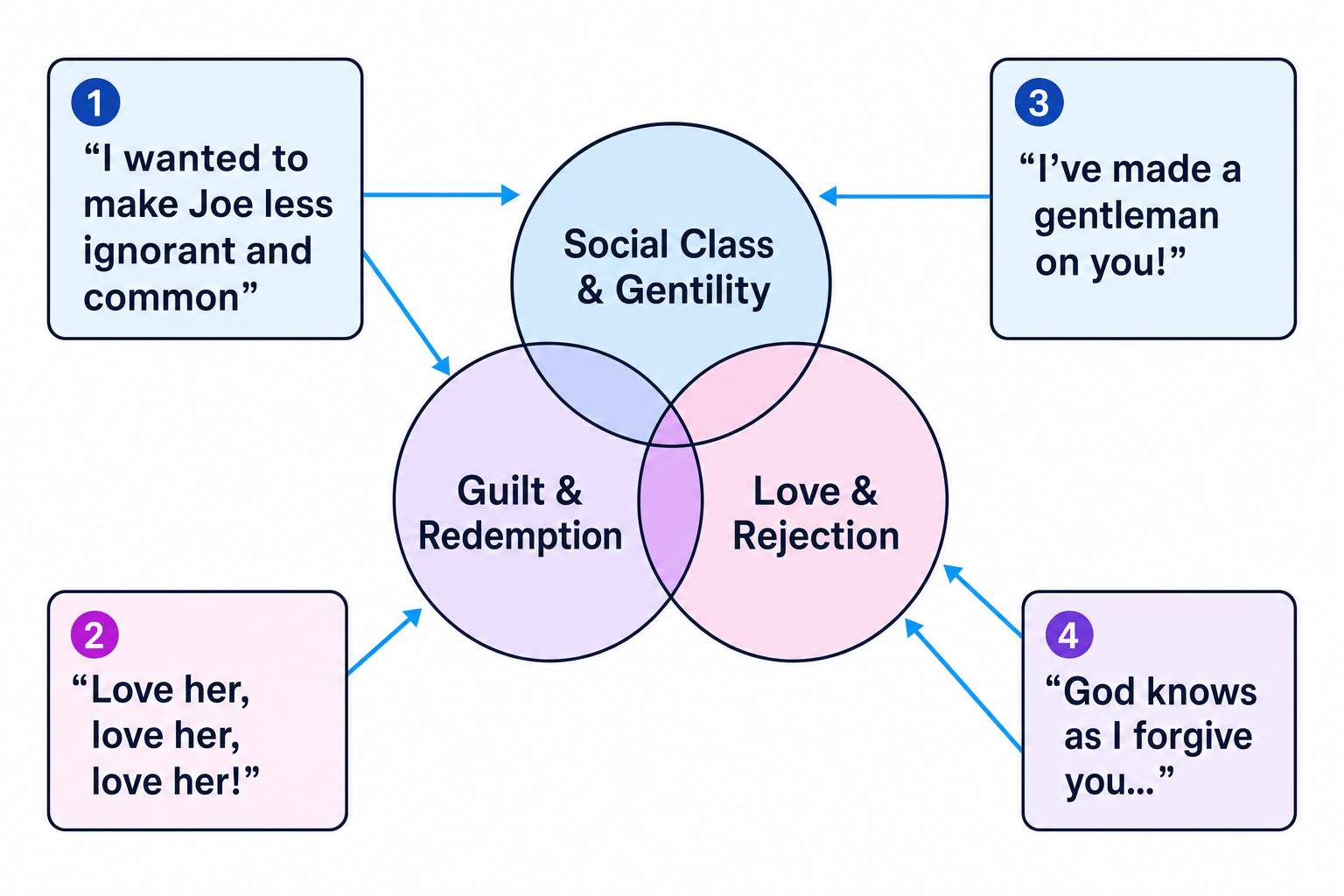
Key Quotations: Analysis and Context
Let’s examine five of the most versatile and powerful quotations in Great Expectations. Each of these can be used across multiple essay topics, including class, ambition, love, guilt, and character development.
1. Pip's Snobbery and Ambition
"I wanted to make Joe less ignorant and common, that he might be worthier of my society..." (Chapter 15)
- Character/Context: Pip speaks these words as his desire for self-improvement morphs into social snobbery. Following his encounters with Estella at Satis House, he begins to view his humble home and his loving surrogate father, Joe Gargery, through the judgmental lens of the upper classes.
- Method Analysis (AO2): The comparative adjectives "less ignorant" and "common" reflect how deeply Pip has internalised Estella’s classist insults. The noun "society" is highly ironic; Pip has no real social standing yet, but he is already pretending to belong to an elite sphere.
- Thematic/Contextual Link (AO3): This quote exposes the destructive nature of the Victorian class system, which equated moral worth with social status. Dickens uses Pip’s snobbery to critique the Victorian obsession with social mobility, showing how it tears families apart.
2. Miss Havisham's Obsessive Control
"Love her, love her, love her! If she favours you, love her. If she wounds you, love her..." (Chapter 29)
- Character/Context: Miss Havisham commands Pip to love Estella. She speaks these words in the decaying ruins of Satis House, revealing her obsessive desire to use Estella as a weapon of revenge against the male sex.
- Method Analysis (AO2): Dickens uses epizeuxis (the immediate repetition of a word) with the imperative verb phrase "love her" to create a frantic, almost manic tone. The juxtaposition of the verbs "favours" and "wounds" strips the concept of love of any warmth, framing it instead as a source of pain and submission.
- Thematic/Contextual Link (AO3): Miss Havisham's distorted view of love reflects how Victorian patriarchal expectations could ruin women. Left at the altar, she is trapped in her trauma, transforming Satis House into a gothic monument to her frozen life.
3. Estella's Defiance of Emotion
"I have not a heart... I have no softness there, no sympathy—sentiment—nonsense." (Chapter 29)
- Character/Context: Estella warns Pip that she is incapable of feeling affection. She has been systematically raised by Miss Havisham to be a cold, unfeeling weapon of male destruction.
- Method Analysis (AO2): The rule of three (or tricolon) in "sympathy—sentiment—nonsense" shows how Estella groups human empathy together with "nonsense". The use of caesura (dashes) creates a halting, mechanical rhythm, reflecting her cold, engineered personality.
- Thematic/Contextual Link (AO3): Estella is a victim of psychological conditioning. Dickens uses her character to critique the cold, transactional nature of Victorian upper-class marriages, where emotional warmth was frequently sacrificed for financial and social security.
The 'Zoom-In' Technique
When analysing a quote like Estella's, zoom in on a single word. Look at the word "nonsense". It suggests that Victorian societal ideals of romance and sentimentality are utterly useless and impractical in her eyes, showing how thoroughly her natural human instincts have been suppressed.
4. Magwitch's Reclamation of Pip
"I'm your second father. You're my son... I've made a gentleman on you!" (Chapter 39)
- Character/Context: Magwitch returns from New South Wales and reveals himself to Pip as his secret benefactor. Pip is horrified to discover his fortune comes from a despised convict, rather than the aristocratic Miss Havisham.
- Method Analysis (AO2): The metaphor "second father" and the possessive pronoun "my" show Magwitch's deep parental affection, but also his sense of ownership over Pip. The non-standard syntax and dialect in "made a gentleman on you" creates a sharp, ironic contrast with the refined "gentleman" Pip has become.
- Thematic/Contextual Link (AO3): This quote is the structural turning point of the novel. It exposes the hypocrisy of Victorian society: the high-class "gentleman" is entirely funded by the labor of an outcast criminal. It directly challenges the Victorian belief that criminality was biological and that gentility was a product of high birth.
5. Joe Gargery's Unconditional Forgiveness
"O dear old Pip, old chap, God knows as I forgive you, if I have anythink to forgive!" (Chapter 57)
- Character/Context: Joe nursed Pip back to health after Pip fell into debt, illness, and despair. Despite Pip's years of neglect and snobbery, Joe treats him with absolute tenderness.
- Method Analysis (AO2): The repetition of the adjective "old" in "old Pip, old chap" acts as a term of endearment, evoking their childhood bond at the forge. The conditional clause "if I have anythink to forgive" reveals Joe’s complete lack of malice; he refuses to even acknowledge Pip’s past cruelty.
- Thematic/Contextual Link (AO3): Joe is Dickens' moral compass. In Victorian England, manual labourers were often dismissed as "common" and unrefined. Dickens uses Joe's christian capacity for forgiveness to show that true gentility is a matter of the heart, not social class or polished manners.
Step-by-Step Quote Analysis
Let's walk through how to construct a high-scoring analytical paragraph in your exam using a key quote.
We will use Magwitch's quote: "I've made a gentleman on you!" (Chapter 39).
Analysing class and irony in Great Expectations
-
Contextualise the quote briefly: Identify who is speaking, to whom, and at what point in the novel.
- Drafting: In Chapter 39, the convict Magwitch reveals himself as Pip's secret benefactor, proudly declaring, "I've made a gentleman on you!"
-
Identify the writer's methods (AO2): Pinpoint specific words or grammatical features and name the literary technique.
- Drafting: Dickens uses the verb "made" alongside Magwitch's non-standard dialect ("on you") to draw attention to the physical creation of Pip's social status.
-
Analyse the layers of meaning and reader impact: Explain how the method creates meaning, focusing on the contrast between Magwitch's speech and his actions.
- Drafting: The verb "made" implies that a "gentleman" is not born of noble blood, but is a manufactured commodity bought with money. The tragic irony is that Pip's high-class identity, which made him look down on working-class characters like Joe, was actually purchased through the hard, brutal labour of an exiled convict.
-
Link your analysis to Victorian context and Dickens' intentions (AO3): Explain why Dickens wrote this. What was his social message to his Victorian audience?
- Drafting: Through this shocking revelation, Dickens directly critiques Victorian utilitarian capitalism and class prejudice. He exposes the moral rot of a society that accepts wealth from imperial exploitation but rejects the humanity of the individuals who generated it.
Device-Spotting
Do not simply list literary devices without explaining their effect. Writing "Dickens uses non-standard dialect in 'on you' to show he is a convict" is device-spotting. Instead, explain the effect of that dialect: it highlights the sharp, ironic contrast between Magwitch's uneducated speech and the polished, upper-class "gentleman" his money has constructed.
In the exam
- Be selective: Do not dump a massive quotation into your essay. Keep your quotes to under five words where possible, and embed them seamlessly into your own sentences.
- Follow the 'Zoom-In' method: Quote a short phrase, identify its technique, and then zoom in on one specific word to extract its deepest connotations.
- Use comparative transitions: When writing about character growth, contrast an early quote with a late quote to show how Dickens develops his characters (e.g., contrast Pip's early desire to be "worthier of my society" with his later realization of Joe's moral superiority).
- Anchor everything to the writer's purpose: Always ask yourself: Why did Dickens choose this exact word? What did he want his Victorian readers to change about their own society?
Check yourself
- Can you identify the speaker and the context of the quote: "Love her, love her, love her!"?
- Which key quote best demonstrates the theme of unconditional, moral goodness over social status?
- Why is using a "micro-quotation" of three words often more effective in an exam than memorising a full two-line sentence?
