When Charles Dickens wrote Great Expectations (1860–1861), he was at the height of his literary powers. To tell Pip's story, he didn't just write a straightforward adventure; he used sophisticated narrative methods to explore theme, character, and morality.
As a GCSE student, mastering these narrative methods is your key to unlocking AO2 (analysing language, form, and structure) and moving your essays from simple plot summaries into Grade 8 and 9 territory.
What you'll learn
- How Dickens uses a dual retrospective narrative to create dramatic irony and explore moral growth.
- How the structural form of the Bildungsroman and Victorian serialisation shape the novel's pacing and suspense.
- How symbolic settings and character foils serve as narrative devices to externalise Pip’s internal conflicts.
The Retrospective First-Person Narrator
Great Expectations is told through a first-person perspective ("I"). However, it is not a diary written in real time. Instead, Dickens uses a retrospective narrator.
Retrospective Narrator
A narrator who tells a story about their own past experiences from a point of greater maturity, wisdom, and chronological distance.
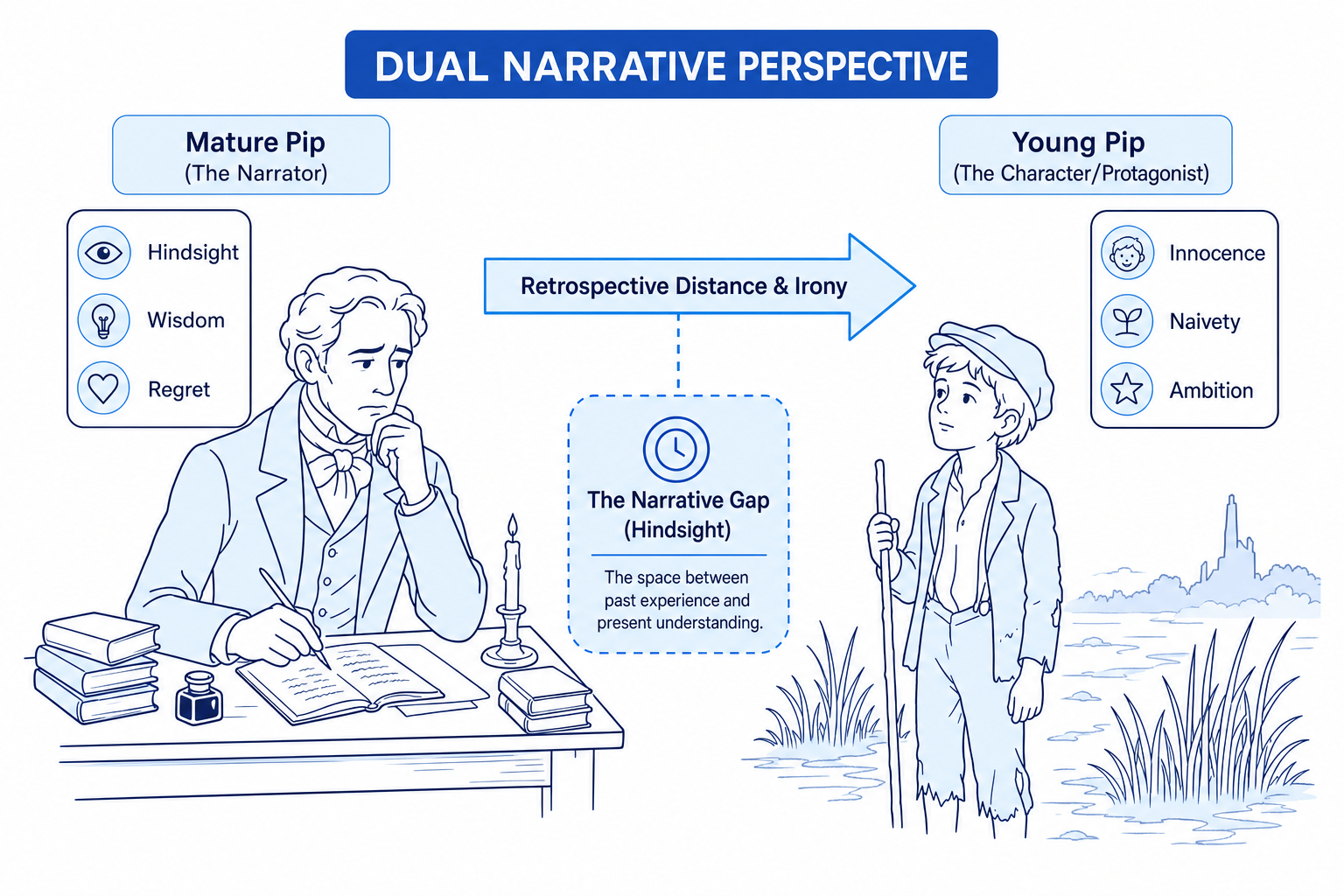
This technique creates a fascinating double perspective. Throughout the novel, we are constantly navigating two different versions of the protagonist:
- Young Pip (The Protagonist/Character): Naive, impressionable, easily influenced by social status, and often morally blind to the value of the people who love him.
- Mature Pip (The Narrator): Wise, remorseful, self-critical, and looking back on his childhood mistakes with a deep sense of guilt and hindsight.
The distance between these two perspectives is called retrospective distance. Dickens uses this gap to create dramatic irony—where the reader and the mature narrator understand the reality of a situation, but young Pip does not.
The Power of the Double Perspective
When analysing the language of Great Expectations, never treat "Pip's voice" as a single entity. Always distinguish between young Pip's blind ambition and mature Pip's deep regret. The novel’s moral lessons rely entirely on this tension.
Confusing Protagonist and Narrator
Do not write: "Pip is arrogant in Chapter 15 because he is ashamed of Joe." Instead, write: "While young Pip feels ashamed of his humble home, the mature retrospective narrator frames this memory with shame, exposing his own past moral failings to the reader."
The Structural Form: The Bildungsroman
The structural framework of Great Expectations is a classic literary form called a Bildungsroman.
Bildungsroman
A German literary term meaning "novel of education" or "novel of formation." It traces the psychological, moral, and social development of a protagonist from youth to adulthood.
Typically, a Bildungsroman follows a set trajectory:
- The Trial: The young protagonist starts in a state of innocence or oppression, experiences a catalyst (gaining expectations), and moves to a larger world (London).
- The Fall: The protagonist succumbs to temptation, loses their moral compass, and suffers a major crisis or disillusionment.
- The Redemption: The protagonist recognises their errors, accepts their true identity, and achieves moral maturity (often ending in a state of humble, quiet contentment rather than grand wealth).
The Three-Stage Structure
Dickens structured the novel very deliberately into three distinct stages of Pip's "expectations," which mirror this psychological journey:
- Stage 1 (Chapters 1–19): Childhood/Innocence. Pip lives in the rural marsh country. He is poor but morally pure, until his visits to Satis House infect him with the desire for social advancement.
- Stage 2 (Chapters 20–39): London/Arrogance. Pip receives his fortune and moves to London. He becomes a superficial "gentleman," rejects his true friends (Joe and Biddy), and grows increasingly snobbish. This stage ends with the shocking climax: the return of Magwitch.
- Stage 3 (Chapters 40–59): Redemption/Wisdom. Pip’s illusions are shattered. He learns that his wealth came from a convict, not Miss Havisham. He loses his money but finds his moral core, risking his life to save Magwitch and finally appreciating Joe's unconditional goodness.
Analyzing retrospective narrative distance
Let's look at how to unpack a passage where mature Pip reflects on his childhood desire to educate Joe Gargery, showing how Dickens uses retrospective distance to critique social class.
The Quote:
"I wanted to make Joe less ignorant and common, that he might be worthier of my society and less open to Estella’s reproach." (Chapter 15)
- Identify the two voices in conflict: Identify how the quote reveals the division between young Pip’s active thoughts and mature Pip’s critical framing. The phrase "worthier of my society" reveals young Pip’s growing arrogance and snobbery, while the raw honesty of confessing this "black ingratitude" reveals the older narrator’s deep remorse.
- Analyse the linguistic methods: Focus on the key adjectives. Young Pip uses the adjectives "ignorant and common" to describe Joe—terms he has absorbed directly from Estella. By having the older Pip quote these exact words, Dickens highlights how easily a child's mind can be corrupted by upper-class prejudice.
- Link to the broader social context (AO3): Connect this linguistic tension to Victorian social mobility. Dickens uses this narrative method to show that Victorian society's obsession with superficial class ("gentility") actually destroys natural, organic moral goodness. True nobility belongs to the "ignorant and common" blacksmith Joe, not the wealthy elite.
Victorian Serialisation and Narrative Pacing
It is important to remember that Great Expectations was not originally published as a single, bound book. Instead, it was published in weekly instalments in Dickens's literary magazine, All the Year Round, between December 1860 and August 1861.
This historical context directly influenced Dickens's structural methods:
- Cliffhangers: To ensure readers bought the magazine the following week, Dickens ended many chapters on moments of intense suspense. For example, the arrival of Magwitch at the end of Stage 2 (Chapter 39) is a massive plot twist designed to leave Victorian readers desperate for the next issue.
- Symmetrical Pacing: Because of the rigid page limits of weekly serialisation, Dickens had to keep the narrative tight. Unlike some of his longer, sprawling novels (like Bleak House), Great Expectations has a highly focused, linear plot with very few unnecessary subplots.
- Thematic Parallels: Dickens balances his dark, Gothic themes (Miss Havisham, Satis House, Newgate Prison) with comic relief (Wemmick’s Aged Parent, the theatrical failures of Mr. Wopsle) to keep his weekly audience entertained while slowly advancing the serious moral themes.
Spotting the Serial Breaks
When writing about structure, look closely at the ends of chapters. If a chapter ends with a sudden revelation, a dramatic declaration, or a shift in setting, discuss how this serves the Victorian serial format to build narrative tension and maintain reader engagement.
Setting and Foils as Narrative Projections
Dickens does not just use narrator commentary to tell his story; he uses external elements—like landscapes and other characters—as narrative tools to reflect Pip’s internal psychological state.
Settings as Psychological Landscapes
Dickens heavily employs pathetic fallacy (attributing human emotions to nature/environment) and Gothic conventions to externalise Pip's feelings:
- The Marshes: Damp, dark, and constantly covered in thick fog, the marshes represent Pip's humble origins, but also his moral confusion and guilt. Whenever Pip is about to do something deceitful (like stealing pie for the convict or leaving Joe), the fog rolls in, symbolising his lost moral compass.
- Satis House: Frozen in time, decaying, and dark, Miss Havisham’s house is a physical manifestation of her corrupted mind and her refusal to move past her heartbreak. It also represents the decay and rot at the heart of the upper-class wealth Pip so desperately craves.
Character Foils
A foil is a character who contrasts sharply with another character, usually the protagonist, to highlight specific qualities of that character.
Character Foil
A character whose qualities or actions serve to emphasize and contrast those of another character (usually the protagonist).
Dickens structures Pip’s world with clear foils to present alternative moral pathways:
- Estella vs. Biddy: Biddy represents domestic virtue, warmth, moral clarity, and the simple life of the forge. Estella represents coldness, emotional abuse, high social status, and the destructive nature of ambition. Pip’s choice between them is a structural representation of his moral choice.
- Joe Gargery vs. Bentley Drummle: Joe is poor, uneducated, but rich in love and integrity. Drummle is wealthy, high-born, but brutal, arrogant, and cruel. They represent the two definitions of a "gentleman" that struggle for Pip’s soul.
In the exam
If you get a question on Great Expectations, keep these structural and narrative strategies in mind:
- Do not retell the plot: Instead of writing "this happens, then that happens," explain how Dickens constructs the story. Use phrases like: "Dickens structurally positions this scene at the climax of Stage Two to..." or "Through the retrospective narrative lens, Dickens invites the reader to..."
- Deconstruct the perspective: Always analyze how the tension between young Pip's actions and older Pip's narration creates meaning. Look for verbs of reflection, such as "I now know" or "I have often regretted since".
- Link form to theme (AO2/AO3): Explicitly state how the Bildungsroman form helps Dickens deliver his social critique of Victorian class obsession. Pip must lose his false expectations to gain his true moral self.
Check yourself
- Why is it historically and structurally significant that Great Expectations was published as a weekly serial?
- Explain the concept of "retrospective distance" and how it affects the reader's view of young Pip's snobbish behaviour in London.
- How do the settings of the Marshes and Satis House act as symbols for Pip's moral journey?
