

Answering questions on Animal Farm requires more than just knowing what happens to individual characters. To secure top marks (especially for Assessment Objectives AO1 and AO2), you must understand the novella's structure. George Orwell carefully designs the sequence of events to expose how revolutionary ideals can be slowly corrupted into a new form of tyranny.
By focusing on four key milestone chapters, you can track this systematic decline and gain a sophisticated understanding of Orwell's political message.
What you'll learn
- How Orwell uses key chapters as structural pillars to construct a political allegory.
- How to analyze shifting power dynamics and character transformations at critical turning points.
- How to link specific structural shifts to historical contexts, such as the rise of Stalinism.
- How to write a high-level, structurally aware essay response.
1. The Structure of a Political Allegory
Before diving into the chapters, we must define how Orwell builds his narrative. Animal Farm is not just a simple story; it is written with a highly deliberate structural design.
Allegory
An allegory is a story that can be interpreted to reveal a hidden political or moral meaning. Every character, event, and setting in Animal Farm directly represents real historical figures and events from the Russian Revolution of 1917 and the subsequent rise of the Soviet Union.
Cyclical Structure
A cyclical structure is a narrative technique where the end of a story mirrors or returns to the conditions of its beginning. In Animal Farm, this structure demonstrates that despite the bloodshed and hope of the rebellion, the animals end up exactly where they started—oppressed by a tyrannical ruling class.
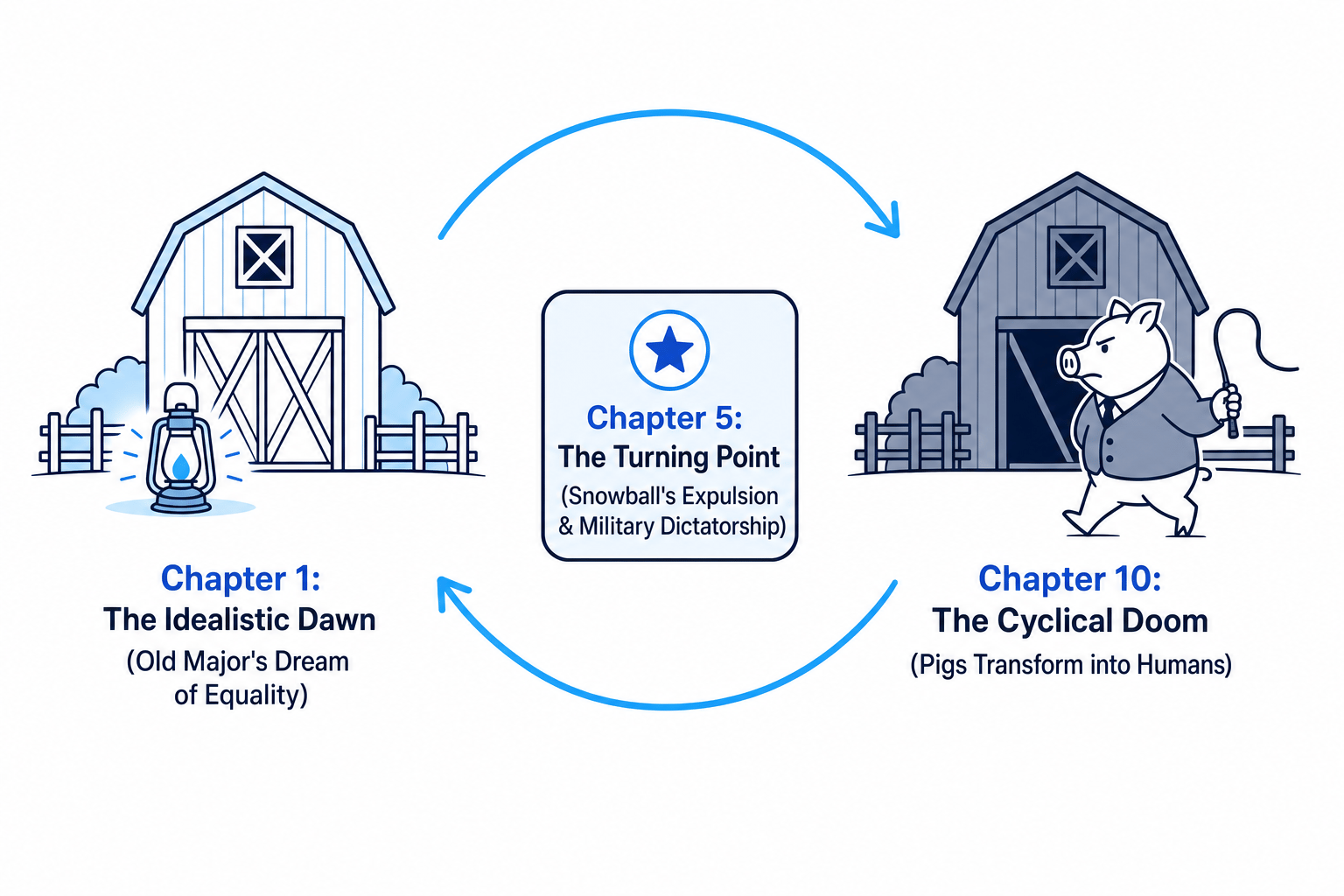
This structure is divided into a series of key milestones across ten chapters. Let's look at the four most important chapters that represent these structural pillars.
2. Chapter 1: The Blueprint of Utopia (The Exposition)
Chapter 1 establishes the exposition of the novella. It introduces the cruel conditions under Mr. Jones and outlines the pure, uncorrupted vision of the future rebellion.
Key Plot and Character Developments
- Old Major’s Speech: The prize Middle White boar gathers the animals in the big barn. He diagnoses their suffering, pointing out that "Man is the only real enemy we have."
- The Ideal of "Animalism": Old Major introduces a radical vision of equality. He insists that all animals are comrades, warning them: "And, above all, no animal must ever tyrannize over his own kind."
- "Beasts of England": This revolutionary anthem unites the animals, inspiring a collective desire for freedom.
Analytical Focus: The Language of Utopia
Orwell uses Old Major's speech to establish the benchmark of revolutionary idealism. When analyzing this chapter, focus on how Orwell uses persuasive techniques to build hope. Old Major employs the triadic structure (rule of three) when describing their lives as "miserable, laborious, and short," creating an emotional hook before presenting his revolutionary solution.
The benchmark of idealism
Chapter 1 is crucial because it sets up the moral standards of the rebellion. Without Chapter 1's pure, egalitarian dream, the corruption in the later chapters would not have the same tragic, ironic impact.
3. Chapter 5: The Subversion of Democracy (The Turning Point)
If the early chapters depict the successful expulsion of Jones, Chapter 5 represents the ultimate rising action and the destruction of the animals' internal democracy.
Key Plot and Character Developments
- The Windmill Debate: Snowball (representing Trotsky) and Napoleon (representing Stalin) clash over the construction of a windmill. Snowball argues it will mechanize the farm and reduce labor, while Napoleon argues for immediate food production.
- The Expulsion of Snowball: Just as the animals are about to vote in favor of Snowball's plan, Napoleon unleashes nine ferocious, privately trained dogs to chase Snowball off the farm.
- The Death of Democracy: Napoleon announces that Sunday morning debates are abolished. All decisions will now be made by a private committee of pigs, presided over by himself.
Analytical Focus: The Rise of Totalitarianism
Orwell structurally positions this chapter in the middle of the novella to mark the transition from a cooperative republic to a military dictatorship.
The dogs represent the state terror used by Stalin (specifically the NKVD, the Soviet secret police) to crush dissent. Squealer's subsequent manipulation of history ("No one believes more firmly than Comrade Napoleon that all animals are equal... but...") shows how language is weaponized to justify tyranny.
Confusing the characters with real people
Do not write about Napoleon and Snowball as if they are simply Joseph Stalin and Leon Trotsky. Remember that they are literary symbols. Frame your analysis by stating: "Orwell uses the character of Napoleon to satirize the authoritarian consolidation of power by Joseph Stalin." This keeps your focus on Orwell's craft as a writer (AO2).
4. Chapter 9: The Tragic Betrayal (The Climax of Oppression)
Chapter 9 is the emotional climax of the novella's tragedy. It focuses on the fate of Boxer, the loyal cart-horse, who represents the exploited working class (the proletariat).
Key Plot and Character Developments
- Boxer’s Collapse: After years of relentless labor rebuilding the windmill, Boxer's lung fails. He looks forward to his planned retirement.
- The Ultimate Betrayal: Napoleon claims to arrange for Boxer to be treated at a veterinary hospital. However, Benjamin reads the side of the departing van: "Alfred Simmonds, Horse Slaughterer and Dog Collier." Boxer is sold to the knacker's yard.
- Squealer’s Propaganda: Squealer pacifies the outrage by claiming the van was merely bought by a vet who had not yet painted over the old sign. The chapter ends with the pigs hosting a banquet fueled by the money they received from selling Boxer for glue.
Analytical Focus: The Betrayal of the Proletariat
Boxer’s death is a structural climax. It represents the point of no return. Up until this chapter, one could argue the pigs were making mistakes or acting out of survival. Selling their most loyal, hardworking comrade to be boiled down for glue proves that the pigs have completely lost their humanity—or rather, fully adopted human cruelty.
Identify the structural parallel
Note how Boxer's collapse is set against the backdrop of the pigs' growing luxury. While the animals' rations are "readjusted" (Squealer's euphemism for reduced), the pigs receive a daily ration of beer. This stark contrast highlights the growing class divide on the farm.
5. Chapter 10: The Irony of the Return (The Resolution)
The final chapter delivers the resolution of the narrative arc, completing the cyclical structure of the novella. Many years have passed, and the original ideals of the rebellion are forgotten by almost all living animals.
Key Plot and Character Developments
- Physical Transformation: The pigs begin walking on their hind legs, carrying whips, and wearing Mr. Jones's old clothes.
- The Revision of the Commandments: The Seven Commandments are completely erased. In their place stands a single, paradoxical law:
"All animals are equal, but some animals are more equal than others."
- The Dinner Party: Human neighbors visit the farm. Napoleon announces that the name "Animal Farm" is abolished; it is now "Manor Farm" once again.
- The Final Mirror: As the other animals peer through the window, they watch the pigs and humans playing cards and arguing over a cheat. They can no longer tell the difference between them.
Dramatic Irony
Dramatic irony occurs when the audience or reader knows more about a situation than the characters in the story. In Chapter 10, the animals look on in confusion, while the reader understands completely that the pigs have become the new oppressors.
Worked Example: Analyzing Chapter 10
Here is how you can write a high-level analytical paragraph evaluating Orwell's structural and linguistic choices at the end of Chapter 10.
Analyzing structural irony in Chapter 10
Question: Explore how Orwell uses the ending of the novel to convey his message about power.
-
State your point clearly, linking structure and theme: Orwell uses a cyclical narrative structure in the final chapter to demonstrate that the corruption of power inevitably returns a society to its original state of oppression if totalitarian tactics are left unchecked.
-
Introduce your textual evidence with precise context: This is masterfully illustrated at the very end of the novella, as the working animals watch the pigs dining with human farmers through the window. Orwell writes:
"The creatures outside looked from pig to man, and from man to pig, and from pig to man again; but already it was impossible to say which was which."
-
Analyze the linguistic and structural methods used by the author: The repetition of the phrase "from pig to man, and from man to pig" creates an alternating, rhythmic syntax that mimics the physical scanning of the confused animals. This linguistic mirroring emphasizes the loss of distinction between the former liberators and the original oppressors. Furthermore, the closing phrase, "impossible to say which was which," relies heavily on bitter dramatic irony. The reader understands that the pig-led regime has fully adopted the capitalist exploitation of Mr. Jones, completing the tragic, cyclical arc of the novella.
-
Link the analysis back to Orwell's political message and context (AO3): Through this cyclical resolution, Orwell offers a sobering warning to his mid-20th-century readers. He suggests that the 1917 Russian Revolution, which began with Old Major's egalitarian ideals (represented by the dream in Chapter 1), ultimately culminated in a regime under Stalin that was indistinguishable from the oppressive Tsarist autocracy it sought to overthrow.
Summary of Key Chapter Contrasts
To write a strong essay, you should compare how themes evolve across these chapters. Use this table as a quick reference guide:
| Theme | The Beginning (Chapter 1) | The Turning Point (Chapter 5) | The End (Chapter 10) |
|---|---|---|---|
| Commandments / Laws | Universal equality: "All animals are equal." | Sunday debates abolished; rules are quietly altered by Squealer. | One contradictory rule: "...some animals are more equal." |
| Leadership | Democratic, collective, self-governed. | Rise of a military dictatorship; Snowball expelled. | Complete totalitarian autocracy; pigs walk on two legs with whips. |
| The Oppressor | Humanity (Mr. Jones) represents the capitalist elite. | Inner conflict; pigs begin to distance themselves from physical labor. | The pigs are indistinguishable from humans. |
In the exam
When writing about the key chapters of Animal Farm, keep these three strategic tips in mind:
- Track the changes chronologically: To show a deep understanding of structure (AO2), compare how a concept (like the Seven Commandments or the concept of "comradeship") changes from the idealism of Chapter 1, through the corruption of Chapter 5, to the complete reversal in Chapter 10.
- Focus on the "Why" (AO3): Orwell did not write this book just to tell a story about pigs on a farm. Every key chapter transition represents a historical shift. Link the end of democracy in Chapter 5 directly to Stalin’s expulsion of Trotsky and the rise of the Soviet dictatorship.
- Analyze Squealer's language: Squealer’s speeches appear in almost every key chapter. Contrast his language of promise in the early chapters with his defensive, manipulative propaganda in Chapter 9 and Chapter 10.
Check yourself
Think about these questions to test your understanding of Animal Farm's key chapters:
- Why is the song Beasts of England banned in Chapter 7, and how does this transition connect the ideals of Chapter 1 to the ultimate tyranny of Chapter 10?
- In Chapter 5, how does Orwell use the characters' reactions to Snowball's expulsion to show the vulnerability of an uneducated working class?
- What is the structural significance of Benjamin finally choosing to read what is written on the side of the knacker's van in Chapter 9?
