Charles Dickens originally published Great Expectations in weekly serial instalments between 1860 and 1861. Because Victorian readers had to wait a week between chapters, Dickens structured his narrative carefully, using key chapters as architectural pillars to hook readers, shift the plot, and develop themes.
To achieve a top grade in your GCSE English Literature exam, you must understand how these crucial chapters function structurally and how Dickens uses them to map Pip's psychological and moral journey.
What you'll learn
- How Chapter 1 establishes the novel's Gothic atmosphere and core themes of guilt and social class.
- How Chapter 8 introduces Satis House as a symbol of social decay and sparks Pip's obsession with status.
- How Chapter 39 serves as the narrative's central turning point (peripeteia), shattering Pip's illusions.
- How to write a high-scoring analytical response tracing character growth across these structural pillars.
The Structural Architecture of the Novel
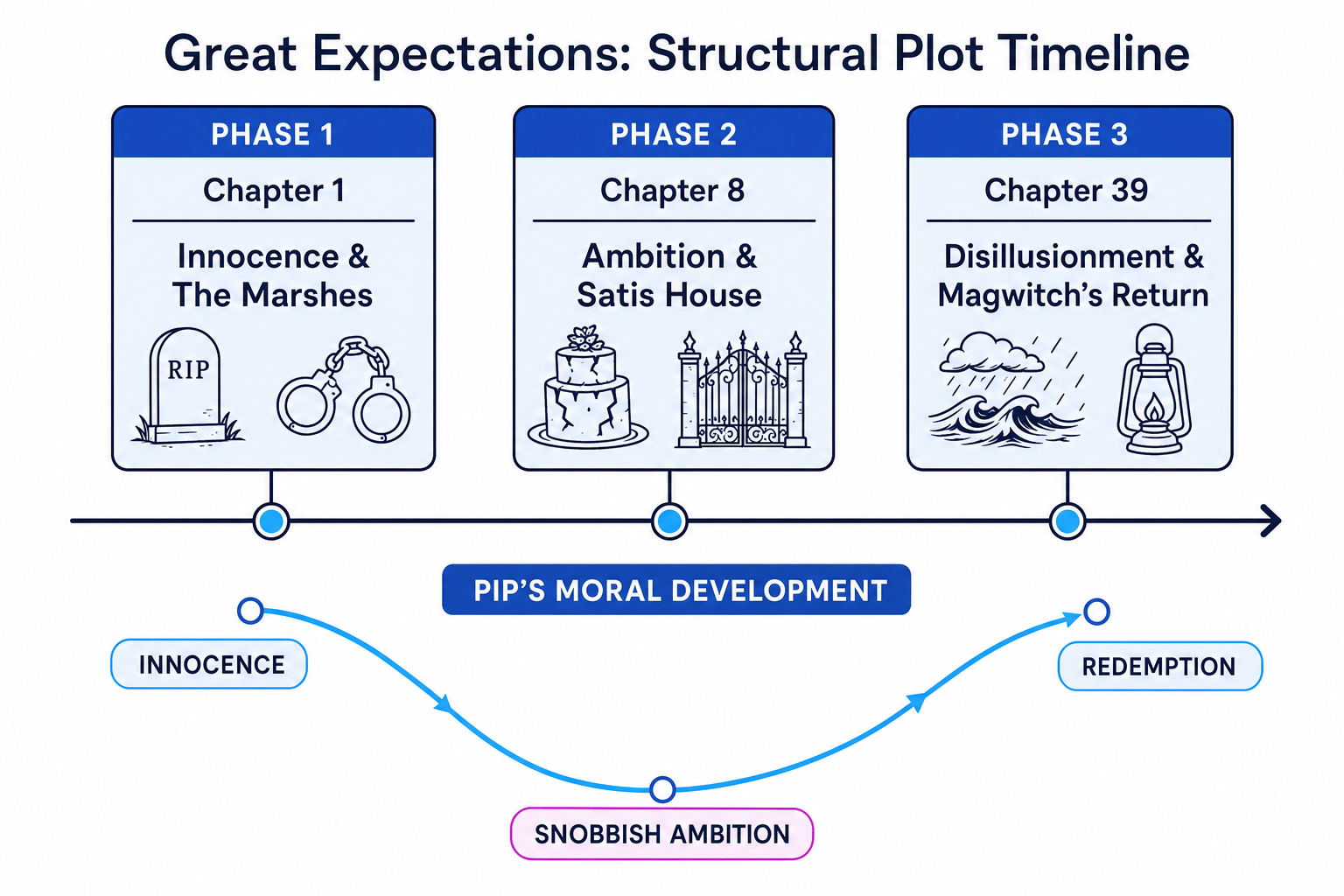
Before diving into individual chapters, it is helpful to look at how the entire novel is put together. Dickens divides the novel into three distinct stages of "Pip's Expectations":
- First Stage (Chapters 1 to 19): Pip's childhood on the marshes and his initiation into the desire for social advancement.
- Second Stage (Chapters 20 to 39): Pip's life in London as a "gentleman," where he grows snobbish, idle, and financially irresponsible.
- Third Stage (Chapters 40 to 59): Pip’s disillusionment, financial ruin, moral redemption, and discovery of true worth.
Bildungsroman
A Bildungsroman is a novel that traces the psychological, moral, and social growth of a protagonist from youth to adulthood. In Great Expectations, Pip's growth is non-linear; his social rise corresponds with a deep moral decline, while his social ruin leads to his moral salvation.
The diagram below maps this structural journey, highlighting how our three key chapters serve as the anchors for each developmental phase.
Chapter 1: The Genesis of Guilt
Chapter 1 introduces us to the young, vulnerable Pip in the damp marshes of Kent. Within a few pages, Dickens establishes the key themes of crime, social class, and vulnerability that run through the entire novel.
The Gothic Setting and Pathetic Fallacy
Dickens makes heavy use of pathetic fallacy (attributing human emotions to nature or the environment) to mirror Pip’s psychological state. The marshes are described as a "dark flat wilderness," and the sea is a "distant savage lair." This hostile, Gothic setting emphasizes Pip’s extreme isolation and vulnerability as an orphan.
The Encounter with Magwitch
When the escaped convict Magwitch seizes Pip, Dickens uses vivid sensory language to contrast physical power with childlike helplessness. Magwitch is described as a "fearful man, all in coarse grey" who limps, shivers, and glares.
The Paradox of Pip's Guilt
In Chapter 1, Pip is an innocent victim. However, his forced assistance to Magwitch (stealing a file and food from Mrs. Joe) instils in him a deep, lifelong sense of criminal guilt. This psychological association between lower-class life and criminality shapes Pip’s desperate desire to escape his origins.
Chapter 8: The Poison of Satis House
Chapter 8 marks Pip's first visit to Satis House, the home of the wealthy, eccentric recluse Miss Havisham. This chapter acts as the catalyst for Pip's dissatisfaction with his humble life at the forge.
Satis House as a Symbol of Decay
"Satis" means "enough" or "plenty" in Latin, making the name highly ironic. Satis House is a place of absolute stagnation, darkness, and decay. Inside, Pip encounters Miss Havisham dressed in a faded, yellowed shroud of a wedding dress, surrounded by stopped clocks and rotting bridal feasts.
The Birth of Social Shame
It is here that Pip meets Estella, Miss Havisham’s adopted daughter. Estella treats Pip with cruel contempt, mocking him for his lower-class background:
"He calls the knaves, Jacks, this boy! And what coarse hands he has! And what thick boots!"
This moment is a psychological turning point for Pip. Before this encounter, he was content with his life at the forge. Afterward, he views his own home and family through Estella’s class-conscious eyes.
Confusing Satis House with High Society
Many students write that Satis House represents the "pinnacle of upper-class life" that Pip aspires to. In reality, Dickens portrays Satis House as physically and morally rotten. Pip's aspiration toward it is tragic because he is lusting after decay, showing his inability to distinguish between superficial wealth and genuine moral worth.
Chapter 39: The Shattering of Expectations
Chapter 39 is the structural climax of the novel's second stage. It takes place on a wild, stormy night in London when Pip is 23 years old. The tempestuous weather acts as a classic Gothic harbinger of the dramatic revelation to come.
The Reversal of Fortune (Peripeteia)
Magwitch, now a wealthy sheep-farmer from Australia, secretly returns to London and reveals himself as Pip's true benefactor.
Peripeteia
Peripeteia is a sudden reversal of fortune or change in circumstances in a literary work. In Chapter 39, Pip's entire understanding of his social standing, his future with Estella, and his moral purity is instantly reversed.
Pip had spent years assuming Miss Havisham was his wealthy patron and that he was destined to marry Estella. Finding out that his lifestyle has been funded by a dirty, hunted convict completely shatters his pride:
"But sharpest and deepest of all, was the dread that I had deserted Joe for this shilling-pensioner of the Crown, the convict; ... I had shrunk from Joe, because of the convict’s side of him; and lo, the convict himself was my patron!"
The Ultimate Irony
Pip’s social elevation was built on the sweat and toil of an outcast. Pip realizes that in his pursuit of becoming a "gentleman," he became a snob, abandoning the only truly gentle man he knew: Joe Gargery.
Step-by-Step Analysis: Putting It Into Practice
In your exam, you will need to analyze how Dickens's language choices convey Pip's complex emotional states in these key chapters. Let's walk through an analysis of a passage from Chapter 39.
Analyzing Pip's Disillusionment in Chapter 39
Analyze the language Dickens uses to present Pip’s reaction to the revelation of his true benefactor in Chapter 39.
- Contextualize the scene: Position this moment structurally. It is the immediate aftermath of Magwitch revealing himself. Pip is experiencing a total collapse of his social illusions.
- Select precise evidence: Focus on a highly charged quotation that captures his psychological torment: "I could not have kept my picture of her, before my mind’s eye, more constantly than it had been there and would then be no more... the ship in which I had sailed was wrecked."
- Identify the writer's methods: Note the extended metaphor of the shipwreck ("the ship in which I had sailed was wrecked") and the contrasting temporal adjectives ("constantly" vs "no more").
- Analyze the effects and meaning: Explain how the shipwreck metaphor conveys the sudden, catastrophic destruction of Pip's life journey. The "ship" represents his grand expectations, his social status, and his dreams of Estella, all of which are now violently sunk by the reality of Magwitch's patronage.
- Link to contextual/thematic ideas: Connect this to Dickens's social critique of Victorian class obsession. Dickens is showing that the rigid British class system is built on an illusion; class superiority is often built on the suffering and labour of the criminalized underclass.
<tip title="The "Unreliable Narrator" Method">
Always remember that Great Expectations is narrated by an older, wiser, matured Pip looking back on his foolish younger self. When analyzing key chapters, distinguish between what the young Pip is feeling in the moment and the gentle, regretful irony of the older narrator describing those feelings.
In the exam
- Track structural shifts: If the exam question focuses on a character (like Magwitch or Pip) or a theme (like ambition or guilt), structure your essay chronologically around these three key chapters to show development over time.
- Examine structural irony: Highlight how events in late chapters mirror or subvert events in early chapters (e.g., how Magwitch’s arrival in Chapter 39 mirrors his sudden, frightening appearance out of the darkness in Chapter 1).
- Embed short, high-impact quotes: Focus on memorizing 2–3 short quotes from each of these three chapters (e.g., "thick boots", "the ship... was wrecked", "dark flat wilderness"). They are easy to weave seamlessly into your sentences.
Check yourself
- Why is it structurally significant that the weather in Chapter 39 is stormy and wet, echoing the weather of the Kent marshes in Chapter 1?
- How does Pip's treatment of Joe change between Chapter 1 (the forge) and Chapter 8 (Satis House)?
- What is the difference between Satis House as a physical setting and Satis House as a psychological symbol for Pip?
