

Planning is the most critical step to securing a high grade in your GCSE English Literature exam. Because the AQA Paper 2 exam is closed-book, you cannot afford to "write on the fly" and hope for the best. A strong, structured plan ensures your essay reads as a coherent, deliberate argument rather than a random collection of memorised quotes.
What you'll learn:
- How to deconstruct an essay question to find Orwell's deeper allegorical purpose.
- How to draft a powerful thesis statement that sets up a sophisticated argument.
- How to structure your main body paragraphs chronologically to match the novel’s circular structure.
- How to seamlessly integrate language analysis and context without sounding formulaic.
The Foundation of a Strong Plan
Before you put pen to paper, you must understand what the examiner is looking for. High-scoring essays do not just retell the story; they analyze how George Orwell constructed the text and why he wrote it.
To plan effectively, you need to understand three core components:
Thesis Statement
A thesis statement is a one- or two-sentence summary of your central argument. It directly answers the exam question and addresses George Orwell's overall satirical purpose, setting the direction for your entire essay.
Allegory
An allegory is a narrative that can be interpreted to reveal a hidden, deeper meaning—typically a moral, social, or political one. Animal Farm is a political allegory representing the events of the 1917 Russian Revolution and the rise of Stalinist totalitarianism.
Topic Sentence
A topic sentence is the opening sentence of a body paragraph. It states the paragraph's main argument and links directly back to your thesis statement, maintaining a clear line of inquiry.
Designing Your Essay Structure
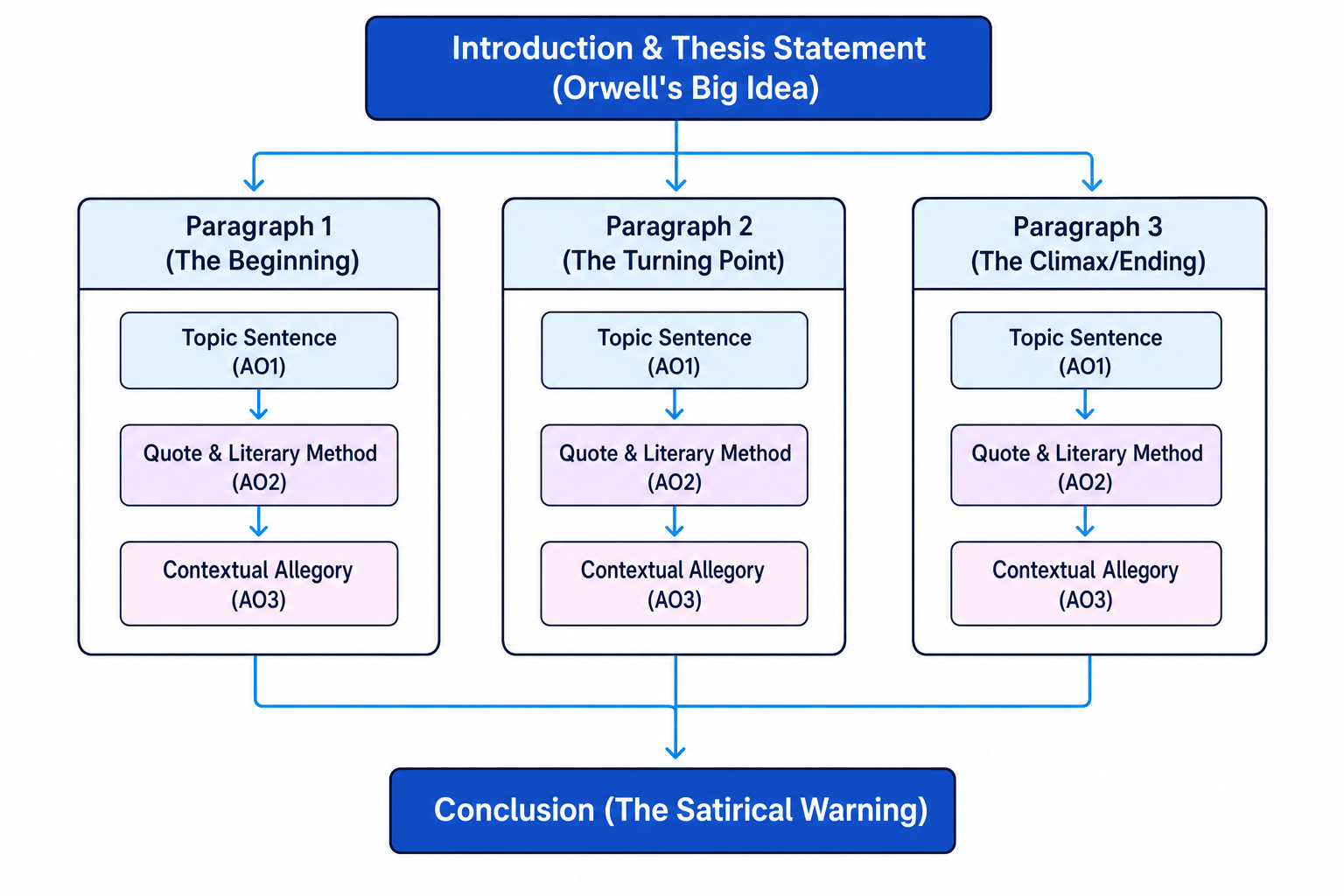
Your essay must follow a logical journey. Because Animal Farm is a short, structurally precise novella, the most effective way to organize your essay is chronologically (following the timeline of the book). This allows you to track how characters change, how language is corrupted over time, and how Orwell's warning unfolds.
Use this simple, robust three-part structure for your plan:
- Introduction: Introduce your thesis statement. Establish Orwell's satirical intent (what warning is he giving the reader?).
- Three Body Paragraphs:
- Paragraph 1 (The Beginning): The initial ideals vs. early signs of corruption.
- Paragraph 2 (The Turning Point): The consolidation of power and the manipulation of the working class.
- Paragraph 3 (The Climax/Ending): The total betrayal of the revolution and the final transformation.
- Conclusion: Summarise how the text acts as a timeless warning against political apathy, ignorance, and dictatorship.
Avoid the 'Pee' Trap
Do not use basic PEEL (Point, Evidence, Explanation, Link) paragraphs. They often lead to mechanical, list-like writing. Instead, treat your body paragraphs as a fluid exploration of Orwell's methods (AO2) and his historical/political context (AO3), always anchored to your central thesis.
Step-by-Step Essay Planning
Let's look at how to construct a plan under timed conditions.
Planning an essay on the corrupting nature of power
Question: Explore how George Orwell presents the corrupting nature of power in Animal Farm.
Follow these steps to construct your plan:
-
Deconstruct the prompt and draft a thesis statement: Connect "power" and "corruption" directly to Orwell's allegorical message. Instead of just saying "power corrupts the pigs," argue that Orwell uses the pigs to demonstrate how easily revolutionary ideals can be hijacked by selfish leaders if the populace remains uneducated and passive.
Draft Thesis: "Orwell presents power as an inherently corrupting force. Through the allegorical transformation of the pigs, he warns that without an active, critical, and educated citizenry, any political revolution is vulnerable to being hijacked by tyrannical leaders who use language and terror to consolidate absolute control."
-
Select Paragraph 1 (The Beginning - Seeds of Corruption): Identify the moment power begins to corrupt. Even in Chapter 2 and 3, right after the Rebellion, the pigs take the milk and apples.
- Topic Sentence: Orwell demonstrates that the corrupting nature of power is present from the very birth of Animal Farm, showing that intellectual privilege quickly leads to unequal resource distribution.
- Evidence & Method: The "disappearance" of the milk and apples; Napoleon's "quiet" authority; Squealer's rhetorical question: "You do not imagine, I hope, that we pigs are doing this in a spirit of selfishness and privilege?" (use of collective pronoun "we" and rhetorical manipulation).
- Context: This represents the early emergence of the Soviet ruling class (the nomenklatura), who enjoyed material privileges while preaching equality.
-
Select Paragraph 2 (The Middle - Consolidation and Manipulation): Look at how power is maintained and escalated mid-novel.
- Topic Sentence: As the pigs consolidate their power, Orwell highlights how language is corrupted to justify the abuse of authority and rewrite history.
- Evidence & Method: The gradual alteration of the Seven Commandments (e.g., "No animal shall sleep in a bed with sheets"); Squealer's constant threat of "Jones would come back!"; the use of Boxer's maximums ("Napoleon is always right") as a tool of psychological control.
- Context: Squealer represents Pravda (the state-controlled Soviet newspaper) and propaganda, demonstrating how totalitarian regimes manipulate objective truth to maintain power.
-
Select Paragraph 3 (The Ending - Absolute Corruption): Anchor the final, tragic regression of the farm.
- Topic Sentence: Ultimately, Orwell presents the complete corruption of power through the terrifying physical and moral regression of the pigs back into their human oppressors.
- Evidence & Method: Napoleon walking on two legs; carrying a "whip in his trotter"; the final commandment: "All animals are equal, but some animals are more equal than others" (paradox/oxymoron). The final image: "The creatures outside looked from pig to man... but already it was impossible to say which was which." (circular structure).
- Context: This reflects the 1943 Tehran Conference, where Stalin allied with Western capitalists, showing that Soviet totalitarianism had become identical to the oppressive capitalist systems it originally sought to overthrow.
Contextual Integration (AO3)
Never write a paragraph that is purely historical. If you write a whole paragraph explaining who Trotsky or Stalin was without linking it back to Orwell's language or literary choices, you will lose marks. Every piece of context must explain why Orwell chose to write that specific moment in the novel.
Managing Your Time in the Exam
In your AQA Paper 2 exam, you have 45 minutes to complete your Animal Farm essay. You should spend exactly 5 to 8 minutes planning.
The 'No-Plan' Rush
Many students think they do not have time to plan. They start writing immediately, run out of ideas by page two, repeat themselves, and drift away from the question. A 5-minute plan keeps your writing focused, fast, and structured.
Do Not Write Full Sentences in Your Plan
Your plan is a roadmap for you, not the examiner. Do not waste precious time writing out long, beautiful sentences in your plan. Use bullet points, short acronyms, and single-word method labels.
In the exam
- Highlight the key terms in the prompt: Identify whether the question is asking about a theme (e.g., lies, hope, leadership) or a character (e.g., Boxer, Squealer, Snowball).
- Write your thesis statement first: Write this out in full at the top of your planning space. Once you have your thesis, every point you plan must support it.
- Map your "Golden Quotes": Jot down 3 or 4 short, memorable quotes that you can analyse in-depth. It is better to have three short, deeply analysed quotes than ten long ones that you only mention in passing.
- Identify Orwell’s ultimate message: Always ask yourself why Orwell wrote this. What warning was he giving his contemporary 1945 readers, and why does that warning still matter to us today?
Check yourself
- Can you explain the difference between a plot-driven paragraph and a thesis-driven analytical paragraph?
- Look at a past exam question. Can you write a thesis statement for it in under two minutes?
- Do you have at least three "golden quotes" memorised for the characters of Napoleon, Boxer, Squealer, and the theme of propaganda?
