To secure a high grade in your GCSE English Literature exam, you must understand that Charles Dickens did not write Great Expectations in a vacuum. The novel, published in serial weekly instalments between 1860 and 1861, is a direct critique of the Victorian world.
In your exam, you are assessed on your ability to connect the themes, characters, and language of the novel to the society in which it was written. This guide will break down the essential historical, social, and biographical contexts of Great Expectations and show you how to weave them naturally into your essays.
What you'll learn
- How the rigid Victorian class system shaped Pip’s social ambitions.
- The reality of the Victorian penal system and its influence on Magwitch's story.
- How Dickens’s own traumatic childhood experiences inspired Pip’s journey.
- How to combine historical context with language analysis to score high marks.
The Four Pillars of Context in Great Expectations
To write a sophisticated essay, think of the context of Great Expectations as four interconnected pillars. Each pillar directly influences the characters' actions and Dickens's moral message.
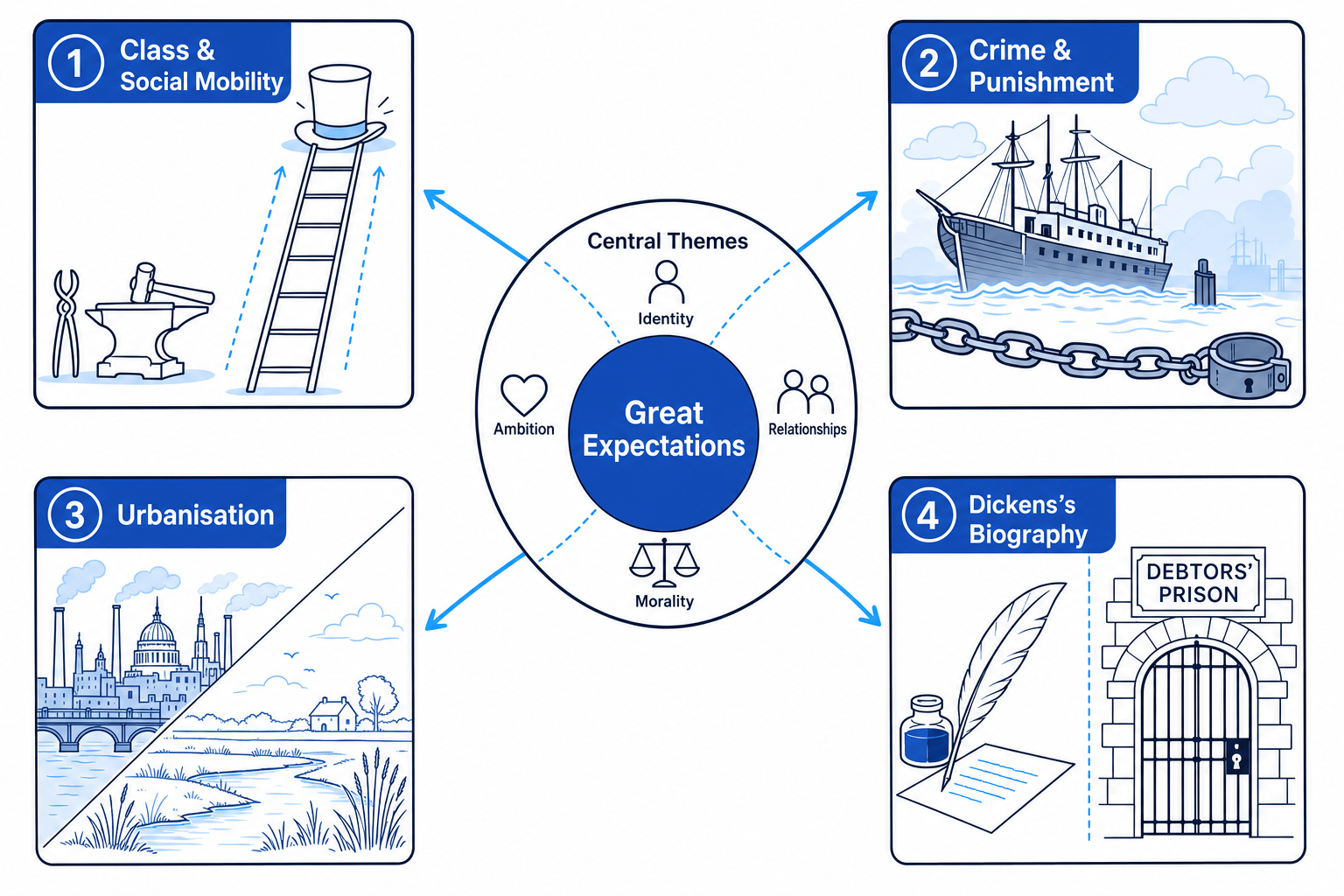
1. Class, Wealth, and Social Mobility
Victorian society was highly stratified, meaning it was divided into strict social classes. At the bottom was the working class (such as Joe Gargery, the blacksmith), in the middle was the rising middle class (like Mr Pumblechook or the lawyer Jaggers), and at the top was the landed gentry and aristocracy (represented by Miss Havisham).
Social Mobility
Social mobility is the ability of an individual or family to move up or down the social ladder (class hierarchy) over time. In Victorian Britain, this was extremely difficult and often met with deep social anxiety.
Dickens lived through a period where the traditional class structures were being challenged. With the growth of capitalism, people could suddenly acquire wealth through trade and industry, rather than inheriting land. However, this created an obsession with becoming a "gentleman"—a term that Victorian society defined through wealth, superficial manners, and fine clothing rather than moral character.
The Moral Gentleman vs. The Social Gentleman
Dickens uses Pip’s journey to critique the Victorian obsession with class. He contrasts the "social gentleman" (like Bentley Drummle, who is wealthy and high-class but cruel and arrogant) with the "moral gentleman" (like Joe Gargery and Biddy, who are poor and uneducated but possess genuine kindness, loyalty, and honour).
2. Crime, Law, and the Penal System
The early 19th-century setting of the novel reflects a brutal and unforgiving legal system. The Victorian penal system focused heavily on punishment and deterrence rather than rehabilitation.
The Hulks
At the start of the novel, Magwitch escapes from the "Hulks." These were decommissioned, decaying warships used as floating prisons moored in the Thames Estuary. Conditions on board were notoriously filthy, cold, and diseased. The presence of the Hulks in the foggy marshes creates a gothic, menacing atmosphere that symbolises how crime hangs over the entire society.
Penal Transportation
Under the Victorian legal system, serious criminals were often sentenced to "transportation."
Penal Transportation
Penal transportation was the practice of deporting convicted criminals to penal colonies, most notably Australia, to serve their sentences of hard labour.
If a transported convict returned to England, it was a capital offence, meaning they would face the death penalty. This historical reality explains the immense danger Magwitch faces when he returns to London to see Pip in Chapter 39. It also highlights Magwitch's profound selflessness: he risks his life simply to see the "gentleman" he has created.
3. Urbanisation and the Industrial Revolution
Great Expectations contrasts two distinct settings: the rural, damp Kent marshes and the dirty, overcrowded city of London.
Industrialisation
Industrialisation is the historical process where an economy transforms from primarily agricultural to one based on the manufacturing of goods, characterized by the growth of large factories and cities.
During the 19th century, the Industrial Revolution caused massive urbanisation. Millions of working-class people migrated to cities in search of work. London became the heart of the British Empire, but it was also a place of extreme poverty, pollution, and moral decay.
When Pip first arrives in London, he expects a golden city of wealth. Instead, he is confronted by Smithfield market, which is filthy and full of "slaughterhouses," and Newgate Prison, which is surrounded by crime and misery. Dickens uses this contrast to show that the wealth of the "gentleman" is built upon the exploitation and suffering of the lower classes.
Wemmick’s Dual Identity
Think about John Wemmick. He maintains a strict division between his professional life in London (where he is cold and obsessed with "portable property") and his personal life at Walworth (where he is a warm, inventive son). This reflects the Victorian anxiety that the industrial city was stripping humans of their warmth and empathy.
4. Dickens’s Biography: The Personal Connection
Dickens poured much of his own life, trauma, and anxiety into Pip.
- The Blacking Factory: When Dickens was twelve, his father was sent to Marshalsea debtors' prison. Charles was taken out of school and forced to work ten-hour days at Warren's Blacking Factory, pasting labels onto shoe-polish bottles. He felt deeply abandoned and ashamed of his working-class degradation—feelings that mirror Pip's intense shame at being apprenticed to Joe at the blacksmith's forge.
- The Desire for Status: Even after achieving immense wealth and fame as a writer, Dickens never fully overcame his childhood fear of poverty and loss of status. Pip’s desperate desire to escape the forge and become a gentleman is directly lifted from Dickens's own psychological scars.
Literary Context: The Genre
To gain top marks for your understanding of structure and form, you should know that Great Expectations belongs to a specific literary genre.
Bildungsroman
A Bildungsroman is a novel that traces the psychological, moral, and social growth of a protagonist from youth to adulthood. Typically, the protagonist must undergo a series of trials, make mistakes, lose their moral compass, and eventually gain wisdom and self-awareness.
Ignoring the Double Narrative Voice
Students often forget that the novel is written from the perspective of an older, wiser Pip looking back on his foolish younger self. When analysing quotes, distinguish between the thoughts of "young Pip" (who is snobbish and blind to what matters) and the voice of "mature Pip" (who regrets his past cruelty to Joe and Biddy).
How to Apply Context in Your Essays
In AQA GCSE English Literature, context (AO3) should never be tacked onto the end of a paragraph like an afterthought. You must weave it together with your language analysis (AO2).
Here is a step-by-step example of how to build a high-scoring analytical paragraph that integrates context seamlessly.
Integrating Context and Language Analysis
Analyse how Dickens presents Pip's attitude toward his social class in Chapter 14.
- State your thesis point (linking character to theme and context): Dickens presents Pip's rising social ambition not as a noble pursuit, but as a moral corruption driven by Victorian class anxieties and his own growing shame.
- Embed a precise, short quotation: After visiting Satis House, Pip reflects on his apprenticeship at the forge, noting, "I had liked it once, but once was not now," admitting that he now felt "restless, aspiring, and discontented."
- Analyse the writer's language and structural methods (AO2): The temporal contrast between "once" and "now" structurally mirrors Pip's psychological shift. The triadic structure of adjectives—"restless, aspiring, and discontented"—creates a cumulative effect that highlights his growing psychological turmoil. The word "aspiring" acts as a double-edged sword; while Victorian society championed aspiration, Dickens uses it here to signal Pip's rejection of domestic warmth in favour of superficial status.
- Weave in the historical and biographical context (AO3): This intense shame of manual labour directly mirrors Dickens’s own biographical trauma when he was forced to work in Warren's Blacking Factory as a child. Just as Dickens felt his prospects "crushed" by working-class toil, Pip views the forge as a prison. Furthermore, Dickens uses Pip's dissatisfaction to critique the wider Victorian capitalist drive for class mobility, which encouraged individuals to abandon genuine communal relationships in pursuit of cold, material status.
- Conclude by linking back to the writer's overall purpose: Ultimately, through Pip's painful rejection of Joe's trade, Dickens warns his contemporary readers that Victorian social ambition often requires a devastating sacrifice of moral integrity and personal loyalty.
In the exam
- Never use context as "potted history": Do not write long paragraphs about the Victorians or Dickens's life without linking them directly to the words in the quotation and the characters in the novel.
- Anchor context to the writer's intent: Use phrases like "Dickens uses this to critique..." or "This reflects the contemporary Victorian anxiety surrounding..." to keep your focus on the author's craft.
- Contrast characters to prove your point: Show how characters represent different Victorian ideals (e.g., contrast Estella’s cold, aristocratic "education" with Biddy’s warm, organic intelligence).
Check yourself
- Why did Dickens split Wemmick's life into two distinct personalities, and what does this tell us about the Victorian view of London?
- How does the character of Magwitch challenge Victorian assumptions about the relationship between criminality and morality?
- In what ways does Pip's development fit the traditional structure of a Bildungsroman?
