

Welcome to your study guide on the characters of George Orwell's Animal Farm. In this section, we will explore how Orwell designs his characters to represent real historical figures and social classes from the Russian Revolution. By understanding these characters as deliberate constructs, you will be able to write sophisticated, high-scoring essays.
What you'll learn
- The difference between literal characters and allegorical figures in a political satire.
- How the main characters represent historical figures from the Russian Revolution and Soviet history.
- How to analyse Orwell's characterisation techniques to meet the Assessment Objectives (AO1, AO2, and AO3).
Character as Allegory
To succeed in your GCSE English Literature exam, you must look past the surface level of the plot. Animal Farm is not just a story about farm animals; it is a political allegory and a satire.
Allegory
An allegory is a story, poem, or picture that can be interpreted to reveal a hidden political, historical, or moral meaning. In Animal Farm, the farm represents Russia, and the characters represent real historical figures, groups, and institutions.
Satire
A satire is a literary work that uses humour, irony, exaggeration, or ridicule to expose and criticise human vice, folly, or political corruption.
When writing your essays, never treat these characters as real animals making personal choices. Instead, refer to them as constructs created by Orwell to convey a message. Use active verbs: "Orwell constructs Napoleon to expose..." or "Through Boxer, Orwell criticises..."
Characters as Tools
Orwell did not write Animal Farm to entertain you with a story about talking animals. He designed each character as a functional tool to warn the world about the dangers of totalitarianism, dictatorship, and political apathy.
The Key Characters
Below is a conceptual map of the main characters, showing how they interact and the real-world historical groups they represent:
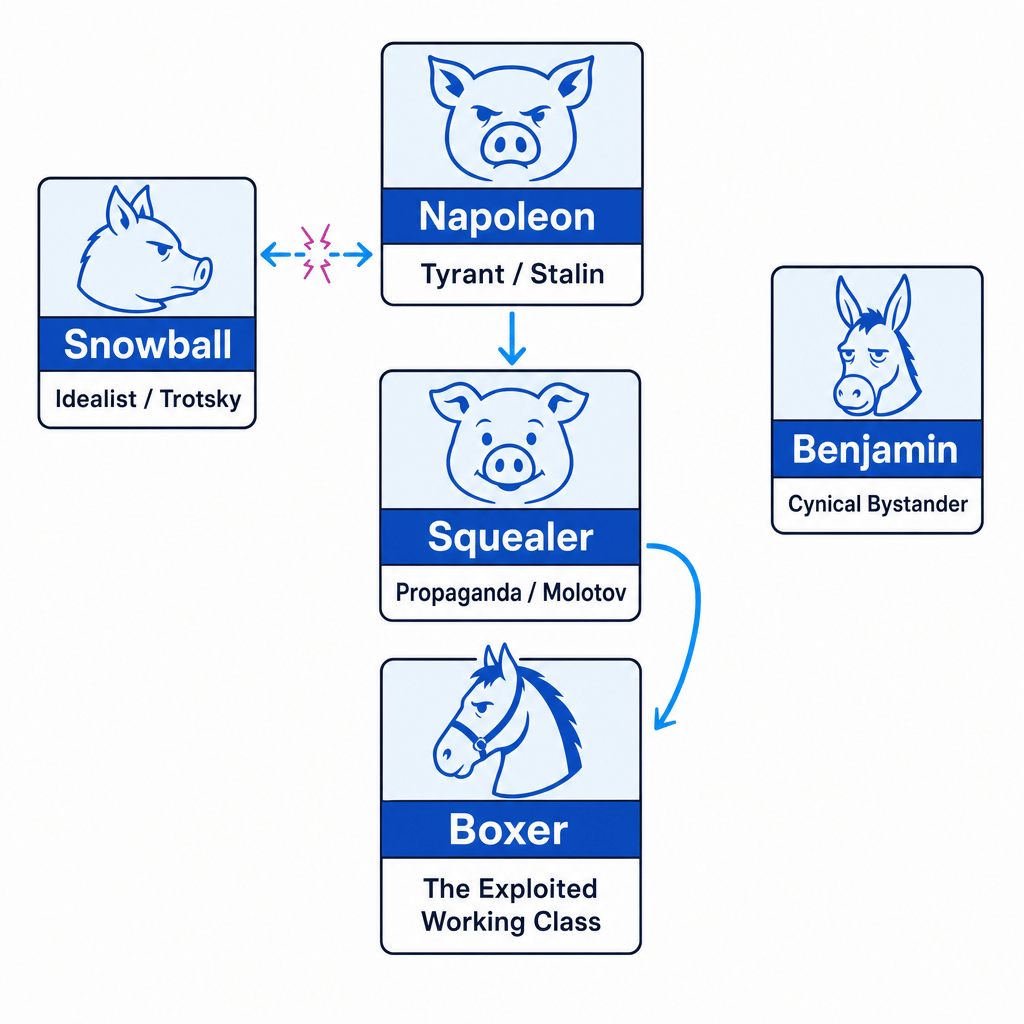
The Pigs (The Ruling Class)
The pigs quickly establish themselves as the intellectual elite on the farm. They represent the Bolshevik leadership who took power after the fall of the Tsar.
Napoleon (Joseph Stalin)
Napoleon is the main antagonist of the novella. He is quiet, manipulative, and deeply selfish. Unlike Snowball, he is not interested in debates or long-term planning; he is interested in power.
- Key Characteristics: Secretive, ruthless, dictatorial, and corrupt.
- Orwell's Presentation: From his first introduction, Orwell notes that Napoleon has a "reputation for getting his own way" (Chapter 2). This immediately alerts the reader to his self-serving nature. He does not contribute ideas to the rebellion; instead, he waits for others to do the work and then seizes control of the results.
- Historical Link: He represents Joseph Stalin, the General Secretary of the Communist Party who gradually eliminated his rivals to become the absolute dictator of the Soviet Union.
Snowball (Leon Trotsky)
Snowball is passionate, eloquent, and full of revolutionary ideals. He is responsible for designing the windmill and organizing the animal committees.
- Key Characteristics: Intellectual, visionary, energetic, but politically naive.
- Orwell's Presentation: Snowball is described as a "more vivacious pig than Napoleon, quicker in speech and more inventive" (Chapter 2). He genuinely believes in the principles of Animalism and wants to improve the animals' lives. However, his focus on abstract theories makes him blind to Napoleon’s physical threat.
- Historical Link: He represents Leon Trotsky, a brilliant intellectual and military strategist who fought Stalin for control of the Party after Lenin's death but was ultimately exiled and demonised.
Squealer (Soviet Propaganda / Vyacheslav Molotov)
Squealer is Napoleon’s mouthpiece. He is a master of manipulation who uses language to distort the truth, rewrite history, and control the other animals.
- Key Characteristics: Persuasive, deceptive, agile, and loyal to power.
- Orwell's Presentation: Squealer is introduced as a pig who could "turn black into white" (Chapter 2). Orwell uses him to show how language can be weaponised by a totalitarian regime to control the masses.
- Historical Link: He represents the state-controlled Soviet media (such as the newspaper Pravda) and figures like Vyacheslav Molotov, who used propaganda to justify Stalin's brutal policies.
The 'Jones' Shield
Notice how Squealer repeatedly uses the rhetorical question "Surely, comrades, you do not want Jones back?" to silence debate. This is a powerful technique of manipulation: using a shared fear of the past to justify present tyranny.
The Working Class (The Exploited Masses)
Boxer (The Loyal Soviet Proletariat)
Boxer is a cart-horse known for his incredible strength and tireless dedication to the farm.
- Key Characteristics: Loyal, hardworking, self-sacrificing, but uncritical and illiterate.
- Orwell's Presentation: Boxer's two personal maxims are "I will work harder" and "Napoleon is always right". Orwell presents Boxer with deep sympathy but also as a tragic warning. Boxer's inability to think critically makes him complicit in his own exploitation. When he becomes too old to work, Napoleon ruthlessly sells him to the knacker (slaughterhouse) to buy whisky.
- Historical Link: Boxer represents the Soviet working class (the proletariat), specifically the Stakhanovite movement, who worked themselves to death believing they were building a socialist paradise, only to be betrayed by their leaders.
Treating Boxer's death as just sad
In your exam, do not just write about how sad it is when Boxer dies. Instead, explain the structural function of his death: Orwell uses Boxer's betrayal to demonstrate that under a totalitarian regime, absolute loyalty is rewarded with absolute betrayal. It is the ultimate critique of totalitarian corruption.
The Cynics and Outsiders
Benjamin (The Cynical Intellectuals)
Benjamin is the old donkey who remains unchanged by the rebellion. He is literate and understands what the pigs are doing, but he refuses to speak out.
- Key Characteristics: Cynical, passive, intelligent, and stubborn.
- Orwell's Presentation: Benjamin's famous phrase is "Donkeys live a long time. None of you has ever seen a dead donkey" (Chapter 3). He represents those who understand that political regimes rise and fall, but believe that life will always be difficult. By the time Benjamin finally decides to act (when Boxer is being taken away), it is too late.
- Historical Link: He represents the skeptical, older generation of Russian intellectuals who saw through Soviet propaganda but did nothing to stop Stalin's rise to power, believing resistance was futile.
The Humans (The Capitalist/Aristocratic Powers)
Mr. Jones (Tsar Nicholas II)
The original owner of Manor Farm. He is an abusive, neglectful alcoholic who starves the animals.
- Historical Link: Represents Tsar Nicholas II, the last Emperor of Russia, whose poor leadership, military failures, and neglect of the Russian people directly triggered the 1917 Russian Revolution.
Worked Example: Analysing Character in an Essay
Let's walk through how to structure a high-scoring analytical paragraph about a character.
Analysing Squealer's use of language
Question: How does Orwell present Squealer as an instrument of political power in Animal Farm?
-
Formulate a clear thesis statement (AO1/AO3): Start by explaining Squealer's function as an allegorical construct representing state propaganda.
- Draft: "Orwell constructs Squealer as an allegory for state propaganda to demonstrate how totalitarian regimes manipulate language to maintain absolute power."
-
Integrate precise, short textual evidence (AO1): Select a memorable quote that shows Squealer in action.
- Draft: "When the pigs take the milk and apples for themselves, Squealer justifies this by warning the other animals that if the pigs fail in their duty, 'Jones would come back!'"
-
Identify and analyse Orwell's methods (AO2): Identify the literary and rhetorical devices Orwell uses through Squealer and explain their immediate effects.
- Draft: "Orwell uses Squealer's rhetorical question, 'Surely, comrades, you do not want Jones back?', to exploit the animals' collective trauma. The collective pronoun 'comrades' creates a false sense of equality, while the threatening tone of the exclamation mark emphasizes the false dilemma presented to the uneducated animals."
-
Link to context and Orwell's authorial message (AO3): Conclude by linking the language analysis back to Orwell's historical target and overall warning.
- Draft: "This mirrors how Stalin’s regime used state-controlled media to manufacture fear of capitalist invasion. Through Squealer's linguistic manipulation, Orwell warns his contemporary readers that a public's lack of critical thinking allows corrupt leaders to rewrite history and justify inequality."
In the exam
- Never treat animals as real animals: Always refer to them as constructs designed by George Orwell to convey a political warning.
- Weave context into character analysis: Whenever you write about a character's actions, immediately link it to Soviet history (e.g., Napoleon's dogs represent the NKVD/secret police; the execution of the hens represents the Great Purge).
- Focus on methods: Look for specific linguistic techniques when characters speak, such as Squealer’s rhetorical questions, Napoleon's silent gestures, or Boxer's repetitive maxims.
Check yourself
- Why did Orwell choose to make the pigs the rulers and the horses the laborers? How does this choice reflect their real-world historical counterparts?
- Explain Squealer's role on the farm. Which specific group from Soviet history does he represent, and what is his primary weapon?
- What is Benjamin's fatal flaw as a character, and how does Orwell use him to criticize passive intellectuals?
