In Charles Dickens’s 1861 novel Great Expectations, characters are not just realistic individuals; they are vivid, sometimes grotesque symbols of Victorian social classes, moral values, and psychological struggles. Understanding how these characters interact, contrast, and develop is your key to securing a top grade in your GCSE English Literature exam.
What you'll learn:
- How Pip’s moral development drives the structure of the novel.
- How Dickens uses "foils" to contrast inner moral worth with external social class.
- How to write an analytical paragraph linking a character’s behaviour to Dickens's social critique.
The Protagonist and the Bildungsroman
To understand Great Expectations, you must first understand its form. The novel is a classic example of a literary genre that traces a character's life journey.
Bildungsroman
A German term translating literally to "formation novel." It refers to a literary genre that focuses on the psychological, moral, and social growth of the protagonist from youth to adulthood.
Pip is our protagonist and first-person narrator. This narrative perspective is crucial: we see the world through young Pip’s impressionable eyes, but we also hear the reflective, often remorseful voice of the older Pip looking back on his life.
Pip’s Three Stages of Development:
- Innocence and Guilt (Chapters 1–19): Raised "by hand" on the Kent marshes by his abusive sister, Mrs. Joe, and the gentle blacksmith, Joe Gargery. His life is simple and morally secure until he visits Satis House and is taught to feel ashamed of his "coarse hands" and "thick boots."
- Arrogance and Decay (Chapters 20–39): Upon receiving a fortune from a secret benefactor, Pip moves to London to become a "gentleman." He becomes snobbish, accumulates debts, and neglects his true friends, Joe and Biddy, believing his wealth makes him superior.
- Redemption and Maturity (Chapters 40–59): The shock discovery that his fortune comes from the escaped convict, Magwitch—rather than the aristocratic Miss Havisham—shatters Pip's illusions. He learns that true gentility is defined by moral integrity, not social class.
Pip's Internal Conflict
Pip's primary struggle is between his inner moral conscience (associated with the forge) and his outer social ambition (associated with Satis House and London).
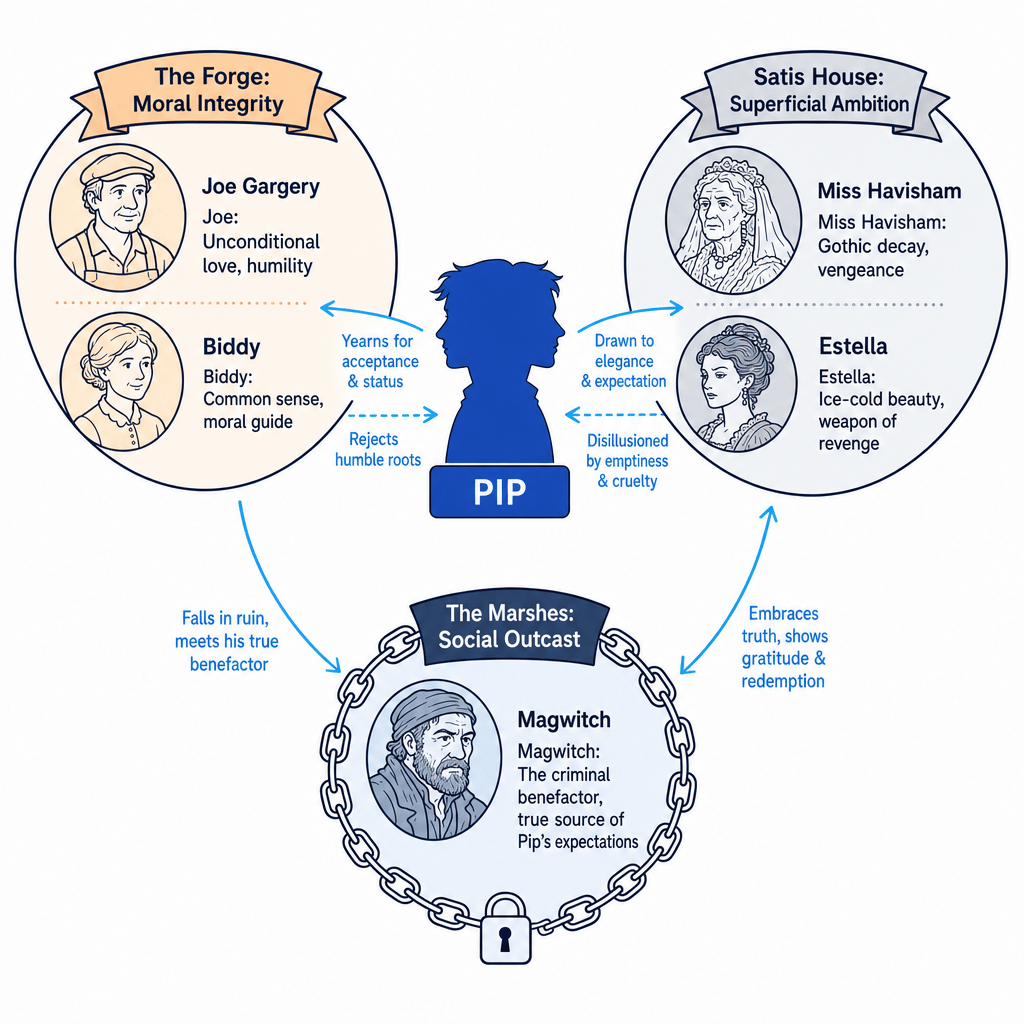
Foils and the Dual Spheres: Moral Worth vs. Social Class
Dickens structures his character list using a series of contrasts. To highlight a main character's traits, he often places them next to a character with opposing values.
Foil
A character who contrasts sharply with another character (usually the protagonist) in order to highlight specific qualities of the latter.
In Great Expectations, the characters are divided into two distinct moral and social spheres.
1. The Sphere of Moral Integrity (The Forge)
These characters represent the Christian virtues of humility, loyalty, and hard work. Dickens uses them to show that social status has no bearing on moral goodness.
- Joe Gargery: The humble blacksmith who offers Pip unconditional love. Joe is physically strong but emotionally tender. When he visits Pip in London, he recognizes that he is out of place, explaining: "I am not in a society suitable for me, nor too any-ways comfortable in it." Joe remains the moral anchor of the novel.
- Biddy: A sensible, kind working-class girl who acts as Pip's early teacher. She is the opposite of Estella—warm, grounding, and emotionally intelligent. She challenges Pip’s early ambitions, asking him why he wants to be a gentleman: "To spite the poor, or to gain over the rich?"
2. The Sphere of Superficial Ambition (Satis House & London)
These characters are wealthy or upper-class, but they are emotionally dead, corrupt, or physically decaying.
- Miss Havisham: A wealthy, bitter spinster who was abandoned at the altar. She has frozen Satis House in the exact moment of her betrayal—rotting wedding cake, stopped clocks, and a decaying bridal dress. She is a gothic figure of vengeance, using her adopted daughter, Estella, to "wreak revenge on all the male sex."
- Estella: Her name means "star," suggesting she is beautiful but cold, distant, and unreachable. Raised by Miss Havisham to be a weapon of revenge, she warns Pip: "I have no heart... I have no softness there, no sympathy, no sentiment." Her emotional coldness is a direct product of her abusive, instrumentalised upbringing.
Context Link (AO3)
In Victorian England, the industrial revolution led to a rising middle class obsessed with social climbing. Through characters like the pompous Uncle Pumblechook and the snobbish Bentley Drummle, Dickens satirises this obsession, arguing that the true "gentleman" is defined by his character (like Joe), not his bank balance or lineage (like Drummle).
The Outcast: Magwitch (Provis)
Abel Magwitch is one of Dickens's most complex characters. He begins the novel as a terrifying gothic monster on the marshes—"A fearful man, all in coarse grey, with a great iron on his leg." Yet, he ends the novel as a figure of deep pathos and Christian redemption.
- The Victim of the Class System: Magwitch was orphaned and forced into crime to survive. At his trial, his accomplice, the upper-class swindler Compeyson, received a much lighter sentence because of his polished appearance and manners. Dickens uses Magwitch to expose the deep prejudice of the Victorian legal system.
- The Secret Benefactor: Magwitch escapes to Australia, makes a fortune, and uses it to turn Pip into a gentleman. He views Pip as his "creation": "If I ain't a gentleman, nor yet ain't got no learning, I'm the owner of such." This highlights the irony of Pip’s social rise: his high-class lifestyle is entirely funded by a social outcast's labor.
Confusing the Benefactor
Many students write that Miss Havisham is Pip's benefactor because she gives him money early on and matches him with Estella. Remember: Miss Havisham deliberately lets Pip believe this to torment her greedy relatives, but Magwitch is his true, secret benefactor.
Constructing a Character Analysis
In your exam, you must show how Dickens uses language and structure to convey character (AO2) and how this reflects his wider social message (AO3).
Here is a step-by-step walkthrough of how to build an analytical paragraph focusing on Joe Gargery’s moral role and how he serves as a foil to Pip's shallow ambitions.
Analysing Joe's Moral Integrity
- Formulate a clear, thematic point (AO1): Start by stating what the character represents in terms of Dickens's broader moral message, rather than just describing their actions.
- Drafting: Dickens uses the character of Joe Gargery to represent pure, uncorrupted moral integrity, serving as a direct moral foil to Pip's shallow social ambitions.
- Introduce and embed a precise quotation (AO1): Select a highly specific quote from memory and integrate it seamlessly into a sentence. Let's look at the moment Joe visits Pip in London (Chapter 27).
- Drafting: When Joe visits Pip’s luxurious London chambers, he immediately senses the emotional distance wealth has created between them, stating, "I’m wrong in these clothes. I’m wrong out of the forge."
- Analyse Dickens's language and structural methods (AO2): Look closely at the words and patterns Dickens uses. Identify the word class or structural device and explain its effect.
- Drafting: The deliberate repetition of the adjective "wrong" highlights Joe's profound self-awareness and his recognition that his identity is inextricably linked to his honest labor at the "forge". Unlike Pip, who attempts to disguise his humble origins under expensive clothing, Joe understands that artificial social elevating leads to moral and spiritual displacement. The noun "forge" acts as a powerful structural motif throughout the novel, symbolising warmth, honest work, and domestic security.
- Connect the analysis to Dickens's social and historical context (AO3): Explain why Dickens presented the character this way to his Victorian audience.
- Drafting: Through Joe’s quiet dignity, Dickens critiques the rigid Victorian class system that equated high social standing with moral superiority. Dickens suggests that true gentility does not lie in London's superficial fashions, but in the domestic affection and humble industry found in the working-class provinces.
In the exam
- Avoid treating characters as real people: Always refer to them as constructs designed by Dickens to deliver a specific message. Use phrases like: "Dickens constructs Miss Havisham to embody..." or "Through Estella, Dickens highlights..."
- Trace character arcs: Do not just write about a character in one single scene. To show a sophisticated understanding (AO1), discuss how they change from the beginning, middle, to the end of the novel.
- Embed short, precise quotes: Instead of copying out two-line block quotes, weave fragments of 2–5 words directly into your sentences (e.g., Pip describing Joe as having "a sweet tempered, good-natured, easy-going" character).
Check yourself
- Why does Dickens make Magwitch, rather than Miss Havisham, the source of Pip's wealth? What point is he making about Victorian society?
- Contrast the symbolic meanings of the Forge and Satis House. How do these physical settings reflect the characters who inhabit them?
- How does the older, first-person narrator Pip feel about the actions of his younger self? Find one moment where this narrative voice expresses regret.
