

What you'll learn
- What allegory and satire mean, and how they work in Animal Farm.
- How Orwell uses a simple animal story to criticise political corruption and propaganda.
- How to move beyond “this character represents…” into strong literary analysis.
- How to write about Orwell’s methods in a closed-book GCSE essay.
Start with the surface story
Before you think about politics, start with the obvious level: Animal Farm is a short story about farm animals who rebel against a human farmer, try to run the farm themselves, and end up under the control of the pigs.
That simple surface is important. Orwell does not write a complicated political essay; he uses a clear, almost childlike story so that the corruption of power becomes easy to see.
Fable
A fable is a short story, often using animals, that teaches a moral or political lesson. A beast fable is a fable where animals behave like humans.
Orwell’s subtitle for the novel was “A Fairy Story”, but the story becomes increasingly dark. This contrast is part of the power of the book: the form looks simple, but the message is serious.
Simplicity is a method
The plain farm setting is not childish by accident. Orwell uses simplicity to make political lies, selfishness, and cruelty look obvious to the reader.
Reading the fable level
- Start with the literal detail: in Chapter 3, the narrator says, “The pigs did not actually work, but directed and supervised the others.”
- Notice the contrast: the other animals physically labour, while the pigs claim a special role because of their “superior knowledge”.
- Connect the method to meaning: Orwell’s plain contrast between working and directing exposes the early growth of inequality.
- Link to effect: the reader sees that the revolution is already being corrupted, even before Napoleon becomes openly tyrannical.
What is allegory?
Allegory
An allegory is a story with two levels of meaning: a literal level and a deeper symbolic level, often political, moral, or religious.
In Animal Farm, the literal level is the farm story. The deeper level is a criticism of how revolutions can be betrayed when leaders use power for themselves. The book especially draws on the Russian Revolution and Stalin’s dictatorship, but its warning is wider than one country.
A helpful way to think about Animal Farm is as three linked layers: what happens on the farm, what it suggests about politics, and how Orwell makes that criticism sharp through satire.
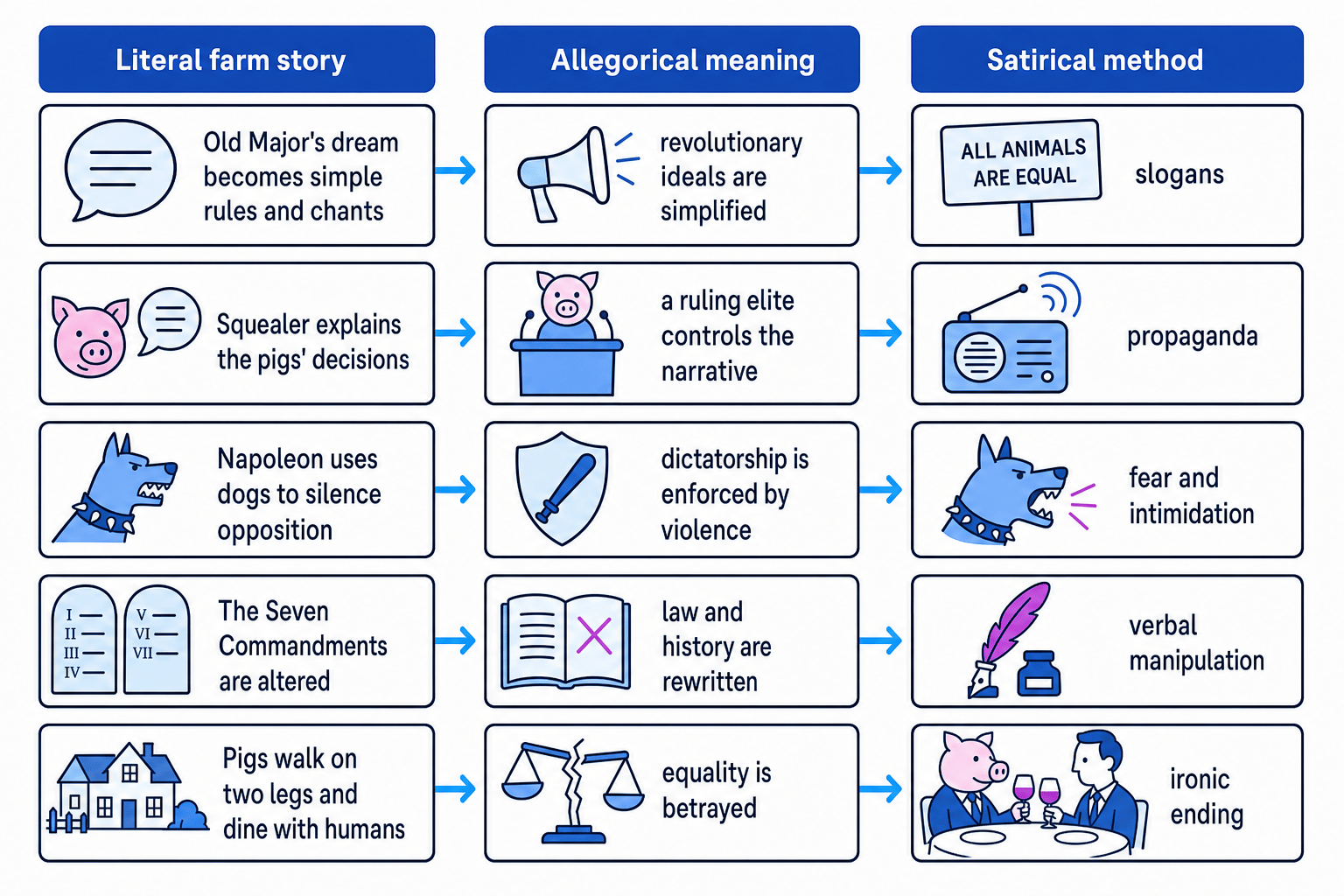
The main allegorical links
You do not need to memorise every possible historical link, but you should know the most important ones:
- Mr Jones suggests the old oppressive ruler who is overthrown.
- Old Major suggests revolutionary thinkers and leaders who inspire change.
- Napoleon suggests the dictator who takes control after the revolution.
- Snowball suggests the rival revolutionary who is driven out and blamed.
- Squealer suggests propaganda: language used to control what people believe.
- Boxer suggests the loyal working class, exploited by those in power.
- The dogs suggest violent enforcement, such as secret police.
- The Seven Commandments suggest political ideals and laws that are gradually corrupted.
Only decoding the allegory
Do not write a whole paragraph that just says “Napoleon represents Stalin” or “Boxer represents the workers”. That is context, not analysis. You must also explain how Orwell presents the character or event and why it affects the reader.
Allegory is not just a code
It can be tempting to treat the novel like a matching exercise: one animal equals one historical figure. That is a useful starting point, but it is not enough for GCSE analysis.
Orwell’s allegory works because each animal also has a role in the story itself. Boxer is not just a historical symbol; he is also a tragic character whose loyalty makes the reader feel anger and pity. Squealer is not just “propaganda”; he is also a comic and frightening speaker whose language shows how lies can sound reasonable.
Best allegory sentence pattern
Try this structure: On the literal level… / Allegorically… / Orwell’s method suggests…
This keeps your answer focused on the text, context, and writer’s choices.
Interpreting the final commandment
- Start with the literal moment: near the end, the final commandment reads, “All animals are equal / But some animals are more equal than others.”
- Identify the contradiction: the phrase “more equal” is logically impossible because equality should not have levels.
- Analyse the method: Orwell uses paradox and satirical language to show how political words can be twisted until they mean the opposite of their original purpose.
- Link to the allegory: the revolution’s ideal of equality has been turned into a justification for hierarchy, privilege, and dictatorship.
What is satire?
Satire
Satire is writing that exposes and criticises foolishness, corruption, or injustice, often through humour, exaggeration, irony, or ridicule.
Animal Farm is satirical because Orwell makes corrupt political behaviour look ridiculous as well as cruel. The pigs’ excuses are absurd, the sheep’s slogans are mindless, and the changing commandments are obviously dishonest — but the consequences are serious.
Irony
Irony is a gap between appearance and reality, or between what is said and what is actually true.
For example, the pigs claim to protect the revolution, but they gradually destroy its original principles. That gap between their words and actions creates bitter irony.
Thinking satire must be light-hearted
Satire is not always cheerful or laugh-out-loud funny. In Animal Farm, the humour often makes the cruelty more disturbing because the reader can see how absurd and dangerous the lies are.
Satire through slogans
One of Orwell’s sharpest satirical methods is the use of slogans. A slogan is a short, memorable phrase designed to be repeated.
The sheep repeatedly chant “Four legs good, two legs bad”. At first, it seems to support animal unity. Later, when the pigs start walking on two legs, the chant becomes “Four legs good, two legs better!” The change is absurd, but it also shows how easily language can be redirected by those in power.
The satire targets political movements that reduce complex ideas to phrases people repeat without thinking. Orwell shows that slogans can create unity, but they can also stop debate.
Satire through propaganda
Propaganda
Propaganda is biased information designed to make people accept a political view, often by hiding the truth or stirring up fear.
Squealer is Orwell’s main vehicle for satirising propaganda. He uses rhetorical questions, false logic, and fear. His repeated warning, “Surely, comrades, you do not want Jones back?”, makes the animals accept the pigs’ privileges because they are terrified of returning to the past.
The word “comrades” is especially important. It sounds equal and friendly, but Squealer uses it while defending inequality. Orwell satirises political language that pretends to serve the people while protecting the rulers.
Analysing Squealer’s propaganda
- Choose the key phrase: Squealer asks, “Surely, comrades, you do not want Jones back?”
- Analyse the question: the rhetorical question pressures the animals because it implies there is only one sensible answer.
- Notice the emotional tactic: mentioning Jones creates fear, so the animals focus on the old danger instead of questioning the pigs’ behaviour.
- Link to satire: Orwell mocks and exposes propaganda that wins obedience by replacing thought with fear.
Satire through dramatic irony
Dramatic irony
Dramatic irony happens when the reader understands more than a character does.
The animals often fail to see what is happening, but the reader can. Boxer’s mottos — “I will work harder!” and “Napoleon is always right” — are tragic because we understand that his loyalty is being exploited.
This is not just sad characterisation. It is satirical because Orwell criticises systems that praise ordinary people’s labour while using them up and discarding them.
The ending: allegory and satire together
The final scene brings the whole method together. The pigs play cards with humans, drink alcohol, and quarrel over cheating. The animals outside look in and realise that the pigs and humans have become indistinguishable: “it was impossible to say which was which.”
This is both allegory and satire. Allegorically, it shows that the new rulers have become like the old rulers. Satirically, the image is grotesque and absurd: the animals rebelled against humans, only for pigs to copy them completely.
Reading the ironic ending
- Focus on the repeated comparison: the animals look “from pig to man, and from man to pig”.
- Analyse the structure: the movement back and forth makes the two groups blur together in the reader’s mind.
- Identify the irony: the revolution began by rejecting human oppression, but ends with the pigs adopting human behaviour.
- Link to Orwell’s message: the ending satirises revolutions that change the rulers but not the system of power.
How to write about this well
A strong paragraph on allegory and satire should not separate meaning from method. You are rewarded for explaining how Orwell’s choices shape the reader’s response.
A useful paragraph might move like this:
- Make a clear point about Orwell’s criticism.
- Use a short quotation you can remember accurately.
- Name the method, such as allegory, satire, irony, slogan, or propaganda.
- Explain the effect on the reader.
- Link briefly to context or the wider warning of the novel.
The strongest argument
Orwell’s allegory shows how revolutionary ideals can be betrayed; his satire exposes the language and behaviour that make that betrayal possible.
In the exam
- Use allegory as a method, not just context: explain what the farm event symbolises and how Orwell presents it.
- Keep quotations short and accurate: “more equal”, “Jones back?”, “I will work harder!”, and “which was which” are all useful.
- Always connect satire to criticism: say what Orwell is exposing, such as propaganda, fear, hypocrisy, or the corruption of equality.
Check yourself
- Can you explain the difference between allegory and satire without using the same definition for both?
- Why is “All animals are equal / But some animals are more equal than others” both funny and frightening?
- How does Squealer’s language help Orwell criticise propaganda?
