What you'll learn
- What international trade, exports and imports mean.
- Why countries trade instead of producing everything themselves.
- The main types of goods and services the UK exports and imports.
- How trade benefits the UK, but also creates global interdependence and risk.
3.2.4.1 Benefits of trade to countries and the UK's exports and imports
Before we get into international trade, remember that an economy is the system of production, spending, incomes and jobs in a country or area. The UK economy includes households, firms such as Tesco or Rolls-Royce, banks, the government, and overseas customers and suppliers.
International trade
International trade is the buying and selling of goods and services between countries. Goods are physical products, such as cars or food. Services are activities people pay for, such as banking, tourism, education or insurance.
Exports and imports
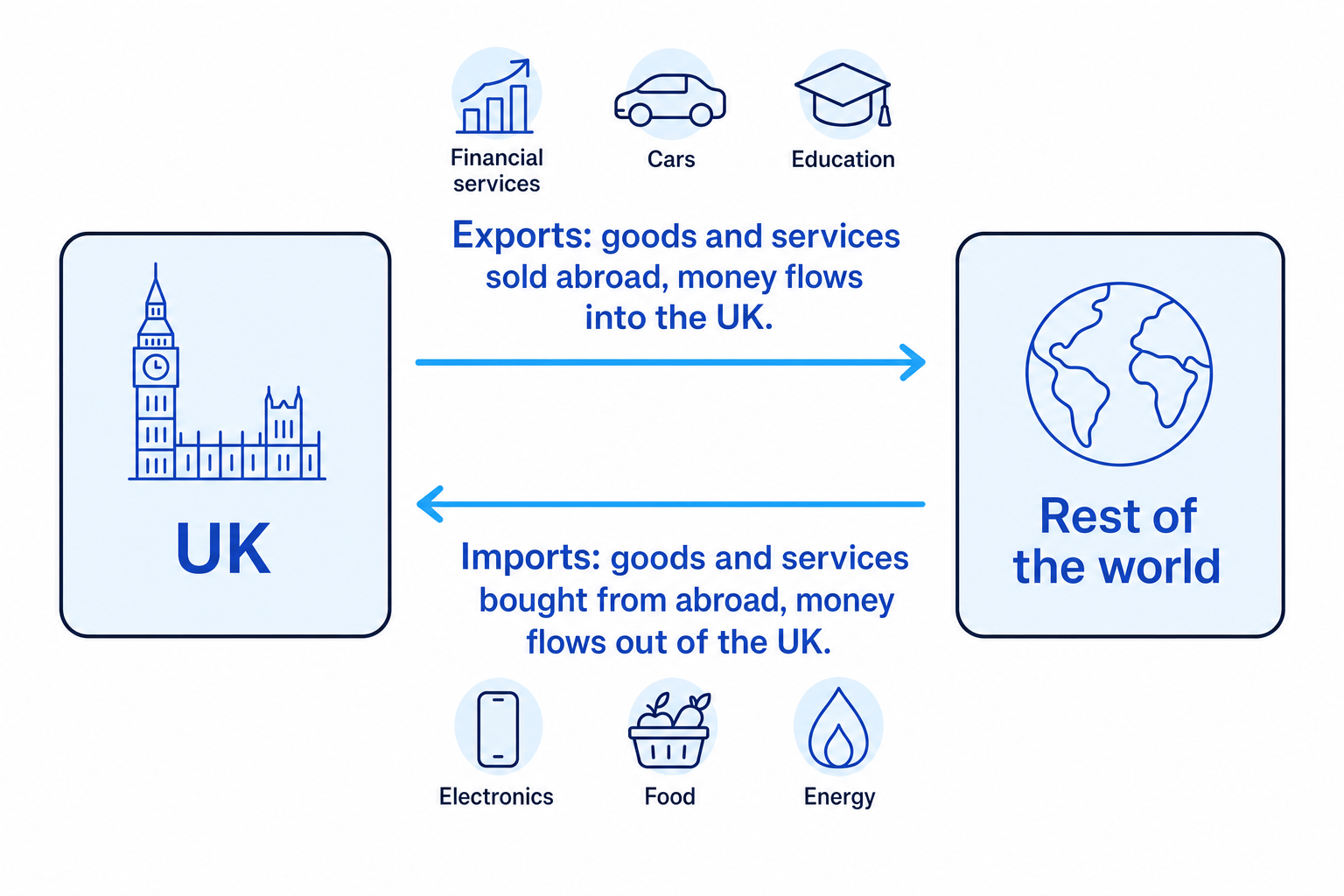
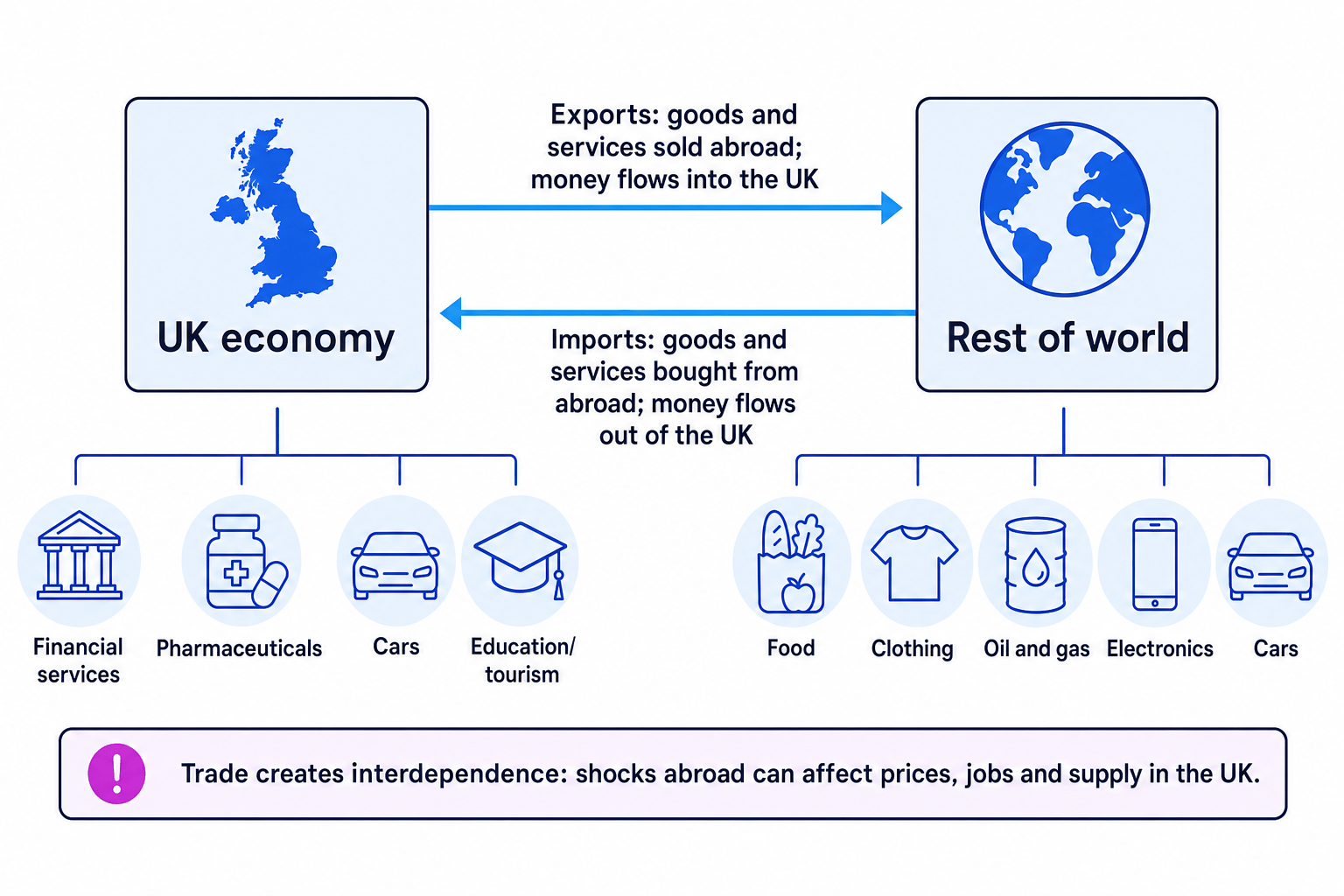
Exports are goods and services sold from the UK to other countries. Imports are goods and services bought by the UK from other countries.
Trade flows in two directions: products and services move one way, while money usually moves the other way.
Classifying UK trade flows
- A tourist from Canada pays £900 for a London hotel. The hotel service is produced in the UK and sold to someone from overseas, so it is a UK export and money flows into the UK.
- A family in Manchester buys a £500 phone assembled in Vietnam. The good is produced abroad and bought by a UK consumer, so it is a UK import and money flows out of the UK.
- A UK car factory buys a battery from Germany and sells the finished car to France. The battery is an import, while the finished car is an export; one final product can involve trade at several stages.
Why countries trade
Countries trade because they do not all have the same resources, climate, technology, skills or costs of production.
For example, the UK cannot grow cocoa beans on a large scale, so chocolate producers import cocoa. The UK is strong in services such as finance, insurance, higher education and business services, so it sells many of these to overseas customers.
Specialisation means focusing on producing particular goods or services. A country may specialise in areas where it is especially productive, then trade for other things it needs.
Why trade happens
International trade allows countries to access goods and services they cannot produce themselves, or cannot produce as cheaply or as well as other countries.
Trade can reduce costs
Trade gives firms access to bigger markets. A market is where buyers and sellers exchange goods or services. When a firm sells to more customers, including overseas customers, it may produce on a larger scale.
Economies of scale are cost advantages from producing on a larger scale, causing average cost per unit to fall. Average cost means total cost divided by output.
Lower average costs through bigger markets
- Before exporting, a UK firm has total costs of £1,000,000 and produces 10,000 bikes. Average cost is £1,000,000 divided by 10,000 bikes = £100 per bike.
- After gaining overseas orders, it produces 20,000 bikes and total costs rise to £1,600,000. Average cost is £1,600,000 divided by 20,000 bikes = £80 per bike.
- The average cost falls from £100 to £80 per bike. This may allow the firm to lower prices, increase profit, or compete more successfully against foreign rivals.
The importance of trade to economies
Trade matters because it affects output, jobs, prices, choice and living standards.
GDP, or gross domestic product, is the value of all goods and services produced in an economy over a period of time. Exports can increase demand for UK output, helping firms sell more, employ workers and pay taxes. Imports can give consumers more choice and give firms access to raw materials, components and technology.
Benefits for consumers
Consumers benefit when trade leads to:
- More choice: UK shoppers can buy French cheese, Japanese games consoles, South Korean phones and Spanish fruit.
- Lower prices: imported goods may be cheaper because they are produced where costs are lower.
- Better quality: competition from foreign firms can push UK firms to improve.
Benefits for producers
Producers benefit when trade gives them:
- Larger markets: UK firms can sell beyond the UK’s 67 million-plus population.
- Imported inputs: an imported input is a raw material, component or service bought from abroad and used in production.
- Access to ideas and technology: global competition can spread new methods and innovation.
Benefits for the wider economy
Trade can support economic growth, employment, profits and tax revenue. For example, if a UK pharmaceutical company sells medicines abroad, it may need scientists, factory workers, delivery firms and office staff in the UK.
But the benefits are not shared equally. Some UK firms may lose sales if they cannot compete with cheaper imports, and workers in affected industries may need retraining.
Exports are not only goods
The UK is especially strong in service exports. If an international student pays fees to study at a UK university, that is a UK education service sold to someone from overseas, so it counts as an export.
The UK’s main exports and imports
The UK trades both goods and services. Services are particularly important for the UK compared with many other countries.
| UK exports often include | UK imports often include |
|---|---|
| Financial services, insurance and business services | Manufactured goods such as electronics, clothing and furniture |
| Pharmaceuticals, chemicals and medical products | Food, including fruit, vegetables and processed foods |
| Cars, aircraft parts and machinery | Cars, car parts and other components |
| Education, tourism and creative services | Energy, including oil and gas |
| Legal, accounting and digital services | Travel services when UK residents spend money abroad |
The EU remains one of the UK’s major trading partners, so changes to trading arrangements after Brexit have mattered for many firms. Some businesses faced extra paperwork, customs checks or rules about where products are made. However, the UK also has more freedom to negotiate its own trade agreements with non-EU countries.
A quick trade data skill
A trade balance compares the value of exports with the value of imports. If exports are greater than imports, there is a trade surplus. If imports are greater than exports, there is a trade deficit.
Calculating a simple trade balance
- Use the rule: trade balance equals exports minus imports, because exports bring money into the country and imports involve money flowing out.
- Suppose the UK exports £860 billion of goods and services and imports £900 billion. The trade balance is £860 billion minus £900 billion = -£40 billion.
- The negative figure means a trade deficit of £40 billion, because imports are £40 billion larger than exports.
Reading trade figures
A trade deficit is not automatically “bad”, and a surplus is not automatically “good”. Ask what is being imported, what is being exported, and whether trade is supporting jobs, investment and living standards.
Global interdependence: the trade-off
Global interdependence
Global interdependence means countries rely on each other for goods, services, resources, finance and markets. This creates opportunities, but it also means shocks in one country can affect others.
Modern products often involve a global supply chain, meaning different stages of production happen in different countries. A UK car might use steel, microchips, software and batteries from several parts of the world.
This can make production cheaper and more efficient, but it also creates vulnerability. If one part of the chain is disrupted, the final product may be delayed or become more expensive.
Recent examples affecting the UK
- During COVID-19, factory closures and shipping delays disrupted global supply chains. Some UK firms struggled to get parts, especially microchips used in cars and electronics.
- In 2022–23, energy and food prices rose sharply after global supply pressures and Russia’s invasion of Ukraine. This contributed to the UK’s cost-of-living squeeze.
- A fall in the value of the pound can make imports more expensive. The exchange rate is the price of one currency in terms of another.
Energy-price shock spreading through trade
- The UK imports some energy and is also affected by global gas prices, so it is exposed to changes in world energy markets.
- When global gas prices rose sharply in 2022–23, UK households faced higher bills and many firms faced higher production costs.
- Higher costs fed into prices for transport, food, heating and manufactured goods. This is an example of imported cost pressure contributing to inflation.
- The overall effect depends on how dependent the UK is on imports, how quickly it can find alternative suppliers, and whether it invests in energy efficiency or domestic renewable energy.
Ethical and sustainability issues
International trade is not just about prices. There are moral, ethical and environmental questions too.
Consumers may enjoy cheaper clothing or electronics, but some products may be made in countries with lower wages, weaker labour rights or poorer safety standards. Firms must decide whether to choose the cheapest supplier or pay more for better working conditions.
Trade can also increase transport emissions, especially when goods travel long distances. On the other hand, trade can help poorer countries develop by creating jobs and incomes, and it can spread cleaner technology.
Trade is not automatically good or bad
A strong answer weighs both sides: trade can raise choice, lower prices and create jobs, but it can also expose the UK to global shocks, environmental costs and pressure on some domestic firms.
Overall judgement
For the UK, international trade is highly important because the UK is an open economy with strong service exports and a high reliance on imported goods, energy, food and components.
The best judgement is balanced: trade usually improves living standards and supports growth, but the UK gains more when it has diverse suppliers, competitive export industries, good worker training, and rules that protect ethical and environmental standards.
In the exam
- Start by defining the trade flow: exports are sold abroad; imports are bought from abroad. Then link the flow to jobs, prices, choice or costs.
- Apply your answer to the UK: services such as financial and business services are major exports, while the UK imports many manufactured goods, food, energy and components.
- For evaluation, weigh gains from trade against interdependence risks, then give a judgement such as: trade is beneficial overall if supply chains are diverse and workers can adapt.
Check yourself
- Why is an overseas student paying fees to a UK university counted as a UK export?
- Give two advantages of international trade for UK consumers or firms.
- Explain one way a shock in another country could raise prices in the UK.