

What you'll learn
- What an exchange rate is and how to convert between currencies.
- How demand for and supply of the pound determine its value.
- What appreciation and depreciation mean.
- How exchange-rate changes affect UK consumers and producers.
3.2.4.2 How exchange rates are determined and why changes matter
Currency: the starting point
A currency is the money used in a country or area. The UK uses pound sterling, usually written as £. The eurozone uses the euro, and the USA uses the dollar.
When people trade, travel, invest or buy things from abroad, they often need to swap one currency for another.
Exchange rate
An exchange rate is the price of one currency in terms of another currency. For example, an exchange rate of €1.20 per £1 means £1 can buy €1.20.
If the exchange rate is €1.20 per £1, a UK tourist with £100 could exchange it for €120, before any fees.
Converting pounds into euros
A student has £250 for a trip to Spain. The exchange rate is €1.15 per £1.
-
Multiply the number of pounds by the euro value of each pound:
£250×€1.15=€287.50\text{£}250 \times \text{€}1.15 = \text{€}287.50£250×€1.15=€287.50 -
Interpret the answer with units: £250 buys €287.50.
-
If a bank charges a fee, the student would receive less than €287.50, so the market exchange rate is not always the exact rate a consumer gets.
The foreign exchange market
The foreign exchange market is the market where currencies are bought and sold.
For GCSE Economics, think of the pound like any other product in a market: it has demand and supply.
- Demand for pounds comes from people, firms or investors who want to buy £.
- Supply of pounds comes from people, firms or investors who want to sell £ to buy another currency.
For example, if a French supermarket wants to buy British cheese, it may need pounds to pay the UK producer. This creates demand for pounds. If a UK family buys a holiday in Greece, they supply pounds to buy euros.
Exchange rates are set by demand and supply
In a floating exchange-rate system, the value of the pound is determined where demand for pounds equals supply of pounds.
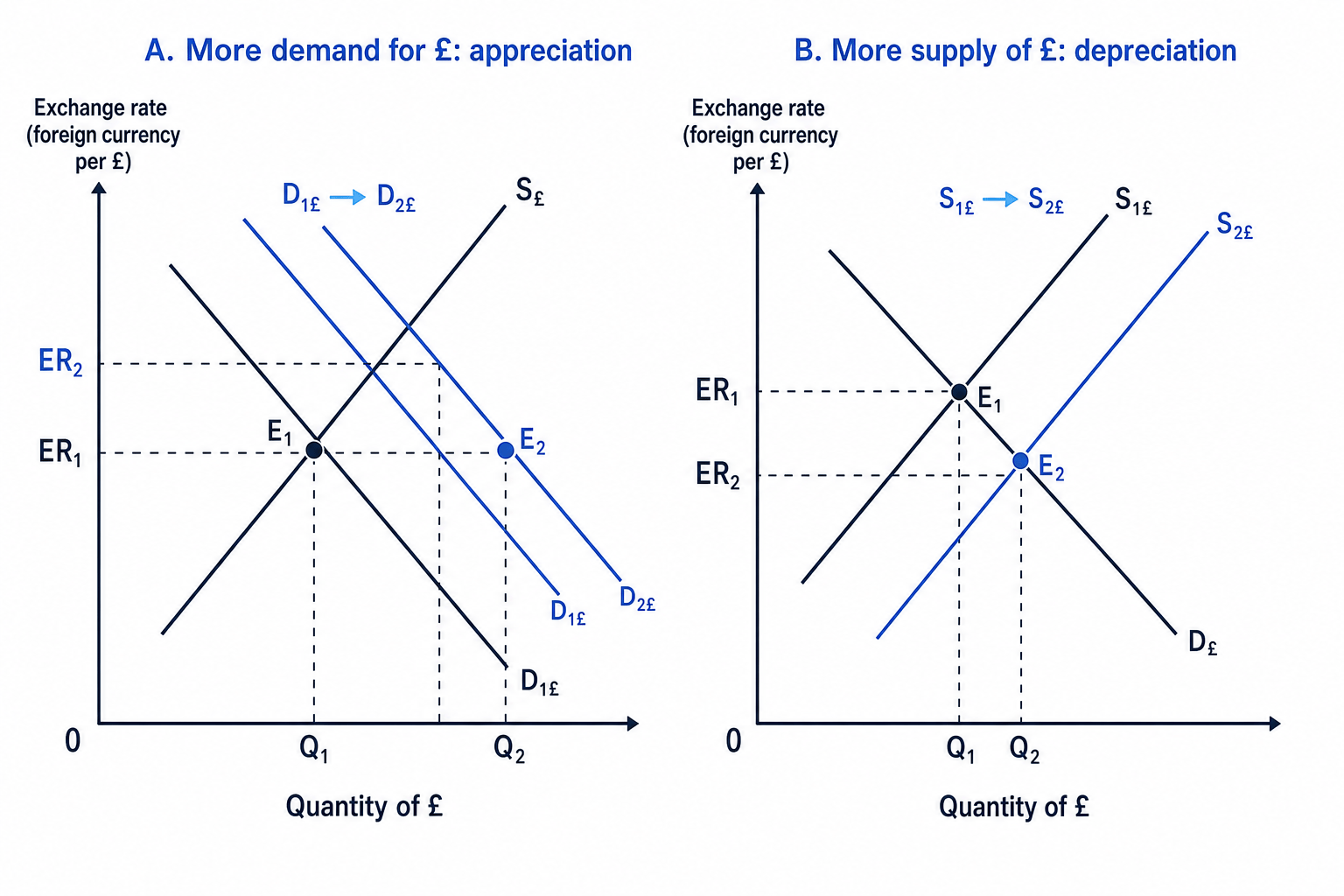
You can show this using a supply and demand diagram for the pound. The vertical axis shows the exchange rate, such as “foreign currency per £”. A higher point on the axis means each pound buys more foreign currency.
What increases demand for pounds?
Demand for pounds may rise when:
- foreigners buy more UK exports, such as UK services, medicines or manufactured goods
- foreign tourists visit the UK and need pounds to spend here
- overseas investors want to save or invest in the UK
- confidence in the UK economy rises
If demand for pounds increases, the demand curve shifts right. The exchange rate rises, so the pound appreciates.
What increases supply of pounds?
Supply of pounds may rise when:
- UK consumers buy more imports, such as imported food, fuel or electronics
- UK tourists go abroad and exchange pounds for foreign currency
- UK firms invest overseas
- investors lose confidence in the UK and sell pounds
If supply of pounds increases, the supply curve shifts right. The exchange rate falls, so the pound depreciates.
Appreciation and depreciation
An appreciation means a currency rises in value. A depreciation means a currency falls in value.
Explaining a demand shift for pounds
Suppose overseas investors expect UK interest rates to rise, so saving in UK banks becomes more attractive.
-
Identify who needs pounds: overseas investors must buy pounds before placing money in UK savings accounts or investments.
-
Decide which curve changes: demand for pounds increases, so the demand curve shifts to the right.
-
Find the effect on the exchange rate: the new equilibrium is at a higher exchange rate, so the pound appreciates.
-
Apply the result: UK consumers may find imports cheaper, but UK exporters may find it harder to sell abroad.
Measuring an exchange-rate change
Exchange-rate changes are often described using percentages.
Calculating an appreciation
The pound rises from €1.10 per £1 to €1.21 per £1.
-
Calculate the change in the exchange rate:
€1.21−€1.10=€0.11\text{€}1.21 - \text{€}1.10 = \text{€}0.11€1.21−€1.10=€0.11 -
Divide by the original exchange rate and multiply by 100:
0.111.10×100=10%\frac{0.11}{1.10} \times 100 = 10\%1.100.11×100=10% -
Interpret the direction: the exchange rate has risen, so the pound has appreciated by 10%.
Mixing up the direction
If the exchange rate is written as “foreign currency per £”, a rise means the pound is stronger. But if the rate is written the other way round, such as “£ per euro”, the interpretation is reversed. Always check what one unit of currency buys.
Effects on consumers
A consumer is a person or household that buys goods and services.
When the pound appreciates, UK consumers can usually buy foreign goods more cheaply. Imports such as food, fuel, clothing, phones and cars may become cheaper. Foreign holidays may also become cheaper because each pound buys more foreign currency.
When the pound depreciates, the opposite happens. Imports become more expensive, so consumers may face higher prices. This can contribute to the cost of living, especially if imported energy or food prices rise.
SPICED and WPIDEC
SPICED: Strong Pound, Imports Cheaper, Exports Dearer. WPIDEC: Weak Pound, Imports Dearer, Exports Cheaper.
A depreciation raising the price of an imported phone
A phone imported from Europe costs €600. The exchange rate falls from €1.20 per £1 to €1.00 per £1.
-
Calculate the old UK price:
€600÷1.20=£500\text{€}600 \div 1.20 = \text{£}500€600÷1.20=£500 -
Calculate the new UK price:
€600÷1.00=£600\text{€}600 \div 1.00 = \text{£}600€600÷1.00=£600 -
Compare the prices: the UK price rises by £100, so the depreciation makes the imported phone more expensive for UK consumers.
There is also an ethical issue here. A weaker pound does not affect everyone equally. Higher prices for imported food, fuel or medicines can hit lower-income households hardest because essentials take up a larger share of their spending.
Effects on producers
A producer is a firm that makes or sells goods and services.
Exchange-rate changes affect producers in two main ways:
- Export prices: UK exports become cheaper or more expensive for foreign buyers.
- Imported costs: imported raw materials, components or energy become cheaper or more expensive for UK firms.
If the pound appreciates, UK exports become more expensive to foreign customers. This can reduce demand for exports and make life harder for firms selling abroad. However, imported materials become cheaper, which can reduce costs for firms that rely on imports.
If the pound depreciates, UK exports become cheaper for foreign customers. This may help exporters such as UK tourism, universities or manufacturers. However, imported inputs become more expensive, which can reduce profit for firms that depend on foreign raw materials or components.
A depreciation increasing a producer’s costs
A UK chocolate producer imports cocoa costing €10,000. Its other costs are £12,000 and its revenue is £25,000. The exchange rate falls from €1.25 per £1 to €1.00 per £1.
-
Convert the cocoa cost before the depreciation:
€10,000÷1.25=£8,000\text{€}10{,}000 \div 1.25 = \text{£}8{,}000€10,000÷1.25=£8,000 -
Convert the cocoa cost after the depreciation:
€10,000÷1.00=£10,000\text{€}10{,}000 \div 1.00 = \text{£}10{,}000€10,000÷1.00=£10,000 -
Compare profit before and after:
Old profit=£25,000−(£12,000+£8,000)=£5,000New profit=£25,000−(£12,000+£10,000)=£3,000\begin{aligned} \text{Old profit} &= \text{£}25{,}000 - \left(\text{£}12{,}000 + \text{£}8{,}000\right) = \text{£}5{,}000 \\ \text{New profit} &= \text{£}25{,}000 - \left(\text{£}12{,}000 + \text{£}10{,}000\right) = \text{£}3{,}000 \end{aligned}Old profitNew profit=£25,000−(£12,000+£8,000)=£5,000=£25,000−(£12,000+£10,000)=£3,000 -
Interpret the result: the weaker pound raises import costs and reduces profit by £2,000, unless the firm raises prices or cuts other costs.
Prices may not change immediately
Exchange-rate changes do not always pass through to prices straight away. Firms may have fixed contracts, existing stock, or may choose to absorb cost changes in their profit margins.
Real-world context: the pound in recent years
After the 2016 Brexit referendum, the pound fell sharply against several currencies. That made some UK exports more price competitive, but it also raised the cost of imported goods and materials.
During the 2022–23 cost-of-living squeeze, imported energy and food prices were a major concern. A weaker pound can worsen this because oil, gas and many food inputs are traded internationally.
Higher Bank of England interest rates can sometimes increase demand for pounds because investors may want to earn better returns in the UK. However, exchange rates are affected by many factors at once, including inflation, confidence, trade flows and global events.
Saying a strong pound is always good
A strong pound benefits consumers buying imports and firms using imported inputs, but it can hurt exporters. A weak pound may help exporters but can raise living costs. Always analyse winners and losers.
In the exam
-
Start with the correct chain of reasoning: change in demand or supply for pounds → new exchange rate → appreciation or depreciation → effect on consumers or producers.
-
Use precise language: say whether imports or exports become cheaper or dearer, and for whom.
-
Evaluate by considering both sides: exporters versus importers, consumers versus producers, and short-term effects versus longer-term adjustment.
Check yourself
- If UK consumers buy more imports, what happens to the supply of pounds and the exchange rate?
- Why might a depreciation help a UK exporter but hurt a UK supermarket?
- Explain one reason why a stronger pound might reduce inflationary pressure in the UK.
