Policies to correct positive and negative externalities
What you'll learn
- What positive and negative externalities are, and why they can cause market failure.
- How government policies such as taxes, subsidies, regulation and information campaigns influence behaviour.
- How to use simple supply and demand reasoning to explain tax and subsidy effects.
- How to evaluate policies using costs, benefits, fairness, sustainability and real UK examples.
3.2.3.4 Externalities: policies to correct them
Start with the basic idea: spillovers
An externality happens when the production or consumption of a good affects a third party who is not directly involved in buying or selling it.
A third party means someone outside the main market transaction. For example, if a factory sells goods to consumers, local residents breathing polluted air are third parties.
Externality
An externality is an external cost or external benefit affecting third parties outside a market transaction.
Externalities matter because consumers and producers often make decisions based on their private costs and private benefits only.
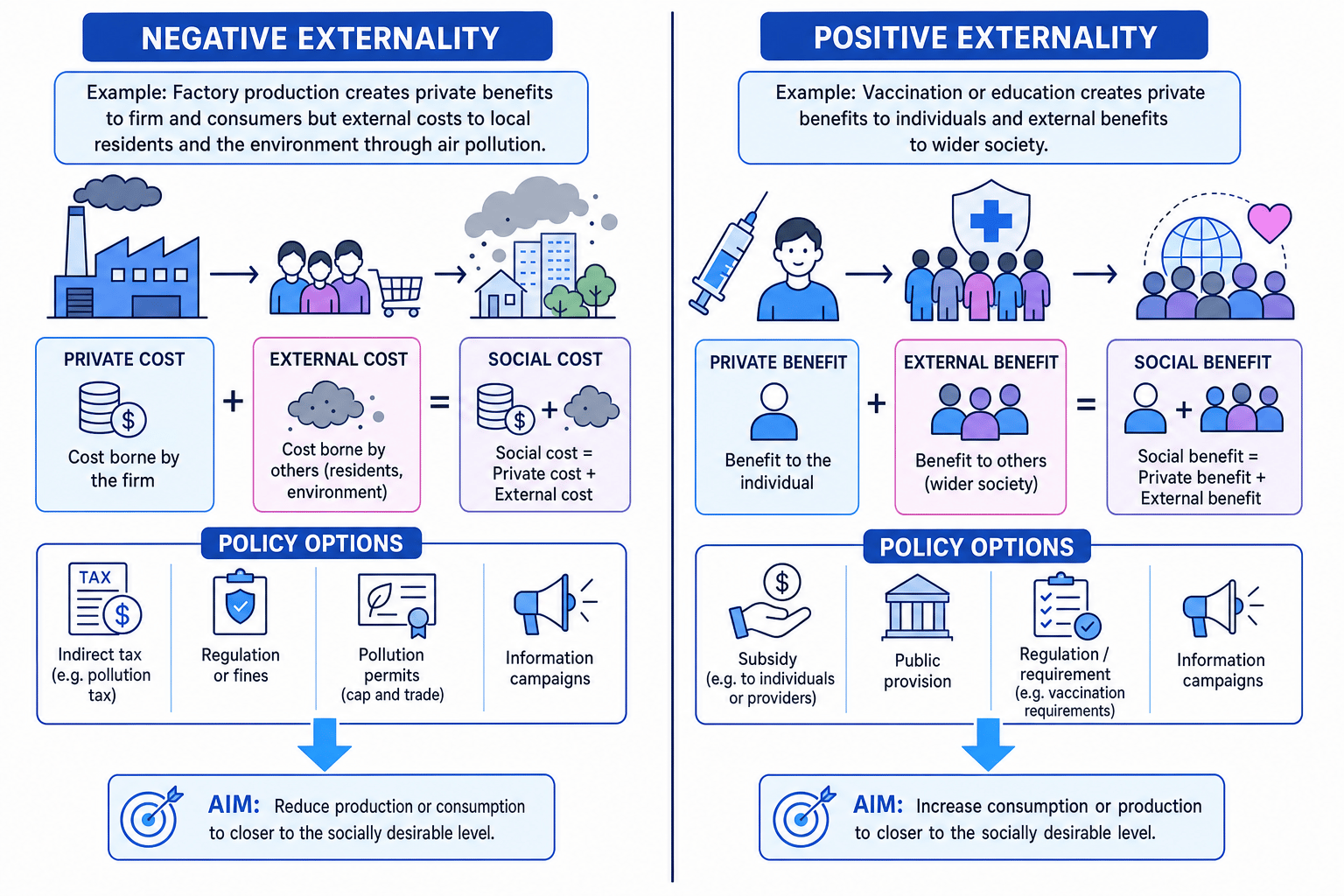
- A private cost is a cost paid by the consumer or producer directly involved.
- A private benefit is a benefit received by the consumer or producer directly involved.
- An external cost is a cost suffered by third parties.
- An external benefit is a benefit gained by third parties.
- A social cost is the total cost to society: private cost plus external cost.
- A social benefit is the total benefit to society: private benefit plus external benefit.
Negative externalities
A negative externality is an external cost. This means the activity creates harm for people not directly involved in the transaction.
Examples include:
- Air pollution from petrol and diesel vehicles.
- Noise and congestion from heavy traffic.
- Health costs linked to smoking, excessive alcohol or high-sugar diets.
- Carbon emissions from energy production, contributing to climate change.
If consumers and producers do not pay the full social cost, the good may be over-produced or over-consumed.
Classifying a negative externality
A factory produces cheap furniture but releases pollution into a nearby town.
- The private benefit is that the firm earns revenue and consumers buy cheaper furniture.
- The external cost is that local residents may suffer poorer air quality and health problems.
- Because the market price may not include the pollution cost, output may be higher than the socially desirable level.
Positive externalities
A positive externality is an external benefit. This means the activity creates benefits for people not directly involved in the transaction.
Examples include:
- Vaccination reducing the spread of disease to others.
- Education improving productivity, tax revenues and civic participation.
- Public transport reducing congestion and pollution if it replaces car journeys.
- Home insulation reducing energy use and carbon emissions.
If consumers or producers do not receive all the benefits, the good may be under-produced or under-consumed.
The market misses spillovers
Negative externalities are often linked to too much of an activity. Positive externalities are often linked to too little of an activity.
Why government intervenes
Market failure occurs when the free market leads to an inefficient outcome for society. Externalities are one cause of market failure because the market price may not reflect the full social costs or benefits.
The government can try to correct externalities by changing incentives. An incentive is something that encourages people or firms to behave in a certain way.
The aim is not always to remove the activity completely. Often, the aim is to move production or consumption closer to the socially desirable level, where society’s overall costs and benefits are better balanced.
Policies to reduce negative externalities
Indirect taxes
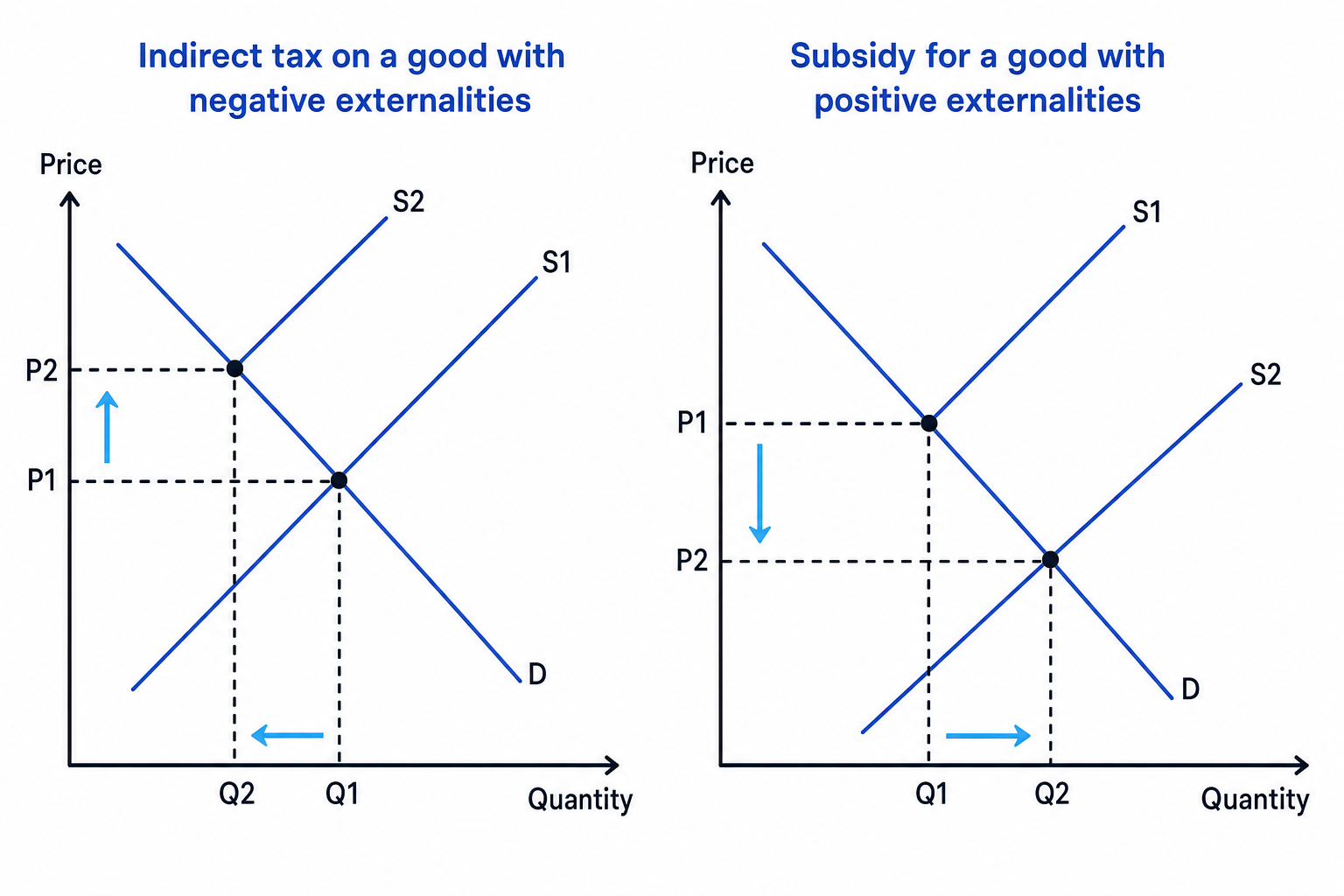
An indirect tax is a tax placed on spending. It increases firms’ costs, so supply usually shifts left/up. This tends to raise price and reduce quantity.
Examples include:
- Fuel duty on petrol and diesel.
- Tobacco and alcohol duties.
- The UK Soft Drinks Industry Levy, introduced in 2018, which encouraged many producers to reduce sugar content.
- Carbon pricing, such as the UK Emissions Trading Scheme, which puts a cost on greenhouse gas emissions.
Calculating revenue from an environmental tax
A government adds a tax of £0.20 per bottle on a sugary drink. The price rises from £1.00 to £1.20, and sales fall from 10,000 bottles to 8,000 bottles.
- The tax increases the producer’s cost by £0.20 per bottle, so if it is fully passed on, the consumer price becomes £1.20.
- Tax revenue is £0.20 per bottle × 8,000 bottles = £1,600.
- The policy may reduce sugar consumption and raise revenue, but if demand is price inelastic, the fall in quantity may be small.
Regulation, bans and fines
Regulation means rules set by the government. Firms or consumers may be legally required to act in a certain way.
Examples include:
- Emissions standards for vehicles.
- Fines for dumping waste illegally.
- Restrictions on where polluting vehicles can drive, such as London’s Ultra Low Emission Zone expansion in 2023.
- Rules on recycling, packaging or factory waste.
Regulation can be effective because it directly limits harmful behaviour. However, it can be expensive to monitor and enforce. It may also increase firms’ costs, which could lead to higher prices for consumers.
Pollution permits
A pollution permit gives a firm permission to emit a certain amount of pollution. Under a cap-and-trade system, the government sets an overall pollution limit and firms can buy or sell permits.
This creates a financial incentive to reduce pollution. If a firm cuts emissions, it may need fewer permits or may sell spare permits to another firm.
A real-world example is the UK Emissions Trading Scheme, launched in 2021 after Brexit.
Information campaigns
An information campaign gives consumers or firms more knowledge so they can make better decisions.
Examples include:
- Public health campaigns about smoking, alcohol or healthy eating.
- Recycling information.
- Energy-efficiency labels on appliances.
- Campaigns encouraging walking, cycling or public transport.
Information campaigns are usually cheaper than subsidies, but they may have a weaker effect if habits are strong or if people lack affordable alternatives.
Assuming one policy fixes everything
A tax may reduce a negative externality, but it can also be unfair if poorer households spend a higher share of their income on the taxed good. Good evaluation weighs both effects.
Policies to encourage positive externalities
Subsidies
A subsidy is a payment from the government to producers or consumers to encourage production or consumption. It lowers costs, so supply usually shifts right/down. This tends to lower price and increase quantity.
Subsidies can encourage goods with external benefits, such as:
- Public transport.
- Training and apprenticeships.
- Low-carbon heating or insulation.
- Vaccinations and preventative healthcare.
The main drawback is the opportunity cost. Money spent on subsidies cannot be spent elsewhere, such as hospitals, schools or debt interest.
Public provision
Public provision means the government provides a good or service directly, often free or at a reduced price at the point of use.
Examples include:
- NHS vaccinations.
- State education.
- Public libraries.
- Some local bus services.
Public provision can increase access, especially for low-income households. This matters ethically because positive externalities often link to fairness: society may benefit when everyone can access education, healthcare or clean transport, not only those who can afford it.
Regulation or requirements
Sometimes the government uses rules to increase beneficial behaviour. For example, young people in England must stay in education or training until 18. This supports skills, employment prospects and wider productivity.
Regulation can work well when the government believes the social benefit is very large. However, it may reduce individual choice, so there is a moral trade-off between personal freedom and wider social benefits.
Information campaigns for positive externalities
Information can also encourage positive externalities. For example, NHS reminders and public health messages can encourage vaccination uptake.
This is especially useful when people underestimate the wider benefits of their choices. During COVID-19, vaccination and testing had external benefits because they helped reduce transmission risks to others.
Choosing a policy for vaccination
A government wants to increase flu vaccination because it protects individuals and reduces the spread of illness to vulnerable people.
- The external benefit is lower transmission to others, so the market may provide too few vaccinations if people only consider their private benefit.
- A subsidy or free public provision can reduce the price barrier, increasing uptake among low-income groups.
- An information campaign can support the policy by explaining the wider benefit, but on its own it may be less effective if cost or access is the main barrier.
Evaluating government policies
In longer answers, you should not just describe a policy. You should judge how well it works.
Effectiveness depends on responsiveness
Price elasticity of demand means how responsive quantity demanded is to a change in price.
If demand is price inelastic, a tax may raise price but reduce quantity only slightly. This is likely for addictive goods, such as cigarettes. That does not make the tax useless, but it may mean the government needs a policy mix: tax, regulation, information and support to quit.
Winners and losers
Policies create trade-offs.
- Consumers may face higher prices after taxes or regulation.
- Firms may face higher costs and lower profits.
- Workers may be affected if firms reduce output.
- Third parties may benefit from cleaner air, less congestion or better health.
- The government may gain tax revenue, but subsidies and public provision cost money.
Moral, ethical and sustainability considerations
Externality policies often involve ethical choices. For example, expanding ULEZ may improve air quality and health, but it can be costly for drivers and small businesses with older vehicles. Grants or phased deadlines can make the policy fairer.
Sustainability is also important. Policies that reduce carbon emissions may impose costs now but protect future generations from worse climate impacts.
A strong evaluation chain
Use this structure: identify the externality, explain the policy incentive, show the likely effect on price or quantity, then evaluate using fairness, cost, enforcement and long-term impact.
Bringing it together
For negative externalities, the government usually tries to make harmful activities more expensive, less convenient or illegal. For positive externalities, it usually tries to make beneficial activities cheaper, easier or more widely available.
The best policy is often a combination. For example, to reduce car pollution, the government might use fuel duty, clean-air zones, public transport investment, EV charging infrastructure and information campaigns.
In the exam
- Name the externality clearly: say whether it is a positive or negative externality and identify the third party affected.
- Link the policy to incentives: explain how it changes costs, benefits, price, quantity or behaviour.
- Evaluate with a judgement: consider effectiveness, fairness, government cost, enforcement and sustainability before deciding how successful the policy is likely to be.
Check yourself
- Why might a sugary drinks tax reduce a negative externality?
- How can a subsidy help correct a positive externality?
- Why might a policy be effective but still considered unfair?