What you'll learn
- What economists mean by money — and why it is more than banknotes and coins.
- The four key functions of money: medium of exchange, unit of account, store of value and means of deferred payment.
- How to apply these functions to real-life UK examples like contactless payments, savings, phone contracts and buy-now-pay-later.
- Common exam traps, especially confusing money with the payment method used to move it.
3.2.5.1 Functions and definition of money
Starting point: why money exists
Before money, people could use barter, which means swapping one good or service directly for another. For example, a baker might swap bread for a haircut.
The problem is that barter needs a double coincidence of wants: each person must want exactly what the other person is offering, at the same time. That is very inconvenient in a modern economy with millions of goods and services.
Money solves this by acting as something everyone is willing to accept in exchange.
Money
Money is anything that is generally accepted as payment for goods and services, and for settling debts.
“Generally accepted” is important. Something only accepted in one shop, or by one small group of people, is not usually money in the full economic sense.
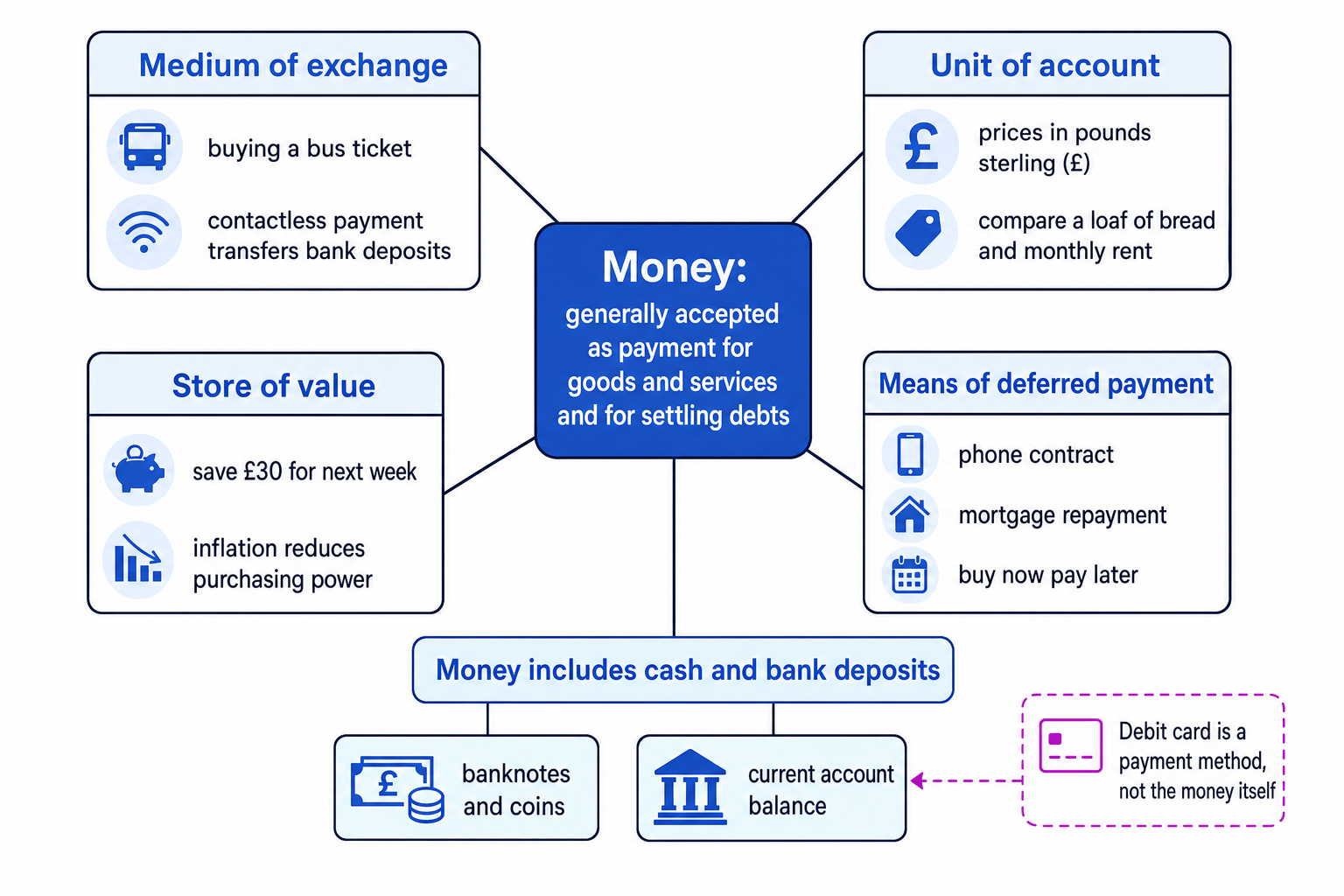
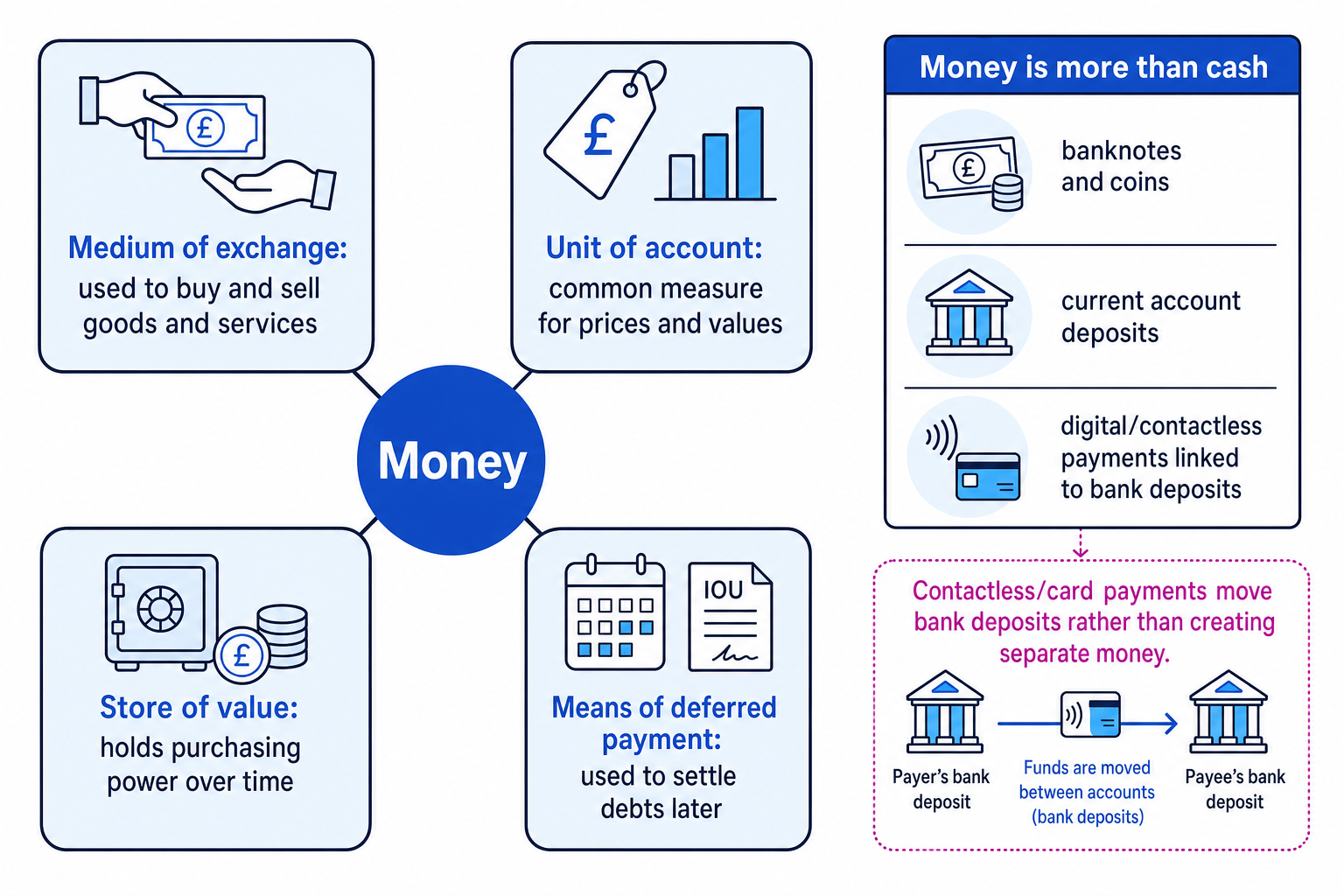
The diagram below summarises the four functions of money and the idea that modern money includes more than cash.
The big idea
Money makes exchange easier because it gives people a trusted, widely accepted way to buy, sell, save, compare prices and pay debts.
The four functions of money
1. Money as a medium of exchange
A medium of exchange is something used to buy and sell goods and services.
When you buy a Greggs sausage roll, pay for a bus ticket, or tap your card in Tesco, money is helping the exchange happen. The seller does not need to want anything you personally produce — they accept money because they know they can use it elsewhere.
This is what makes a large, specialised economy possible. People can focus on one job, earn income, and use that income to buy the things they need.
2. Money as a unit of account
A unit of account is a common measure used to state prices and values.
In the UK, prices are usually measured in pounds sterling (£). This lets you compare very different things using the same unit: a £2 loaf of bread, a £9 cinema ticket, a £25 phone contract, or a £1,200 monthly rent.
Businesses also use money as a unit of account when recording revenue, costs and profit. Without a common unit, it would be much harder to compare options or keep financial records.
3. Money as a store of value
A store of value means money can be kept and used later.
If you receive £30 for a birthday and save it for next month, the money is storing value between now and then. This is much more useful than being paid in something perishable, such as fresh fruit, which might go off before you can use it.
However, money is not a perfect store of value. If prices rise, the same amount of money buys less than before. This became very clear during the UK cost-of-living squeeze in 2022–23, when food, energy and other prices rose sharply.
How inflation weakens the store of value
- Suppose you save £100 in cash to buy a basket of goods that currently costs £100.
- If prices rise by 10%, that same basket now costs £110.
- Your £100 is still money, but it no longer buys the full basket. So money has stored value, but its purchasing power has fallen.
Purchasing power
Purchasing power means how much you can buy with a given amount of money.
Store of value does not mean value never changes
Money can store value over time, but inflation can reduce what it can buy. So do not write that money “keeps its value perfectly”.
4. Money as a means of deferred payment
A means of deferred payment means money can be used to settle debts or payments at a future date. Deferred means delayed until later.
This matters for borrowing and credit. For example, if you take out a phone contract, the monthly payment is stated in pounds and paid later. If someone has a mortgage, the amount borrowed and the repayments are also measured and paid in money.
Buy-now-pay-later services are another modern example. They allow consumers to receive goods now and pay in future instalments. This can be convenient, but it can also encourage people to spend more than they can afford.
Identifying the function of money
A student sees a pair of trainers priced at £60, pays with a debit card, keeps £20 in their bank account for next week, and has a phone bill due at the end of the month.
- The £60 price tag shows money as a unit of account because it measures the value of the trainers in pounds.
- Paying by debit card shows money as a medium of exchange because it allows the trainers to be bought and sold.
- Keeping £20 for next week shows money as a store of value because it transfers spending power into the future.
- The phone bill due at the end of the month shows money as a means of deferred payment because it settles a payment later.
Quick memory aid
Use MUDS: Medium of exchange, Unit of account, Deferred payment, Store of value.
Money is more than banknotes and coins
When people hear “money”, they often think of cash: physical banknotes and coins. Cash is money, but it is not the whole story.
In a modern UK economy, much money exists as bank deposits. A bank deposit is money recorded in a bank account, such as the balance in a current account. You can use it to make payments by debit card, bank transfer, standing order, direct debit or contactless payment.
During and after COVID-19, many UK consumers used less cash and more contactless and online payments. That did not mean money disappeared — it meant people were increasingly moving bank deposits electronically.
Bank deposit
A bank deposit is money held in a bank account that can be used to make payments or be withdrawn as cash.
A debit card is not itself money. It is a tool that gives instructions to move money from one bank account to another.
Do not call the card the money
If you tap a debit card in a shop, the card is the payment method. The money is the bank deposit being transferred from your account to the seller’s account.
What counts as money?
To decide whether something is money, ask whether it is widely accepted for payments and debts.
Deciding whether something counts as money
- A £10 note counts as money because shops generally accept it as payment for goods and services.
- £250 in a current account also counts as money because it can be used through card payments, bank transfers or cash withdrawals.
- A Tesco Clubcard voucher is not usually money in the full economic sense because it is only accepted in limited places and under certain conditions.
- A cryptocurrency may be valuable to some people, but if most UK shops and lenders do not accept it for everyday payments and debts, it does not perform the functions of money reliably.
Why this matters in the real economy
Money is not just an abstract idea. It affects everyday decisions.
For consumers, money makes it easier to compare prices, save for future spending, and use credit. But the rise of digital payments also raises ethical questions. Some people — including some elderly, rural or low-income consumers — may rely more heavily on cash. If shops, banks or public services move too quickly away from cash, those consumers can be excluded.
For businesses, money makes trading faster and record-keeping easier. A supermarket can price thousands of products in pounds, receive card payments quickly, and compare costs and revenues.
For the wider economy, trust in money is essential. If people stop believing that money will be accepted, or if inflation becomes very high, money becomes less useful as a store of value and unit of account.
Modern money depends on trust
Money works because people trust that others will accept it and that it will keep enough value to be useful in future transactions.
Bringing the functions together
The four functions overlap in real life.
For example, imagine you buy a £4 meal deal using contactless payment:
- The £4 price shows money as a unit of account.
- The payment transfers bank deposits, so money acts as a medium of exchange.
- If the shop lets you pay later through an app or account, money becomes a means of deferred payment.
- If you saved that £4 from last week, money was also a store of value.
So in exam answers, do not treat the functions as completely separate worlds. A single situation can show more than one function of money.
In the exam
- If asked to define money, include the phrase generally accepted as payment and mention that it can settle debts.
- If asked about the functions of money, name the function and link it directly to the context: price tag, payment, saving, or future debt.
- Remember that money is more than cash: bank deposits used through debit cards, transfers and contactless payments also count.
Check yourself
- Why would barter make trade difficult in a modern economy?
- Which function of money is shown by a £30 monthly phone contract payment due next month?
- Why is a debit card not itself money, even though it is used to pay?