What you'll learn
- What globalisation means and the main features of a global economy.
- Why globalisation has grown, especially because of new technology and multinational companies.
- How globalisation affects producers, workers and consumers in the UK and in less developed countries.
- How to weigh up the moral, ethical and sustainability issues when UK firms trade globally.
3.2.4.4 The big idea: what is globalisation?
Before globalisation, remember the basic idea of international trade: countries buy and sell goods and services with each other. An import is bought from another country; an export is sold to another country.
Globalisation goes further than ordinary trade. It means economies are becoming more connected, so decisions in one country can quickly affect firms, workers and consumers in another.
Globalisation
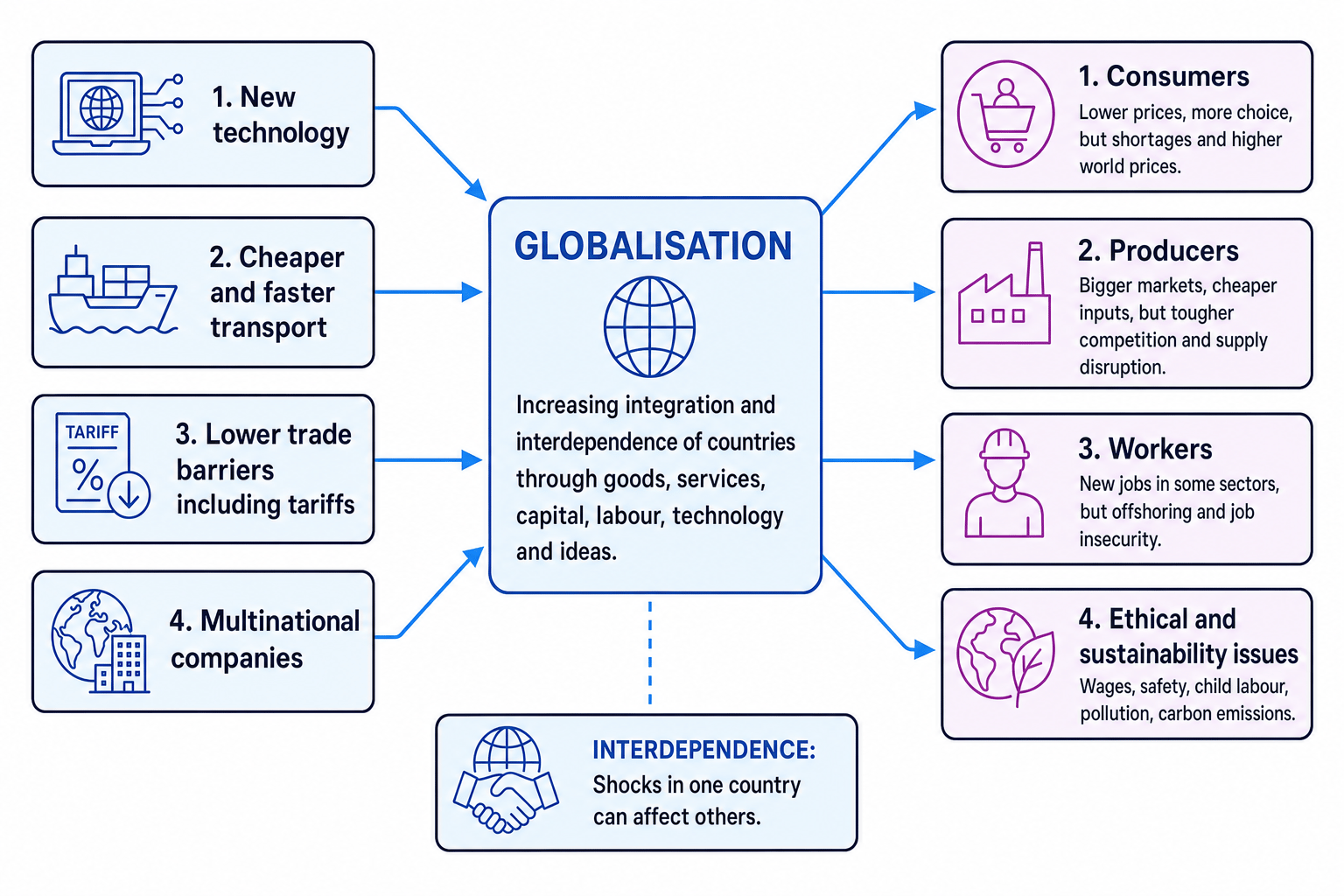
Globalisation is the increasing integration and interdependence of countries through the movement of goods, services, capital, labour, technology and ideas across borders.
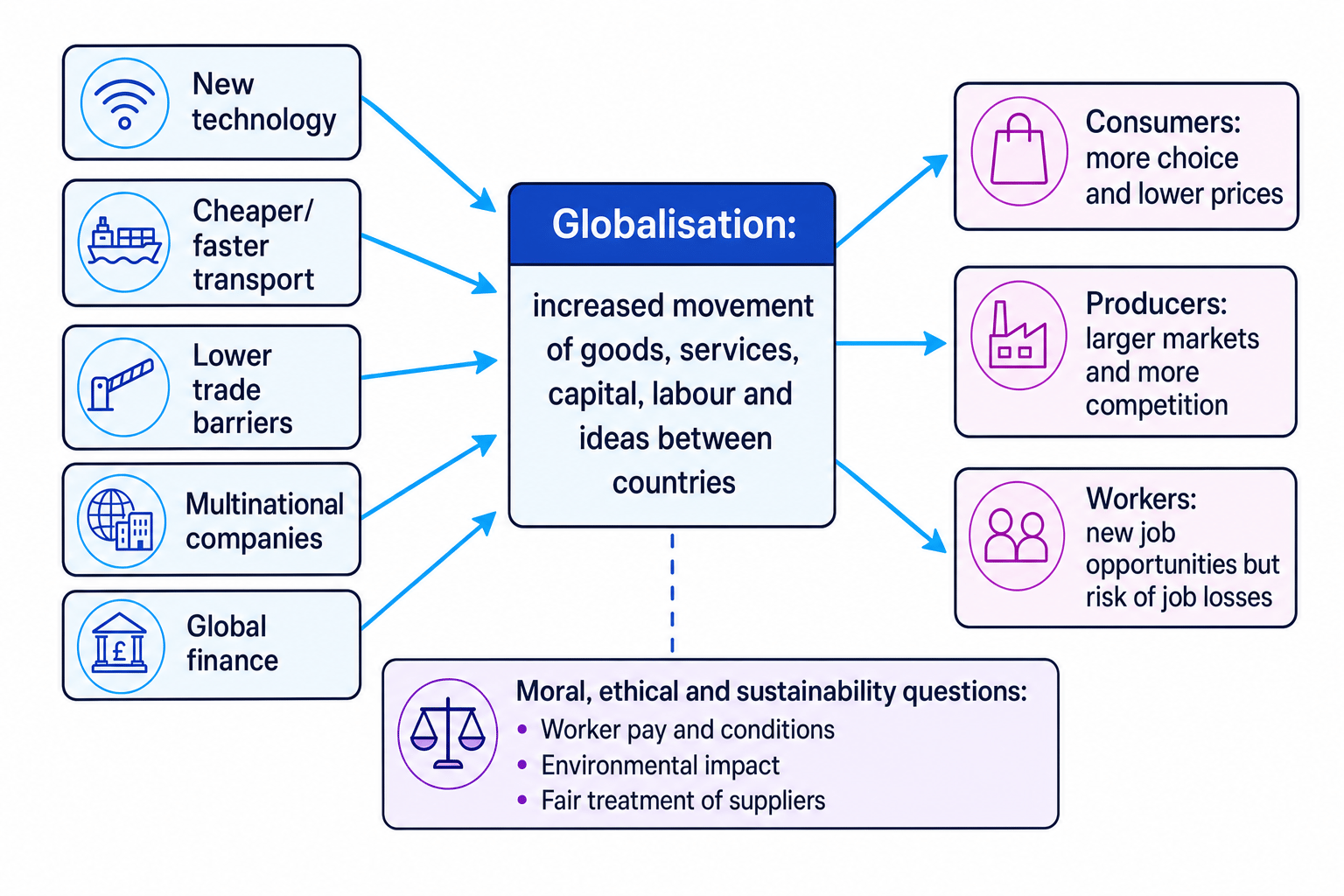
The diagram summarises the main causes of globalisation and the groups affected by it.
The key trade-off
Globalisation can create lower prices, more choice and bigger markets, but it can also create job insecurity, dependence on global supply chains and ethical concerns.
Main features of globalisation
More trade in goods and services
Countries now buy and sell far more with each other than in the past. For example, UK consumers might buy phones assembled in China, clothes made in Bangladesh, fruit from Spain, and streaming services from US companies.
Global supply chains
A supply chain is the network of activities needed to produce and deliver a product. In a global supply chain, different stages happen in different countries.
For example, a UK clothing brand might design a coat in London, buy fabric from Turkey, use a factory in Vietnam, ship the finished coat through European ports, and sell it online to UK consumers.
More movement of capital and firms
Capital means man-made resources used in production, such as machinery, factories and equipment. In this topic, capital can also mean money invested into businesses.
A company may invest in another country by building a factory, opening offices or buying equipment there. This is one way globalisation spreads jobs, technology and business methods.
More interdependence
Interdependence means countries rely on each other. This can be helpful when trade is smooth, but risky when there are shocks.
During COVID-19 and its aftermath, global shipping delays and shortages of items such as microchips affected UK firms and consumers. The 2022–23 energy-price shock also showed how world markets can feed into UK inflation and the cost-of-living squeeze.
Why globalisation has grown
New technology
Technology has made globalisation faster and cheaper.
- The internet allows firms to advertise, sell and communicate globally.
- Online banking and digital payments make cross-border trade easier.
- Video calls and cloud software help firms manage overseas suppliers.
- Tracking systems make it easier to monitor containers and deliveries.
A small UK business can now sell through an online marketplace to customers abroad in a way that would have been much harder 30 years ago.
Cheaper and faster transport
Container ships, air freight and improved logistics have lowered the cost of moving goods around the world. This makes it more profitable for firms to produce in one country and sell in another.
Lower trade barriers
A trade barrier is something that restricts international trade. A tariff is a tax on imports. When tariffs and other barriers are reduced, importing and exporting become cheaper and easier.
Brexit is a useful UK context here: it did not end UK trade with the EU, but it did add new paperwork and checks for some firms, increasing costs and delays.
Multinational companies
Multinational company
A multinational company is a business that operates in more than one country, often producing, sourcing and selling across several economies.
Multinational companies, or MNCs, have helped globalisation grow because they organise production across borders. For example, a firm might locate its head office in one country, its factories in another, its customer service in another, and sell to consumers worldwide.
MNCs often look for lower costs, skilled workers, reliable infrastructure and access to large markets.
Globalisation is not just imports
Do not write as if globalisation only means “buying goods from abroad”. It also includes global investment, global production, technology transfer, migration, branding and ideas.
Effects on developed countries: the UK
A developed country is a country with relatively high average income, strong infrastructure, advanced industries and generally higher living standards. The UK is a developed country.
Globalisation affects UK consumers, producers and workers in different ways.
UK consumers
Consumers often gain from globalisation.
They may benefit from:
- Lower prices, because firms can source goods from lower-cost producers.
- More choice, such as food, clothing, technology and entertainment from around the world.
- Better quality, because competition encourages firms to improve.
However, consumers may also face drawbacks.
They may be affected by:
- Supply shortages if global supply chains are disrupted.
- Price rises when world energy, food or shipping costs increase.
- Concerns about how goods are produced, such as poor working conditions or environmental damage.
During the cost-of-living squeeze in 2022–23, UK households saw how global energy and food markets could contribute to higher prices.
UK producers
Producers can gain because globalisation gives them access to bigger markets. A UK firm can sell to customers abroad, source cheaper inputs and grow its output. This may help the firm benefit from economies of scale, which are lower average costs when output increases.
But producers also face tougher competition. UK firms may compete with overseas businesses that have lower labour costs or fewer regulations. Some firms may struggle if they cannot match prices.
There are also risks from supply disruption. A UK manufacturer relying on imported parts may have to stop production if shipping is delayed.
UK workers
Some UK workers gain from globalisation. Jobs may be created in exporting industries, logistics, finance, technology, marketing and multinational firms.
But other workers may lose out. If a UK factory closes because production moves overseas, workers may become unemployed or need retraining. The effects can be uneven: some regions and industries benefit, while others face decline.
Judging the impact on a UK clothing market
A UK clothing retailer starts importing more low-cost clothing from overseas factories.
- For UK consumers, imported clothing may reduce prices and increase choice, so households can buy more with the same income.
- For the UK retailer, lower production costs may increase competitiveness, sales and profit, especially if rivals also sell low-cost fashion.
- For UK clothing workers, the effect may be negative if domestic factories receive fewer orders and reduce employment.
- Overall, the short-term benefit is likely to be strongest for consumers and the retailer, but the judgement changes if job losses are severe or working conditions abroad are poor.
Effects on less developed countries
A less developed country is a country with lower average income, less developed infrastructure and often a greater reliance on primary industries or low-cost manufacturing.
Globalisation can support development, but it does not automatically benefit everyone.
Producers in less developed countries
Local producers may gain access to large overseas markets. For example, farmers may sell cocoa, coffee or fruit to UK and European buyers. Factories may receive orders from global brands.
MNC investment can also bring machinery, training, management skills and more reliable demand.
However, producers may become dependent on powerful overseas buyers. If one multinational company switches supplier, a local producer may lose a major source of revenue. Small local firms may also struggle to compete with large global businesses.
Workers in less developed countries
Workers may benefit from new jobs in factories, farms, transport and services. These jobs may pay more than local alternatives and help households afford better food, education and healthcare.
But there can be serious drawbacks. Workers may face low pay, long hours, unsafe conditions or weak employment rights. If firms are mainly attracted by cheap labour, there may be pressure to keep wages low.
Consumers in less developed countries
Consumers may gain more choice and access to new goods, services and technology. Imported medicines, phones and machinery can improve living standards and productivity.
However, local consumers may also face price changes caused by world markets. If a country relies heavily on imported food or fuel, global price rises can make essentials less affordable.
Assessing an overseas factory investment
A multinational company opens a factory in a less developed country to supply UK retailers.
- The factory may create jobs and raise incomes for local workers, especially if alternative employment is limited.
- Local producers may gain if they supply materials, transport, packaging or food services to the factory.
- The drawbacks are larger if wages are very low, safety standards are weak, or pollution damages the local environment.
- A balanced judgement depends on the quality of regulation: globalisation is more beneficial when workers are protected and environmental rules are enforced.
Moral, ethical and sustainability considerations
UK producers do not only think about cost and profit when trading with other countries. They may also face pressure from consumers, pressure groups, governments and employees to trade responsibly.
Moral, ethical and sustainability considerations
- Moral considerations are about what is right or wrong.
- Ethical considerations are about fair and responsible behaviour by firms.
- Sustainability means meeting today’s needs without damaging the ability of future generations to meet their needs.
Important issues include:
- Whether overseas workers are paid fairly.
- Whether working conditions are safe.
- Whether child labour or forced labour is involved.
- Whether suppliers are treated fairly by powerful buyers.
- Whether production causes pollution, deforestation, excessive waste or high carbon emissions.
For example, a UK chocolate producer buying cocoa from West Africa may need to consider whether farmers receive a fair price and whether farming methods damage the environment. A UK clothing business may need to check factory safety and worker pay, not just choose the cheapest supplier.
How to evaluate ethical trade-offs
A strong answer recognises that ethical sourcing may increase costs and prices, but it can also protect a firm’s reputation, reduce risk and appeal to consumers who care about responsible production.
How to evaluate globalisation
Globalisation is not simply “good” or “bad”. In GCSE Economics, the best answers usually compare winners and losers.
Think about:
- Which group? Consumers, producers and workers may be affected differently.
- Which country? The UK and a less developed country may experience different benefits and drawbacks.
- Which industry? Technology firms may gain, while some manufacturing firms may lose.
- Which time period? Consumers may gain lower prices now, but workers may need time to retrain.
- What rules exist? Strong labour and environmental regulations can reduce the drawbacks.
In the exam
- Identify the group affected: consumer, producer or worker, and whether they are in the UK or a less developed country.
- Build a chain of analysis: globalisation causes a change, which affects costs, prices, jobs, choice or living standards.
- Make a balanced judgement using “however” and “depends on”, especially for ethical and sustainability issues.
Check yourself
- Why have new technology and multinational companies helped globalisation grow?
- Give one benefit and one drawback of globalisation for UK workers.
- Why might a UK firm face an ethical dilemma when choosing an overseas supplier?