What you'll learn
- What the financial sector does for households, firms and the wider economy.
- Who the main financial agents are, including the Bank of England, high street banks and building societies.
- How interest rates affect savers, borrowers and investment.
- Why financial stability matters for confidence, jobs and output.
3.2.5.2 The financial sector: the big picture
Financial sector
The financial sector is the part of the economy made up of institutions that manage money, including saving, lending, borrowing, payments and financial stability.
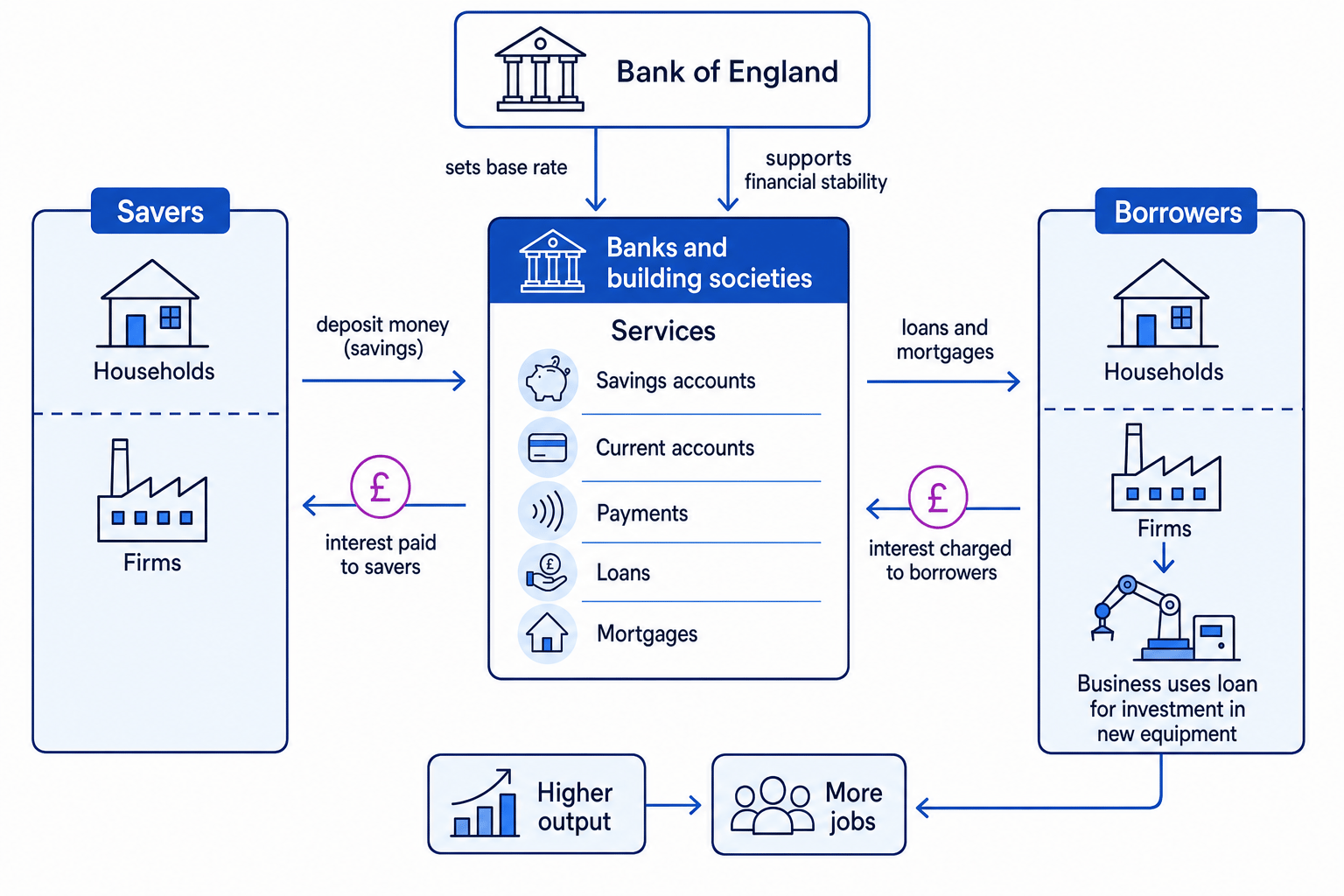
The financial sector helps money move around the economy. Some people and firms have money they do not want to spend immediately: they are savers. Others need money now and are willing to repay it later: they are borrowers.
Interest is the reward paid to savers or the cost paid by borrowers. An interest rate is interest shown as a percentage of the amount saved or borrowed, usually per year.
The financial sector matters because it supports everyday activity: wages paid into accounts, card payments at Tesco or Greggs, mortgages for home buyers, and loans for businesses investing in equipment.
The bridge role
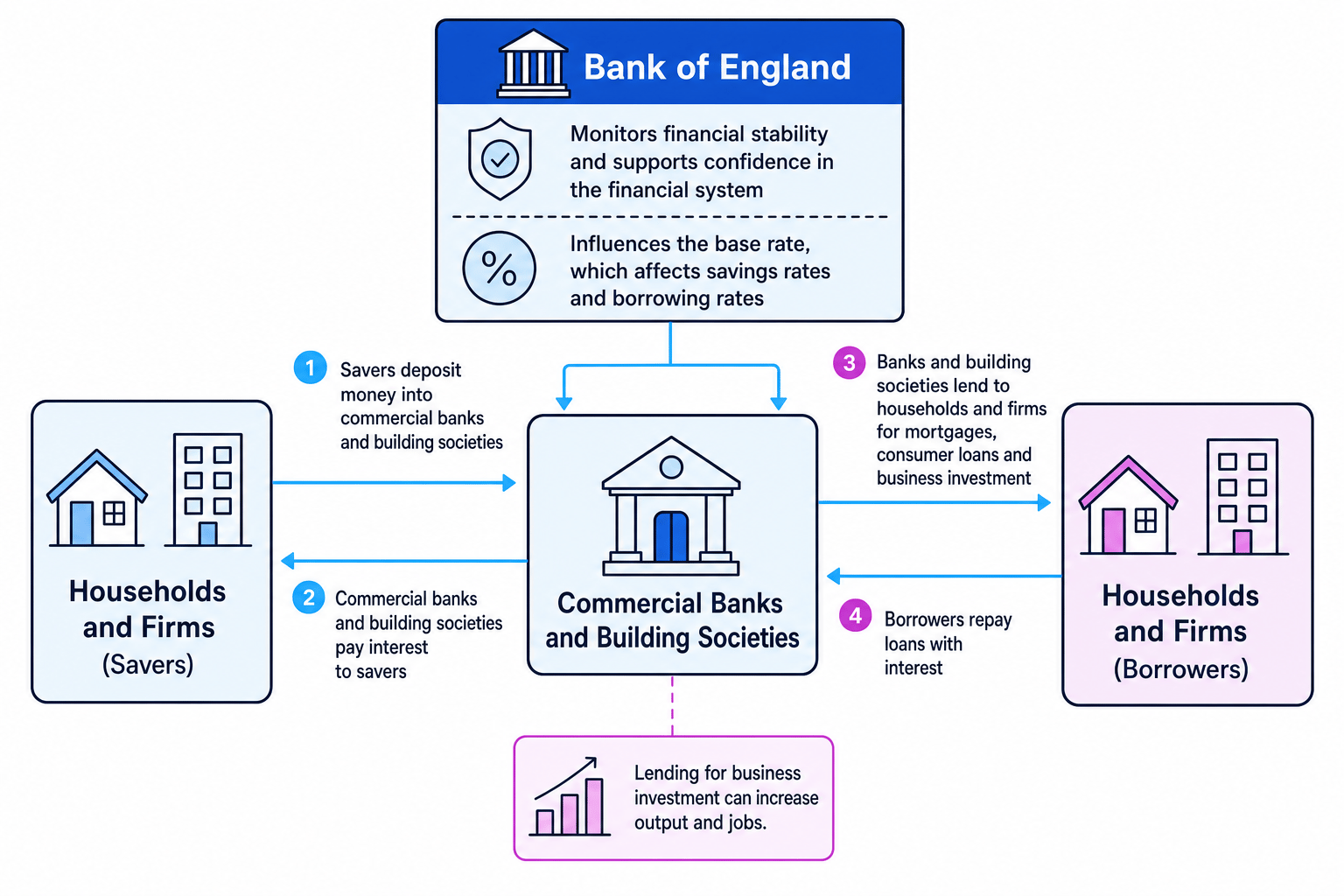
A key role of the financial sector is to connect savers with borrowers, so money that is not being used immediately can help fund spending and investment elsewhere in the economy.
Tracing savings into investment
-
A household saves £1,000 in a bank account rather than spending it immediately. The bank provides a safe place to hold the money and may pay interest to the saver.
-
The bank can use funds from many savers to provide loans to borrowers, after checking whether the borrower is likely to repay. This makes the bank a financial intermediary, meaning it stands between savers and borrowers.
-
A small bakery borrows money to buy a new oven. If the oven allows the bakery to produce more cakes and bread, output may rise and the firm may need more workers.
-
The wider economy benefits if the lending leads to more production, employment and income. However, the loan must still be repaid with interest, so borrowing creates risk.
The main agents in the financial sector
An agent in economics is a person, firm or institution that makes economic decisions. In this topic, the main agents are the Bank of England, commercial banks and building societies.
The Bank of England
The Bank of England is the UK’s central bank. A central bank is not a normal high street bank for the public. You do not open a regular current account with it. Its job is to support the stability of the UK’s money and financial system.
Commercial banks
A commercial bank is a profit-making bank that provides financial services such as current accounts, savings accounts, loans, mortgages and payment services. Examples include Barclays, HSBC, Lloyds, NatWest and Santander.
A high street bank is a commercial bank that households and businesses commonly use, through branches, websites and banking apps.
Building societies
A building society is a financial institution owned by its members, such as savers and borrowers, rather than by external shareholders. Building societies often specialise in savings accounts and mortgages. Examples include Nationwide and Coventry Building Society.
Bank of England vs high street banks
Do not write as if the Bank of England gives ordinary households debit cards or personal loans. High street banks serve everyday savers and borrowers; the Bank of England influences the whole financial system.
The role of the Bank of England
The Bank of England has two especially important roles for GCSE Economics:
- influencing interest rates
- helping to ensure stability of the financial system
Influencing interest rates
Base rate
The base rate is the key interest rate set by the Bank of England. It influences the interest rates that commercial banks and building societies pay to savers and charge to borrowers.
When the Bank of England raises the base rate, borrowing usually becomes more expensive and saving becomes more rewarding. This can reduce borrowing and spending by households and firms.
When the Bank of England lowers the base rate, borrowing usually becomes cheaper and saving becomes less rewarding. This can encourage borrowing, spending and investment.
A recent UK example is the 2022–23 inflation spike. As prices rose quickly, the Bank of England increased interest rates. This helped reduce inflationary pressure, but it also made many mortgages and business loans more expensive.
Calculating the effect of a rate rise
-
A saver has £2,000 in a savings account. At an interest rate of 3%, the annual interest is 2,000×0.03=602{,}000 \times 0.03 = 602,000×0.03=60, so the saver earns £60 per year.
-
If the interest rate rises to 5%, the annual interest is 2,000×0.05=1002{,}000 \times 0.05 = 1002,000×0.05=100, so the saver earns £100 per year.
-
The saver gains an extra £40 per year because £100 - £60 = £40. Higher interest rates can therefore encourage saving.
-
For a borrower, the effect is the opposite. If a firm borrows £10,000, interest at 5% is 10,000×0.05=50010{,}000 \times 0.05 = 50010,000×0.05=500, so the loan costs £500 per year in interest. Higher rates can discourage borrowing and investment.
Interest rates do not pass through perfectly
The Bank of England influences interest rates, but it does not directly set every savings rate, credit card rate or mortgage rate. Commercial banks still make their own decisions, and fixed-rate mortgages may not change immediately.
Ensuring stability of the financial system
Financial stability
Financial stability means the financial system is working smoothly, so people can make payments, access money, save, borrow and trust that banks are operating safely.
The Bank of England helps maintain confidence in the financial system. This matters because modern economies depend on trust. If people and firms cannot trust banks or payment systems, spending and investment can quickly fall.
The Bank of England monitors risks in the banking system, checks whether banks could cope with shocks, and can support the system in a crisis. This is important because banks do not keep every pound of deposits sitting unused; they also lend money out.
Why confidence in banks matters
-
Imagine many households worry that a bank is unsafe and all try to withdraw their money at once. This is called a bank run.
-
The bank may struggle because much of its money has been lent out as mortgages and business loans. Even a bank with valuable loans can face a short-term cash problem.
-
If panic spreads to other banks, firms may struggle to borrow, households may cut spending, and confidence across the economy may fall.
-
Bank of England monitoring and crisis support aim to reduce this risk, helping the financial system keep working.
The role of high street banks and building societies
High street banks and building societies provide services for both savers and borrowers.
For savers, they offer current accounts for day-to-day payments, savings accounts that may pay interest, and secure ways to receive wages or benefits.
For borrowers, they offer loans. A loan is money borrowed now and repaid later, usually with interest. A mortgage is a long-term loan used to buy property. Banks may also offer business loans and overdrafts, where an overdraft is short-term borrowing through a current account.
Helping to fund investment
Investment
In GCSE Economics, investment means spending by firms on capital goods, such as machinery, buildings, vehicles or technology, to increase productive capacity. It does not simply mean putting money into a savings account.
High street banks help fund investment by lending to firms. For example, a restaurant may borrow to refurbish its kitchen, or a delivery company may borrow to buy electric vans.
This can benefit the economy because investment can increase output, productivity, employment and future tax revenue. But banks must judge risk carefully. If they lend irresponsibly, borrowers may be unable to repay and the bank may suffer losses.
Judging whether a business loan supports investment
-
A small firm borrows £10,000 to buy new equipment. The bank charges 8% interest per year, so annual interest is 10,000×0.08=80010{,}000 \times 0.08 = 80010,000×0.08=800. The loan costs £800 per year in interest.
-
The equipment increases the firm’s revenue by £5,000 per year, but extra wages and materials cost £3,600. The extra amount before interest is £5,000 - £3,600 = £1,400.
-
After paying interest, the firm gains £1,400 - £800 = £600. In this case, the investment improves profit by £600 per year.
-
However, if demand for the firm’s product falls, the extra revenue may not appear. The loan could then become a burden rather than a benefit.
Calling all saving investment
In everyday speech, people say they “invest” in a savings account. In GCSE Economics, business investment means firms buying capital goods to produce more in the future.
Why the financial sector is important for the economy
A strong financial sector supports economic activity in several ways.
It helps households manage money, receive wages, pay bills and buy homes. It helps firms borrow to invest, expand and survive difficult periods. During COVID-19, bank lending, including government-backed loan schemes, helped some firms keep operating, although some loans were later not repaid.
It also supports confidence. If households trust banks, they are more willing to save and use digital payments. If firms trust lenders, they are more willing to plan long-term investment.
But there are trade-offs. Higher interest rates can help savers and reduce inflationary pressure, but they can also squeeze mortgage borrowers and discourage firms from investing. Banks must also consider ethics: lending should be responsible, fees should be fair, and access to banking services matters for people who are elderly, disabled or living in areas where branches have closed.
Sustainability can matter too. Banks can choose whether to fund projects that support cleaner energy and lower emissions, or projects that may damage the environment. These choices affect not only profits, but also society.
Winners and losers
Changes in the financial sector rarely affect everyone in the same way. A rise in interest rates may benefit savers but harm borrowers, so strong answers explain both sides before reaching a judgement.
In the exam
-
Be precise about the institution: the Bank of England influences interest rates and financial stability; high street banks and building societies serve savers and borrowers.
-
Always link the financial sector to the wider economy: borrowing can fund investment, investment can raise output, and output can support jobs and incomes.
-
For interest rate questions, separate savers from borrowers. Explain who gains, who loses, and why.
-
Add real-world context where useful, such as the 2022–23 inflation spike, Bank of England rate rises, mortgages, or business loans after COVID-19.
Check yourself
- What is the difference between the Bank of England and a high street bank?
- How might a rise in interest rates affect a saver, a mortgage borrower and a firm planning investment?
- Why can bank lending help the economy grow, and what risks can it create?