What you'll learn
- How producers set objectives such as profit, sales growth and market share.
- How to identify and calculate fixed costs, variable costs, total cost and average cost.
- How to calculate total revenue, average revenue and profit.
- Why higher prices can encourage firms to expand production — and why producer motives can raise ethical issues.
3.1.4.1 The importance of cost, revenue and profit for producers
A producer is a person or business that makes goods or provides services. For example, Greggs produces bakery products, Tesco provides retail services, and Netflix produces and streams entertainment.
Producers need to understand their costs, revenues and profit because these figures guide almost every business decision: what price to charge, how much to produce, whether to expand, and whether the business can survive.
Business objectives
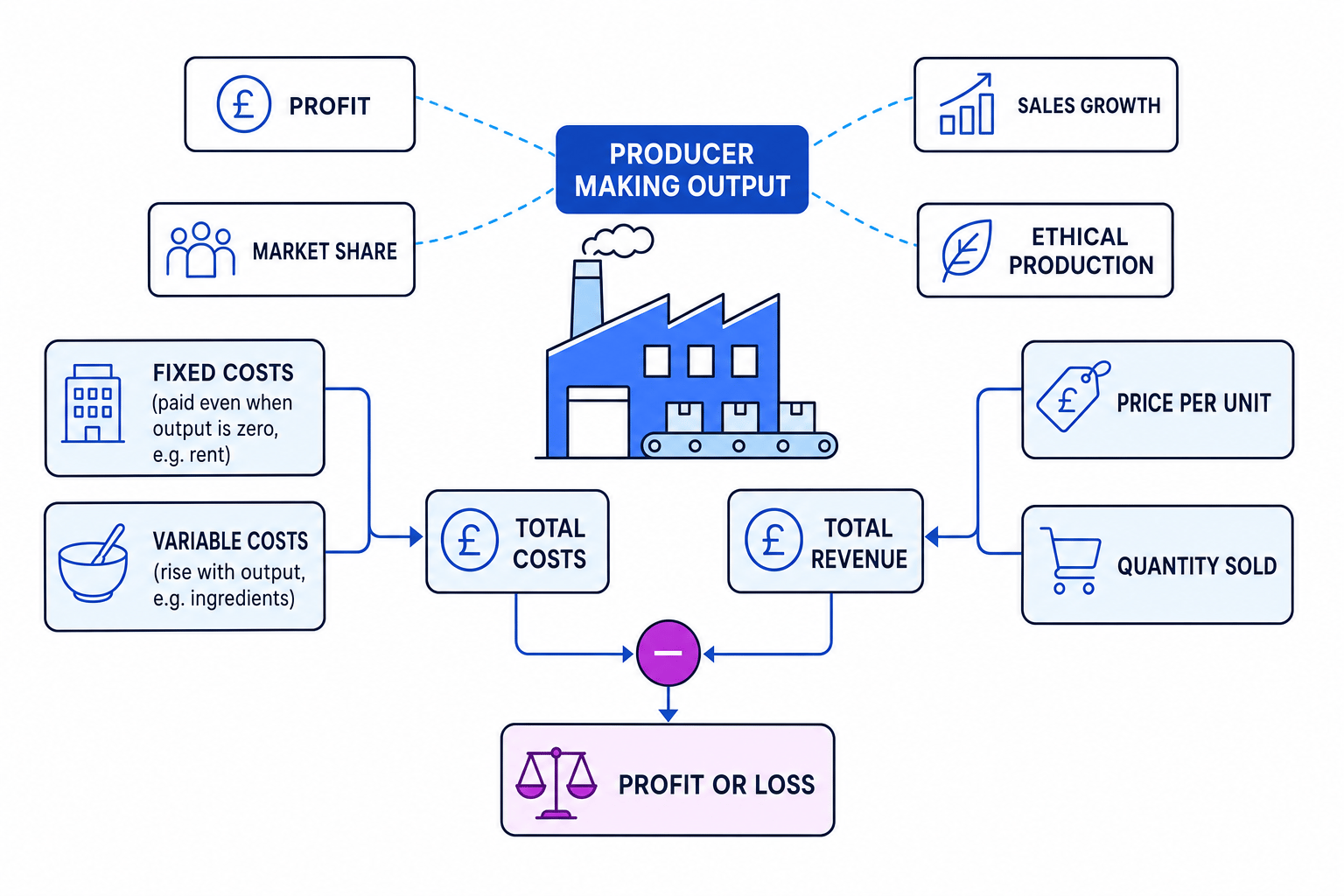
A business objective is a target that a business wants to achieve. Different firms may prioritise different objectives depending on their size, market and situation.
Profit
Profit
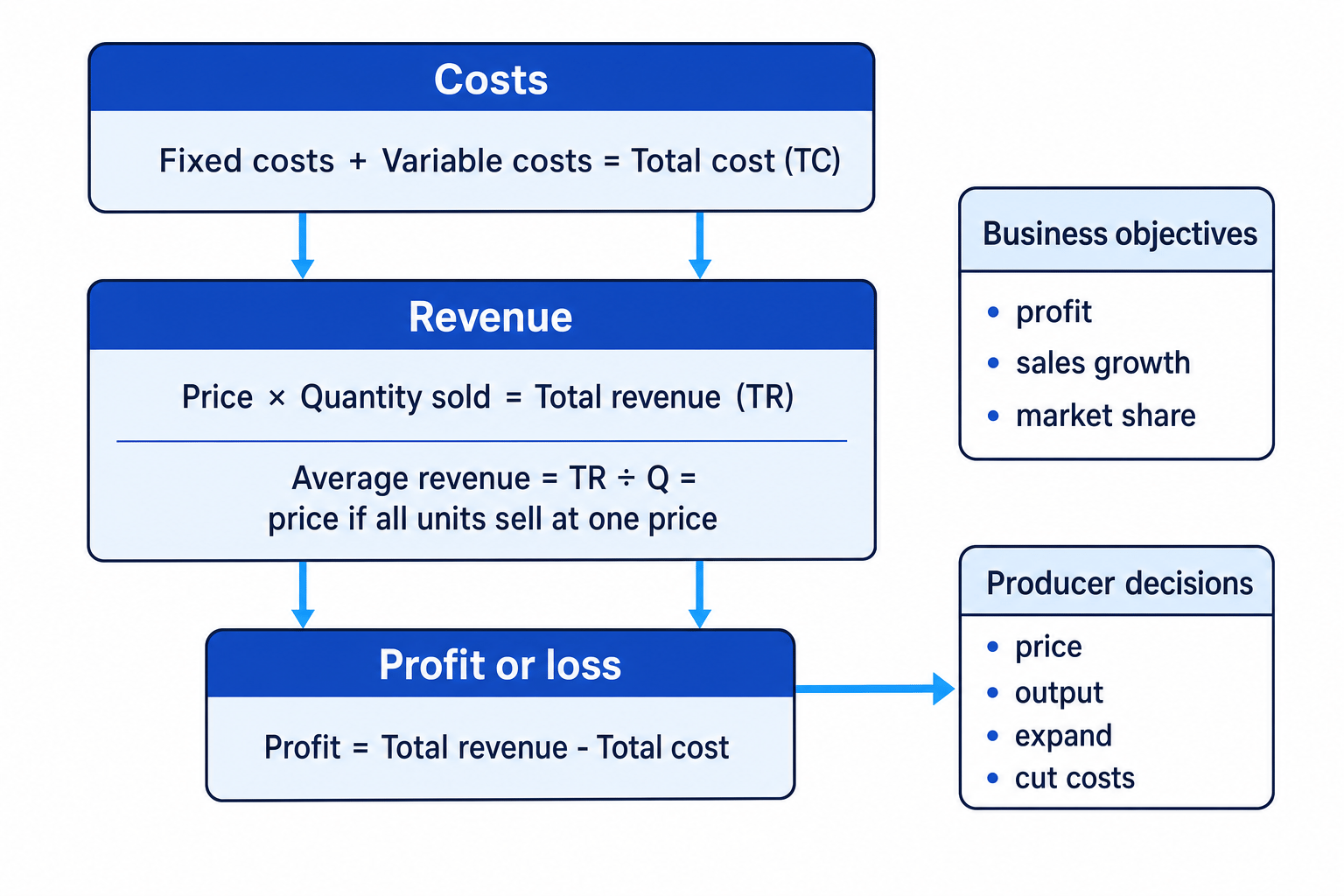
Profit is the amount left over when total costs are subtracted from total revenue. In simple terms, it is the financial reward for enterprise and risk-taking.
Many firms aim to maximise profit because profit can be used to reward owners, pay dividends to shareholders, invest in new equipment, open new branches or survive difficult periods.
Sales growth
Sales growth
Sales growth means increasing the amount or value of goods and services sold over time.
A firm might accept lower profit in the short run to increase sales. For example, a streaming service may offer a discounted subscription to attract more customers, hoping to earn more later.
Market share
Market share
Market share is the percentage of total market sales made by one firm.
A firm with a larger market share may have more power over suppliers, stronger brand recognition and more influence in the market.
Market share=firm’s salestotal market sales×100\text{Market share} = \frac{\text{firm's sales}}{\text{total market sales}} \times 100Market share=total market salesfirm’s sales×100Calculating market share
A supermarket has sales of £30 million in a market where total supermarket sales are £200 million.
- Identify the firm’s sales and the total market sales: firm’s sales = £30 million, total market sales = £200 million.
- Substitute into the formula: market share = £30 million ÷ £200 million × 100.
- Calculate the percentage: 0.15 × 100 = 15%, so the supermarket’s market share is 15%.
Objectives can conflict
A firm may not be able to maximise everything at once. Cutting prices might increase sales growth and market share, but it may reduce profit per unit.
Types of costs
A cost is money spent by a business to produce goods or services. Producers need to know their costs so they can decide whether production is worthwhile.
Fixed costs
Fixed cost
A fixed cost is a cost that does not change with output in the short run. It has to be paid even if the firm produces nothing.
Examples include rent, business rates, insurance and some salaries. A café still has to pay rent even if it sells fewer coffees during a quiet week.
Variable costs
Variable cost
A variable cost is a cost that changes directly with output.
Examples include raw materials, packaging, electricity used in production and wages for hourly staff. If a bakery makes more loaves of bread, it needs more flour and packaging.
Total cost
Total cost
Total cost is the full cost of producing a given level of output.
where TCTCTC is total cost, FCFCFC is fixed cost and VCVCVC is variable cost.
Average cost
Average cost
Average cost is the cost per unit of output.
Average cost matters because it helps a firm compare the cost of making one unit with the price it can charge for that unit.
Calculating total and average cost
A small bakery has fixed costs of £200 per day. It makes 500 cakes, and the variable cost is 40p per cake.
- Calculate total variable cost: 500 cakes × £0.40 = £200.
- Add fixed costs and variable costs: £200 + £200 = £400 total cost.
- Calculate average cost: £400 ÷ 500 cakes = £0.80 per cake.
Mixing up fixed and variable costs
Do not decide whether a cost is fixed or variable by asking whether it is “important”. Ask whether it changes when output changes. Rent is usually fixed; ingredients are usually variable.
Types of revenue
Revenue is the income a firm receives from selling goods and services. It is not the same as profit because costs have not yet been subtracted.
Total revenue
Total revenue
Total revenue is the total income from sales.
where TRTRTR is total revenue, PPP is price and QQQ is quantity sold.
Average revenue
Average revenue
Average revenue is the revenue per unit sold.
If every unit is sold at the same price, average revenue is the same as the price.
Calculating total and average revenue
A food stall sells 300 burgers for £4 each.
- Use price × quantity to calculate total revenue: £4 × 300 = £1,200.
- Use total revenue ÷ quantity to calculate average revenue: £1,200 ÷ 300 = £4 per burger.
- Interpret the result: because every burger sold for the same price, average revenue equals the selling price.
Revenue is before costs
If a business says it “took £1,200 today”, that is revenue. It is only profit after costs such as ingredients, wages and rent are subtracted.
Profit
Profit links costs and revenue together. It shows whether production has been financially worthwhile.
Profit=TR−TC\text{Profit} = TR - TCProfit=TR−TCIf total revenue is greater than total cost, the firm makes a profit. If total cost is greater than total revenue, the firm makes a loss.
Calculating profit
A local takeaway earns total revenue of £2,500 in a week. Its total costs are £1,850.
- Identify the two figures needed: total revenue = £2,500 and total cost = £1,850.
- Subtract total cost from total revenue: £2,500 − £1,850 = £650.
- State the result with units: the takeaway makes £650 profit for the week.
A firm can try to increase profit in two main ways:
- Increase revenue, for example by raising prices, selling more units, improving advertising or launching a popular new product.
- Reduce average costs, for example by buying supplies in bulk, improving productivity or using technology more efficiently.
Increasing profit by reducing average cost
A firm sells 1,000 items for £5 each. Its original total cost is £4,200. It then improves efficiency and reduces total cost to £3,800.
- Calculate total revenue: £5 × 1,000 = £5,000.
- Calculate original profit: £5,000 − £4,200 = £800.
- Calculate new profit after costs fall: £5,000 − £3,800 = £1,200.
- Compare the results: profit rises by £400 because total cost and average cost have fallen.
Why higher prices can encourage more production
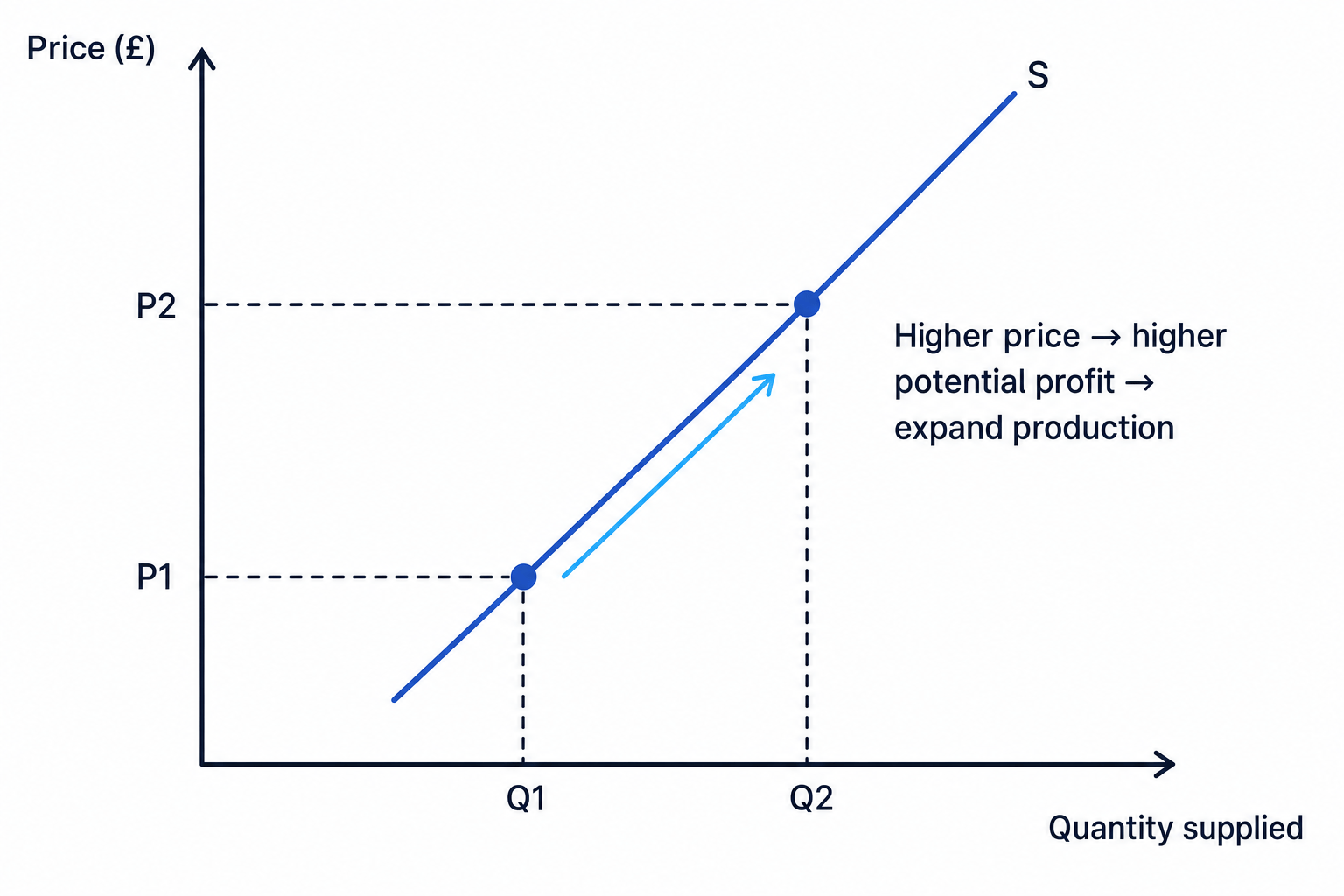
If the market price of a good rises, producers usually have a stronger incentive to supply more. This is because a higher price can increase the profit made on each unit, assuming costs and sales do not change too much.
For example, after energy prices rose sharply in 2022–23, firms producing or supplying energy had a stronger incentive to expand supply where possible. However, businesses using lots of energy, such as manufacturers and restaurants, faced higher costs instead.
The producer incentive
Higher prices can signal that production is more profitable, encouraging firms to expand output or enter the market.
Assuming higher price always means higher profit
A higher price does not guarantee higher profit. If customers buy far fewer units, or if costs rise at the same time, profit may not increase.
Why cost, revenue and profit matter for producers
Producers use these figures to make decisions. For example:
- A café may compare average cost with price to decide whether a meal deal is profitable.
- A supermarket may track revenue to judge whether a new product range is popular.
- A manufacturer may reduce costs by investing in machinery, but only if the expected extra profit justifies the investment.
- A firm facing higher wages, rent or energy bills may raise prices, reduce output or try to become more efficient.
This became very visible during the UK cost-of-living squeeze after the 2022–23 inflation spike. Many businesses faced higher costs for energy, ingredients and transport. Some raised prices; others reduced portion sizes, changed suppliers or accepted lower profits.
Use the chain of reasoning
A strong explanation often follows this chain: costs or prices change → revenue or profit changes → producer changes output, prices or investment.
Moral and ethical considerations
Producer motivations can conflict with moral and ethical interests. A firm may want to reduce costs or increase profit, but this can create difficult trade-offs.
For example:
- Paying very low wages may reduce costs, but it can be unfair to workers.
- Raising prices during shortages may increase profit, but consumers may see it as exploitative.
- Using cheaper suppliers may reduce costs, but it could involve poor working conditions.
- Cutting environmental standards may save money, but it can damage sustainability and local communities.
In the UK, debates around minimum-wage rises, supermarket supplier treatment, fast fashion and energy company profits all show that producer decisions are not only financial. They affect workers, consumers, communities and the environment.
Profit is not the only judgement
Economics often asks you to weigh business benefits against wider effects. A decision can increase profit but still raise ethical concerns.
In the exam
- Define the key term first, such as fixed cost, total revenue or profit.
- Show calculations clearly with £ units, and keep the formula visible in your working.
- For longer answers, link the numbers to a producer decision: price, output, expansion, cost-cutting or ethics.
Check yourself
- What is the difference between a fixed cost and a variable cost?
- How would you calculate total revenue and average revenue?
- Why might a producer’s aim to increase profit conflict with ethical interests?