What you'll learn
- The difference between production and productivity.
- How to calculate simple labour productivity.
- The main factors that can increase or reduce productivity.
- Why higher productivity can benefit firms, consumers, workers and the wider UK economy.
3.1.4.2 — Production and productivity
The starting point: producers use inputs to create outputs
A producer is a business or individual that supplies goods or services. A good is a physical product, such as a loaf of bread or a phone. A service is something useful done for someone, such as a haircut, bus journey or streaming subscription.
Producers combine inputs — resources used in production — to create outputs, which are the goods and services produced.
Factors of production
The factors of production are the resources used to make goods and services:
- Land — natural resources, such as farmland, oil, water and minerals.
- Labour — human effort, including workers’ time, skills and knowledge.
- Capital — man-made resources used to produce output, such as machinery, tools, factories and software.
- Enterprise — organising production and taking business risks.
Production
Production means the process of making goods and services. It can also refer to the total amount of output a firm or economy produces.
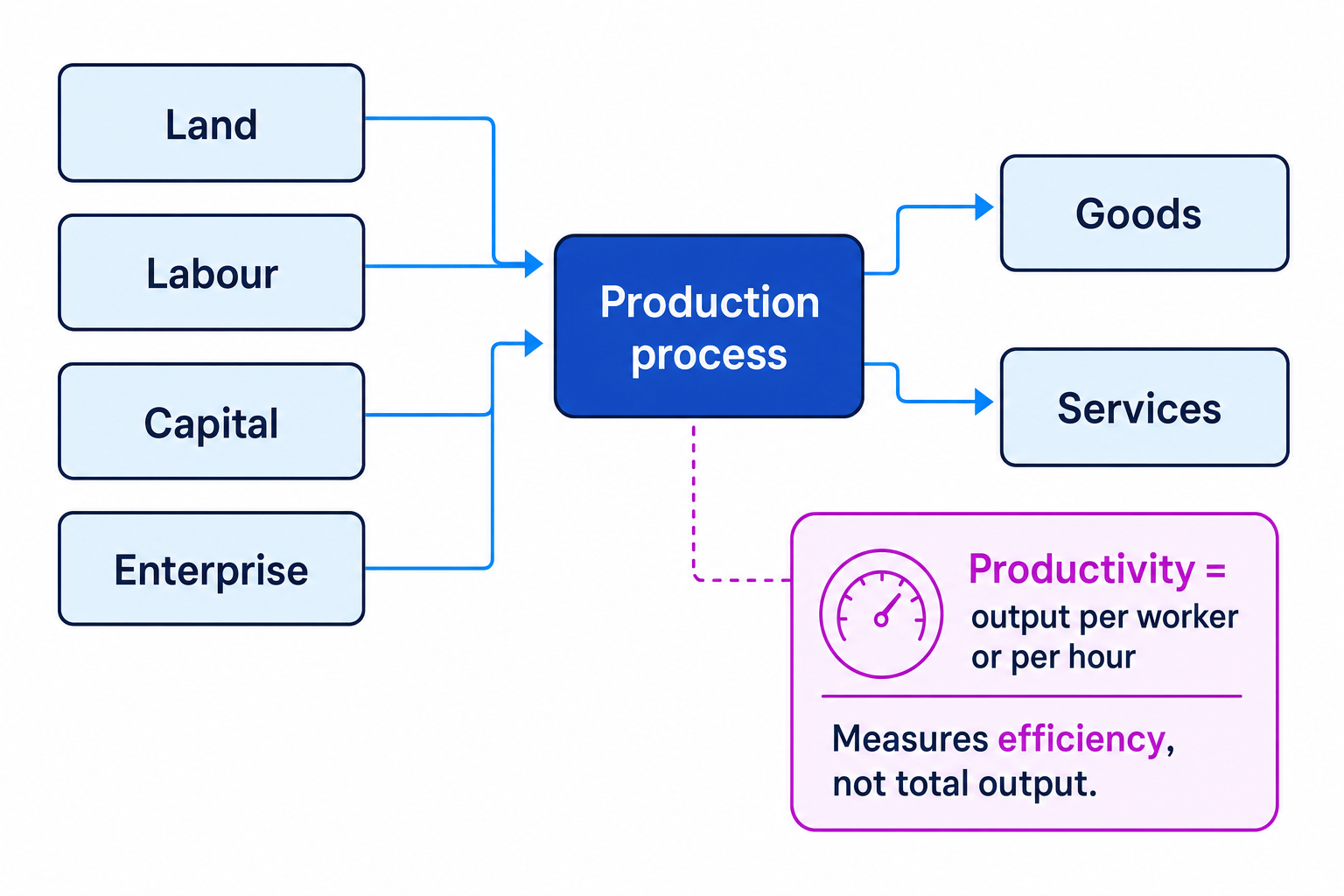
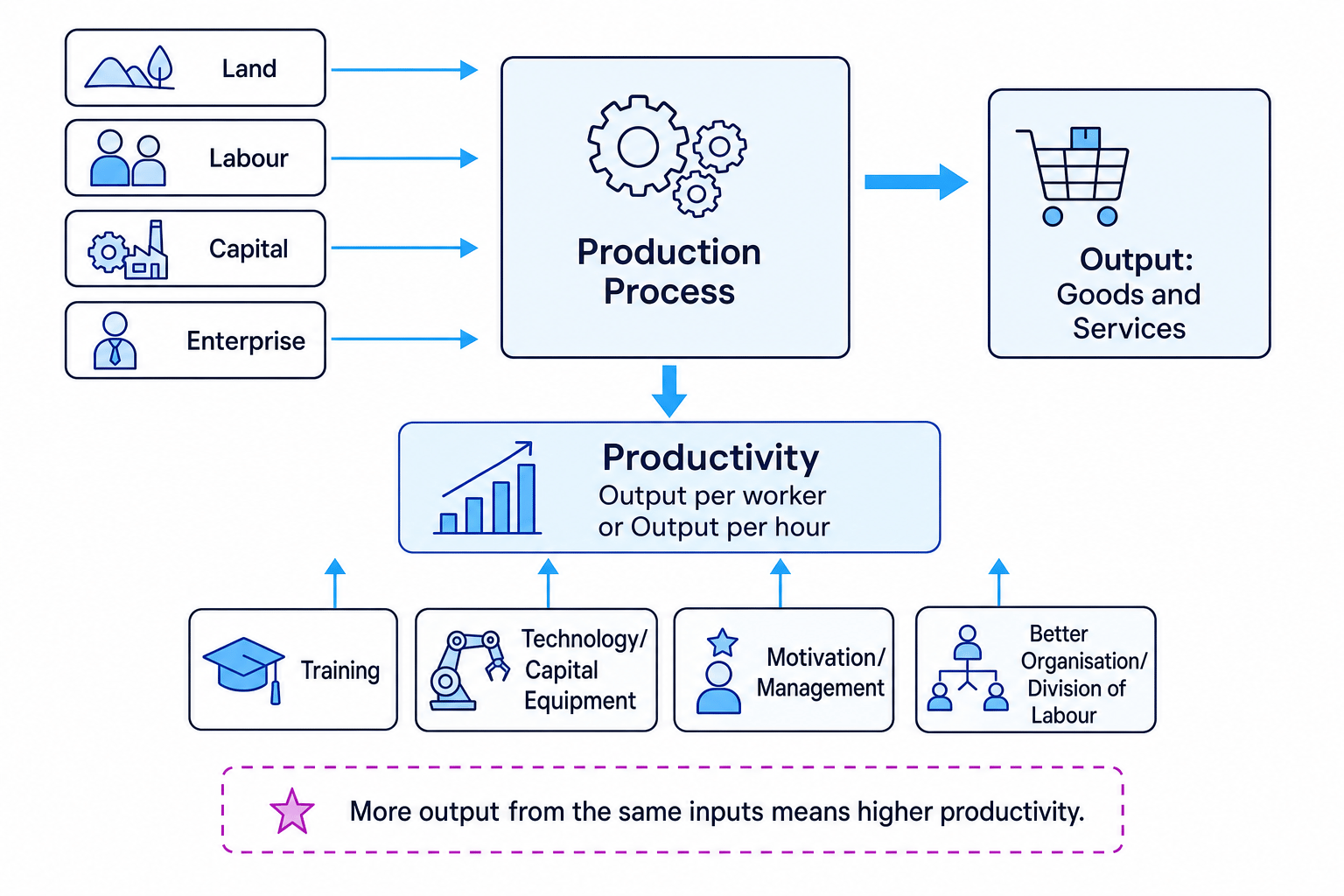
The diagram shows how inputs flow into the production process, and how productivity measures the efficiency of that process.
Production is about amount; productivity is about efficiency
It is very important not to mix these up.
- Production asks: “How much output was made?”
- Productivity asks: “How much output was made from each input?”
Productivity
Productivity is a measure of efficiency: how much output is produced from a given amount of input. A common GCSE measure is labour productivity:
Labour productivity=total outputnumber of workers\text{Labour productivity}=\frac{\text{total output}}{\text{number of workers}}Labour productivity=number of workerstotal outputYou may also see productivity measured as output per hour worked:
Labour productivity per hour=total outputtotal labour hours\text{Labour productivity per hour}=\frac{\text{total output}}{\text{total labour hours}}Labour productivity per hour=total labour hourstotal output| Situation | Production | Productivity |
|---|---|---|
| A bakery makes more loaves in total | Higher production | Productivity may rise, stay the same or fall |
| A bakery makes the same number of loaves with fewer workers | Same production | Higher productivity |
| A bakery makes more loaves with the same workers | Higher production | Higher productivity |
Production rising while productivity falls
A bakery originally makes 1,000 loaves per day with 5 workers. Later, it makes 1,200 loaves per day with 8 workers.
- Compare total output: 1,200−1,000=2001{,}200 - 1{,}000 = 2001,200−1,000=200, so production has increased by 200 loaves per day.
- Calculate old labour productivity: 1,000÷5=2001{,}000 \div 5 = 2001,000÷5=200 loaves per worker.
- Calculate new labour productivity: 1,200÷8=1501{,}200 \div 8 = 1501,200÷8=150 loaves per worker.
- Compare the two productivity figures: 150 is less than 200, so productivity has fallen even though production has risen.
Output up does not always mean productivity up
If a firm produces more only because it uses many more workers, machines or hours, productivity may stay the same or even fall. Always compare output with the inputs used.
Factors that influence productivity
Productivity improves when a firm can produce more output from the same inputs, or the same output from fewer inputs. This does not happen by magic: it usually depends on skills, technology, organisation and motivation.
Training and skills
Training improves workers’ ability to do their jobs. More skilled workers may make fewer mistakes, work faster, waste fewer materials and provide better customer service.
Human capital means the skills, knowledge, experience and health of workers. Better human capital usually supports higher productivity.
For example, a restaurant that trains staff to use a new ordering system may serve more customers per hour with the same number of workers.
Capital equipment and technology
Capital equipment includes machinery, tools, vehicles, buildings and digital systems used in production. Better equipment can help workers produce more output per hour.
In economics, investment means spending on capital goods, such as machines, software, delivery vehicles or factory buildings. This is different from everyday use of the word “investment”, such as buying shares.
UK supermarkets using self-service checkouts, barcode scanners and automated warehouses are examples of technology that can raise output per worker.
Division of labour and specialisation
Division of labour means splitting production into separate tasks, with different workers specialising in particular jobs. Specialisation means focusing on a narrower range of tasks.
This can raise productivity because workers become quicker through practice, waste less time switching between tasks and may use specialist equipment more effectively.
For example, in a sandwich factory, one worker may prepare fillings, another may assemble sandwiches and another may pack them. This is usually faster than every worker making each sandwich from start to finish.
Motivation and management
Motivation means how willing workers are to put effort into their work. Good pay, fair treatment, safe conditions, recognition and chances for promotion can all improve motivation.
Good management also matters. Clear instructions, sensible rotas, reliable supplies and well-designed workplaces can reduce delays and mistakes.
Raising productivity
Productivity improves when workers have better skills, better tools, better organisation or stronger motivation — but the improvement should not come from unsafe working conditions or a damaging fall in quality.
Comparing two productivity improvements
A UK online retailer currently ships 2,000 parcels per day using 20 warehouse workers. It is considering either staff training or new barcode scanners.
- Calculate current productivity: 2,000÷20=1002{,}000 \div 20 = 1002,000÷20=100 parcels per worker.
- With staff training, output rises to 2,300 parcels using the same 20 workers: 2,300÷20=1152{,}300 \div 20 = 1152,300÷20=115 parcels per worker.
- With barcode scanners, output rises to 2,400 parcels using the same 20 workers: 2,400÷20=1202{,}400 \div 20 = 1202,400÷20=120 parcels per worker.
- Compare the results: 120 is higher than 115, so the scanners raise labour productivity more. However, a full judgement would also consider the cost of the scanners and whether training improves quality or safety.
Counting speed but ignoring quality
A firm might appear more productive if workers rush and produce more units, but if the products are faulty or customers receive poor service, the real benefit may be much smaller.
Why increased productivity matters
Higher productivity is important because it can reduce the cost of producing each unit. This can help firms compete, especially when costs are rising.
Average cost
Average cost means the cost per unit of output:
Average cost=total costoutput\text{Average cost}=\frac{\text{total cost}}{\text{output}}Average cost=outputtotal costBenefit 1: lower average costs
If a firm produces more output using the same workers, machines or premises, the cost per unit often falls. This can make the firm more efficient and more competitive.
Using productivity to lower average cost
A coffee shop has daily total costs of £600. Before improving its equipment and staff training, it sells 300 coffees per day. Afterwards, it sells 400 coffees per day with the same total daily cost.
- Calculate average cost before the improvement: £600÷300=£2\pounds600 \div 300 = \pounds2£600÷300=£2 per coffee.
- Calculate average cost after the improvement: £600÷400=£1.50\pounds600 \div 400 = \pounds1.50£600÷400=£1.50 per coffee.
- Compare the results: £2−£1.50=£0.50\pounds2 - \pounds1.50 = \pounds0.50£2−£1.50=£0.50, so average cost falls by 50p per coffee.
- The coffee shop could use this gain to lower prices, increase profit, improve wages or invest in more equipment.
Benefit 2: higher profits or lower prices
Profit is total revenue minus total costs. If productivity reduces costs, a firm may earn higher profit on each unit sold.
Alternatively, it may lower prices. This can benefit consumers and help the firm win customers from rivals. For example, a supermarket that improves warehouse efficiency may be able to offer lower prices during a cost-of-living squeeze.
Benefit 3: improved competitiveness
Competitiveness means how well a firm can attract customers compared with its rivals. Higher productivity can allow firms to charge lower prices, improve quality or deliver goods faster.
This matters in UK markets such as food retail, parcel delivery, car manufacturing and streaming services, where consumers can switch quickly if price or service worsens.
Benefit 4: higher wages and better living standards
If productivity rises, firms may be able to afford higher wages without raising prices as much. This is especially relevant when the National Living Wage rises: firms often look for ways to improve productivity so they can afford higher labour costs.
At the economy-wide level, higher productivity can help raise living standards, meaning people’s material wellbeing and quality of life. If each worker produces more output, there is more potential income to share between workers, firms and government.
Benefit 5: more tax revenue and investment
Higher profits and incomes can lead to more tax revenue for the government. This may help fund public services such as schools, the NHS and transport.
Higher productivity can also encourage firms to invest more, creating a cycle of better equipment, better skills and further productivity improvements.
Recent UK context
Productivity is not just a textbook idea. It has mattered in several recent UK economic situations.
During COVID-19, sickness, self-isolation and social distancing reduced productivity in some sectors, especially hospitality and transport. At the same time, digital tools helped some office-based workers continue producing output from home.
After Brexit, some firms faced extra paperwork, supply-chain delays or labour shortages. This encouraged some businesses to invest in automation or training, but it also made production harder for others.
During the 2022–23 inflation spike and energy-price shock, many firms faced higher costs. More productive firms were often better placed to absorb cost increases without raising prices as sharply.
Evaluation point
Higher productivity is usually good, but always ask who gains and who loses. Automation may reduce boring tasks and cut waste, but it can also threaten jobs or increase pressure on workers if handled badly.
Moral, ethical and sustainability considerations
Productivity improvements are not automatically fair or sustainable.
A firm might raise productivity by using safer technology, reducing waste and improving training. That is likely to be good for workers, consumers and the environment.
But a firm might also try to raise productivity by cutting breaks, setting unrealistic targets or ignoring safety. That may increase output in the short run, but it raises moral and ethical concerns.
There is also a sustainability question. If productivity rises because a factory uses less energy per unit, that can reduce environmental impact. But if higher productivity simply leads to much higher total production and more resource use, the overall environmental effect may be mixed.
In the exam
- Start by separating the key terms: production is total output, while productivity is output per input.
- For calculations, write the formula, substitute the figures and keep units in your answer, such as “loaves per worker” or “£ per coffee”.
- Add application and evaluation: explain how productivity affects costs, prices, profits or wages, then consider possible drawbacks such as job losses, quality problems or sustainability concerns.
Check yourself
- What is the difference between production and productivity?
- A factory makes 900 units with 6 workers. What is labour productivity?
- Give two ways a UK firm could improve productivity, and one ethical issue it should consider.