What you'll learn
- What an economic resource is and why resources are scarce.
- The four factors of production: land, labour, capital and enterprise.
- The reward earned by the owner of each factor.
- How to apply the four factors to real businesses such as Greggs, Tesco and housebuilding.
3.1.1.2 The factors of production
Before you can understand markets, businesses or the whole economy, you need to understand what is being used to make output.
Output means the goods and services produced in an economy. A good is a physical product, such as a phone, loaf of bread or electric car. A service is an activity done for someone, such as a haircut, banking app, bus journey or streaming subscription.
Economic resources: the starting point
An economy cannot produce things from nothing. To make any good or service, producers need inputs: people, places, equipment, raw materials, ideas and organisation.
Economic resource
An economic resource is an input used to produce goods and services. Economic resources are scarce, meaning there is not enough of them to satisfy everyone’s wants fully.
Scarcity matters because resources have alternative uses. For example, land in a town centre could be used for flats, a supermarket, a park or a car park. Choosing one use usually means giving up another.
The basic economic problem
People have unlimited wants, but resources are limited. This creates choices about what to produce, how to produce it and who receives the output.
Why resources are “economic”
A resource is called “economic” when it is useful and scarce. Air for breathing is usually not treated as an economic resource because it is freely available in most situations. But clean air in a polluted city, or oxygen in a hospital, can become scarce and valuable.
In the UK after COVID-19, some sectors faced shortages of workers, building materials and shipping capacity. These shortages showed that production depends on access to the right resources at the right time.
Recognising scarce economic resources
A new housing development needs land, builders, bricks, machinery and someone to organise the project.
- Identify the output being produced: the output is new houses, which are goods because they are physical products.
- Pick out the scarce inputs: land, skilled builders, bricks, diggers and project management are all limited and have other possible uses.
- Decide whether each input is economic: because each input is useful in production and scarce, each one counts as an economic resource.
Factors of production
Economists group economic resources into four main categories. These are called the factors of production.
Factors of production
The factors of production are the four main types of economic resource used to produce goods and services: land, labour, capital and enterprise.
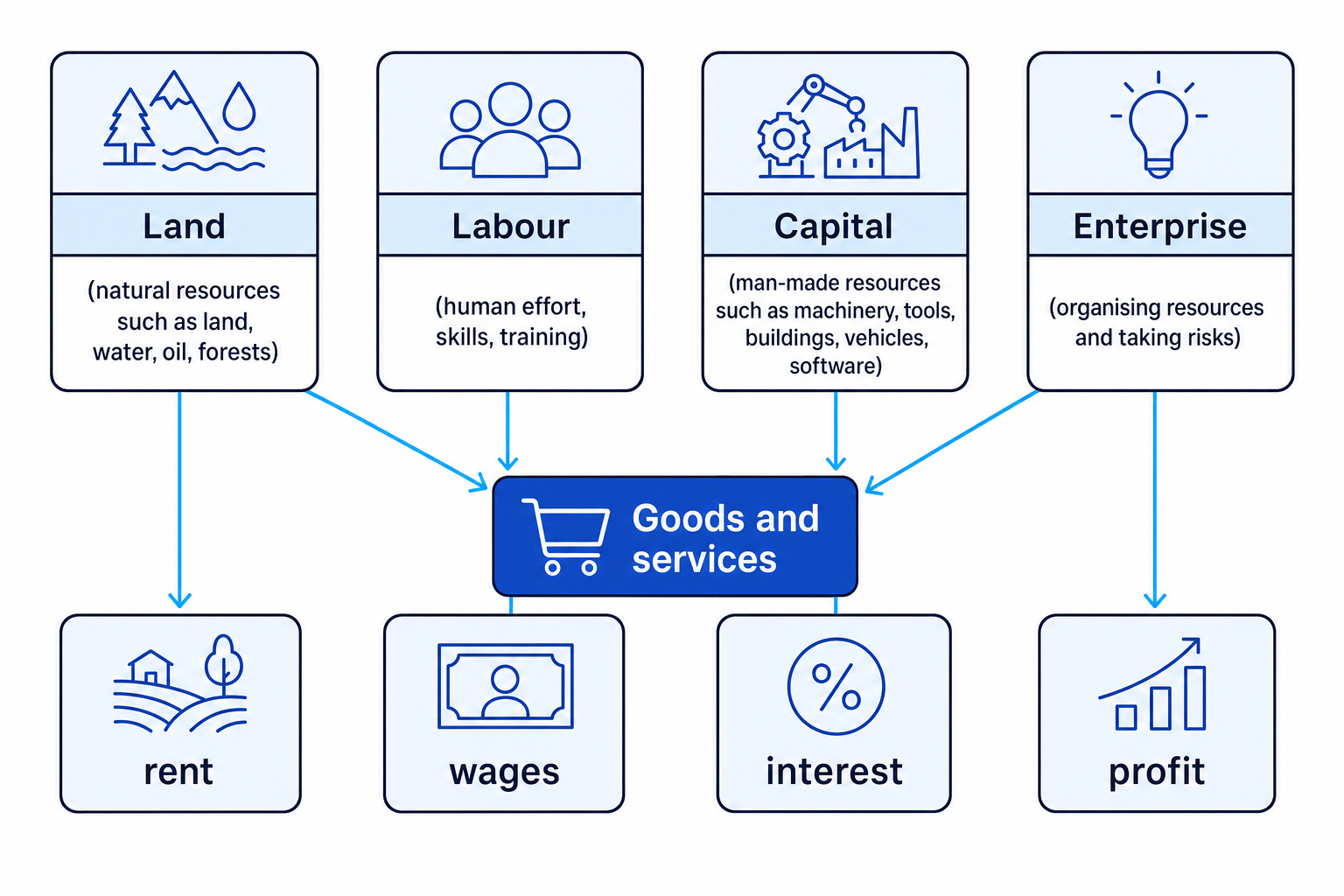
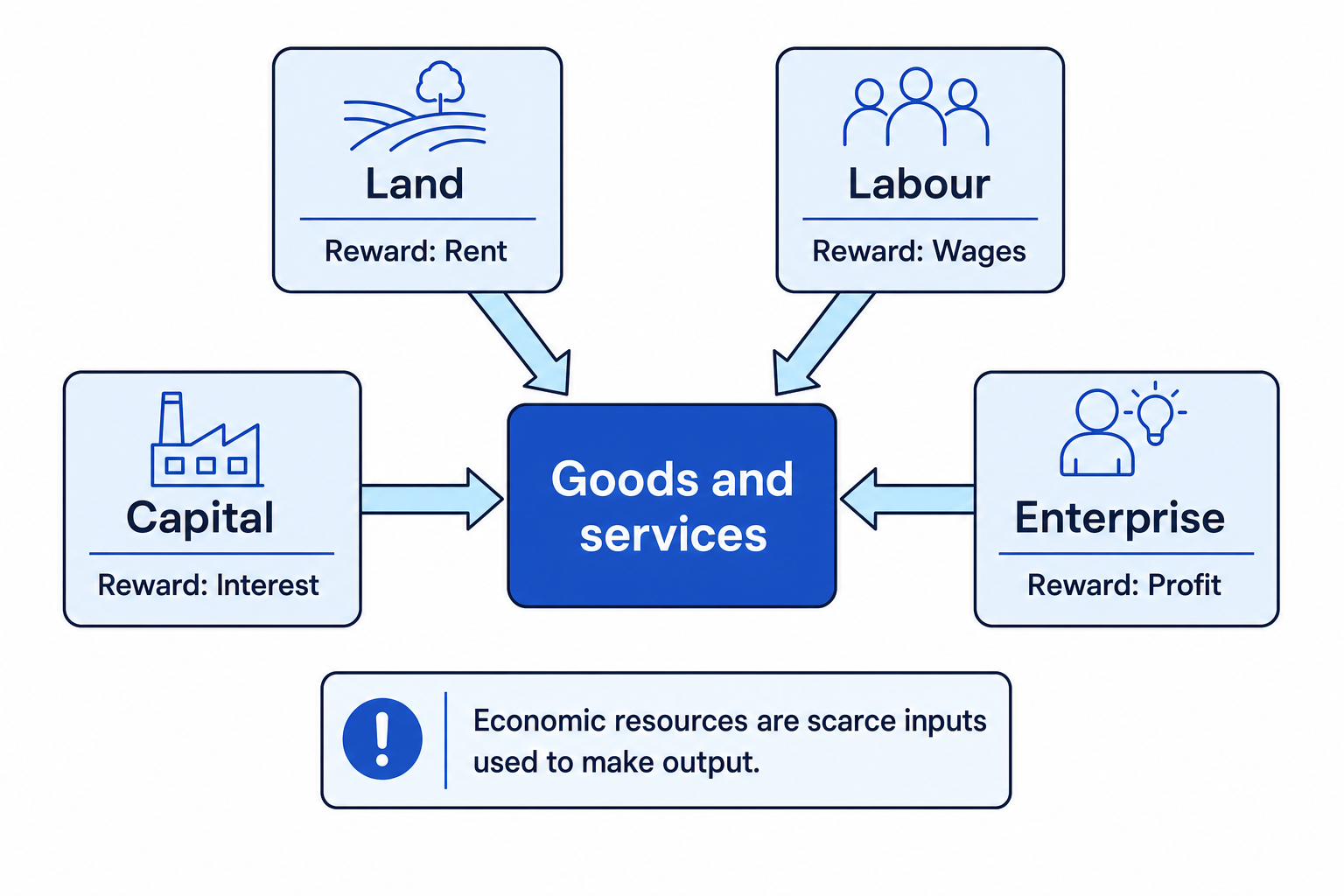
The diagram shows how the four factors of production flow into the production of goods and services, and the reward earned by each factor.
Land
In economics, land means natural resources used in production. It is much wider than just the ground under your feet.
Land
Land is all natural resources used to produce goods and services, including physical land, water, forests, oil, gas, minerals, fish and renewable resources such as wind and sunlight.
Examples of land include:
- farmland used to grow wheat
- oil and gas from the North Sea
- water used by a soft drinks factory
- lithium used in electric car batteries
- a town-centre site used for a shop
The reward for land is rent. Rent is the income earned by the owner of land or natural resources when they allow others to use them.
Reward for land
The reward for land is rent.
Land also raises sustainability issues. For example, using farmland for housing may increase the supply of homes, but it can reduce green space and affect wildlife. Extracting fossil fuels may support jobs and energy supply, but it can increase pollution and carbon emissions.
Labour
Labour means human effort used in production. It includes both physical and mental work.
Labour
Labour is the human input into production, including workers’ time, effort, skills, training and experience.
Examples of labour include:
- a nurse treating patients
- a software developer writing code
- a delivery driver working for Tesco
- a chef preparing food in a restaurant
- a teacher planning and delivering lessons
The reward for labour is wages. This can include hourly pay, salaries, bonuses and other payments for work.
Reward for labour
The reward for labour is wages.
Labour is not all the same. Some workers have more skills, training or experience than others. For example, a surgeon, electrician and supermarket assistant all provide labour, but their skills and pay are likely to differ.
Ethical issues can arise when firms try to reduce labour costs. Lower wages may reduce prices for consumers, but workers may face financial pressure, especially during periods such as the 2022–23 cost-of-living squeeze.
Capital
In everyday speech, people often use “capital” to mean money. In GCSE Economics, capital usually means man-made resources used to produce other goods and services.
Capital
Capital is man-made resources used in production, such as machinery, tools, factories, vehicles, computers, software and equipment.
Examples of capital include:
- ovens used by Greggs to bake pastries
- tills and self-checkouts in a supermarket
- delivery vans used by an online retailer
- robots used in car manufacturing
- laptops and software used by an accountancy firm
The reward for capital is interest. This is because firms often borrow money to buy capital goods, and the lender receives interest as payment.
Reward for capital
The reward for capital is interest.
Confusing capital with money
Money itself is not usually counted as the factor of production called capital. Money helps a firm buy capital goods, but the productive resource is the machine, building, vehicle or equipment.
Capital can make labour more productive. For example, a builder with a digger can move more earth than a builder using only a spade. However, replacing workers with machines can create moral and social concerns if it leads to job losses.
Enterprise
The fourth factor is enterprise. This is the factor that brings the other three together.
Enterprise
Enterprise is the ability and willingness to organise land, labour and capital to produce goods and services, while taking risks.
The person who shows enterprise is called an entrepreneur. Entrepreneurs make decisions such as:
- what product to sell
- which workers to hire
- what equipment to buy
- where to locate the business
- whether the risk is worth taking
The reward for enterprise is profit. Profit is the money left after business costs have been paid. However, enterprise involves risk, so entrepreneurs can make a loss instead.
Reward for enterprise
The reward for enterprise is profit.
Enterprise has been important in recent UK markets such as food delivery apps, streaming services and electric vehicles. Entrepreneurs spotted changing consumer habits and organised resources to meet demand.
Remember the four rewards
Use the order land, labour, capital, enterprise and match it to rent, wages, interest, profit.
Applying the four factors to a business
In exams, you may be asked to identify factors of production in a real situation. The key is to classify each input correctly.
Classifying inputs at a bakery
A Greggs branch uses a rented shop, staff, ovens, delivery vans, flour, electricity and managers to sell food to customers.
- Classify the natural resources as land: the physical shop site, flour from wheat and energy resources used to generate electricity all come from natural resources.
- Classify the human effort as labour: shop assistants, bakers, delivery drivers and managers provide time, skills and effort.
- Classify the man-made equipment as capital: ovens, tills, fridges and delivery vans are human-made resources used to produce or sell output.
- Classify the organising and risk-taking as enterprise: the entrepreneur or business owners decide to open the branch, combine the resources and accept the risk of profit or loss.
- Match the rewards: the landlord receives rent, workers receive wages, lenders or owners of capital may receive interest, and the entrepreneur aims to earn profit.
The four factors work together
No single factor usually produces output alone. A supermarket needs land for stores and warehouses, labour from staff, capital such as checkouts and lorries, and enterprise from managers and owners making decisions.
If one factor is missing, production may be limited. For example:
- A restaurant with skilled chefs but no premises cannot serve customers.
- A factory with machines but no workers may not operate fully.
- A business idea without funding or equipment may struggle to launch.
- Land and capital may sit unused if no entrepreneur organises production.
Ingredients and the recipe
The factors of production are like ingredients, but enterprise is like the recipe and the cook’s decision-making. Having flour, eggs and equipment is not enough unless someone organises them into a finished cake.
Rewards and who receives them
The word reward means the income earned from providing a factor of production.
| Factor of production | What it means | Reward | Who receives the reward? |
|---|---|---|---|
| Land | Natural resources | Rent | Landowners or owners of natural resources |
| Labour | Human effort, skills and time | Wages | Workers |
| Capital | Man-made resources used in production | Interest | Owners or lenders of capital |
| Enterprise | Organising resources and taking risk | Profit | Entrepreneurs or business owners |
This helps you analyse winners and losers. For example, if a new wind farm is built, landowners may earn rent, workers may earn wages, lenders may earn interest and entrepreneurs may earn profit. But local residents may object to noise or changes to the landscape. A good economics answer can recognise these trade-offs.
Forgetting the reward
Do not just name the factor. If the question asks for the reward, include the correct income: land earns rent, labour earns wages, capital earns interest and enterprise earns profit.
Why this topic matters
The factors of production link to many later GCSE Economics topics:
- Supply: if firms gain more or better resources, they may be able to produce more.
- Costs: wages, rent and interest are costs to businesses.
- Productivity: better capital or skilled labour can increase output per worker.
- Government policy: education improves labour, infrastructure supports capital, and planning rules affect land use.
- Sustainability: using land and natural resources can create environmental costs.
For example, after Brexit and COVID-19, some UK firms reported labour shortages. This made it harder to produce and deliver goods, contributing to higher costs in some markets. Energy-price shocks also affected land as a natural resource because oil and gas are part of land in the economic sense.
In the exam
- If asked to define an economic resource, link it to production and scarcity.
- If given a business scenario, classify each input as land, labour, capital or enterprise before explaining its role.
- When asked for rewards, use the exact pairs: land → rent, labour → wages, capital → interest, enterprise → profit.
Check yourself
- Why is oil counted as land in economics, even though it is not a field or building site?
- What is the difference between capital in everyday speech and capital as a factor of production?
- For a new coffee shop, can you identify one example of each factor of production and its reward?