What you'll learn
- Why the basic economic problem forces people, businesses and governments to make choices.
- How to compare the costs and benefits of different options.
- What opportunity cost means in everyday, business and government decisions.
- How to explain choices using real UK examples such as the cost-of-living squeeze, NHS spending and business investment.
3.1.1.3 Making choices: the big idea
Economics is about how people use limited resources to satisfy wants and needs. In this topic, you are learning the logic behind almost every economic decision: because resources are limited, we cannot have everything, so we must choose.
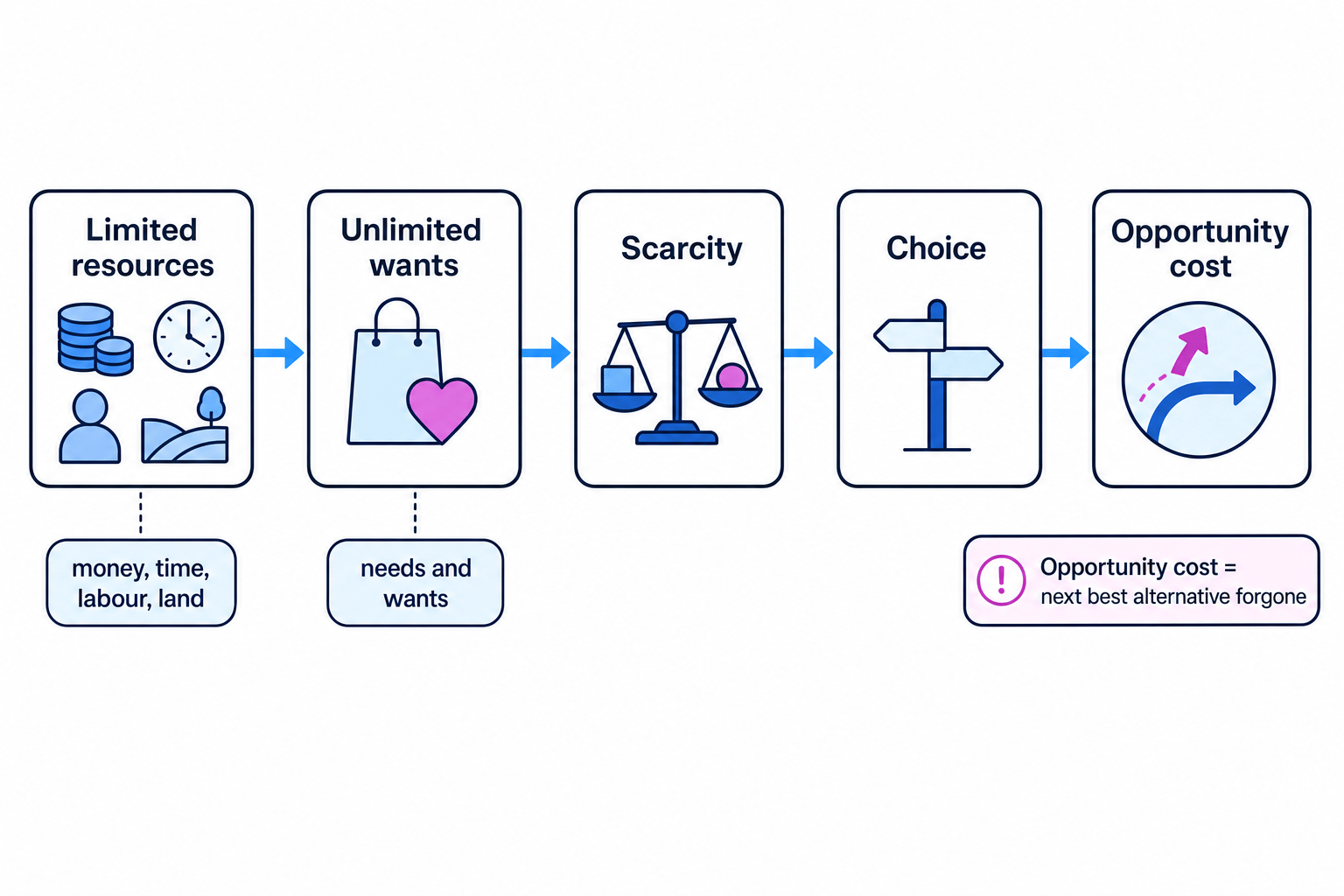
This chain is the heart of the topic: limited resources + unlimited wants → scarcity → choice → opportunity cost.
The basic economic problem
Before you can understand economic choices, you need three starting ideas: needs, wants and resources.
Needs and wants
A need is something necessary for survival or basic living, such as food, water, shelter, heating and healthcare.
A want is something people would like to have, but do not strictly need to survive. Examples include a new phone, a holiday, branded trainers or a streaming subscription.
The problem is that human wants are effectively unlimited. Even if you get one thing you want, you can usually think of something else you would also like.
Resources
A resource is anything used to produce goods and services. In economics, these include the factors of production:
- Land: natural resources, such as oil, farmland, water and forests.
- Labour: human effort, skills and time.
- Capital: human-made resources used to produce other goods and services, such as machines, factories and delivery vans.
- Enterprise: the ability to organise the other factors of production and take risks to start or run a business.
These resources are limited. A worker only has so many hours. A government only has so much tax revenue. A business only has so much money to invest.
The basic economic problem
The basic economic problem is that people have unlimited wants, but the resources used to satisfy those wants are limited.
Why choices are unavoidable
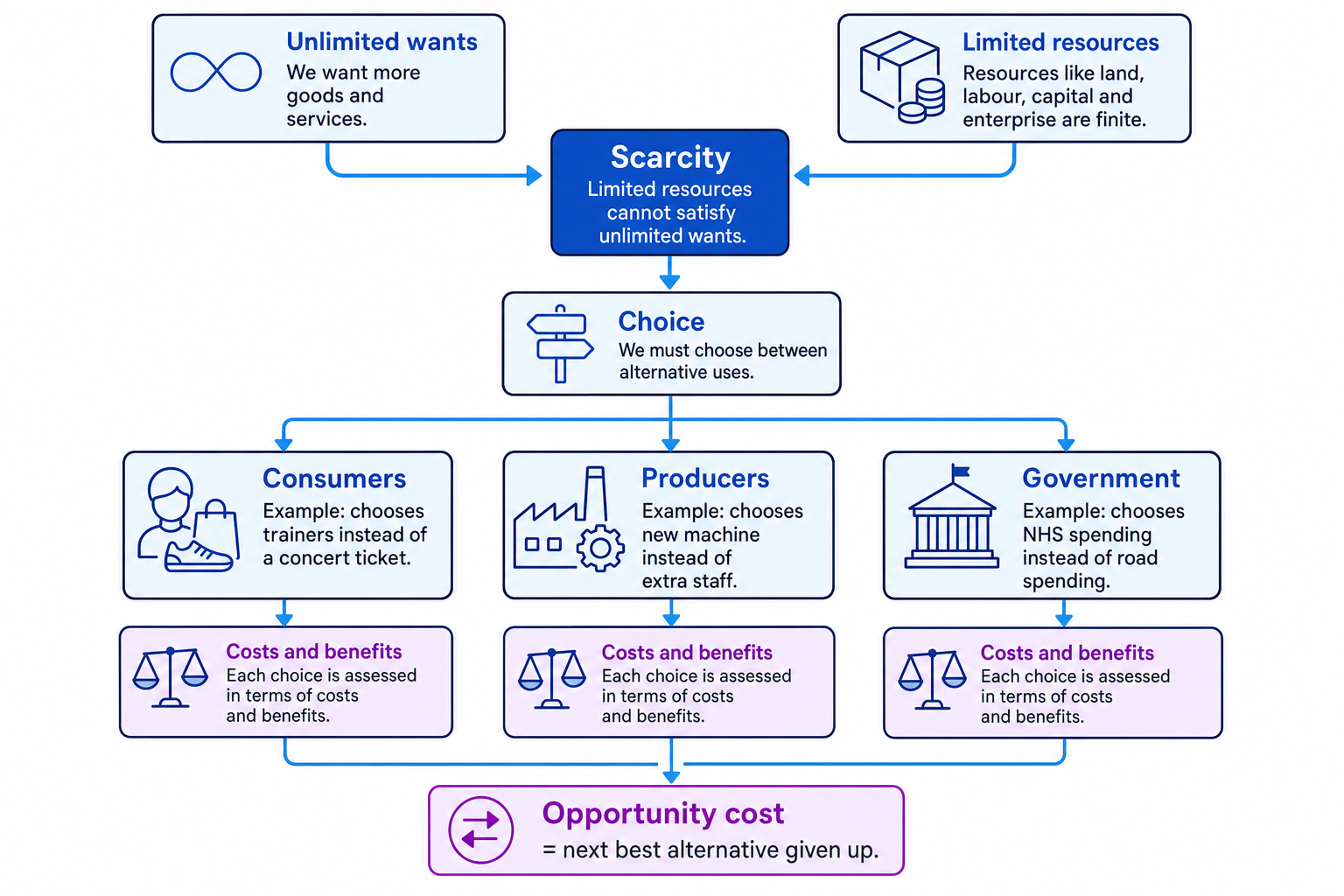
Because resources are scarce, every economic group — consumers, producers and governments — must decide how best to use them.
Scarcity and choice
Scarcity means there is not enough of something to satisfy everyone’s wants fully. Scarcity does not always mean “there is none left”; it means there is not enough for every possible use.
For example, during the 2022–23 cost-of-living squeeze, many UK households faced higher energy, food and mortgage costs. Their income had to cover more expensive essentials, so they had to make harder choices about non-essential spending.
Scarcity
Scarcity exists when limited resources cannot fully satisfy unlimited wants.
Who makes economic choices?
Economic choices are made by different groups:
- Consumers choose how to spend their income, such as whether to buy lunch from Greggs or save the money.
- Producers choose how to use resources to make goods and services, such as whether Tesco should open more self-checkouts or employ more staff.
- Governments choose how to spend tax revenue, such as whether to prioritise NHS funding, defence, schools, roads or support with energy bills.
These groups often face different aims. A consumer may want value for money. A producer may want profit. A government may want to improve living standards, reduce inequality or protect the environment.
Costs and benefits of economic choices
When making a choice, people often weigh up costs and benefits.
A cost is something negative or something given up as a result of a decision. Costs can be financial, such as paying £40 for a train ticket, but they can also be non-financial, such as time, effort, stress or environmental damage.
A benefit is something positive gained from a decision. Benefits can also be financial or non-financial. For example, a business may benefit from higher sales, while a consumer may benefit from convenience or enjoyment.
Costs and benefits
A cost is what is paid, lost or sacrificed when making a choice. A benefit is what is gained from that choice.
Weighing costs and benefits
A sensible economic choice usually involves comparing the expected benefits with the expected costs.
This does not mean people always choose the cheapest option. They may choose the option with the greatest overall benefit to them. For example, you might pay more for a warmer coat because it lasts longer, keeps you comfortable and saves replacing it next year.
Weighing the costs and benefits of a consumer choice
You have £30 to spend on Saturday. You are choosing between going to the cinema with snacks or buying a hoodie in a sale.
-
Compare the money cost: the cinema trip costs £18, while the hoodie costs £30, so the hoodie uses all your available money.
-
Compare the benefits: the cinema gives short-term enjoyment with friends, while the hoodie may be useful for months.
-
Compare what matters most in this situation: if you need warmer clothing, the longer-lasting benefit of the hoodie may outweigh the extra £12 cost.
-
Make a reasoned choice: choosing the hoodie could be economically sensible because the benefit lasts longer, even though it has the higher money cost.
Costs are not always money
In Economics, “cost” can mean more than price. Time, convenience, stress, health, pollution and fairness can all matter when weighing up a choice.
Opportunity cost
Because choosing one option means rejecting another, economists use the idea of opportunity cost.
Opportunity cost
Opportunity cost is the value of the next best alternative given up when a choice is made.
The phrase “next best” is important. Opportunity cost is not every possible thing you give up. It is the best alternative you would have chosen if your first choice was not available.
For example, if a council spends money improving a leisure centre, it cannot spend the same money filling potholes. If pothole repairs were the next best alternative, then that is the opportunity cost.
The sentence to remember
The opportunity cost of a choice is the next best alternative forgone.
Opportunity cost for consumers
Consumers face opportunity costs because income and time are limited.
If you spend £12 on a takeaway, you cannot spend that same £12 on saving, transport or a birthday present. If the birthday present was your next best option, that is the opportunity cost.
Identifying opportunity cost for a consumer
Mia has £25. Her options are: buy a concert ticket, buy a video game, or save the money. She prefers the concert ticket most, the video game second, and saving third.
-
Identify the choice made: Mia chooses the concert ticket.
-
Identify the next best alternative: her second favourite option is the video game.
-
State the opportunity cost: the opportunity cost of the concert ticket is the video game she gives up.
Listing all the alternatives
Do not say the opportunity cost is “the video game and saving the money”. Opportunity cost is only the next best alternative, not every rejected option.
Opportunity cost in economic activity
Economic activity means the production, distribution and consumption of goods and services. Opportunity cost appears throughout economic activity because resources can usually be used in more than one way.
Producers and opportunity cost
A producer is a business or organisation that makes goods or provides services. Producers must decide how to use limited resources such as workers, machinery, buildings and money.
For example, a small bakery may choose between buying a new oven or hiring another worker. The oven might increase output, but the extra worker might improve customer service. The business cannot do both if it has limited funds.
Opportunity cost for a producer
A café has £4,000 available. It can either buy a new coffee machine or refurbish its seating area. The owner expects the coffee machine to increase weekly sales by £250, while the seating area may improve customer comfort and increase weekly sales by £150.
-
Compare the expected benefits: the coffee machine is expected to add £250 per week, while the seating area is expected to add £150 per week.
-
Choose the option with the larger expected financial benefit: the café chooses the coffee machine.
-
Identify the next best alternative given up: the seating refurbishment is the opportunity cost.
-
Add judgement: the café might still choose the seating area if customer comfort and long-term reputation matter more than short-term weekly sales.
This is where evaluation matters. Economics is not just about choosing the biggest number. A business may consider customer loyalty, worker wellbeing, environmental impact and brand reputation.
Governments and opportunity cost
A government also faces opportunity costs because tax revenue is limited. If the UK government spends more on one area, it may have less available for another area, unless it raises taxes, borrows more or cuts spending elsewhere.
For example, after COVID-19, the government faced pressure to spend on the NHS, education catch-up, business support, energy bills and debt interest. More spending on one priority could mean less spending on another.
Government choices often involve moral and ethical issues. Spending more on healthcare may save lives, but spending more on education may improve future opportunities. Investing in renewable energy may support sustainability, but it may require upfront costs now.
Opportunity cost for government spending
A local council has £2 million available. It can either improve bus services or repair a flood defence. It chooses the flood defence because recent storms have increased the risk of serious damage.
-
Identify the chosen option: the council spends £2 million on the flood defence.
-
Identify the next best alternative: improving bus services was the other best use of the funds.
-
State the opportunity cost: the opportunity cost is the improved bus service that residents do not receive.
-
Add analysis: the choice may be justified if flood damage would create larger costs for homes and businesses than poor bus services.
Making a good economic judgement
In GCSE Economics, you often need to move beyond definitions. A strong answer explains why a choice is made and who gains or loses.
When analysing a choice, ask:
- What resources are limited?
- What options are available?
- What are the costs and benefits of each option?
- What is the next best alternative given up?
- Are there wider effects on other people, society or the environment?
For example, a supermarket may choose to install more self-checkouts. The benefit could be lower labour costs and shorter queues. The cost could be fewer jobs, more customer frustration and greater exclusion for people who struggle with technology. The opportunity cost might be hiring more checkout staff instead.
Use real-world context
You can apply this topic to almost anything: household budgets during inflation, Bank of England interest-rate rises affecting borrowers and savers, NHS waiting lists, energy-price support, or firms choosing whether to raise wages.
Putting it all together
The topic “Making choices” is small but powerful. It explains why economics exists in the first place.
If resources were unlimited, there would be no need to choose. But in the real world, resources such as money, time, workers, land and raw materials are scarce. That means every choice has a cost, and the most important cost is often the opportunity cost: the next best alternative forgone.
In the exam
-
Define key terms precisely: scarcity means limited resources and unlimited wants; opportunity cost means the next best alternative forgone.
-
Apply your answer to the context given, such as a household, firm or government, rather than writing a generic definition only.
-
When judging a choice, weigh costs against benefits and mention the opportunity cost before reaching a clear conclusion.
Check yourself
- Why does scarcity force consumers, producers and governments to make choices?
- What is the difference between a money cost and an opportunity cost?
- If the government spends more on the NHS, what might be the opportunity cost?