

What you'll learn
- The difference between needs and wants, and why this can change over time.
- Why the central purpose of economic activity is to produce goods and services.
- The three key economic decisions: what, how, and who benefits.
- How consumers, producers and government interact in the economy.
3.1.1.1 Economic activity: the starting point
Economics begins with a simple problem: people need and want lots of things, but the resources used to make them are limited. Because we cannot produce everything for everyone, choices have to be made.
Economic activity
Economic activity is the production, exchange and use of goods and services. In GCSE Economics, the central purpose of economic activity is the production of goods and services to satisfy needs and wants.
Needs and wants
A need is something essential. A want is something desirable, but not essential.
Needs and wants
- A need is something required for survival or a basic standard of living, such as food, water, shelter, heating and basic healthcare.
- A want is something people would like to have, but could live without, such as designer trainers, a games console upgrade or a premium streaming subscription.
This is not always fixed forever. Needs and wants can change over time because of technology, income, age, social expectations and world events.
For example, home internet access may once have seemed like a luxury. Now, for many students and workers, it is much closer to a need because schoolwork, job applications, banking and healthcare appointments often rely on online access. During COVID-19, items such as masks, hand sanitiser and home delivery became much more important for many households.
Need or want?
Do not decide only from the product name. Ask what the item is being used for and what the person’s circumstances are. A basic phone for safety may be a need; the newest phone with a better camera is more likely to be a want.
Classifying needs and wants
A Year 11 student says, “I need a new phone.” How could you judge this economically?
- Identify the essential function: the student may need a way to contact family, access school messages and complete online tasks.
- Separate the basic function from extra features: a working, affordable phone may meet the need, but a top-of-the-range model mainly adds wants such as a better camera or larger screen.
- Consider the context: if the old phone is broken and the student relies on it for school and safety, replacing it may be a need; choosing the newest model is still a want.
Goods, services and production
Economic activity produces goods and services.
Goods, services and production
- Goods are physical products you can touch, such as bread, school uniforms, smartphones or cars.
- Services are activities done for people, such as haircuts, bus journeys, tutoring, banking or healthcare.
- Production means making goods or providing services using resources such as workers, equipment, buildings and raw materials.
A Tesco meal deal is mainly a good. A haircut is a service. A train journey is also a service, even though trains, tracks and stations are physical things used to provide it.
Central purpose
The central purpose of economic activity is not simply “making money”. The bigger economic purpose is producing goods and services that satisfy people’s needs and wants.
Producers may aim to earn profit, workers may aim to earn wages, and government may aim to improve living standards. But all of this is connected to satisfying needs and wants.
From a need to economic activity
Think about the need for warm homes during winter.
- Start with the need: households need heating to maintain a safe basic standard of living.
- Identify the goods and services involved: energy companies supply gas and electricity, engineers repair boilers, and shops sell insulation products.
- Connect this to wider economic activity: producers employ workers, households pay bills, and government may regulate energy suppliers or provide support during an energy-price shock.
The three key economic decisions
Because resources are limited, every economy has to answer three key questions.
Scarcity
Scarcity means resources are limited, while people’s needs and wants are greater than what can be produced.
| Key decision | What it means | Example |
|---|---|---|
| What to produce? | Which goods and services should be made, and in what quantities? | Should a bakery produce more bread, cakes, vegan options or sandwiches? |
| How to produce? | Which resources and methods should be used? | Should a supermarket use more self-checkouts, more staff, or more online delivery technology? |
| Who is to benefit? | Who receives the goods and services produced? | Are products sold only to people who can pay, or are some provided by government according to need? |
The “how” question often involves moral, ethical and sustainability issues. A producer might choose cheaper packaging to reduce costs, but that could create more plastic waste. A business might use automation to lower prices, but some workers may lose jobs. These choices create winners and losers.
Remember the three decisions
Use What? How? Who benefits? as your quick checklist whenever a question asks about economic choices.
Applying the three key decisions
A new café opens near a school. How do the three key economic decisions apply?
- Decide what to produce: the café might choose sandwiches, hot drinks and low-cost snacks because students and staff want quick, affordable food.
- Decide how to produce: it could use local ingredients and more staff, which may support jobs but raise costs, or use pre-packaged food, which may be cheaper but less fresh.
- Decide who benefits: students benefit if prices are affordable, workers benefit from wages, the owner may benefit from profit, and government may receive tax revenue.
The main economic groups
The three main economic groups in this topic are consumers, producers and government.
Main economic groups
- Consumers are people or households who buy and use goods and services to satisfy needs and wants.
- Producers are firms or organisations that make goods or provide services, such as Greggs, Tesco, Netflix, local plumbers or train companies.
- Government is the public authority that makes laws, collects taxes and provides or funds public services such as education, healthcare, policing and roads.
A tax is a compulsory payment to government. A market is any place or system where buyers and sellers exchange goods and services, such as a high street shop, a supermarket, an app or an online platform.
How consumers, producers and government interact
The economy is not three separate groups acting alone. They constantly affect one another.
Consumers buy goods and services from producers. Producers receive money, then use it to pay costs, employ workers and produce more. Many consumers are also workers, so they earn wages from producers. Government collects taxes from consumers and producers, then uses tax revenue to fund public services, laws, regulation and support.
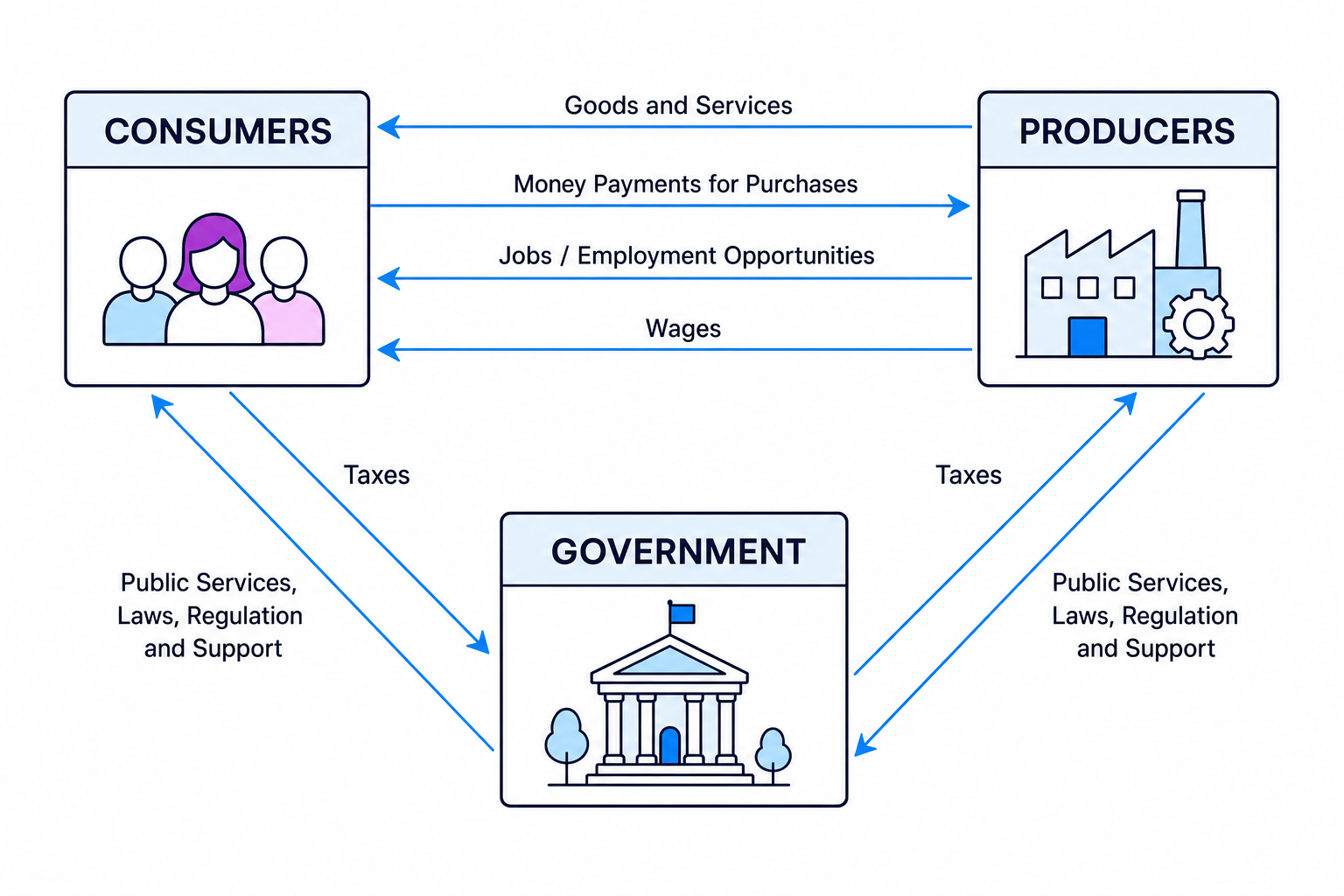
These interactions are easy to see in recent UK events. During COVID-19, consumers bought more home delivery and streaming services. Producers adjusted by expanding delivery, online ordering and digital services. Government affected both groups through lockdown rules, furlough support and public health guidance.
During the 2022–23 cost-of-living squeeze, many consumers prioritised needs such as food, rent and heating over wants such as eating out. Producers responded with value ranges, discounts or smaller pack sizes. Government support, tax decisions and regulation also affected households and businesses.
Tracing interactions during a cost-of-living squeeze
A household cuts back on takeaway meals because food and energy bills have risen.
- Link the consumer to the producer: the household buys fewer takeaways, so local restaurants receive less revenue.
- Explain the producer response: restaurants may offer discounts, reduce opening hours, change menus or look for cheaper suppliers.
- Add the government link: government may support households with energy payments, while still collecting taxes that help fund public services.
The economy is connected
A decision by one group often affects the others. Consumers influence what producers sell; producers influence jobs, wages and prices; government influences both through taxes, laws, spending and support.
Bringing it together
Economic activity exists because people have needs and wants. To satisfy them, goods and services must be produced. But because resources are limited, choices must be made about what to produce, how to produce it, and who benefits from it.
For GCSE Economics, always try to move beyond naming the groups. Explain the relationship between them. A strong answer might show that consumers create demand, producers supply goods and services, and government shapes behaviour through laws, taxes and public services.
In the exam
- If asked about needs and wants, explain that the difference depends on purpose, circumstances and time.
- If asked about economic choices, structure your answer around what to produce, how to produce, and who benefits.
- If asked about interactions, name at least two groups and show a clear two-way link, such as consumers paying producers and producers supplying goods, services or jobs.
Check yourself
- Give one example of something that used to be a want but may now be closer to a need. Why has it changed?
- What are the three key economic decisions every economy must make?
- How might a rise in food prices affect consumers, producers and government?
