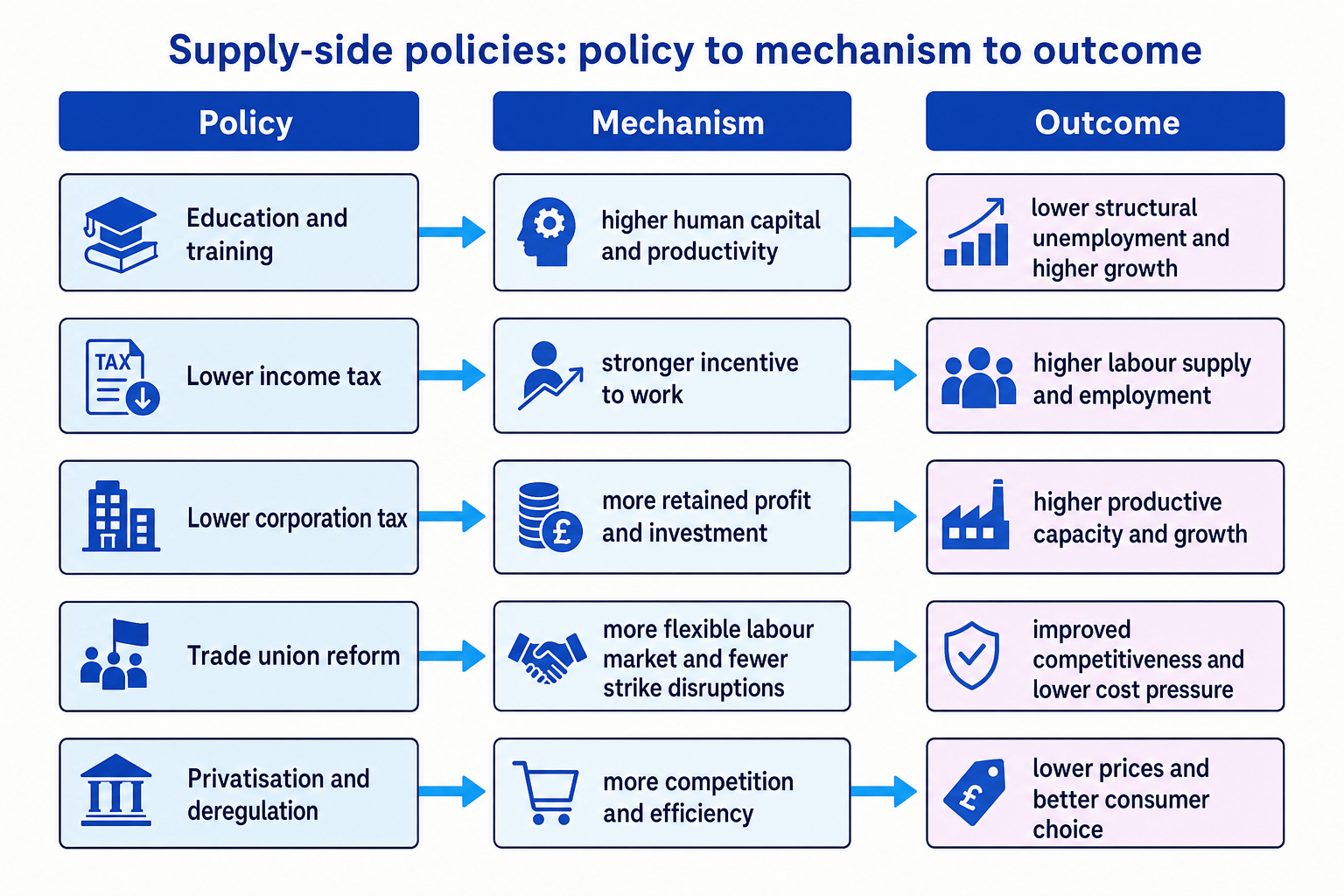
What you'll learn
- What supply-side policies are and why governments use them.
- How education, tax changes, trade union reform, privatisation and deregulation can affect the economy.
- The main advantages, disadvantages and trade-offs of these policies.
- How to link supply-side policies to government objectives in GCSE Economics answers.
3.2.3.3 Supply-side policies
Starting point: what is the government trying to manage?
In this topic, you are still in the wider section How the government manages the economy. Governments usually aim for objectives such as:
- economic growth — an increase in the value of goods and services produced in the economy
- low unemployment — more people who want work are able to find jobs
- low and stable inflation — prices rise slowly and predictably
- a sustainable balance of payments — the UK can pay for imports using income from exports and other international flows
- improved living standards — people can enjoy better income, services, health and opportunities
Supply-side policies are one way to try to achieve these objectives, especially in the long run.
Supply-side policy
A supply-side policy is a government policy designed to increase the economy’s ability to produce goods and services by improving productivity, incentives, efficiency or competition.
The supply side is about what firms and workers are able and willing to produce. This depends on things like skills, technology, investment, taxes, labour-market rules and how competitive markets are.
Productivity means output per input. For example, if workers can produce more per hour because they have better training or equipment, productivity has risen.
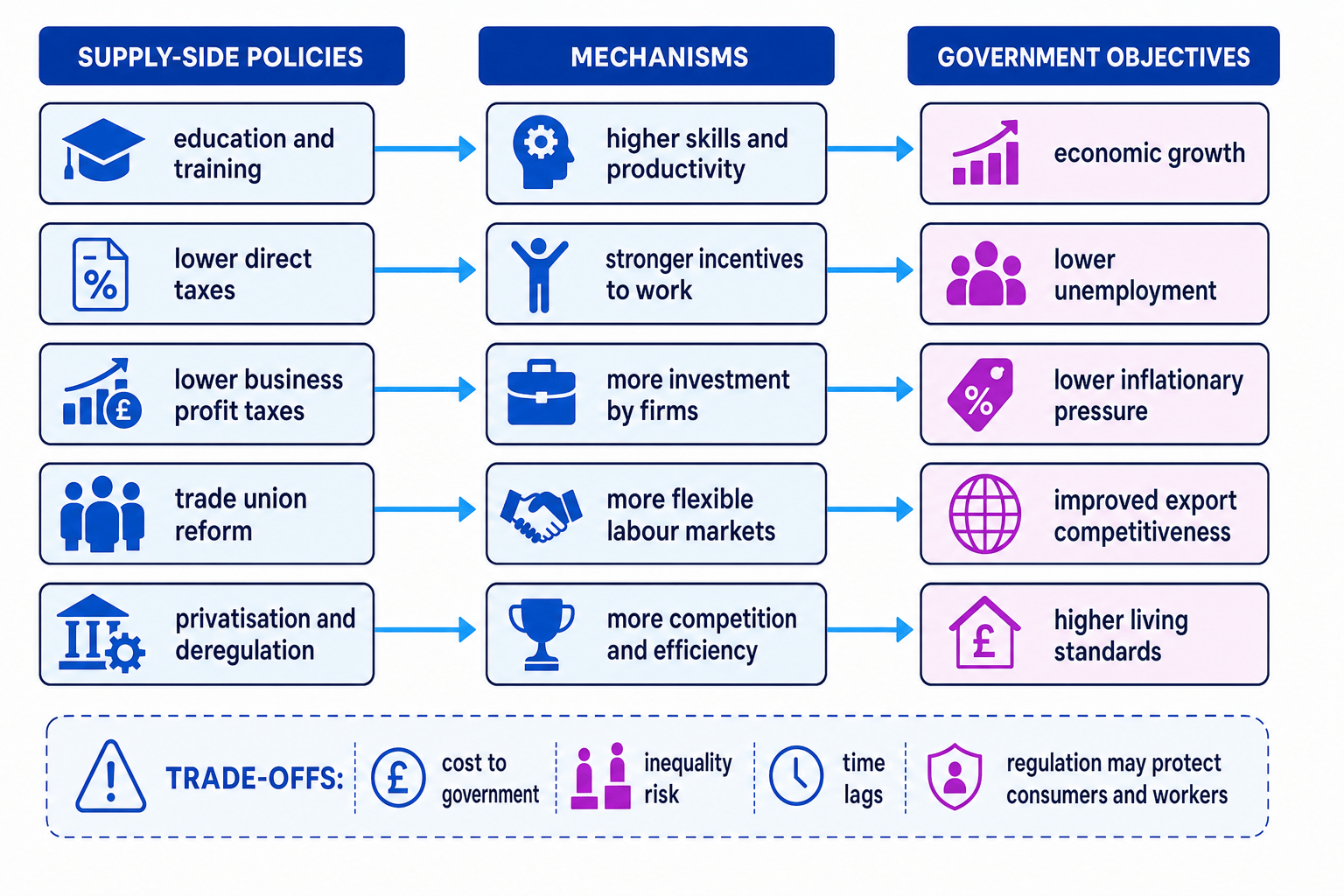
The diagram below shows the main supply-side policies in this GCSE topic and the routes through which they may help government objectives.
The basic chain
A strong supply-side answer links policy → mechanism → objective → evaluation. For example: training improves skills, which raises productivity, which supports growth, but it costs money and takes time.
Why use supply-side policies?
Demand-side policies, such as changing government spending or interest rates, often try to influence total spending in the economy. Supply-side policies focus more on the economy’s capacity to produce.
If supply-side policies work, they can help the economy produce more without as much upward pressure on prices. This matters after events like the COVID-19 pandemic, Brexit-related labour shortages, and the 2022–23 inflation spike, when the UK faced problems with skills, supply chains, energy costs and living standards.
Confusing supply-side with demand-side
A tax cut is not automatically a supply-side policy. It is supply-side when you explain how it improves incentives, investment, productivity or competition — not just because it gives people more money to spend.
Main supply-side policies
1. Investment in education and training
Education and training improve human capital, which means the skills, knowledge and experience of workers.
Examples include apprenticeships, vocational courses, digital skills training, and retraining workers for green industries such as insulation, renewable energy and electric vehicle maintenance.
This can help because better-trained workers are often more productive. Firms may produce more output with the same number of workers, or produce higher-quality goods and services. Training can also reduce structural unemployment, which happens when workers’ skills do not match the jobs available.
Advantages:
- Raises productivity and long-term economic growth.
- Helps workers earn higher wages.
- Can reduce unemployment caused by skills shortages.
- May improve UK competitiveness if firms produce better-quality goods.
Disadvantages:
- Expensive for the government, so there is an opportunity cost: money spent on training cannot be spent elsewhere.
- Benefits may take years to appear.
- Training may not match what firms actually need.
- Some workers may not be able to access training equally, raising ethical concerns.
2. Lower direct taxes
A direct tax is a tax paid directly to the government by the person or organisation it is imposed on. Examples include income tax, paid on earnings, and taxes linked to business profits.
Lower income tax can increase the incentive to work because workers keep more of each extra pound they earn. This may encourage people to work longer hours, take promotions, return to work, or move into higher-paid jobs.
Advantages:
- Can increase incentives to work.
- May increase labour supply, helping firms fill vacancies.
- Can raise disposable income, which may improve living standards.
Disadvantages:
- Reduces tax revenue in the short run, making it harder to fund public services such as the NHS or schools.
- May increase inequality if higher earners gain the most.
- If people do not respond by working more, the supply-side effect may be weak.
- If the economy is already close to full capacity, extra spending could add to inflation.
3. Lower taxes on business profits
A tax on business profits is often called corporation tax. Lower taxes on profits mean firms keep more of their profit after tax.
The supply-side argument is that firms may use extra retained profit to invest in new machinery, technology, research and development, or worker training. This can increase productive capacity.
Calculating the effect of a lower profit tax
-
A firm makes £500,000 profit. At a 20% profit tax rate, the tax bill is £500,000×0.20=£100,000\pounds 500{,}000 \times 0.20 = \pounds 100{,}000£500,000×0.20=£100,000, so profit after tax is £500,000−£100,000=£400,000\pounds 500{,}000 - \pounds 100{,}000 = \pounds 400{,}000£500,000−£100,000=£400,000.
-
If the tax rate falls to 15%, the tax bill is £500,000×0.15=£75,000\pounds 500{,}000 \times 0.15 = \pounds 75{,}000£500,000×0.15=£75,000, so profit after tax is £500,000−£75,000=£425,000\pounds 500{,}000 - \pounds 75{,}000 = \pounds 425{,}000£500,000−£75,000=£425,000.
-
The firm keeps an extra £25,000 after tax. This could fund investment, but the evaluation point is that the firm might instead pay higher dividends to shareholders or hold the money as cash.
Advantages:
- May encourage business investment.
- Can attract foreign firms to locate in the UK.
- May support innovation and productivity.
- Could create jobs if firms expand.
Disadvantages:
- Government receives less tax revenue.
- Firms may not invest if business confidence is low.
- Benefits may go mainly to shareholders rather than workers.
- Other countries may respond with their own tax cuts, creating tax competition.
4. Trade union reform
A trade union is an organisation that represents workers, often negotiating pay and working conditions with employers.
Trade union reform means changing the laws or rules affecting trade unions. For example, the government might make strike action harder, change voting rules for strikes, or limit the power of unions in wage bargaining.
The supply-side argument is that weaker union power can make labour markets more flexible. Firms may face fewer disruptions from strikes and may be more willing to hire workers if wage costs are easier to control.
This became especially relevant during the 2022–23 cost-of-living squeeze, when many UK workers took strike action over pay falling behind inflation.
Advantages:
- May reduce disruption from strikes.
- Could reduce wage pressure on firms.
- May make firms more confident about hiring and investing.
- Could improve competitiveness if labour costs grow more slowly.
Disadvantages:
- Workers may have less bargaining power.
- Pay and working conditions may worsen.
- Inequality may increase.
- Lower morale can reduce productivity.
- There are ethical issues: workers may need unions to protect safety, fairness and basic rights.
5. Privatisation and deregulation
The public sector is the part of the economy owned or controlled by the government. The private sector is owned by individuals, firms or shareholders.
Privatisation means transferring a business or service from public-sector ownership to private-sector ownership.
Deregulation means reducing or removing government rules in a market.
The supply-side argument is that private firms and more competitive markets may have stronger incentives to cut costs, innovate and improve efficiency.
For example, competition in telecoms and streaming services can encourage firms to improve quality and lower prices. However, essential services such as water, rail and energy show why regulation may still be important.
Deregulation is not always better
Some regulations protect consumers, workers and the environment. Removing rules can reduce business costs, but it may also lead to unsafe products, poor working conditions or environmental damage.
Advantages:
- May increase efficiency due to the profit motive.
- Can increase competition if new firms enter the market.
- May reduce costs and prices for consumers.
- Privatisation can raise money for the government when assets are sold.
Disadvantages:
- A private monopoly may exploit consumers if competition is weak.
- Firms may prioritise profit over service quality.
- Essential services may become less affordable for low-income households.
- Deregulation can create sustainability problems, such as pollution or overuse of natural resources.
How supply-side policies help government objectives
Supply-side policies can support objectives in several ways:
- Economic growth: higher productivity and investment allow the economy to produce more goods and services.
- Lower unemployment: training helps workers fill vacancies, while lower taxes may increase incentives to work.
- Lower inflationary pressure: if firms can produce more cheaply and efficiently, cost pressures may fall in the long run.
- Better trade performance: more productive UK firms may become more competitive, helping exports.
- Higher living standards: workers may gain better jobs and higher wages if skills and productivity improve.
Choosing a supply-side policy for a government objective
-
Suppose the government wants to reduce unemployment in areas where workers lack digital skills. A suitable supply-side policy is investment in training, because the problem is a skills mismatch.
-
Training can increase human capital, so workers become more employable and firms can fill vacancies more easily. This supports lower unemployment and higher output.
-
The judgement is that training is likely to help in the long run, but it may not solve unemployment quickly because courses take time and some workers may need financial support while retraining.
Overall advantages and disadvantages
Advantages of supply-side policies
Supply-side policies can improve the economy’s long-term performance. They may raise productivity, increase employment, improve competitiveness and reduce inflationary pressure. They can also make the economy more resilient after shocks, such as pandemics, energy price rises or supply-chain disruption.
Disadvantages of supply-side policies
Many supply-side policies have time lags, meaning the effects take time to appear. They may also involve difficult trade-offs. For example, education spending costs money, tax cuts reduce government revenue, and deregulation may reduce protections.
Evaluation shortcut
Use “it depends on…” to evaluate: it depends on the size of the policy, how firms and workers respond, the state of the economy, time lags, and whether the benefits are fairly shared.
Moral, ethical and sustainability considerations
Supply-side policies are not just technical economic tools. They affect people’s lives.
Lower taxes may encourage enterprise, but they can also reduce funding for public services. Trade union reform may reduce disruption for businesses, but it can weaken worker protection. Deregulation may cut costs, but it can damage the environment if firms are allowed to pollute more easily.
A strong answer recognises both efficiency and fairness.
In the exam
-
Name the policy precisely — for example, “investment in apprenticeships” is stronger than just “training”.
-
Explain the mechanism — show how the policy affects skills, incentives, investment, flexibility or competition.
-
Link to an objective and evaluate — connect it to growth, unemployment, inflation or trade, then add a limitation such as cost, time lag, inequality or uncertainty.
Check yourself
- How could investment in education and training reduce structural unemployment?
- Why might a lower corporation tax rate fail to increase investment?
- What is one advantage and one disadvantage of deregulation?