

What you'll learn
- What monetary policy means and who controls it in the UK.
- How interest rates affect saving, borrowing, spending and investment.
- How monetary policy can help control inflation.
- How it can also affect economic growth, unemployment and the balance of payments.
3.2.3.2 Monetary policy
Start with the big picture: government objectives
Governments try to manage the economy to meet several economic objectives. These include stable prices, economic growth, low unemployment, a fairer distribution of income, and a healthy balance of payments.
Monetary policy is one of the main tools used to help achieve these objectives.
Monetary policy
Monetary policy is the use of interest rates and the money supply to influence borrowing, saving, spending, investment, inflation and economic activity.
In the UK, monetary policy is mainly carried out by the Bank of England, not directly by the government. The government sets the inflation target, and the Bank of England tries to meet it.
Bank of England Bank Rate
The Bank Rate, sometimes called the base rate, is the interest rate set by the Bank of England. It influences the interest rates that commercial banks charge borrowers and offer to savers.
Key prerequisite: what interest rates do
An interest rate is the cost of borrowing money or the reward for saving money.
If interest rates rise:
- borrowing becomes more expensive
- saving becomes more rewarding
- households may spend less
- firms may invest less
If interest rates fall:
- borrowing becomes cheaper
- saving becomes less rewarding
- households may spend more
- firms may invest more
Calculating interest after a rate rise
A saver has £2,000 in a savings account. The annual interest rate rises from 2% to 5%.
-
Calculate the old annual interest: £2,000×0.02=£40\pounds 2{,}000 \times 0.02 = \pounds 40£2,000×0.02=£40.
-
Calculate the new annual interest: £2,000×0.05=£100\pounds 2{,}000 \times 0.05 = \pounds 100£2,000×0.05=£100.
-
Compare the two amounts: £100 − £40 = £60 more interest per year, so saving becomes more attractive and spending may fall.
Monetary policy is not fiscal policy
Monetary policy is about interest rates and the money supply. Fiscal policy is about government spending and taxation.
How monetary policy controls inflation
Inflation
Inflation is a rise in the general price level over time. In the UK it is commonly measured using the Consumer Prices Index, or CPI.
The UK government’s inflation target is 2% CPI inflation. The Bank of England’s job is to keep inflation close to this target.
If inflation is too high, the Bank of England can use contractionary monetary policy.
Contractionary monetary policy
Contractionary monetary policy is policy designed to reduce spending pressure in the economy, usually by raising interest rates or reducing the money supply.
The main chain is:
Bank Rate rises → banks raise lending and saving rates → borrowing falls and saving rises → spending and investment fall → demand in the economy falls → upward pressure on prices eases → inflation falls towards target.
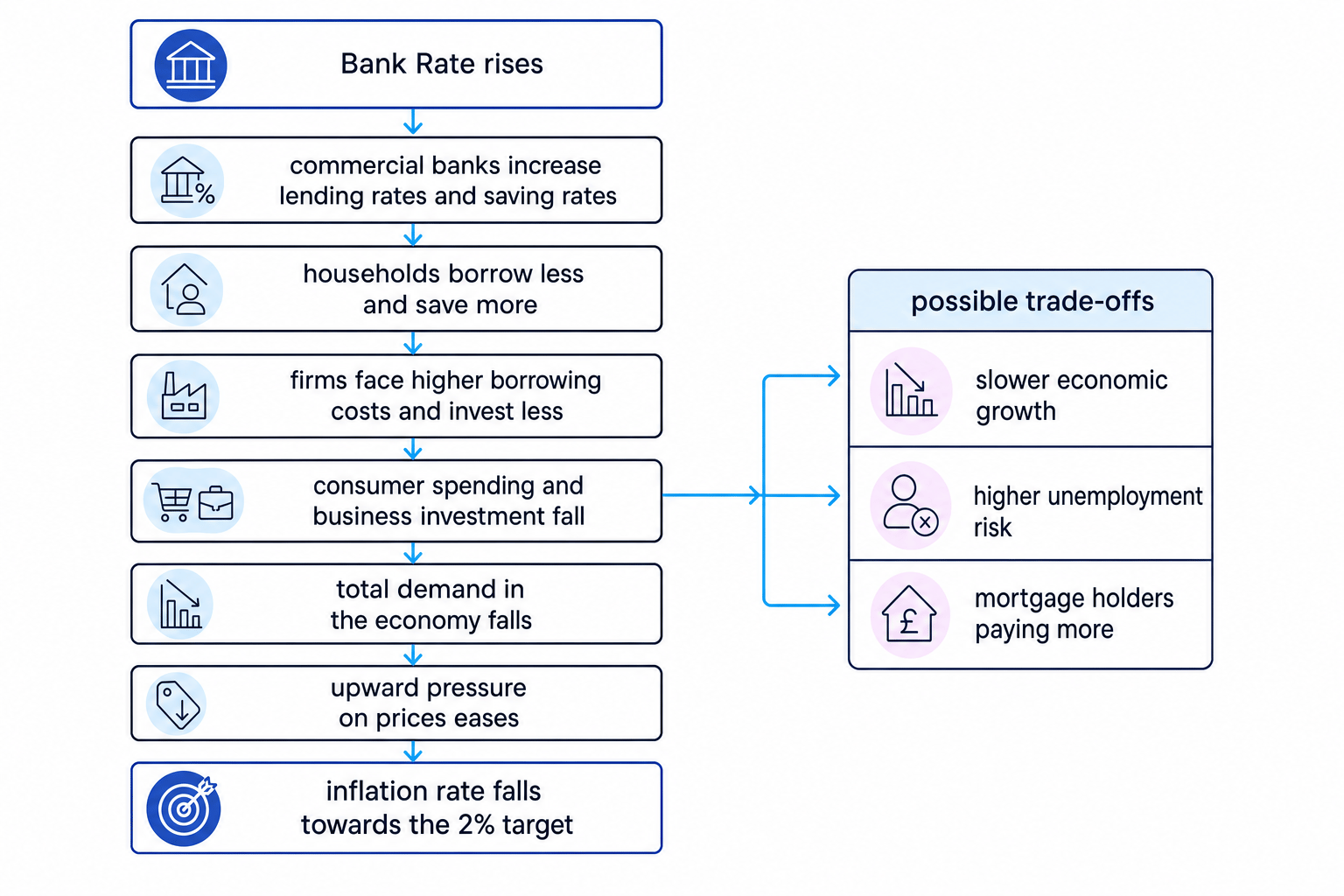
This was important during the 2022–23 inflation spike, when UK inflation rose sharply after COVID-19 disruption, energy price shocks and higher food costs. The Bank of England raised Bank Rate from very low levels to over 5% to help bring inflation down.
Choosing a policy response to high inflation
Suppose UK inflation is 9%, while the target is 2%.
-
Compare the data with the target: 9% is far above 2%, so the economy has a price stability problem.
-
Choose the likely monetary policy response: the Bank of England may raise Bank Rate to reduce borrowing and encourage saving.
-
Apply the transmission chain: higher rates make mortgages, loans and business borrowing more expensive, so households and firms reduce spending and investment.
-
Analyse the effect on inflation: lower total demand means firms face less pressure to keep raising prices, so inflation should fall over time.
-
Evaluate the trade-off: this may also reduce economic growth and increase unemployment, especially if firms cut output or delay expansion.
Interest rates work with a time lag
Monetary policy does not work instantly. A rate rise may take many months to affect mortgage payments, business investment, consumer spending and inflation.
The money supply and quantitative easing
The money supply means the amount of money circulating in the economy.
The Bank of England can also influence the economy through quantitative easing, often shortened to QE.
Quantitative easing
Quantitative easing is when the central bank creates new money to buy financial assets, which increases the money supply and can encourage lending, borrowing and spending.
QE was used after the 2008 financial crisis and again during the COVID-19 period to support the economy when interest rates were already very low.
If the Bank wants to reduce inflationary pressure, it may stop expanding QE or reverse some support. For GCSE, the key idea is simple: increasing the money supply can support spending, while reducing monetary support can help slow spending.
Using monetary policy for other government objectives
Monetary policy is not only about inflation. It can also affect other objectives.
Economic growth
Economic growth
Economic growth means an increase in the value of goods and services produced by an economy over time, usually measured by real GDP.
Lower interest rates can support growth because households may borrow and spend more, and firms may borrow to invest in new shops, factories, equipment or technology.
For example, after the COVID-19 shock in 2020, very low interest rates helped support borrowing and spending while the economy was weak.
Employment
If lower interest rates increase demand for goods and services, firms may need more workers. This can reduce unemployment.
But if interest rates rise sharply, firms may cut investment or reduce output, which can increase unemployment.
Balance of payments
Balance of payments
The balance of payments records money flows between the UK and the rest of the world. The current account includes trade in goods and services.
Interest rates can affect the exchange rate, which is the price of one currency in terms of another.
If UK interest rates rise, saving or investing in pounds may become more attractive. This can increase demand for pounds, causing the pound to rise in value.
A stronger pound can:
- make imports cheaper, helping reduce imported inflation
- make UK exports more expensive abroad, which may hurt exporters
Living standards and fairness
Monetary policy creates winners and losers.
Higher interest rates may benefit savers, including some pensioners. But they can hurt mortgage holders, renters if landlords pass on costs, and firms with large debts.
Lower interest rates may help borrowers and firms investing for growth. But they reduce returns for savers and can push up asset prices, such as houses, making it harder for first-time buyers.
Policy trade-offs
Monetary policy can help achieve one objective while making another harder. Raising rates may reduce inflation, but it can also slow growth and increase unemployment.
Expansionary versus contractionary monetary policy
| Economic situation | Likely monetary policy | Main effect | Possible trade-off |
|---|---|---|---|
| Inflation is too high | Raise interest rates | Spending and borrowing fall | Growth may slow |
| Growth is weak | Cut interest rates | Spending and investment rise | Inflation may increase later |
| Unemployment is high | Cut interest rates | Firms may expand and hire | Savers receive less interest |
| Imports are becoming expensive | Higher rates may strengthen the pound | Imports may become cheaper | Exports may become less competitive |
Expansionary monetary policy
Expansionary monetary policy is policy designed to increase spending and economic activity, usually by lowering interest rates or increasing the money supply.
Think in chains
For analysis questions, use a clear chain: policy change → borrowing/saving → spending/investment → demand → objective affected.
Evaluating monetary policy
Good evaluation means explaining when monetary policy is likely to work well, and when it may not.
Monetary policy may be effective when inflation is caused by too much spending in the economy. Higher interest rates can cool demand.
But it may be less effective when inflation is mainly caused by higher costs, such as energy price shocks. A UK interest rate rise cannot directly make global oil or gas cheaper.
This mattered in 2022–23 because much of the inflation pressure came from energy, food and global supply problems. Rate rises could reduce demand, but they also squeezed households already facing higher bills.
Best judgement
Monetary policy is powerful, but it is not painless. The Bank of England must balance lower inflation against the risks of weaker growth, higher unemployment and pressure on borrowers.
In the exam
-
Define the policy clearly: monetary policy means using interest rates and the money supply to influence the economy.
-
Build a cause-and-effect chain, not a one-step answer: for example, higher Bank Rate → more saving and less borrowing → lower spending → reduced inflationary pressure.
-
Evaluate with a trade-off: explain who benefits, who loses, and whether the policy helps one objective while damaging another.
Check yourself
- Why might raising Bank Rate help reduce inflation?
- How could lower interest rates increase economic growth and employment?
- Why might higher interest rates be unfair or painful for some households?
