

What you'll learn
- What specialisation, division of labour and exchange mean.
- How individuals and firms decide what to specialise in.
- Why division of labour can raise productivity and reduce costs.
- The possible downsides for workers, firms and society.
Starting point: why we cannot all make everything
In economics, people have limited resources but many wants and needs. Because we cannot produce everything ourselves, we often focus on what we are relatively good at and then trade with others.
For example, you probably do not grow your own wheat, mill it into flour, bake bread, make your own phone, and build your own house. Instead, different people and firms do different jobs, and we rely on exchange to get the goods and services we want.
Exchange
Exchange means giving one thing in return for another. In modern economies this usually means selling labour, goods or services for money, then using that money to buy other goods and services.
3.1.2.3 The benefits and costs of specialisation, division of labour and exchange
Specialisation
Specialisation
Specialisation means concentrating on producing a particular good or service, or performing a particular task, rather than trying to do everything.
Specialisation can happen at different levels:
- Individuals specialise when they train for a particular job, such as nurse, plumber, teacher, software developer or chef.
- Firms specialise when they focus on particular products or services, such as Greggs specialising in bakery food or Netflix specialising in streaming entertainment.
- Regions or countries can also specialise, such as the UK having strengths in financial services, pharmaceuticals and creative industries.
People and firms specialise because it usually allows them to become better and faster at what they do. This can increase productivity, which means output per worker or output per hour.
Productivity
Productivity is the amount of output produced using a given amount of input, such as output per worker or output per hour.
Why individuals specialise
Individuals specialise for several reasons:
- They have different skills, talents and interests.
- They gain qualifications or training in particular areas.
- Some jobs pay higher wages because the skills are scarce or in demand.
- People often become more efficient through practice.
For example, a trained electrician can wire a house more safely and quickly than someone with no training. Their specialist knowledge makes their labour more valuable.
Why specialisation matters
Specialisation can make workers more productive because they build skills, confidence and speed in a narrower area of work.
Division of labour
Division of labour
Division of labour means splitting the production process into separate tasks, with different workers specialising in each task.
This is a more specific idea than specialisation. Specialisation is the general idea of focusing on one area. Division of labour is about breaking production into stages.
For example, in a sandwich factory, one worker might prepare the bread, another adds fillings, another packages the sandwich, and another checks quality. No single worker makes the whole sandwich from start to finish.
The diagram shows the key difference between one worker doing every task and several workers each specialising in one stage.
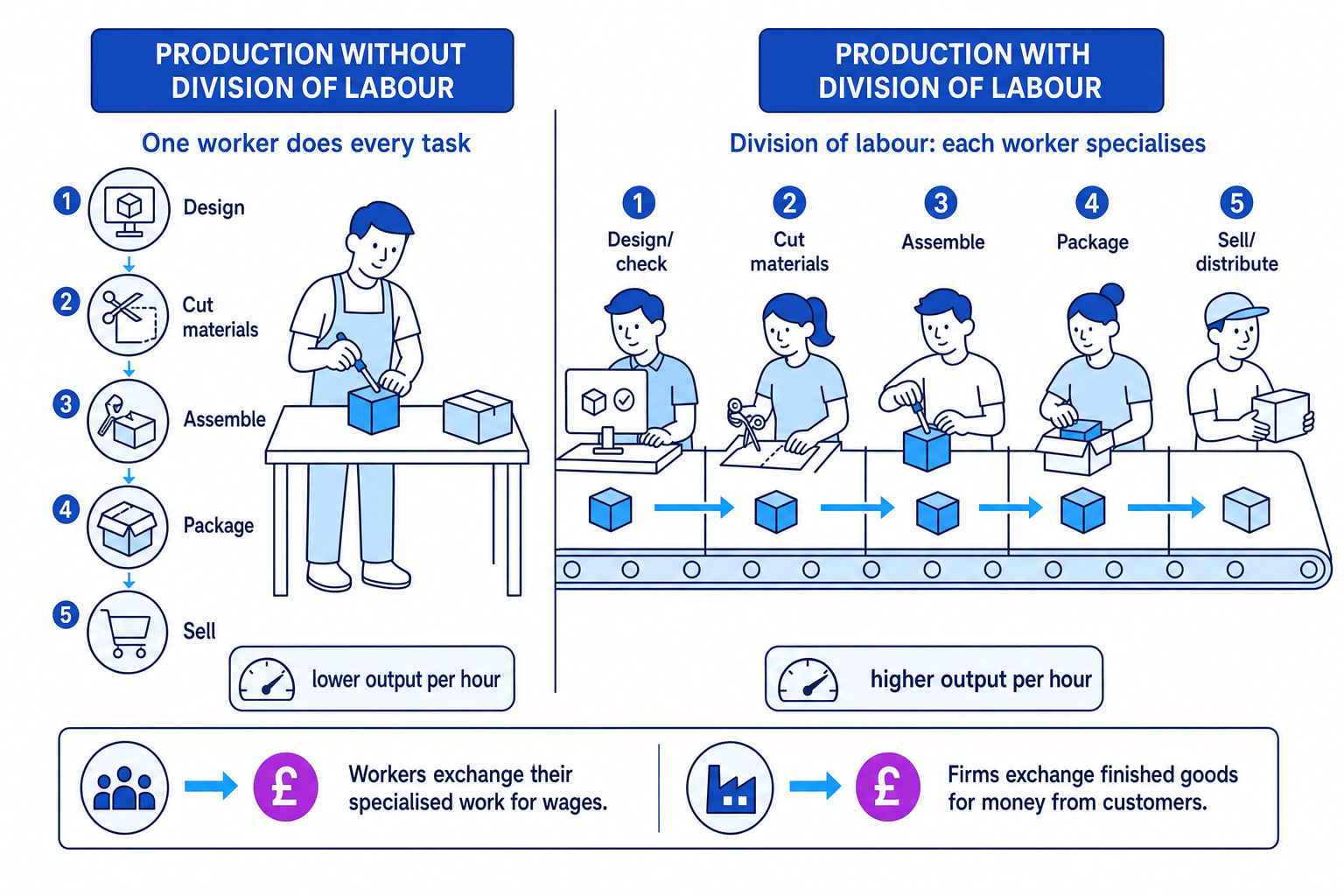
How division of labour increases output
Division of labour can raise output because:
- workers become quicker through repetition
- less time is wasted switching between tasks
- workers can use specialised tools or machinery
- firms can train workers for one task more quickly
- production can be organised as a continuous flow
This is why many factories, fast-food kitchens, supermarkets and delivery firms use highly organised roles.
Comparing output with division of labour
A small firm employs 4 workers. Each worker is paid £12 per hour.
Before division of labour, the workers produce 24 units per hour. After splitting production into specialist tasks, they produce 48 units per hour.
- Find the total labour cost per hour: 4 workers × £12 = £48 per hour.
- Work out the labour cost per unit before division of labour: £48 ÷ 24 units = £2 per unit.
- Work out the labour cost per unit after division of labour: £48 ÷ 48 units = £1 per unit.
- Compare the results: labour cost per unit falls from £2 to £1, so the firm can produce each unit more cheaply.
Benefits of division of labour for firms
For firms, division of labour can bring several important benefits.
Lower average costs
When output rises using the same number of workers, the cost of producing each unit can fall. This may allow the firm to lower prices, increase profit, or both.
Higher output
A firm can produce more goods or services in a given time. For example, a car factory such as Nissan in Sunderland uses specialised workers, machinery and production stages to produce vehicles at scale.
Better quality and consistency
If workers repeat a task many times, they may become more accurate. This can reduce mistakes and improve the consistency of the final product.
Easier training
A firm may not need to train every worker to complete the whole production process. Training someone to perform one task can be quicker and cheaper.
Firm benefits: think cost, speed, quality
If an exam question asks for benefits to a firm, organise your answer around lower costs, higher output, and better quality or consistency.
Benefits of division of labour for workers
Division of labour can also benefit workers.
Greater skill in a task
A worker can become highly skilled at one part of production. This may increase their confidence and performance.
Higher wages in some roles
If a specialised skill is valuable and not many people have it, workers may earn higher wages. For example, specialist engineers, software developers or medical professionals may be paid well because their skills are in demand.
Less training needed for simple tasks
Some workers can enter employment more quickly if a job only requires training in a narrow task. This may help people gain work experience.
Winners can differ
Division of labour can benefit both firms and workers, but the size of the benefit depends on the type of job, the skill required and the bargaining power of workers.
Costs of division of labour for workers
Division of labour is not always positive. It can create problems, especially for workers.
Boredom and low motivation
Repeating the same task all day can become boring. This may reduce motivation and job satisfaction.
Deskilling
Deskilling
Deskilling happens when workers only perform narrow, simple tasks and do not develop a wider range of skills.
If a worker only learns one small part of a process, they may find it harder to move into other jobs. This can reduce their long-term employment opportunities.
Greater risk if demand changes
If a worker specialises in one area and demand for that skill falls, they may need retraining. For example, changes in technology can reduce demand for some routine roles while increasing demand for digital skills.
Health and wellbeing concerns
Repetitive work can sometimes cause stress, tiredness or physical strain. This creates an ethical issue: firms may gain efficiency, but workers may face poorer working conditions.
Only writing about the firm
A common error is to explain that division of labour increases output, but forget the worker. GCSE questions often ask for effects on both the firm and the worker, so cover both sides when needed.
Costs of division of labour for firms
Firms can also face disadvantages.
Workers may become demotivated
If work is repetitive, workers may become less motivated. This can lead to lower quality, more mistakes, absenteeism or higher staff turnover.
Production becomes interdependent
Interdependence
Interdependence means different people, firms or stages of production rely on each other.
When production is split into many tasks, each stage depends on the previous stage. If one worker, machine or supplier fails, the whole process can slow down.
This became very clear during COVID-19 and its aftermath. Many firms relied on global supply chains, but factory closures, shipping delays and shortages of parts disrupted production. Car firms, for example, were affected by shortages of microchips.
Less flexibility
A firm with very specialised workers may find it harder to change production quickly. If demand changes, the firm may need to retrain workers or reorganise production.
Analysing a production delay
A bakery uses division of labour. One team mixes dough, one bakes, one packages, and one delivers to shops. The packaging machine breaks for two hours.
- Identify the link in the production chain: packaging comes after baking and before delivery.
- Analyse the immediate effect: baked goods cannot be packed, so finished products build up before the packaging stage.
- Analyse the wider effect: deliveries to shops may be late, so the bakery could lose sales and damage its reputation with customers.
- Make a judgement: division of labour helps the bakery produce quickly when everything works, but it also makes the firm vulnerable if one stage breaks down.
Exchange: why specialisation only works if people trade
Specialisation creates a problem: if you only produce one thing, you still need many other goods and services. Exchange solves this problem.
A worker might specialise as a nurse and receive wages. They then exchange that money for food, rent, transport, energy, clothes and entertainment. A firm might specialise in producing bakery products and exchange them for money from customers.
Money makes exchange easier because people do not need to find someone who wants exactly what they offer. Without money, exchange would rely on barter, which means swapping goods or services directly.
Barter
Barter is direct exchange without money, such as swapping bread for eggs.
Barter is difficult because both sides must want what the other person has. Money avoids this problem by acting as a widely accepted way to pay.
Benefits of specialisation and exchange
Specialisation and exchange help the economy work more efficiently.
More choice for consumers
Consumers can buy goods and services from many specialists rather than making everything themselves. For example, a household can buy food from Tesco, use a mobile network, stream music, and pay a plumber when needed.
Higher living standards
If firms produce more efficiently, goods may become cheaper or better quality. This can improve living standards because people can access more goods and services.
Growth of markets
Exchange allows producers to sell to wider markets. Online platforms, delivery apps and international trade all make it easier for specialised producers to reach customers.
Innovation
Specialists often improve methods over time. For example, UK firms in pharmaceuticals, green energy and financial technology can develop expertise and new products.
Specialisation needs exchange
Specialisation raises output, but exchange makes it useful. You can focus on one job because you can use income from that job to buy what others produce.
Costs and risks of specialisation and exchange
There are also important risks.
Overdependence
If a firm, worker or country becomes too specialised, it may be vulnerable to changes in demand or supply disruption. For example, firms relying heavily on imported energy faced higher costs during the 2022–23 energy price shock.
Inequality between workers
Specialisation may increase wages for workers with scarce skills, but leave routine workers with lower pay or less secure work. This raises moral and ethical questions about fair wages, training and working conditions.
Environmental concerns
Specialised production and exchange can involve long supply chains, transport emissions and high resource use. A firm may choose the cheapest production method, but society may care about sustainability as well as profit.
Loss of local skills or businesses
If consumers buy from large specialised firms, smaller local producers may struggle to compete. This can affect local communities and employment.
Efficiency is not the same as fairness
Division of labour may reduce costs and increase output, but that does not automatically mean everyone benefits equally. In evaluation, consider workers, firms, consumers and wider society.
Bringing it together
Specialisation means focusing on a particular job, product or service. Division of labour means splitting production into smaller tasks so workers specialise in different stages. Exchange allows people and firms to trade what they produce for what they need.
The main economic benefit is greater productivity. Firms may produce more at lower cost, and consumers may gain from lower prices and more choice. However, there can be costs: workers may become bored or deskilled, firms may become less flexible, and the economy may become more dependent on complex supply chains.
In the exam
- Define the key term first: for example, explain that division of labour means splitting production into separate tasks carried out by different workers.
- Separate effects on the firm from effects on the worker so your answer stays focused.
- Add evaluation by weighing benefits against costs: higher productivity may be valuable, but repetitive work, deskilling or supply-chain disruption can reduce the overall benefit.
Check yourself
- What is the difference between specialisation and division of labour?
- How can division of labour reduce a firm’s cost per unit?
- Why might a worker not benefit from doing the same specialised task every day?
