

What you'll learn
- What the primary, secondary and tertiary sectors are.
- How big these sectors are in the UK economy.
- The difference between a good and a service.
- How to classify real businesses, like farms, factories, supermarkets and streaming platforms.
3.1.2.2 Economic sectors
Economists often split the economy into sectors. This helps us understand what type of work is happening and where scarce resources are being used.
Economic sector
An economic sector is a broad group of economic activity. In GCSE Economics, you need to know the primary, secondary and tertiary sectors.
The three sectors are linked to production, which means making goods or providing services to satisfy people’s wants and needs.
The primary sector
The primary sector is the part of the economy that extracts, grows or collects raw materials from nature.
Primary sector
The primary sector involves extracting or harvesting natural resources, such as farming, fishing, mining, forestry and oil extraction.
Examples include:
- a farm growing wheat
- a fishing boat catching cod
- a quarry extracting stone
- North Sea oil and gas production
In the UK, the primary sector is very small compared with the rest of the economy. It is important, but it employs far fewer people than services such as healthcare, retail, finance and education.
The secondary sector
The secondary sector uses raw materials to make finished or semi-finished products. It also includes construction.
Secondary sector
The secondary sector involves manufacturing and construction: turning raw materials into physical products or building things.
Examples include:
- a car factory making vehicles
- a bakery making bread
- a housebuilding firm constructing new homes
- a pharmaceutical company making medicines
The UK still has important manufacturing industries, such as aerospace, pharmaceuticals, food production and car manufacturing. However, manufacturing is a much smaller share of UK output and employment than it was in the past.
The tertiary sector
The tertiary sector provides services rather than making physical products.
Tertiary sector
The tertiary sector involves providing services to consumers and businesses, such as retail, banking, transport, healthcare, education, hospitality and entertainment.
Examples include:
- Tesco selling groceries
- a nurse providing healthcare
- a teacher delivering lessons
- a bank offering mortgages
- a streaming platform providing access to films and TV programmes
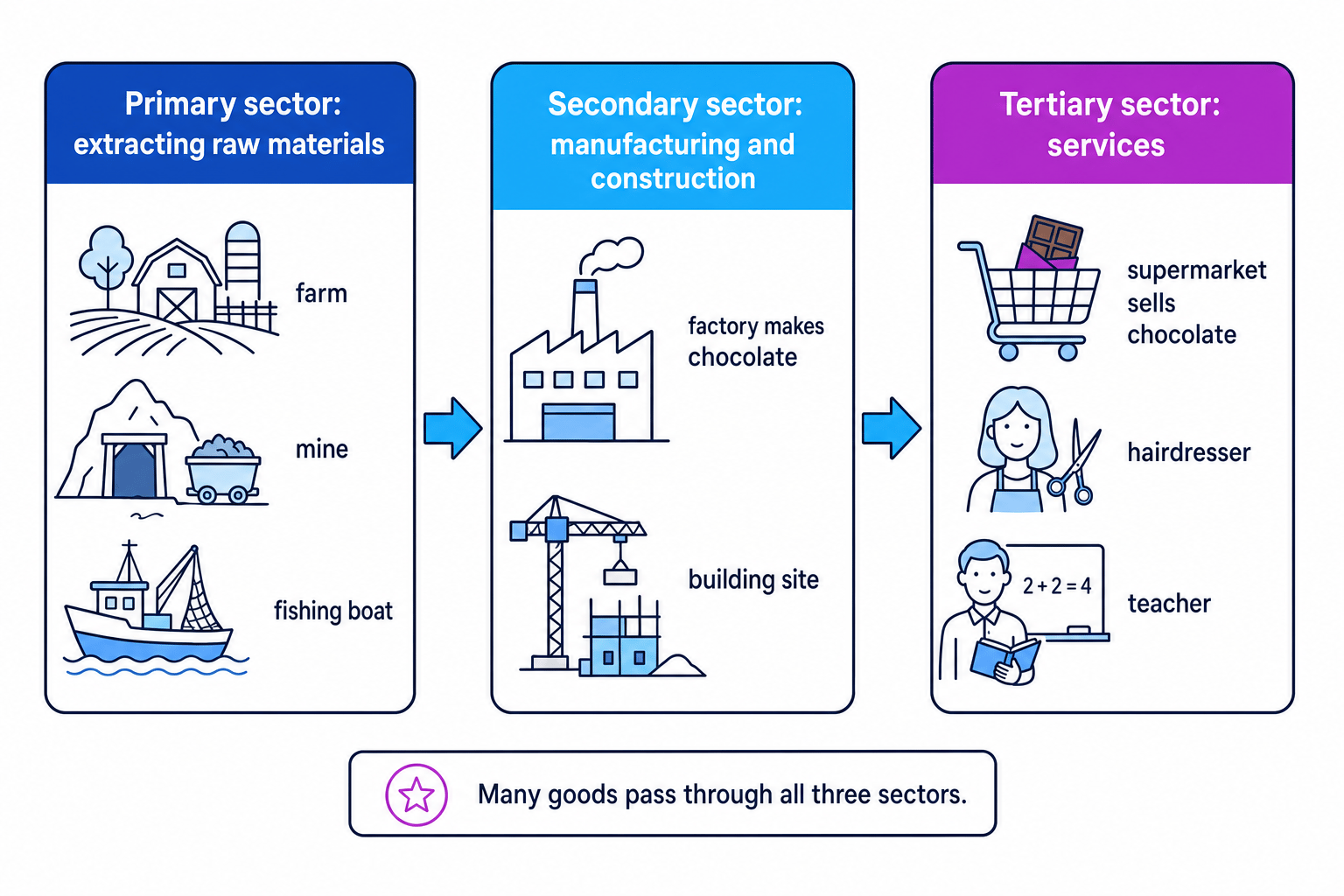
Many products move through all three sectors before reaching the customer.
Quick memory check
Use E-M-S: Extract in the primary sector, Make in the secondary sector, Serve in the tertiary sector.
Classifying a chocolate production chain
-
Cocoa beans are grown on a farm. This is the primary sector because the farm is growing a natural raw material.
-
A factory turns cocoa beans, sugar and milk into chocolate bars. This is the secondary sector because the factory is manufacturing a physical product.
-
A supermarket sells the chocolate bar to customers. This is the tertiary sector because retailing is a service that helps customers access products.
-
The chocolate bar itself is a good, but the supermarket’s activity is a service.
Classifying the object instead of the activity
A supermarket sells physical goods, but the supermarket is usually in the tertiary sector because its main activity is retailing, which is a service.
The relative sizes of sectors in the UK
The relative size of a sector means how large it is compared with the rest of the economy. This can be measured by its share of employment or its share of output.
Output
Output means the amount of goods and services produced. At a national level, economists often measure output using gross domestic product, or GDP, which is the total value of goods and services produced in a country over a period of time.
In the UK:
- the tertiary sector is by far the largest sector, making up around four-fifths of economic activity
- the secondary sector is much smaller, including manufacturing and construction
- the primary sector is very small, often around 1% or less of employment and output depending on the measure used
This means the UK is often described as a service economy.
Service economy
A service economy is an economy where most output and employment come from the tertiary sector.
There are several reasons why the UK’s tertiary sector is so large:
- UK consumers spend heavily on services such as health, education, transport, leisure and finance.
- Some manufacturing has moved overseas where production costs may be lower.
- Technology has created new service industries, such as online retail, streaming and app-based delivery.
- As incomes rise, people often spend a larger share of their income on services.
The COVID-19 pandemic showed how important the tertiary sector is. Lockdowns badly affected hospitality, travel, entertainment and high-street retail, while online services and delivery firms grew quickly.
Comparing sector shares
Suppose an economy has total output of £2,000 billion. The tertiary sector produces £1,600 billion, the secondary sector produces £360 billion and the primary sector produces £40 billion.
-
Add the sector outputs to check the total: £1,600 billion + £360 billion + £40 billion = £2,000 billion.
-
Calculate the tertiary sector’s share, using the figures in £ billion:
- Calculate the secondary sector’s share:
- Calculate the primary sector’s share:
- Compare the results: the tertiary sector is much larger than the other two sectors, so this economy is mainly service-based.
Goods and services
A good is a physical product. A service is an activity done for someone.
Good
A good is a tangible product that can be touched, such as a phone, a loaf of bread, a car or a school uniform.
Service
A service is an intangible activity provided for a customer, such as a haircut, bus journey, lesson, medical appointment or insurance policy.
The word tangible means something can be physically touched. The word intangible means it cannot be touched in the same way.
Some businesses provide both goods and services. For example, a restaurant provides food, which is a good, but it also provides cooking, table service and the experience of eating out, which are services.
Deciding whether outputs are goods or services
-
A bakery sells a loaf of bread. The customer receives a physical item, so the loaf is a good.
-
A barber cuts someone’s hair. The customer pays for skill and time, not a separate physical object, so this is a service.
-
A restaurant sells a meal. The food is a good, but the cooking, serving and dining experience are services.
-
A streaming subscription gives access to films for a month. The customer does not own a physical product, so this is mainly a service.
Why economic sectors matter
Sectors help you analyse how resources are allocated in an economy.
If more workers move into healthcare, education, retail and finance, the tertiary sector grows. If a government invests in housebuilding, construction in the secondary sector may expand. If energy prices rise, primary industries such as gas extraction and secondary industries such as manufacturing can face higher costs.
Sectors also connect to moral, ethical and sustainability issues.
Sustainability
Sustainability means meeting people’s needs today without damaging the ability of future generations to meet their needs.
For example:
- primary sector activity, such as mining or oil extraction, can create jobs but may damage the environment
- secondary sector manufacturing can raise living standards but may cause pollution if poorly regulated
- tertiary sector work can create flexible jobs, but some workers in delivery or hospitality may face insecure hours or low pay
The big picture
The UK economy is dominated by the tertiary sector, but the three sectors depend on each other. Services often rely on goods, goods rely on manufacturing, and manufacturing often relies on raw materials.
In the exam
-
Classify by the activity, not just the product: extracting is primary, making is secondary, and serving is tertiary.
-
When asked about the UK, remember that the tertiary sector is the largest, the secondary sector is smaller, and the primary sector is very small.
-
For goods and services, use the words tangible and intangible, and mention if an example contains both.
Check yourself
- Why is a car factory in the secondary sector?
- Why is Tesco usually classed as tertiary even though it sells physical goods?
- Give one reason why the tertiary sector is so large in the UK.
