

What you'll learn
- What economies of scale mean and how they affect average cost.
- The five named types: managerial, purchasing, financial, technical and risk-bearing.
- How economies of scale change business behaviour, prices and profits.
- Why growth can create diseconomies of scale if a business becomes too large to manage well.
3.1.4.3 Economies of scale
Economies of scale are part of production, costs, revenue and profit. The big question is: what happens to the cost of each unit when a business produces more?
Start with the prerequisites: output, total cost and average cost
Production means making goods or providing services. Output is the quantity produced in a period, such as 10,000 loaves of bread per week.
Total cost is all the cost of producing that output. It includes fixed costs — costs that do not change with output in the short term, such as rent — and variable costs, which do change with output, such as ingredients.
Average cost
Average cost is the cost of producing one unit. It is calculated as:
AC=TCQAC = \frac{TC}{Q}AC=QTCwhere ACACAC is average cost, TCTCTC is total cost and QQQ is output.
Calculating average cost as production rises
A bakery produces 10,000 cakes with total costs of £120,000. After expanding, it produces 25,000 cakes with total costs of £200,000.
- Calculate the first average cost: AC=£120,00010,000=£12AC = \frac{\pounds120{,}000}{10{,}000} = \pounds12AC=10,000£120,000=£12 per cake.
- Calculate the new average cost: AC=£200,00025,000=£8AC = \frac{\pounds200{,}000}{25{,}000} = \pounds8AC=25,000£200,000=£8 per cake.
- Compare the two results: output has risen by 15,000 cakes, while average cost has fallen by £4 per cake.
- Apply the concept: this is evidence of economies of scale because producing more has reduced the cost per unit.
The meaning of economies of scale
Scale means the size or level of a firm’s operations. A larger scale usually means more output, more workers, more machinery, more branches or larger production sites.
Economies of scale
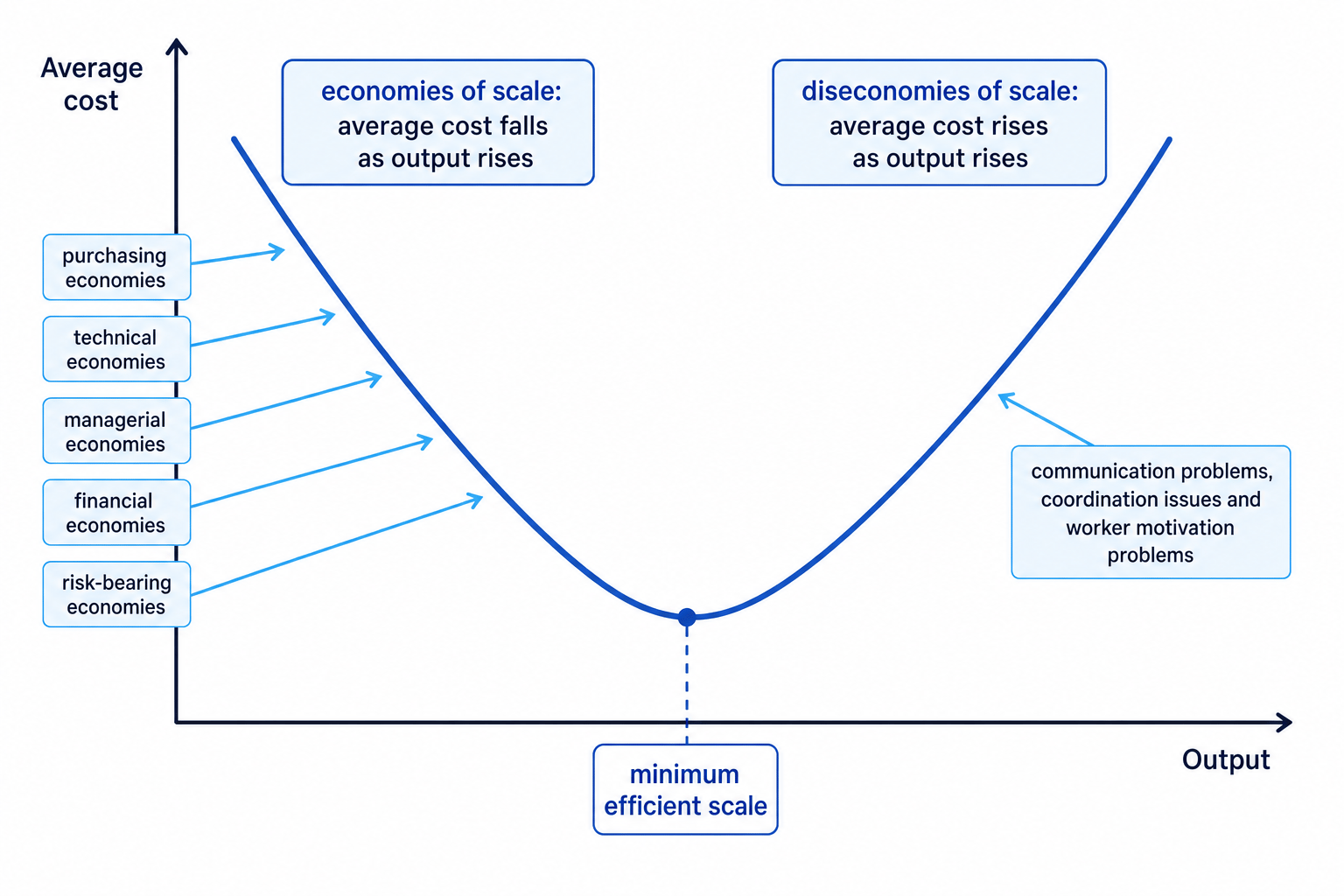
Economies of scale occur when a rise in production leads to a fall in average cost. In simple terms: the business produces more, and each unit becomes cheaper to make.
This does not mean total cost always falls. A business may spend more in total because it is producing far more, but the cost of each individual unit can fall.
The diagram shows the main idea: average cost falls at first as output rises, but if the firm grows too far, average cost can start rising again. The lowest point is sometimes called the minimum efficient scale, meaning the smallest output level where average cost is at its lowest.
Confusing total cost with average cost
Do not write “economies of scale mean costs fall” without saying average costs. Total costs often rise when output rises; the key point is that cost per unit falls.
Why economies of scale affect business behaviour
If a firm has lower average costs, it has more choices.
It could lower prices, which may help it win customers and increase its market share — the percentage of total sales in a market made by one business. This is why large supermarkets can often sell some products more cheaply than small convenience shops.
It could also keep prices the same and earn more profit per unit. Profit is total revenue minus total cost. Total revenue is the money received from sales.
Economies of scale can also encourage firms to grow further. A business may open more branches, invest in better technology, advertise heavily or buy smaller rivals. This can create barriers to entry, meaning obstacles that make it harder for new firms to compete.
During the 2022–23 cost-of-living squeeze, large UK retailers often had more power to negotiate with suppliers and invest in efficient delivery systems. That could help keep some prices lower, but it also raises ethical questions: are suppliers, farmers and workers being treated fairly?
The core idea
Economies of scale can make large firms more competitive because lower average costs allow them to reduce prices, increase profit, invest more, or expand market share.
Types of economies of scale
AQA expects you to know five types. Each one explains a different reason why average cost may fall as output rises.
| Type | How it lowers average cost | Example |
|---|---|---|
| Purchasing economies | Large firms buy inputs in bulk and may get a lower price per unit. | Tesco buying huge quantities of food, packaging or cleaning products. |
| Technical economies | Large firms can afford expensive machinery or automation, meaning machines do tasks with less human input. The high cost is spread over many units. | A car factory using robots, or a bakery chain using large automated ovens. |
| Managerial economies | Large firms can employ specialist managers with expertise in areas such as finance, marketing, logistics or human resources. | A national retailer hiring a specialist logistics manager to reduce delivery waste. |
| Financial economies | Large firms may borrow at lower interest rates because lenders see them as less risky. An interest rate is the percentage cost of borrowing money. | A well-known supermarket receiving a cheaper bank loan than a small start-up. |
| Risk-bearing economies | Large firms can spread risk across products, regions or sales channels. If one area performs badly, another may still do well. | A retailer selling in stores and online, so it is less dependent on one source of sales. |
Spot the type quickly
- Bulk buying usually means purchasing economies.
- Machines or technology usually means technical economies.
- Specialist managers usually means managerial economies.
- Cheaper borrowing usually means financial economies.
- Spreading risk across products or markets usually means risk-bearing economies.
Matching examples to types of economy of scale
A growing bakery chain makes several changes as it expands.
- It negotiates a lower price for flour because it now buys much larger quantities. This is a purchasing economy because bulk buying reduces the cost of inputs per unit.
- It installs automated ovens that bake thousands of items per hour. This is a technical economy because expensive machinery becomes worthwhile when output is high.
- It hires a specialist distribution manager to plan deliveries. This is a managerial economy because specialist expertise helps the firm operate more efficiently.
- It receives a loan at a lower interest rate than a small bakery. This is a financial economy because lenders may see the larger firm as safer.
- It sells through high streets, service stations and delivery apps. This is a risk-bearing economy because weak demand in one channel may be balanced by stronger demand elsewhere.
Costs and benefits of growth for a business
Growth can be attractive because it may bring economies of scale, higher sales and greater market power. A larger firm may be able to advertise more, invest in research, improve delivery networks and compete with rivals more effectively.
But growth also has costs. It may require expensive buildings, machinery, new staff and borrowing. This can be risky if demand is weaker than expected, especially when interest rates are high, as they were in the UK after the Bank of England raised rates to fight inflation.
There are also moral, ethical and sustainability issues. Sustainability means using resources in a way that can continue long term without unnecessary environmental damage. Large-scale production may reduce waste through efficient transport and packaging, but it may also increase emissions, pressure suppliers, replace workers with machines, or make it harder for small local firms to survive.
Weighing a growth decision
A sandwich producer currently sells 20,000 sandwiches at £3 each, with total costs of £50,000. After expanding, it expects to sell 60,000 sandwiches at £2.70 each, with total costs of £135,000.
- Calculate current total revenue and profit: total revenue is £3×20,000=£60,000\pounds3 \times 20{,}000 = \pounds60{,}000£3×20,000=£60,000, so profit is £60,000−£50,000=£10,000\pounds60{,}000 - \pounds50{,}000 = \pounds10{,}000£60,000−£50,000=£10,000.
- Calculate expected total revenue and profit after expansion: total revenue is £2.70×60,000=£162,000\pounds2.70 \times 60{,}000 = \pounds162{,}000£2.70×60,000=£162,000, so profit is £162,000−£135,000=£27,000\pounds162{,}000 - \pounds135{,}000 = \pounds27{,}000£162,000−£135,000=£27,000.
- Compare the outcomes: profit is expected to rise by £17,000, even though the price falls by 30p, because the firm sells far more units.
- Make a judgement: growth looks worthwhile if the sales forecast is realistic, but it could fail if management problems, quality issues or weaker demand push costs up.
Diseconomies of scale
Growth is not automatically good. A firm can become so large and complex that average cost starts to rise.
Diseconomies of scale
Diseconomies of scale occur when a rise in production leads to a rise in average cost. The business has grown so much that extra size makes it less efficient.
Common causes include poor communication, slow decision-making, coordination problems between departments, reduced worker motivation and weaker quality control. For example, a very large chain may struggle to keep service standards consistent across hundreds of branches.
Diseconomies can affect behaviour too. A business may stop expanding, close underperforming branches, split into smaller divisions, simplify its product range or invest in better management systems.
Spotting diseconomies from average cost data
A firm records its costs at three output levels.
- At 50,000 units, average cost is AC=£100,00050,000=£2AC = \frac{\pounds100{,}000}{50{,}000} = \pounds2AC=50,000£100,000=£2 per unit.
- At 100,000 units, average cost is AC=£160,000100,000=£1.60AC = \frac{\pounds160{,}000}{100{,}000} = \pounds1.60AC=100,000£160,000=£1.60 per unit, so the firm has economies of scale between 50,000 and 100,000 units.
- At 150,000 units, average cost is AC=£270,000150,000=£1.80AC = \frac{\pounds270{,}000}{150{,}000} = \pounds1.80AC=150,000£270,000=£1.80 per unit, so the firm has diseconomies of scale between 100,000 and 150,000 units.
- The key comparison is average cost, not output alone: output keeps rising throughout, but the cost per unit first falls and then rises.
In the exam
- Define carefully: economies of scale mean output rises and average cost falls; diseconomies mean output rises and average cost rises.
- Apply the named type to the scenario: bulk buying, machinery, specialist managers, cheaper borrowing or spreading risk.
- Analyse business behaviour: lower average costs may lead to lower prices, higher profit, growth, greater market share or barriers to entry.
- Evaluate growth: it is beneficial only if the cost savings and extra sales outweigh higher management costs, borrowing risk and possible ethical or sustainability concerns.
Check yourself
- If output rises from 10,000 to 30,000 units and average cost falls from £5 to £3, what concept is shown?
- Which type of economy of scale involves cheaper borrowing, and which involves bulk buying?
- Give one reason why a very large business might start to experience diseconomies of scale.
