What you'll learn
- Why a price change does not always lead to the same-sized change in quantity demanded.
- How to tell the difference between price elastic and price inelastic demand.
- How to calculate price elasticity of demand (PED) from given data.
- How producers, consumers and governments use PED in real UK markets.
3.1.3.5 Price elasticity of demand
Start with demand and quantity demanded
Before elasticity, you need two basic ideas.
Demand means the willingness and ability of consumers to buy a good or service at different prices.
Quantity demanded means the actual amount consumers want to buy at one particular price.
Usually, when price rises, quantity demanded falls. When price falls, quantity demanded rises. This is a movement along the demand curve, assuming other factors have not changed.
Price changes do not have equal effects
A 10% price rise does not always cause a 10% fall in quantity demanded. Some goods are very responsive to price changes; others are not.
For example, if the price of a streaming subscription rises, some consumers may cancel and switch to another service. But if petrol prices rise, many commuters still need to drive to work, at least in the short run.
What price elasticity of demand means
Price elasticity of demand measures how responsive quantity demanded is to a change in price.
Price elasticity of demand (PED)
Price elasticity of demand is calculated as:
PED=percentage change in quantity demandedpercentage change in price\text{PED} = \frac{\text{percentage change in quantity demanded}}{\text{percentage change in price}}PED=percentage change in pricepercentage change in quantity demandedPED focuses on percentages, not just raw changes. This makes it easier to compare very different markets, such as a 20p rise in a Greggs snack and a £2,000 rise in the price of a used car.
Price elastic demand
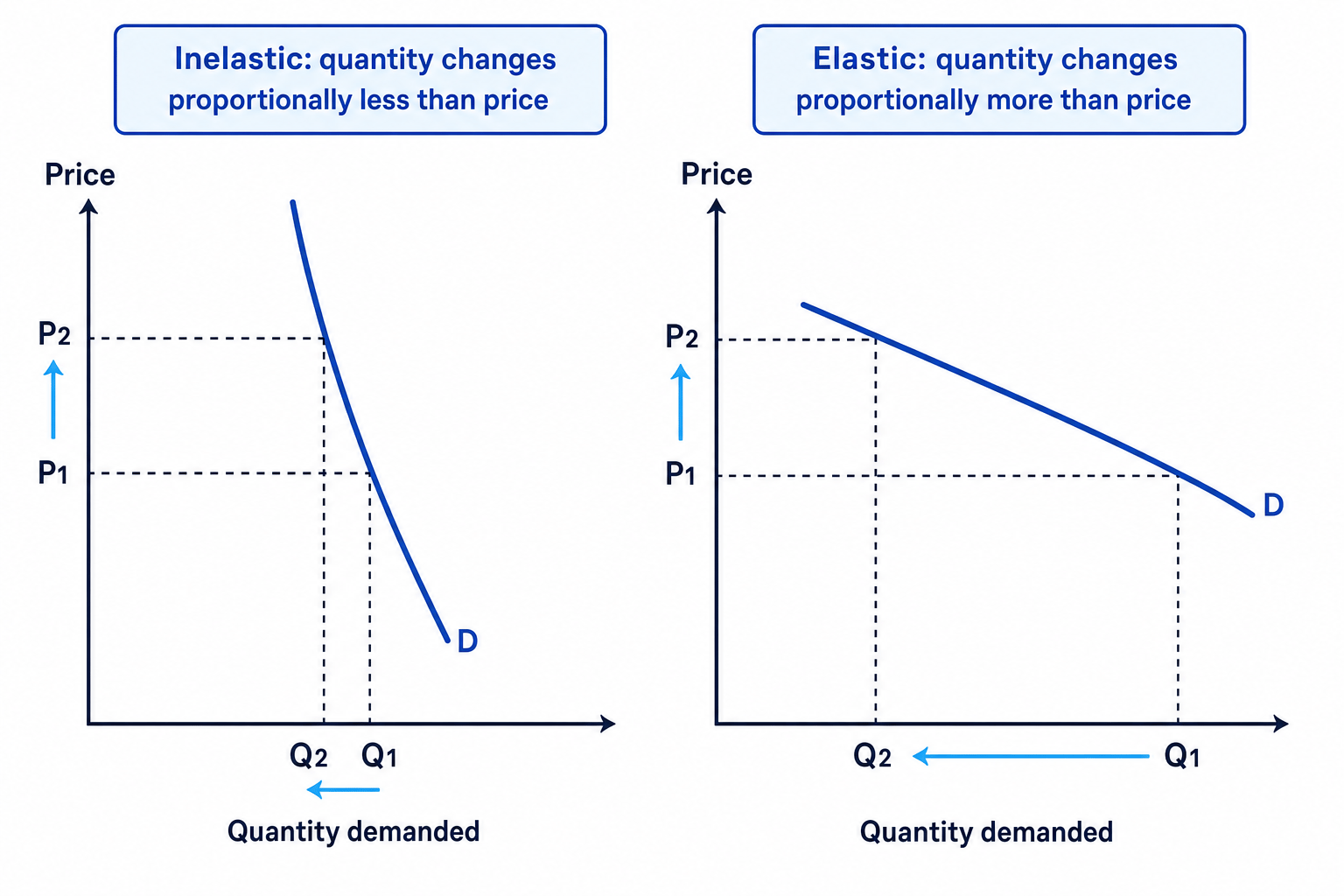
Demand is price elastic when quantity demanded changes by a larger percentage than price.
In GCSE terms, demand is price elastic when the size of PED is above 1.
Example: if price rises by 10% and quantity demanded falls by 25%, consumers are very responsive.
Price inelastic demand
Demand is price inelastic when quantity demanded changes by a smaller percentage than price.
In GCSE terms, demand is price inelastic when the size of PED is below 1.
Example: if price rises by 10% and quantity demanded falls by only 3%, consumers are not very responsive.
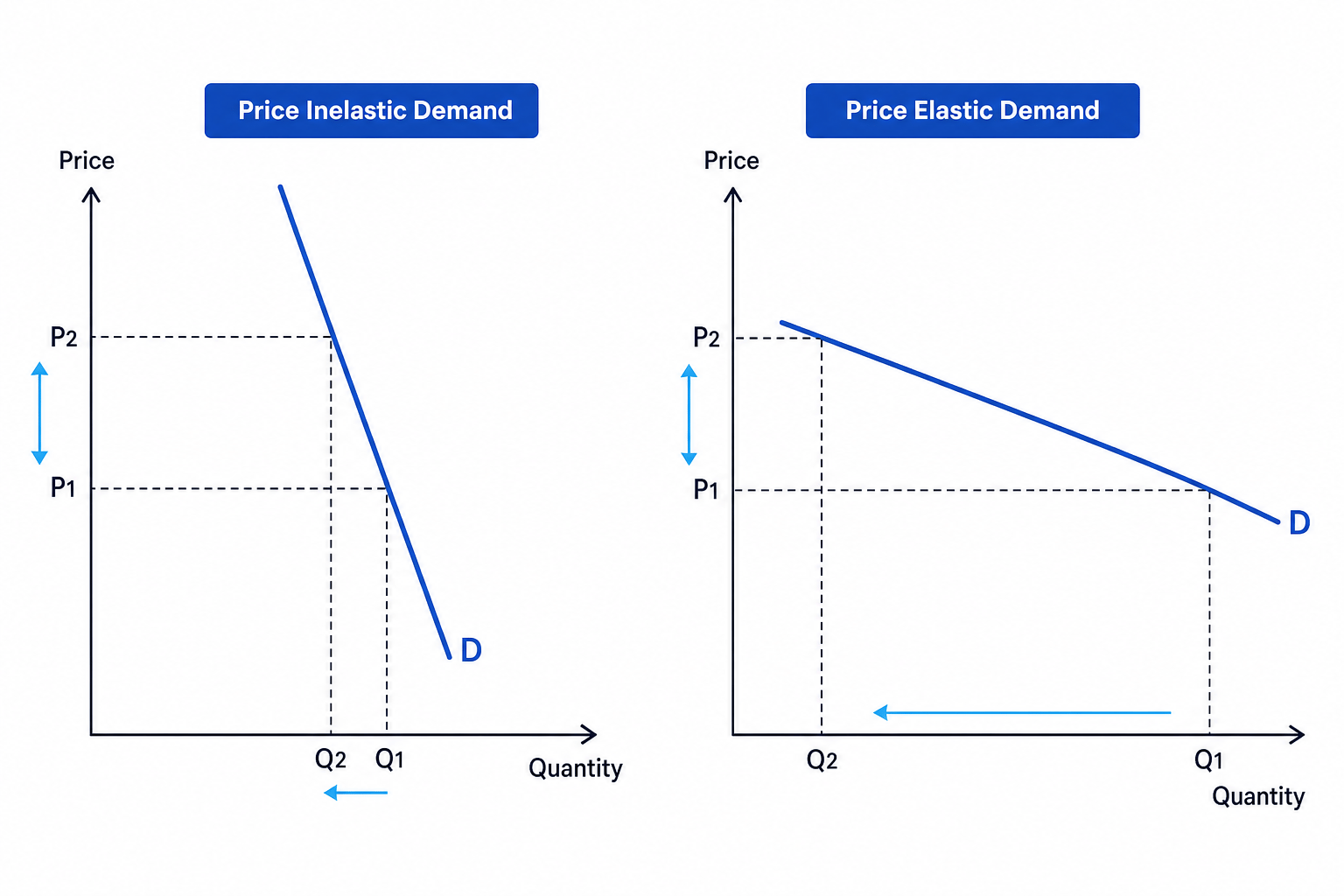
The diagram below compares the same price rise for an inelastic good and an elastic good.
Quick classification
Ignore the minus sign when classifying PED. A PED of -2 has a size of 2, so demand is elastic. A PED of -0.4 has a size of 0.4, so demand is inelastic.
Measuring PED
To calculate PED, you need two percentage changes:
percentage change=new value−old valueold value×100\text{percentage change} = \frac{\text{new value} - \text{old value}}{\text{old value}} \times 100percentage change=old valuenew value−old value×100Then divide the percentage change in quantity demanded by the percentage change in price.
Calculating PED for a bakery snack
A bakery raises the price of a snack from £1.50 to £1.80. Weekly quantity demanded falls from 1,000 to 850.
-
Calculate the percentage change in price: the price rises by £0.30, and £0.30 as a percentage of £1.50 is 20%.
-
Calculate the percentage change in quantity demanded: quantity falls by 150, and 150 as a percentage of 1,000 is 15%, so the percentage change is -15%.
-
Substitute into the PED formula:
- Interpret the result: the size of PED is 0.75, which is below 1, so demand is price inelastic.
Using quantity change instead of percentage change
Do not calculate PED using “150 divided by 30p”. PED compares percentage changes, so you must convert both price and quantity into percentages first.
Why some goods have elastic or inelastic demand
PED depends on how easy it is for consumers to change their behaviour when price changes.
Availability of substitutes
A substitute is a good or service that can be used instead of another good or service.
If there are many close substitutes, demand tends to be more price elastic. For example, if one brand of crisps becomes more expensive, shoppers in Tesco can choose another brand.
If there are few substitutes, demand tends to be more price inelastic. For example, many households had limited alternatives when gas and electricity prices rose during the 2022–23 cost-of-living squeeze.
Necessity or luxury
A necessity is something consumers feel they need, such as basic food, heating or transport to work. Necessities tend to have more price inelastic demand.
A luxury is something consumers can more easily go without, such as premium holidays or expensive fashion items. Luxuries tend to have more price elastic demand.
Proportion of income spent
If a product takes up only a tiny proportion of income, consumers may not react much to a price rise. For example, a 10p rise in a small packet of chewing gum may not change many buying decisions.
If a product takes up a large proportion of income, consumers are more likely to compare prices and reduce demand. For example, a rise in rent or mortgage payments can strongly affect household choices.
Time period
Demand is often more inelastic in the short run because consumers need time to adjust.
Over time, demand can become more elastic. If petrol prices stay high, some consumers may switch to public transport, buy a more fuel-efficient car, cycle more, or move closer to work.
Brand loyalty and habit
If consumers are loyal to a brand, demand may be more inelastic. Some people will keep buying the same phone brand, trainers or coffee even after a price rise.
Habit-forming goods can also have inelastic demand, though this raises ethical issues if firms or governments rely on consumers struggling to cut consumption.
Judging the factors affecting PED
A cinema increases ticket prices by 12%. A local bus company also increases fares by 12%. Which is likely to have more elastic demand?
-
Compare necessity: bus travel may be needed for school, work or appointments, while cinema trips are more optional.
-
Compare substitutes: cinema customers may switch to streaming, gaming or cheaper leisure activities; bus users may have fewer alternatives if they do not own a car.
-
Reach a judgement: cinema tickets are likely to have more price elastic demand than bus travel, because consumers can more easily avoid or replace cinema trips.
PED and total revenue
Total revenue is the money a producer receives from selling output.
Total revenue
Total revenue is:
total revenue=price×quantity sold\text{total revenue} = \text{price} \times \text{quantity sold}total revenue=price×quantity soldPED matters because a price change affects both parts of total revenue: the price charged and the quantity sold.
If demand is price inelastic
A price rise may increase total revenue because quantity demanded falls by a smaller percentage than price rises.
This is why firms selling necessities may be tempted to raise prices. However, there are moral and ethical considerations, especially during a cost-of-living crisis. Raising prices for essential goods such as food, energy or medicines can put pressure on low-income households.
If demand is price elastic
A price rise may reduce total revenue because quantity demanded falls by a larger percentage than price rises.
For goods with elastic demand, firms may prefer discounts, loyalty schemes or sales promotions. A lower price can attract enough extra customers to increase revenue.
Using PED to predict revenue
A streaming service cuts its monthly price from £10 to £8. Subscribers rise from 10,000 to 14,000.
-
Calculate revenue before the price cut: £10 times 10,000 subscribers = £100,000 per month.
-
Calculate revenue after the price cut: £8 times 14,000 subscribers = £112,000 per month.
-
Compare the two totals: revenue rises by £12,000 per month, so the price cut has increased total revenue.
-
Link to PED: quantity demanded rose by a larger percentage than price fell, so demand was price elastic.
Assuming higher price always means higher revenue
A higher price only raises revenue if the loss of customers is proportionally small. If demand is elastic, a price rise can reduce total revenue.
Implications for producers and consumers
Producers
Producers use PED when deciding whether to raise prices, cut prices, launch promotions or absorb higher costs.
For example, if a food producer faces higher energy and ingredient costs, it may pass some costs on to consumers. If demand is inelastic, sales may not fall much. If demand is elastic, customers may switch to supermarket own-brand alternatives.
PED also matters for taxes. The UK Soft Drinks Industry Levy, often called the sugar levy, increased costs for high-sugar drinks. If demand is elastic, higher prices may reduce consumption more. If demand is inelastic, consumers may keep buying, so the tax raises revenue but changes behaviour less.
Consumers
Consumers are affected differently depending on PED.
When demand is inelastic, consumers have fewer realistic choices. Price rises reduce their disposable income, especially for essentials such as rent, heating and transport.
When demand is elastic, consumers have more power to switch, delay buying, or choose cheaper alternatives. This can pressure firms to keep prices competitive.
PED creates winners and losers
Inelastic demand can benefit producers through higher revenue, but it can hurt consumers if the product is essential. Elastic demand gives consumers more choice and makes producers more cautious about raising prices.
In the exam
-
State whether demand is elastic or inelastic by comparing the size of PED with 1.
-
Always show percentage change working before using the PED formula.
-
Link your answer to consequences: total revenue for producers, affordability and choice for consumers, and any ethical issues if the good is essential.
Check yourself
- If price rises by 20% and quantity demanded falls by 5%, is demand elastic or inelastic?
- Name two factors that make demand for a product more price elastic.
- Why might a producer with price inelastic demand be criticised for raising prices during a cost-of-living crisis?