

What you'll learn
- What complementary goods and substitute goods are.
- How a change in demand, supply or price in one market can affect another market.
- How to trace the chain of effects using GCSE supply and demand logic.
- How to apply this to real UK examples, such as petrol, streaming services and the cost-of-living squeeze.
3.1.3.4 Complements and substitutes
Before we link markets together, you need the core idea: markets do not exist in isolation. A change in the price of one product can affect the demand for another product.
Market
A market is any arrangement where buyers and sellers exchange a good or service, causing a price to be formed.
For example, there is a market for coffee, a market for tea, a market for petrol, a market for train journeys, and a market for streaming subscriptions.
Quick recap: demand, supply and equilibrium
Demand, supply and equilibrium
Demand is the quantity consumers are willing and able to buy at different prices. Supply is the quantity producers are willing and able to sell at different prices. Equilibrium is the price and quantity where demand equals supply.
If demand increases, the demand curve shifts right. This usually raises both equilibrium price and equilibrium quantity.
If supply decreases, the supply curve shifts left. This usually raises equilibrium price but lowers equilibrium quantity.
Markets are connected
An event in one market can change the price or quantity sold there, which can then change demand in a related market.
Complementary goods
Complementary goods
Complementary goods are goods that are often used together, so demand for one is linked to demand for the other.
Examples include:
- printers and ink cartridges
- games consoles and video games
- cars and petrol
- smartphones and phone cases
- coffee machines and coffee pods
If the price of one good falls, consumers may buy more of it. Because they now use more of it, demand for its complement may rise.
For example, if the price of games consoles falls during a sale, more people may buy consoles. This can increase demand for games, controllers and online subscriptions.
A fall in console prices affecting games
- The price of games consoles falls, perhaps because a retailer such as Argos or Currys runs a promotion.
- Consumers move along the demand curve for consoles and buy more consoles because they are cheaper.
- Games are a complement to consoles, because many consumers buy games to use with the console.
- Demand for games shifts right, so the equilibrium price and quantity of games are likely to rise.
Only looking at the first market
Do not stop after saying “the price of consoles falls”. The exam is asking about intermarket effects, so you must explain what happens in the related market too.
Complements can raise ethical issues
Some firms deliberately sell the main product cheaply but charge high prices for the complement. For example, a printer may be affordable, but replacement ink can be expensive.
This can be profitable for producers, but it may raise ethical questions if consumers feel “locked in” after buying the first product.
Substitute goods
Substitute goods
Substitute goods are goods that can be used instead of each other, so consumers may switch between them.
Examples include:
- tea and coffee
- butter and margarine
- cinema trips and streaming services
- petrol cars and electric cars
- Tesco and Aldi own-brand products
If the price of one good rises, demand for its substitute may rise because consumers look for a cheaper alternative.
For example, during the 2022–23 cost-of-living squeeze, some households switched from premium branded products to supermarket own-brand alternatives.
A rise in branded cereal prices affecting own-brand cereal
- The price of branded cereal rises from £3.00 to £3.80.
- Some consumers decide the branded cereal is now too expensive and look for a cheaper alternative.
- Own-brand cereal is a substitute because it satisfies a similar want.
- Demand for own-brand cereal shifts right, so its equilibrium price and quantity are likely to rise.
Quick test
Ask yourself: “Would people usually use these goods together, or instead of each other?” Together means complements. Instead means substitutes.
How one market affects another
The basic chain is:
- Something changes in the first market.
- This changes the price or quantity in that market.
- Consumers or producers respond.
- Demand changes in a related market.
- The related market gets a new equilibrium price and quantity.
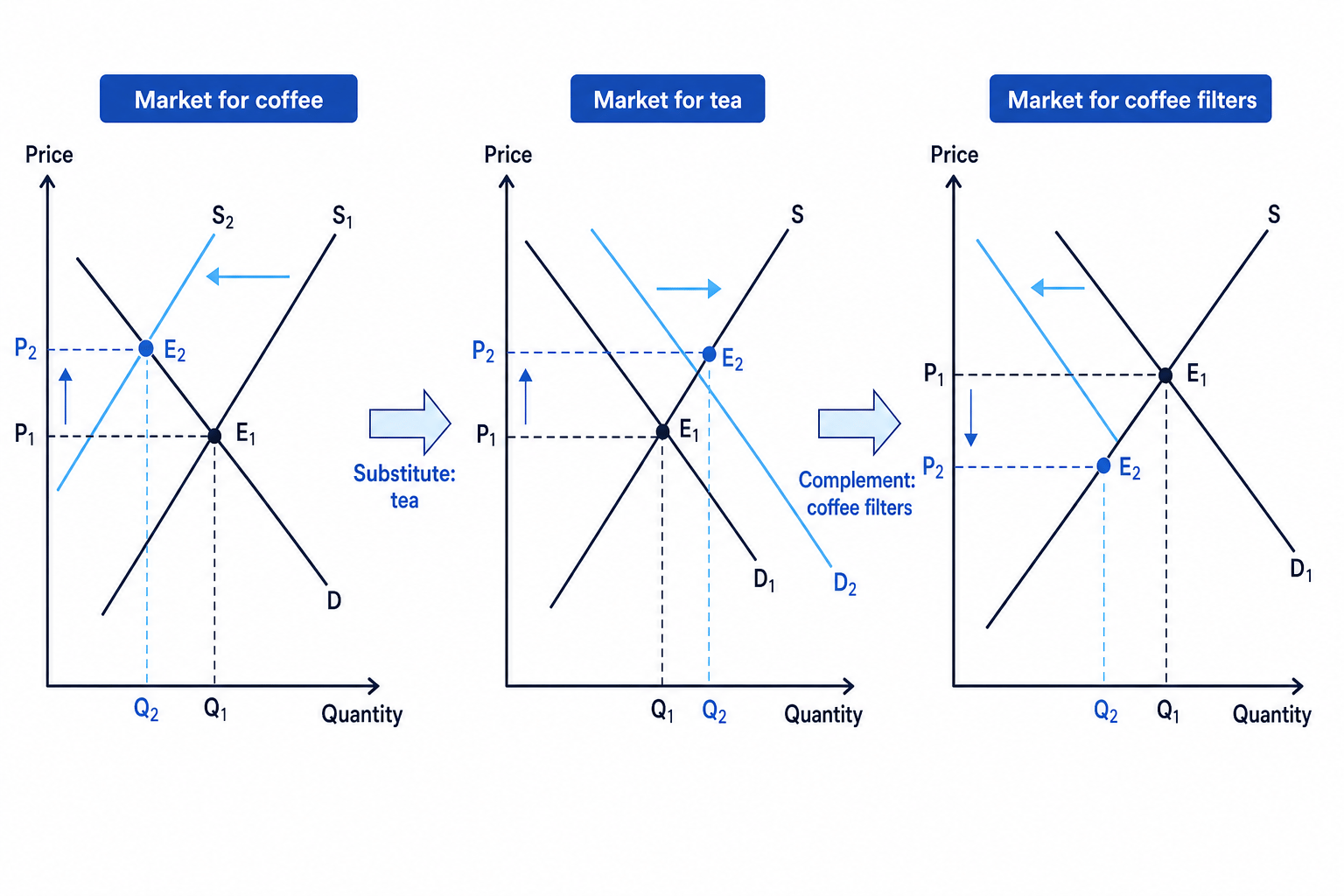
The diagram below shows a supply shock in the coffee market affecting two related markets: tea as a substitute and coffee filters as a complement.
When the first market changes because demand changes
If demand rises in the first market, price and quantity usually rise. That can affect other markets.
Example: if demand for electric cars rises, demand for home charging points may also rise because they are complements.
Higher demand for electric cars affecting charging points
- Demand for electric cars rises, perhaps because fuel prices are high or consumers want lower-emission transport.
- In the electric car market, the demand curve shifts right, increasing equilibrium price and quantity.
- Charging points are a complement to electric cars because many electric car owners need to charge their vehicles.
- Demand for home charging points shifts right, so their equilibrium price and quantity are likely to rise.
When the first market changes because supply changes
If supply falls in the first market, price usually rises and quantity falls. This can push consumers towards substitutes and away from complements.
For example, if poor weather reduces the supply of potatoes, the price of potatoes may rise. Some consumers may buy rice or pasta instead.
Lower supply of potatoes affecting rice
- Bad weather reduces the supply of potatoes, shifting the supply curve left.
- The equilibrium price of potatoes rises and the equilibrium quantity falls.
- Rice is a substitute for potatoes because both can be used as a carbohydrate in meals.
- Demand for rice shifts right, so the equilibrium price and quantity of rice are likely to rise.
Using price signals
Price signal
A price signal is information given by a price change that encourages consumers and producers to change their behaviour.
A higher price tells consumers that a good has become more expensive relative to alternatives. This may encourage them to switch to substitutes.
A lower price can encourage consumers to buy more of a good, which can also increase demand for its complements.
Price is the link
In intermarket questions, the price change in the first market often acts as the signal that changes demand in the second market.
Real-world applications
Petrol and public transport
When petrol prices rose sharply in 2022, some drivers looked for alternatives to car journeys. For some people, buses, trains or cycling became more attractive substitutes.
However, the strength of this effect depends on whether consumers have realistic alternatives. A rural worker with no nearby bus route may be unable to switch, even if petrol becomes expensive.
Not all substitutes are equally useful
A good may be a theoretical substitute but not a practical substitute for every consumer. Always consider the context.
Streaming services and cinemas
Streaming services such as Netflix, Disney+ and Amazon Prime Video can act as substitutes for cinema visits. If cinema tickets become more expensive, some households may choose to watch films at home instead.
But they are not perfect substitutes. Cinemas offer a bigger screen, social experience and new releases, while streaming may be cheaper and more convenient.
Fast food and takeaway delivery
Takeaway delivery apps and fast-food restaurants can be complements. If more people use delivery apps, demand for restaurant meals sold through those apps may rise.
But there can also be a cost issue. If delivery fees rise, some consumers may switch to collecting food themselves or cooking at home.
Moral, ethical and sustainability considerations
Intermarket relationships are not just about prices. They can affect people and the environment.
If petrol prices rise, demand for public transport or electric cars may increase. This could reduce emissions, which supports sustainability. But higher petrol prices can also hurt low-income households, especially those who need a car for work.
Businesses may also exploit complements. For example, a company might sell a device cheaply but make accessories, subscriptions or replacement parts expensive. This can increase profit, but it may be criticised if consumers have limited choice after purchase.
How to write an intermarket explanation
A strong GCSE answer usually follows this structure:
- Identify the first market and what changed.
- Explain the effect on price and quantity in that market.
- State whether the second good is a complement or substitute.
- Explain the demand shift in the second market.
- Finish with the likely effect on equilibrium price and quantity in the second market.
Writing the chain for petrol and bus travel
- Petrol becomes more expensive, perhaps because global oil prices rise.
- The higher petrol price makes driving more costly for consumers.
- Bus travel is a substitute for some car journeys because it can be used instead of driving.
- Demand for bus travel may shift right as some consumers switch away from cars.
- This is likely to increase the equilibrium price and quantity of bus journeys, although the effect depends on whether bus routes are available.
Confusing complements and substitutes
If the goods are used together, demand usually moves in the same direction. If they are used instead of each other, demand often moves in the opposite direction when one price changes.
In the exam
- Name the relationship clearly: write “X and Y are complements” or “X and Y are substitutes” before explaining the effect.
- Trace the chain: change in first market → price or quantity change → demand shift in related market → new equilibrium.
- Add context and judgement: mention why the effect may be stronger or weaker, such as consumer habits, availability of alternatives or cost-of-living pressures.
Check yourself
- If the price of coffee rises, what is likely to happen to demand for tea?
- If more people buy electric cars, what might happen to demand for home charging points?
- Why might a rise in petrol prices affect city consumers differently from rural consumers?
