

What you'll learn
- What a non-competitive market is and how it differs from a competitive market.
- How producers behave when they have market power.
- The meanings of monopoly and oligopoly.
- The causes and consequences of monopolistic and oligopolistic power for prices, choice and society.
3.1.5.3 Non-competitive markets
Starting point: what does “competitive” mean?
A market is any situation where buyers and sellers exchange goods or services. For example, the market for UK supermarkets includes shoppers, Tesco, Sainsbury’s, Aldi, Lidl, Asda and others.
In a very competitive market, there are many firms, customers have lots of choice, and it is hard for one producer to control the price. If one café charges much more than nearby cafés for a similar coffee, many customers can switch.
A producer is a business or organisation that makes or supplies goods and services. A consumer is someone who buys or uses goods and services.
What is a non-competitive market?
A market becomes non-competitive when competition is weak. This usually happens because one firm, or a few large firms, have a lot of control over the market.
Non-competitive market
A non-competitive market is a market where one producer, or a small number of producers, has enough power to influence price, output, product quality or consumer choice.
The key idea is market power.
Market power
Market power is the ability of a producer to influence the market, especially by setting higher prices or limiting consumer choice more than would be possible in a highly competitive market.
In a competitive market, firms are closer to being price takers: they must accept the going market price. In a non-competitive market, firms are more like price makers: they have more freedom to set prices.
This spectrum helps you place different market structures from more competitive to less competitive.
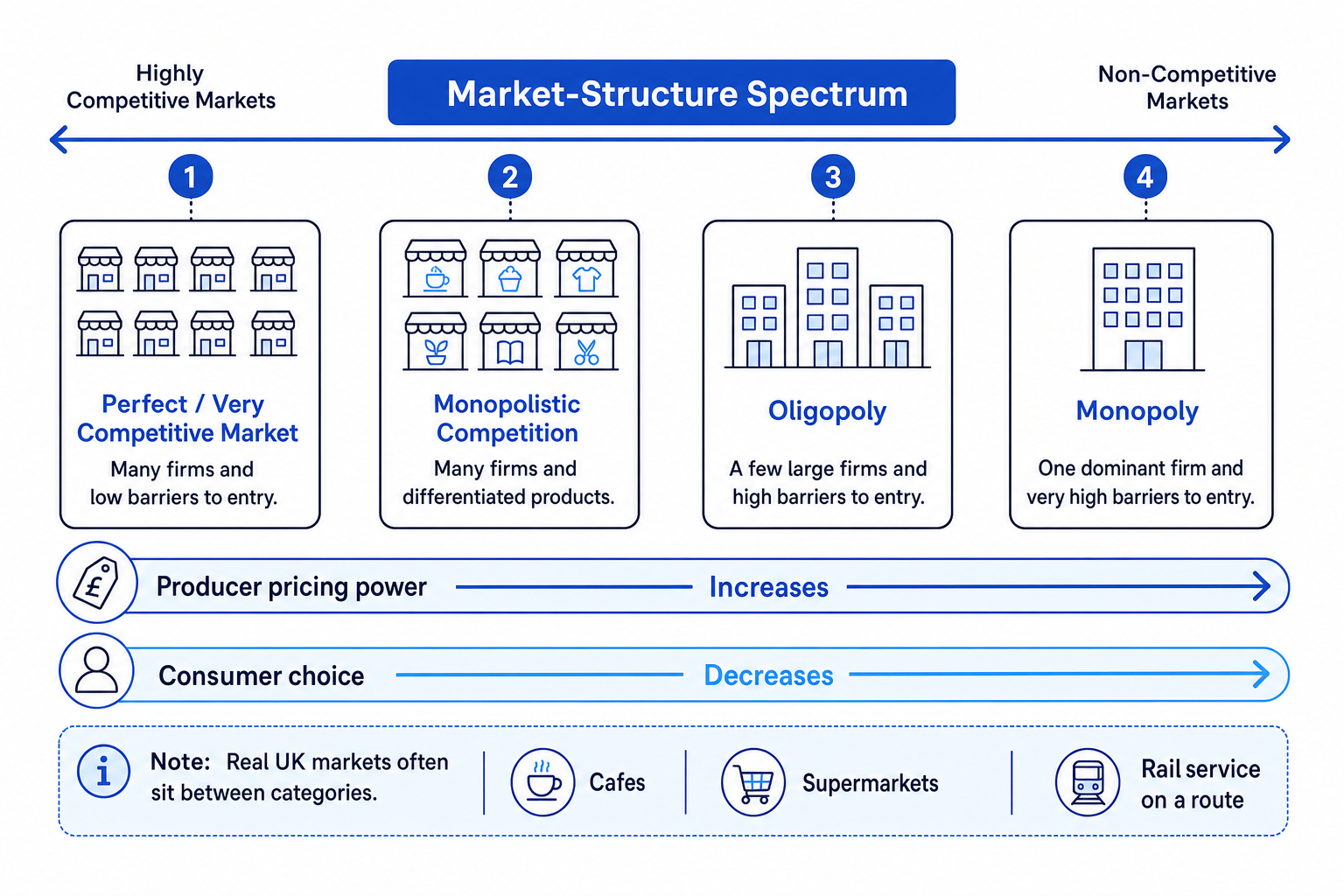
The big shift
As a market becomes less competitive, producers usually gain more power, while consumers usually have fewer alternatives.
Classifying a market as non-competitive
A town has one main bus company. It runs most local routes, owns the depot, and smaller rivals find it difficult to enter because buying buses and hiring drivers is expensive.
- Identify the number of important producers: there is one main bus company supplying most local routes.
- Look at consumer choice: passengers may have few realistic alternatives, especially if they do not own a car.
- Look at barriers to entry: high costs for buses, depots and drivers make it hard for new firms to enter.
- Make the judgement: this market is likely to be non-competitive because one producer has strong market power.
How producers operate in non-competitive markets
Producers in non-competitive markets often behave differently from firms in highly competitive markets.
They may:
- charge higher prices because consumers have fewer alternatives
- limit output if doing so helps maintain higher prices
- use advertising and branding to make consumers loyal
- offer loyalty schemes, subscriptions or exclusive products
- merge with or take over rivals
- use long-term contracts or control of key resources to make entry difficult for new firms
Barriers to entry
Barriers to entry are obstacles that make it difficult for new firms to enter a market and compete with existing producers.
Common barriers to entry include high start-up costs, strong brand loyalty, patents, legal restrictions, access to important technology, and economies of scale.
Economies of scale happen when a firm’s average cost falls as it produces more. Large firms may be able to buy supplies more cheaply, use specialist equipment, or spread advertising costs over millions of sales.
Using economies of scale as a barrier
A large supermarket chain can buy milk from suppliers at a lower cost than a small corner shop because it orders huge quantities.
- Compare the size of the firms: the supermarket buys millions of litres, while the corner shop buys much less.
- Compare costs: the supermarket may negotiate a lower price per litre because suppliers want its large orders.
- Link to competition: the supermarket can charge low prices while still making profit, making it harder for small shops to compete.
- Reach a conclusion: economies of scale can become a barrier to entry because new or smaller firms struggle to match the large firm’s costs.
Assuming big always means bad
A large firm is not automatically bad for consumers. It may charge high prices, but it may also have lower costs, better technology, wider product ranges or more reliable service.
The impact on price and choice
The main GCSE focus is how non-competitive markets affect price and choice.
Impact on price
In a competitive market, firms fear losing customers to rivals. That pressure helps keep prices down.
In a non-competitive market, the pressure is weaker. If a firm is the only realistic supplier, or one of very few suppliers, it may be able to charge higher prices.
This can be especially important in essential markets such as energy, water, rail travel or broadband, where consumers may not be able to stop buying the service easily.
Analysing a price rise with market power
A broadband provider increases its monthly price from £25 to £30. Customer numbers fall from 10,000 to 9,500 because many households have limited alternatives.
- Calculate revenue before the price rise: £25 × 10,000 customers = £250,000 per month.
- Calculate revenue after the price rise: £30 × 9,500 customers = £285,000 per month.
- Compare the two figures: £285,000 − £250,000 = £35,000 extra revenue per month.
- Interpret the result: because relatively few customers left, the provider gained revenue, showing how market power can allow higher prices.
Impact on choice
Non-competitive markets may reduce choice because fewer firms are supplying the market. Consumers might face fewer brands, fewer product features, fewer locations, or fewer price options.
However, the impact is not always simple. Large firms may offer a wide range of products. For example, a big streaming platform may provide thousands of shows, even if the market is dominated by a few major platforms.
Price and choice sentence frame
For analysis questions, try: “Because there are few close substitutes, consumers have limited ability to switch, so the producer may be able to charge a higher price or offer less choice.”
Monopoly
A monopoly is the strongest form of non-competitive market.
Monopoly
A monopoly is a market dominated by one producer or supplier.
In a pure monopoly, there is only one seller. In real life, GCSE questions may use “monopoly” more broadly to mean one firm has a very dominant position.
Examples can include a rail operator on a particular route, a local water company, or a firm with exclusive control of a product or technology.
Causes of monopoly power
Monopoly power can be caused by:
- high start-up costs, such as railway networks, water pipes or energy infrastructure
- legal protection, such as patents on a medicine or technology
- ownership of key resources, such as land, data or specialist equipment
- economies of scale, where the largest firm has much lower average costs
- mergers and takeovers, where firms combine and reduce the number of competitors
- brand loyalty, where consumers strongly prefer one firm’s product
Consequences of monopoly power
A monopoly may lead to:
- higher prices for consumers
- less choice
- less pressure to improve quality or customer service
- higher profits for the producer
- fewer opportunities for new firms
But there can also be benefits:
- large firms may afford expensive research and development
- economies of scale may lower average costs
- one network may be more efficient than several competing networks in some industries, such as water pipes
Monopoly judgement
A strong answer does not just say “monopoly is bad”. It weighs higher prices and less choice against possible benefits like economies of scale, investment and reliability.
Oligopoly
An oligopoly is less extreme than monopoly, but still non-competitive.
Oligopoly
An oligopoly is a market dominated by a few large firms.
UK supermarkets are a useful example. Tesco, Sainsbury’s, Asda, Aldi, Lidl and Morrisons are important competitors, but the market is still dominated by a relatively small number of large firms compared with the thousands of individual shoppers.
How firms behave in an oligopoly
Firms in an oligopoly are interdependent.
Interdependence
Interdependence means that each firm’s decisions affect, and are affected by, the decisions of rival firms.
If one supermarket cuts prices, others may respond with price cuts. If one mobile phone network offers more data for the same price, rivals may copy. This makes oligopoly behaviour strategic.
Oligopolies often compete using non-price competition.
Non-price competition
Non-price competition is when firms compete using methods other than price, such as branding, quality, advertising, loyalty schemes, delivery speed or customer service.
For example, supermarkets may compete through Clubcard or Nectar prices, own-label ranges, delivery slots, store locations and advertising campaigns.
Identifying oligopoly behaviour
Several UK supermarkets sell similar groceries. One supermarket launches a loyalty-card discount on hundreds of products, and rivals quickly advertise their own discounts.
- Identify the market structure: a few large supermarkets dominate sales, so this suggests oligopoly.
- Apply interdependence: one firm’s discount affects rivals because shoppers may switch stores.
- Identify the type of competition: the loyalty-card discount is partly price competition, but also non-price competition because it builds customer loyalty and gathers data.
- Analyse the effect: consumers may benefit from discounts, but loyalty schemes can also make switching less likely.
Collusion and cartels
In an oligopoly, firms may be tempted to avoid competing aggressively. Collusion occurs when firms secretly or openly agree to limit competition, for example by fixing prices or dividing up markets.
A cartel is a formal agreement between firms to reduce competition. In the UK, cartels and price-fixing are illegal because they harm consumers.
Do not confuse collusion with normal competition
It is legal for firms to watch rivals and respond to their prices. It is illegal for firms to agree with rivals to fix prices, restrict output or share markets.
Moral, ethical and sustainability issues
Non-competitive markets raise important ethical questions.
If a firm has strong market power in an essential market, such as energy or transport, high prices can hit low-income households hardest. During the 2022–23 cost-of-living squeeze, energy and food price rises made this issue especially visible in the UK.
There are also questions about workers and suppliers. A powerful supermarket may push suppliers to accept low prices. That might reduce prices for shoppers, but it could put pressure on farmers’ incomes or working conditions.
Sustainability matters too. A dominant firm could use its profits to invest in greener technology. But if it faces little competition, it may have less pressure to improve unless consumers, government or regulators demand change.
Overall effects: winners and losers
Non-competitive markets create trade-offs.
Consumers may lose from higher prices and less choice. New firms may lose because they cannot enter the market easily. Workers may gain if a large profitable firm pays stable wages, but they may lose if there are few alternative employers nearby.
Producers with market power usually gain higher profits and more control. Government may need to regulate markets to protect consumers, but regulation can be difficult because too much control might reduce business investment.
In the exam
- Define the market structure clearly: say whether it is monopoly, oligopoly or simply non-competitive.
- Apply your answer to the context: use the firm, product or market named in the question, such as supermarkets, rail, broadband or energy.
- Analyse both sides: explain possible harms like higher prices and less choice, then consider benefits like economies of scale, investment or innovation.
- Make a judgement: decide whether consumers are likely to be better or worse off, and say why.
Check yourself
- Why can barriers to entry give existing firms market power?
- How is an oligopoly different from a monopoly?
- In what ways might a non-competitive market benefit consumers as well as harm them?
