

What you'll learn
- What a competitive market is and the features it usually has.
- How producers behave when customers can easily switch to rivals.
- How competition affects prices, choice, consumers, producers and workers.
- Why profits are usually lower in competitive markets than in markets dominated by a few large firms.
3.1.5.2 The main characteristics and impacts of competitive markets
Starting point: what is a market?
Before we get to competition, we need the basic language.
Market
A market is any arrangement where buyers and sellers exchange goods or services. It does not have to be a physical place: the market for trainers includes shops, websites and apps.
A consumer is a person or household that buys goods and services. A producer is a business or organisation that makes or supplies goods and services.
So, in the UK supermarket market, households are consumers, while Tesco, Sainsbury’s, Asda, Morrisons, Aldi and Lidl are producers.
What is a competitive market?
Competitive market
A competitive market is a market where many producers compete to sell goods or services to consumers, and no single producer has much power to control the price.
A competitive market usually has these features:
- Many producers: lots of firms are trying to attract customers.
- Many consumers: lots of buyers are choosing between producers.
- Similar products: the goods or services are close substitutes, so customers can switch.
- Low barriers to entry: it is relatively easy for new producers to enter the market.
- Limited market power: individual producers cannot usually charge much more than rivals without losing customers.
Barriers to entry and market power
Barriers to entry are obstacles that make it hard for new firms to enter a market, such as high start-up costs, strong brand loyalty or legal restrictions. Market power is the ability of a producer to influence price, quality or choice in a market.
Think of market structures as a spectrum. At one end, there are highly competitive markets with many producers. At the other end, there are concentrated markets where one or a few firms dominate.
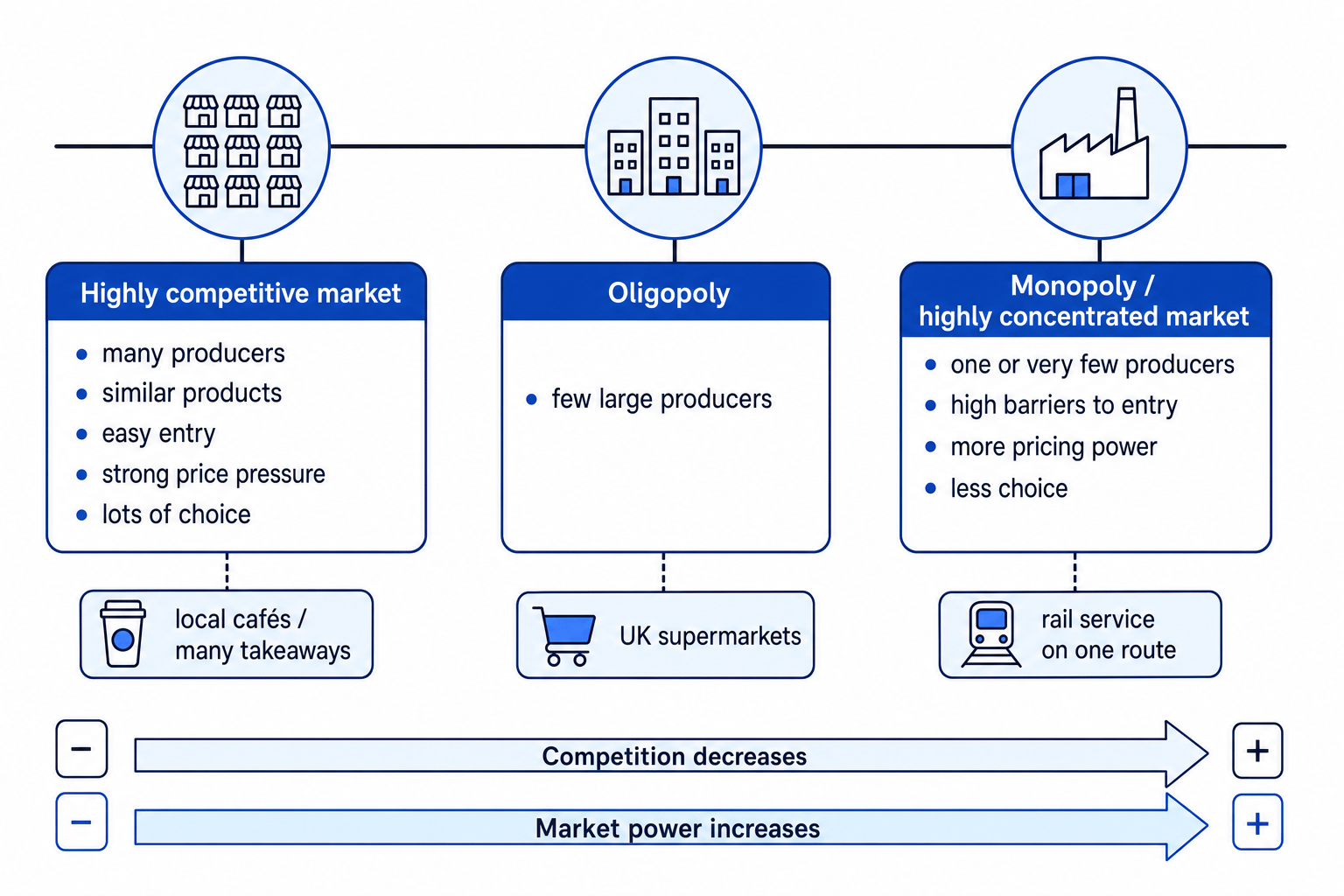
The core idea
In a competitive market, producers must work hard to keep customers because consumers have alternatives.
How producers operate in a competitive market
In a competitive market, producers are under pressure to offer a good deal. This does not always mean the lowest possible price, but it does mean they must give consumers a reason to choose them.
Price competition
Price competition means producers try to attract customers by charging lower prices than rivals, offering discounts, or using promotions.
For example, during the 2022–23 cost-of-living squeeze, UK supermarkets competed heavily using price-matching schemes and loyalty-card offers. Aldi and Lidl put pressure on larger supermarkets because many consumers became more willing to switch to cheaper stores.
Non-price competition
Non-price competition
Non-price competition means producers compete using factors other than price, such as quality, customer service, convenience, branding, delivery speed or ethical credentials.
For example, two cafés might charge similar prices, but one may compete by offering faster service, vegan options, loyalty points or locally sourced ingredients.
Product differentiation
Product differentiation means making a product seem different from rivals’ products. This can be done through design, packaging, branding, location, quality or customer experience.
This matters because if a producer can make its product stand out, consumers may be less likely to switch purely because another firm is slightly cheaper.
Choosing a strategy in a competitive café market
A local café faces three similar cafés on the same high street.
-
The owner considers raising sandwich prices from £4 to £5. Because customers can easily compare cafés, many are likely to switch to a rival instead of paying more.
-
This means the café has limited market power: a higher price may reduce sales enough to damage revenue.
-
A better competitive response could be non-price competition, such as faster service, a loyalty card or fresher ingredients, so customers have a reason to choose this café without relying only on lower prices.
-
The judgement is that the best strategy depends on costs: fresher ingredients may attract customers, but if they raise total costs too much, profit may still fall.
Think: can customers switch?
The easier it is for consumers to switch to another producer, the more competitive the market is likely to be.
The impact of competition on price and choice
Price
Competition usually puts downward pressure on prices. If one producer charges much more than its rivals, consumers can buy from someone else.
However, prices may still rise if costs rise. For example, food prices rose sharply in the UK during the 2022–23 inflation spike because energy, transport and ingredient costs increased. Competition did not stop prices rising completely, but it may have limited how far some firms could raise prices.
Thinking competition always means prices fall
Competition usually makes prices lower than they otherwise would be, but prices can still rise if producers face higher costs.
Choice
Competition can increase choice because producers try to attract different types of consumers. They may offer:
- different product ranges
- different quality levels
- different prices
- better customer service
- online ordering, delivery or click-and-collect
- more ethical or sustainable options
For example, streaming services compete through exclusive shows, price plans and user experience. Supermarkets compete through budget ranges, premium ranges, vegan products and meal deals.
But there is a possible downside: if competition becomes extremely intense, some producers may leave the market because they cannot make enough profit. This can reduce choice in the long run.
Economic impact on consumers, producers and workers
Competition creates winners and losers. In an exam, you should try to consider more than one group.
Consumers
Consumers often benefit from competitive markets because they may get:
- lower prices
- better quality
- more choice
- improved customer service
- more innovation
For example, competition between mobile phone providers can lead to cheaper data packages or better network deals.
But consumers may not benefit if firms cut costs in ways that reduce quality, safety or service. A very cheap product is not always the best value if it breaks quickly or has poor after-sales support.
Producers
Producers face both opportunities and pressures.
Efficient producers can gain customers and grow. They may become better at controlling costs, improving quality and responding to consumer wants.
Less efficient producers may struggle. If they cannot match rivals’ prices or quality, they may lose sales, make lower profits or leave the market.
Profit
Profit is the money left after a producer subtracts total costs from total revenue. Total revenue is the money received from sales. Total costs are the costs of producing the good or service.
Workers
Workers can be affected in different ways.
Competition can create jobs if successful firms expand or if new producers enter the market. For example, a new takeaway, supermarket branch or delivery service may hire more staff.
But competition can also put pressure on workers. If firms are trying to keep prices low, they may try to control labour costs by limiting wage rises, reducing hours, increasing workload or using automation. UK minimum-wage rises can improve pay for low-paid workers, but competitive firms may respond by raising prices, accepting lower profit or reducing staffing hours.
Competition affects real people
Competition is not just about prices. It affects business survival, job security, wages, working conditions and the quality of goods and services.
Why profits are usually lower in competitive markets
Profits are likely to be lower in a competitive market than in a market dominated by a small number of producers.
A concentrated market is a market where a small number of large producers account for a high share of total sales. An oligopoly is a market dominated by a few large firms. A monopoly is a market with one main producer.
In competitive markets, profits tend to be lower because:
-
Consumers can switch easily
If a firm raises prices too much, consumers move to rivals. -
New firms can enter
If existing firms are making high profits, new producers may enter the market, increasing competition and pushing prices down. -
Firms spend money to attract customers
Advertising, loyalty schemes, better service and promotions can increase costs. -
Producers have limited pricing power
They cannot simply charge much higher prices without losing sales.
In concentrated markets, firms may face less pressure from rivals. If consumers have fewer alternatives, large producers may be able to charge higher prices and earn higher profits.
Comparing profit before and after new competitors enter
A takeaway used to be the only one near a school. It sold 1,000 lunches per week at £5 each, with total costs of £3,200. Then three rival takeaways opened nearby. To keep customers, it lowered its price to £4. It now sells 1,100 lunches per week, with total costs of £3,450.
-
Before the new competitors entered, total revenue was £5 multiplied by 1,000 lunches = £5,000.
-
Before competition increased, profit was £5,000 minus £3,200 = £1,800 per week.
-
After competitors entered, total revenue was £4 multiplied by 1,100 lunches = £4,400. Profit was £4,400 minus £3,450 = £950 per week.
-
Profit fell from £1,800 to £950, a fall of £850 per week. Consumers gained a lower price and more choice, but the original producer earned less profit even though it sold more lunches.
Confusing revenue with profit
A producer can sell more units and still make less profit if the price falls or costs rise. Always compare total revenue and total costs.
Moral, ethical and sustainability considerations
Competition can be good for consumers, but the method of competing matters.
If firms compete by becoming more efficient, reducing waste and improving products, the impact is likely to be positive. But if they compete by squeezing suppliers, reducing worker conditions or ignoring environmental damage, there may be ethical and sustainability concerns.
For example, very cheap clothing can benefit consumers on low incomes, but it may raise questions about factory conditions, waste and environmental impact. Similarly, supermarkets competing on low prices may benefit shoppers, but can create pressure on farmers and suppliers.
So your judgement should be balanced: competition often improves price and choice, but it is not automatically good in every way.
In the exam
-
Define the market clearly: say whether there are many producers, whether consumers can switch, and whether barriers to entry are low or high.
-
Build a chain of analysis: more competition → more pressure on producers → lower prices or better quality → effects on consumers, producers and workers.
-
Evaluate by weighing winners and losers: consumers may gain from lower prices, but producers may face lower profits and workers may face pressure on pay or conditions.
Check yourself
- Why does the ability to switch supplier make a market more competitive?
- How might competition benefit consumers but harm some producers?
- Why are profits usually lower in a competitive market than in a concentrated market?
