The labour market
What you'll learn
- What the labour market is and why wages act like a “price” for work.
- How supply and demand determine wages in a simple labour market diagram.
- Why wages differ within and between occupations.
- How to calculate gross pay and net pay using simple income information.
3.1.5.4 The labour market
The labour market: the basics
A market is any situation where buyers and sellers interact. In a product market, consumers buy goods and services from firms. In the labour market, firms “buy” labour by hiring workers, and workers “sell” their time, effort and skills.
Labour market
The labour market is where employers demand labour and workers supply labour. The wage rate is the price of labour, often shown as £ per hour, per week or per year.
In this market:
- Firms demand labour because workers help produce goods and services.
- Workers supply labour because they want income and other rewards from work.
- The wage is the payment workers receive for labour.
A supermarket such as Tesco demands checkout staff, delivery drivers and managers because it needs workers to sell groceries. Workers supply their labour if the wage and conditions make the job worthwhile.
Demand for labour
Demand for labour
Demand for labour is the number of workers employers are willing and able to hire at different wage rates.
Demand for labour usually slopes downwards: as wages rise, labour becomes more expensive, so firms may hire fewer workers, reduce overtime, or invest in labour-saving technology.
Demand for labour is often derived demand. This means it comes from demand for the final good or service the worker helps produce. For example, if demand for home deliveries rises, supermarkets and delivery firms may demand more drivers.
Supply of labour
Supply of labour
Supply of labour is the number of workers willing and able to work at different wage rates.
Supply of labour usually slopes upwards: as wages rise, more people may be attracted into that job, work more hours, or train for that occupation.
For example, if wages for electricians rise, more people may choose apprenticeships in electrical work, though this takes time because training is needed.
Wage determination using supply and demand
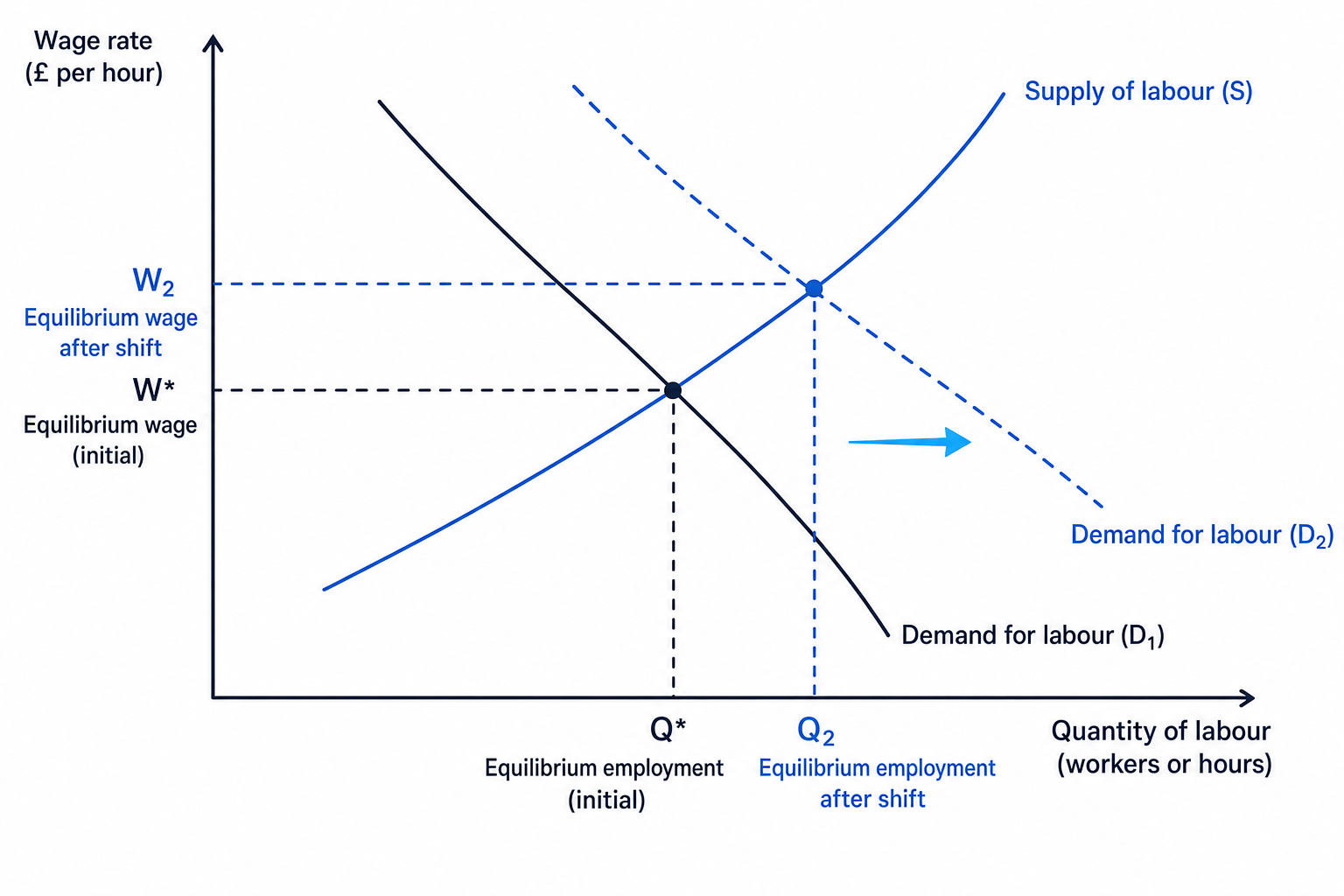
In a simple labour market, wages are determined where demand for labour equals supply of labour. This point is called the equilibrium.
Equilibrium wage
The equilibrium wage is the wage rate where the quantity of labour demanded equals the quantity of labour supplied.
The diagram below shows how a labour market works. The vertical axis shows the wage rate, and the horizontal axis shows the quantity of labour. A rise in demand for labour shifts the demand curve to the right, increasing both the equilibrium wage and employment.
Wages are a price
In the labour market, the wage is the price of labour. If demand for a type of worker rises faster than supply, wages tend to rise. If supply rises faster than demand, wages tend to fall or grow more slowly.
What can shift demand for labour?
Demand for labour can increase when:
- Demand for the product rises, such as more demand for online shopping increasing demand for delivery drivers.
- Workers become more productive, so each worker adds more value to the firm.
- A sector expands, such as renewable energy creating demand for engineers and technicians.
- Firms need scarce skills, such as coding, data analysis or cyber-security.
Demand for labour can decrease when:
- Demand for the product falls.
- A firm replaces some workers with machines or software.
- Production moves abroad.
What can shift supply of labour?
Supply of labour can increase when:
- Wages rise and attract more workers.
- Training and qualifications become more available.
- Migration increases the number of available workers.
- More people choose to enter that occupation.
Supply of labour can decrease when:
- Workers retire or leave the labour force.
- Fewer people train for that job.
- Working conditions are unattractive.
- Migration rules reduce the number of available workers.
Brexit affected some UK labour markets by reducing the supply of EU workers in areas such as hospitality, agriculture and social care. COVID-19 also changed labour supply because some people left certain sectors, became economically inactive, or changed their work preferences.
Explaining a rise in wages for delivery drivers
-
Online shopping and takeaway deliveries increase, so firms such as supermarkets and delivery platforms need more drivers. This shifts demand for delivery-driver labour to the right.
-
At the original wage, firms want to hire more drivers than are available. This creates excess demand for labour, so employers compete by offering higher pay, bonuses or better hours.
-
The new equilibrium is at a higher wage and a higher quantity of labour employed, assuming enough people are willing and able to become drivers.
Product demand versus labour demand
Do not say “customers demand workers”. Customers demand goods and services. Firms demand workers because workers help produce those goods and services.
Wage differentials
Wage differential
A wage differential is a difference in wage rates between workers, jobs, occupations, regions or industries.
Wage differentials happen because labour is not all the same. Workers have different skills, qualifications, experience and productivity. Jobs also differ in responsibility, risk, working conditions and how scarce the required skills are.
Wage differentials between occupations
Wages often differ between occupations. For example, a surgeon is usually paid more than a retail assistant because the job requires many years of training, high responsibility, scarce skills and intense pressure.
Common causes include:
- Skill and qualifications: jobs needing specialist training often pay more.
- Experience and productivity: more productive workers may generate more revenue for firms.
- Risk and responsibility: dangerous or high-pressure jobs may need higher wages to attract workers.
- Scarcity of labour: if few workers have the right skills, supply is limited, so wages can be higher.
- Demand for the final product: if demand for a service is high, demand for workers in that sector may rise.
- Trade unions and bargaining power: some workers can negotiate better pay and conditions.
Wage differentials within occupations
Wages can also differ within the same occupation. Two teachers, nurses, chefs or software developers may not earn the same wage.
This can happen because of:
- Experience or seniority.
- Location, such as London weighting.
- Overtime, unsocial hours or shift work.
- Performance-related pay.
- Different employers, such as small firms compared with large firms.
- Discrimination, although unequal pay based on protected characteristics such as sex or race is illegal and unethical.
Comparing wage differentials
-
A junior chef earns £12 per hour, while a head chef earns £20 per hour. The wage differential is £20 − £12 = £8 per hour.
-
The head chef is likely to have more experience, responsibility and decision-making power, so their labour may be more valuable to the restaurant.
-
If there is a shortage of skilled chefs in a city, restaurants may offer higher wages to attract and keep them, widening the wage differential.
A strong wage-differential answer
Link the wage difference to supply and demand. For example: “Software engineers may earn more because demand for digital skills is high, while the supply of workers with those skills is relatively limited.”
Ethical issues in the labour market
Labour markets are not just about efficiency and profit. Pay affects people’s living standards, motivation and wellbeing.
Firms may want to keep labour costs low to increase profits, but very low pay can create in-work poverty, especially during periods like the 2022–23 cost-of-living squeeze. Governments may respond with policies such as increases in the National Minimum Wage or National Living Wage, though firms may argue that higher wage costs can increase prices or reduce hiring.
Pay gaps can also raise moral and ethical concerns. If workers doing equal work are paid differently because of discrimination, this is unfair and illegal. Even when differences are legal, society may still debate whether very large wage gaps are acceptable.
Gross pay and net pay
When you get paid, there is a difference between the amount you earn before deductions and the amount you actually take home.
Gross pay and net pay
Gross pay is pay before deductions. Net pay is pay after deductions, so it is the worker’s take-home pay.
Common deductions include:
- Income tax.
- National Insurance contributions.
- Pension contributions.
- Student loan repayments, if relevant.
- Other deductions agreed with the employer.
For GCSE Economics, you do not need complicated tax rules unless the question gives them. Use the information in the question carefully.
Net pay is take-home pay
Gross pay is the bigger “before deductions” figure. Net pay is what the worker actually receives after deductions.
Calculating gross pay
Gross pay can be calculated in different ways depending on how the worker is paid.
For hourly pay:
Gross pay = hours worked × hourly wage
For a salary:
Monthly gross pay = annual salary divided by 12
For overtime, add the overtime pay to normal pay.
Calculating net pay
Net pay is calculated by subtracting deductions from gross pay:
Net pay = gross pay − total deductions
Calculating gross and net pay
-
Maya works 40 hours at £12 per hour. Her normal gross pay is 40 × £12 = £480.
-
She also works 5 hours of overtime at £18 per hour. Her overtime pay is 5 × £18 = £90.
-
Her total gross pay is £480 + £90 = £570.
-
Her deductions are income tax £60, National Insurance £35 and pension contributions £25. Total deductions are £60 + £35 + £25 = £120.
-
Her net pay is £570 − £120 = £450. This is the amount Maya takes home.
Mixing up gross and net
If a question asks for net pay, you must subtract deductions. If you only calculate earnings before deductions, you have found gross pay, not net pay.
Bringing it together
The labour market is part of the wider economy because wages affect both firms and households.
For workers, wages are a major source of income and influence living standards. For firms, wages are a cost of production. If wages rise, workers may benefit from higher incomes, but firms may face higher costs and may raise prices, reduce profits or hire fewer workers.
This is why labour-market questions often involve trade-offs. A higher minimum wage may improve fairness and reduce poverty for some workers, but it may also increase costs for businesses such as cafés, care homes or small retailers. A balanced answer explains both sides before reaching a judgement.
In the exam
-
For wage determination, always identify whether demand for labour or supply of labour changes, then explain the effect on wages and employment.
-
For wage differentials, explain the pay gap using economic reasons such as skills, training, productivity, risk, scarcity and bargaining power.
-
For pay calculations, label your answer clearly as gross pay or net pay, carry the £ sign through your working, and subtract all deductions when finding take-home pay.
Check yourself
- Why might wages for cyber-security workers rise if firms become more worried about online crime?
- Give two reasons why a nurse and a supermarket assistant might earn different wages.
- A worker earns £520 gross pay and has deductions of £95. What is their net pay?