What you'll learn
- What fiscal policy means and how it affects income and expenditure in the UK economy.
- How taxes and government spending can help achieve government objectives such as growth, low unemployment and lower inflation.
- What a balanced budget, budget surplus and budget deficit mean.
- Why fiscal policy involves trade-offs, winners and losers, and moral choices.
3.2.3.1 Fiscal policy and the government budget
The basic idea: government can influence the economy
The government is a major economic decision-maker. It collects money through taxation and spends money on public services, benefits, infrastructure and support for households and businesses.
Fiscal policy
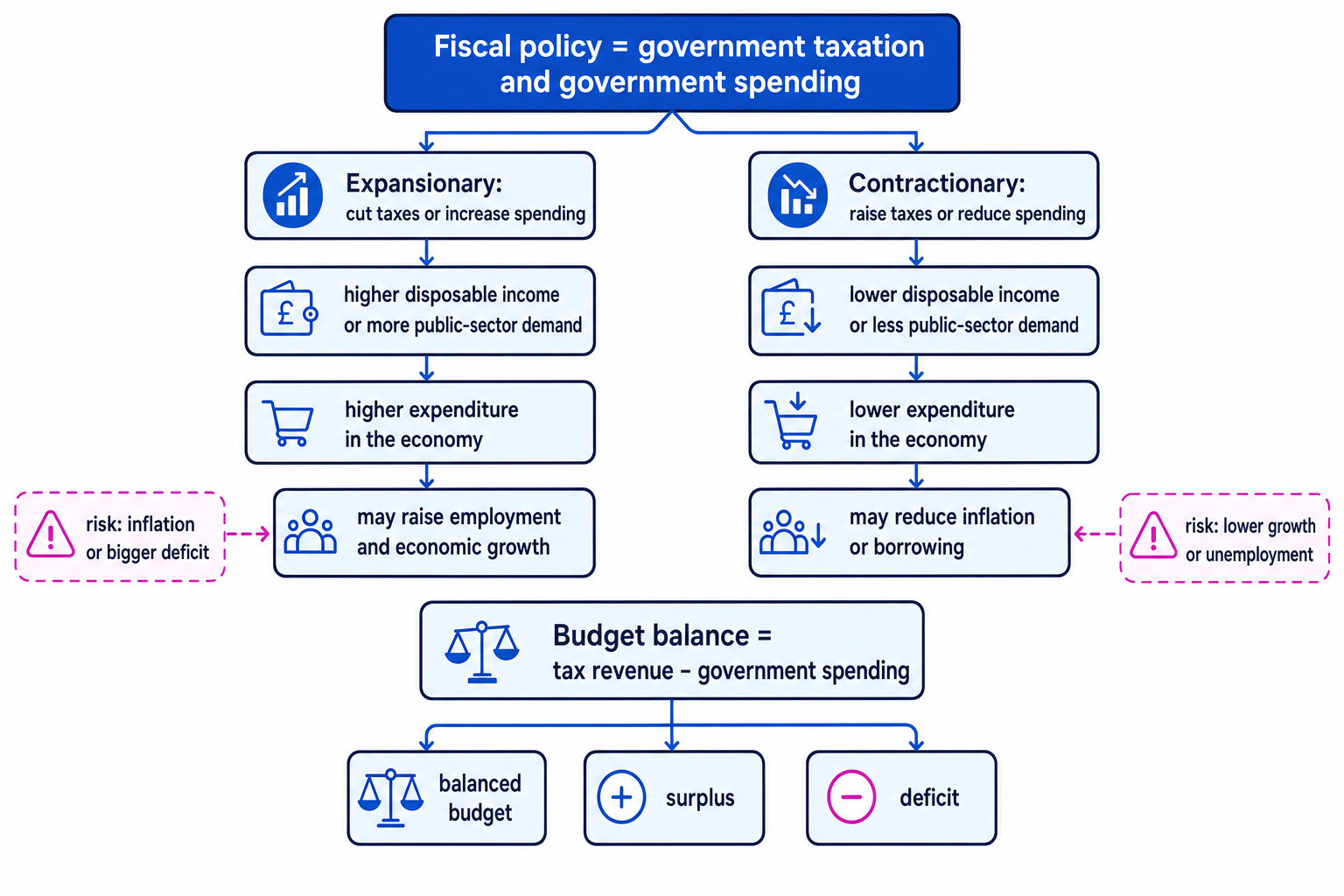
Fiscal policy is the use of government taxation and government spending to influence the economy.
A tax is money paid to the government. A direct tax is paid directly on income or profits, such as income tax or corporation tax. An indirect tax is added to spending, such as VAT, fuel duty or the sugar levy.
Government spending is money spent by central or local government, for example on the NHS, schools, defence, roads, benefits, pensions and grants to businesses.
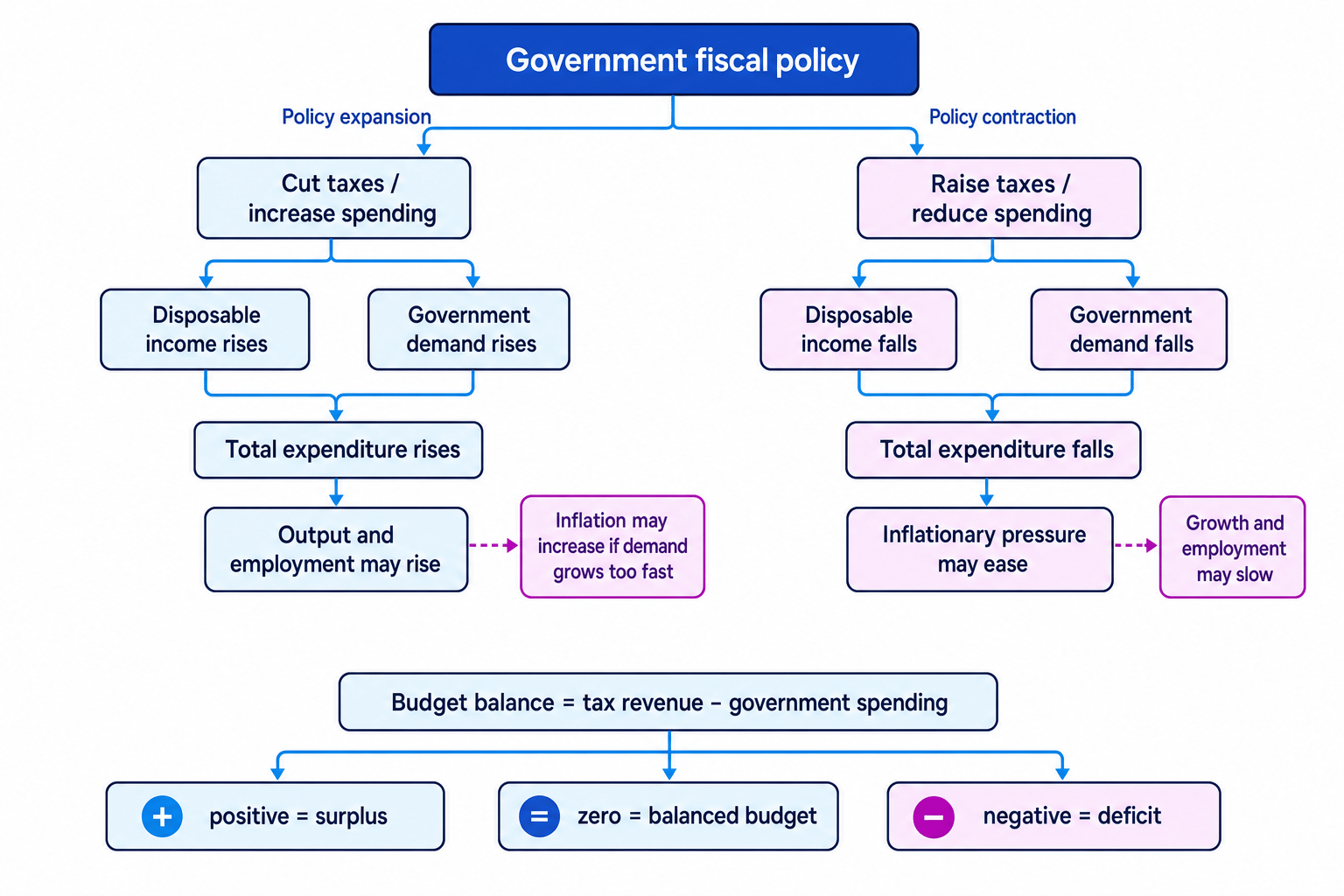
Here is the big picture of how fiscal policy works: taxes and spending affect people’s incomes, which then affects expenditure in shops, firms and public services.
Income, expenditure and disposable income
Income is money received by households or firms. For households, this includes wages, salaries, benefits, pensions and profits from owning a business.
Expenditure means spending on goods and services. In GCSE Economics, when we talk about the level of expenditure in the economy, we mean the overall amount being spent by households, firms and government.
Disposable income
Disposable income is the income households have left after direct taxes have been paid and benefits have been received. It is the money available for spending or saving.
If the government cuts income tax, many workers keep more of their pay. Their disposable income rises, so they may spend more at places like Tesco, Greggs, restaurants, cinemas or on streaming services.
If the government raises income tax, disposable income falls. Households may reduce spending, especially on non-essential goods and services.
Tax changes affect spending
Lower taxes usually increase disposable income and can increase expenditure. Higher taxes usually reduce disposable income and can reduce expenditure.
Tax cut and consumer spending
Suppose the government gives 2 million households an income tax cut worth £10 per week each.
-
Calculate the total increase in disposable income:
Extra disposable income=2 million households×£10 per week=£20 million per week\begin{aligned} \text{Extra disposable income} &= \text{2 million households} \times \text{£10 per week} \\ &= \text{£20 million per week} \end{aligned}Extra disposable income=2 million households×£10 per week=£20 million per week -
If households spend 80% of this extra income, calculate the extra expenditure:
Extra expenditure=£20 million×80%=£16 million per week\begin{aligned} \text{Extra expenditure} &= \text{£20 million} \times 80\% \\ &= \text{£16 million per week} \end{aligned}Extra expenditure=£20 million×80%=£16 million per week -
Firms may see higher sales, so they may employ more workers or offer more hours. This can raise incomes further, although it is not guaranteed if firms are short of workers or prices rise instead.
Expansionary and contractionary fiscal policy
An expansionary fiscal policy is designed to increase income and expenditure in the economy. The government might:
- cut taxes
- increase spending on public services
- increase benefits or support payments
- give grants or subsidies to firms
This can help when economic growth is weak or unemployment is rising. During the COVID-19 pandemic, the UK government used large amounts of spending, including the furlough scheme, to protect jobs and household incomes.
A contractionary fiscal policy is designed to reduce income and expenditure in the economy. The government might:
- raise taxes
- reduce spending
- reduce benefits or support schemes
This may be used when inflation is too high or when the government wants to reduce borrowing.
Fiscal policy is not monetary policy
Fiscal policy is about taxation and government spending. Monetary policy is mainly about interest rates and the money supply, controlled in the UK by the Bank of England.
How fiscal policy can achieve government objectives
Governments usually have several economic objectives. These objectives can conflict with each other, so fiscal policy often involves judgement.
Objective 1: economic growth
Economic growth means an increase in the output of goods and services, usually measured by real GDP. Fiscal policy can support growth by increasing expenditure.
For example, spending on transport, broadband, schools and training can help firms become more productive. Tax cuts can encourage households to spend and firms to invest.
Objective 2: low unemployment
Unemployment means people who are willing and able to work cannot find a job. If the government increases spending on infrastructure, such as roads or hospitals, firms may need more workers. If tax cuts increase demand for goods and services, firms may also hire more staff.
The furlough scheme during COVID-19 is a strong recent UK example. Government spending supported workers’ incomes when many businesses could not operate normally.
Using fiscal policy to protect jobs
During a lockdown, many hospitality firms lose revenue because customers cannot visit restaurants, pubs and hotels.
-
The government identifies the objective: prevent a sharp rise in unemployment and protect household incomes.
-
It increases spending through wage support or grants, so firms can keep workers attached to their jobs even when sales are temporarily low.
-
This supports disposable income, so household expenditure does not collapse as sharply. The trade-off is that government spending rises, so borrowing and the budget deficit may increase.
Objective 3: price stability
Price stability means keeping inflation low and stable. Inflation is a sustained rise in the general price level.
If spending in the economy is rising too quickly, the government may use contractionary fiscal policy. Higher taxes or lower government spending can reduce expenditure, which may reduce pressure on prices.
However, not all inflation is caused by too much spending. In 2022–23, much UK inflation was linked to energy-price shocks and global supply problems. Tax rises might reduce spending, but they would not directly produce more gas, oil or food.
Always link policy to the cause
If inflation is caused by too much spending, contractionary fiscal policy may help. If inflation is caused by energy or import costs, fiscal policy may need to focus on targeted support for the worst affected households.
Objective 4: reducing inequality and supporting living standards
Fiscal policy can redistribute income. Redistribution means changing the distribution of income so that it becomes more equal.
The government may use:
- progressive income tax, where higher earners pay a higher percentage of income in tax
- benefits for low-income households
- spending on public services such as healthcare, education and social housing
This has moral and ethical importance. For example, during the cost-of-living squeeze after 2021, support with energy bills helped many households, but the government had to decide whether support should be universal or targeted at those most in need.
Objective 5: sustainability and healthier choices
Fiscal policy can also influence behaviour. The UK sugar levy is a tax on sugary soft drinks. It gives producers an incentive to reduce sugar content and encourages consumers to choose healthier options.
Governments can also spend on greener transport, home insulation or renewable energy. This may support long-term sustainability, but it costs money now and may require higher taxes or borrowing.
Fiscal policy has trade-offs
A policy that helps one objective may damage another. For example, extra spending may reduce unemployment, but it may also increase borrowing or add to inflation.
The government budget
The government budget compares how much money the government receives with how much it spends over a period of time, usually one year.
Government budget
The government budget is the government’s plan for tax revenue and public spending. A simple way to measure the budget position is:
budget balance=tax revenue−government spending\text{budget balance} = \text{tax revenue} - \text{government spending}budget balance=tax revenue−government spendingBalanced budget
A balanced budget occurs when government tax revenue equals government spending.
So if the government receives £900 billion in tax revenue and spends £900 billion, the budget is balanced. There is no budget surplus and no budget deficit for that year.
A balanced budget can make public finances look stable. However, forcing a balanced budget during a recession may be harmful if it means cutting spending or raising taxes when households and firms are already struggling.
Budget surplus
A budget surplus occurs when tax revenue is greater than government spending.
For example, if the government receives £950 billion and spends £920 billion, it has a surplus of £30 billion.
Possible consequences of a surplus include:
- the government may repay some debt
- future interest payments may fall
- confidence in public finances may improve
- but household and firm expenditure may be lower because more money is being taken in taxes than spent by government
A surplus is not automatically “good”. If public services are underfunded, running a surplus may raise ethical questions.
Budget deficit
A budget deficit occurs when government spending is greater than tax revenue.
For example, if the government receives £910 billion and spends £1,030 billion, it has a deficit of £120 billion.
The government usually finances a deficit by borrowing. This adds to the national debt, which is the total amount the government owes from past borrowing.
Calculating the budget position
Suppose UK government tax revenue is £910 billion and government spending is £1,030 billion.
-
Use the budget balance formula:
budget balance=tax revenue−government spending\text{budget balance} = \text{tax revenue} - \text{government spending}budget balance=tax revenue−government spending -
Substitute the figures:
budget balance=£910 billion−£1,030 billion=−£120 billion\begin{aligned} \text{budget balance} &= \text{£910 billion} - \text{£1,030 billion} \\ &= -\text{£120 billion} \end{aligned}budget balance=£910 billion−£1,030 billion=−£120 billion -
The answer is negative, so the government has a budget deficit of £120 billion. It will need to borrow, use reserves, or change taxes and spending.
Consequences of operating a deficit
A deficit can be useful when the economy is weak. Extra spending or lower taxes can protect incomes, support firms and reduce unemployment.
But deficits also have costs:
- borrowing increases the national debt
- interest payments can take money away from other public services
- future governments may need to raise taxes or cut spending
- if the economy is already close to full capacity, extra spending may increase inflation
Deficit and debt are different
A budget deficit is the extra borrowing needed in one year. The national debt is the total amount owed from many years of borrowing.
Making a judgement about fiscal policy
In the exam, avoid saying “tax cuts are good” or “deficits are bad” without context. The best answer depends on the situation.
If unemployment is high, a deficit caused by job-support spending may be justified. If inflation is high and the economy is already overheating, more borrowing to fund tax cuts may be risky.
A strong evaluation considers:
- the size of the policy
- whether it is temporary or permanent
- who gains and who loses
- the opportunity cost
- whether it supports long-term growth, fairness and sustainability
In the exam
-
Define the key fiscal policy tool: is the government changing taxation, spending, or both?
-
Chain the effects: policy change → disposable income or public spending → expenditure → jobs, growth, inflation or borrowing.
-
Evaluate using context: explain whether the policy is suitable for the economic problem, such as COVID-19 unemployment, 2022–23 inflation, or the cost-of-living squeeze.
Check yourself
- How could a cut in income tax affect disposable income and expenditure?
- What is the difference between a budget deficit and the national debt?
- Why might a budget surplus be harmful during a recession?