

What you'll learn
- What economists mean by a market — and why it does not have to be a physical place.
- How markets help decide how scarce resources are used.
- The difference between product markets and factor markets.
- How to explain resource allocation using real UK examples.
3.1.2.1 Markets, allocation of resources, and factor/product markets
This section is the starting point for understanding how markets work. Before you draw supply and demand diagrams later, you need the basic idea: markets are one way societies decide what gets produced, how it is produced, and who gets it.
The starting problem: scarcity
Economics begins with a simple problem: people want lots of things, but the resources available to make them are limited.
Scarcity
Scarcity means there are not enough resources to satisfy all wants. A resource is anything used to produce goods and services. A good is a physical item, such as a phone or loaf of bread. A service is an action done for someone, such as a haircut, bus journey, or Netflix subscription.
Because resources are scarce, choices have to be made. For example, a piece of land in a town centre could be used for flats, a supermarket, a park, or offices — but not all of them at once.
That is why resource allocation matters.
Resource allocation
Resource allocation means deciding how scarce resources are used between competing uses.
What is a market?
In everyday language, you might think of a market as a place with stalls. In economics, the meaning is wider.
Market
A market is an opportunity for buyers and sellers to interact in order to establish a price. A buyer is someone who wants to purchase something. A seller is someone offering something for sale. A price is the amount of money paid for a good, service, or resource.
A market can be:
- a physical place, such as a farmers’ market
- an online platform, such as eBay or Vinted
- a local service market, such as plumbers in Manchester
- a national market, such as the UK housing market
- a global market, such as oil, coffee, or smartphones
The key point is not the location. The key point is that buyers and sellers can interact.
Thinking a market must be a place
A market does not have to be a physical location. The UK market for streaming services includes firms such as Netflix, Disney+ and Amazon Prime, even though most buying happens online.
How a price is established
A price is not usually chosen by one side alone. It comes from the interaction between what buyers are willing and able to pay, and what sellers are willing and able to accept.
If lots of buyers want a product and it is hard to get, sellers may be able to charge a higher price. If sellers have too much stock and buyers are not interested, the price may fall.
Establishing a price for strawberries
A fruit stall is selling punnets of strawberries.
-
At £2 per punnet, many buyers want strawberries, and the stall sells out quickly. This suggests the price may be low compared with the number of buyers wanting them.
-
At £4 per punnet, fewer buyers are willing to buy, and several punnets are left unsold. This suggests the price may be too high for the current level of demand.
-
At about £3 per punnet, enough buyers are willing to purchase, and the seller can sell most of the stock while covering costs. This is how interaction between buyers and sellers can help establish a market price.
The role of markets in allocating scarce resources
Markets help allocate resources because prices act like messages.
A price signal is information given by a price that helps buyers and sellers make decisions. An incentive is something that encourages a person or business to act in a particular way.
When the price of a product rises, it can signal that the product is scarce or strongly wanted. Producers may respond by using more resources to make it, because higher prices can mean higher revenue and possible profit.
How markets allocate resources
Markets allocate scarce resources by using prices to signal what consumers want and by giving producers incentives to supply those goods and services.
For example, if demand for electric cars increases, car manufacturers may allocate more labour, machinery, factory space, and raw materials towards electric vehicle production. At the same time, fewer resources may be used for older petrol and diesel models.
Reallocating resources during the hand-sanitiser boom
During COVID-19, demand for hand sanitiser rose sharply.
-
Consumers, hospitals, schools, and businesses wanted much more hand sanitiser than before, so empty shelves and higher prices signalled strong demand and scarcity.
-
Some distilleries and chemical firms responded by shifting resources such as alcohol, plastic bottles, workers, and delivery capacity towards producing hand sanitiser.
-
Resources were therefore reallocated from less urgent uses towards a product society suddenly wanted much more. However, very high prices also raised fairness concerns, especially where essential products were involved.
Markets are useful, but not always fair
Markets are powerful because they can respond quickly to changes in demand and supply. However, they allocate resources mainly according to willingness and ability to pay, not necessarily according to need.
This matters in real life. During the 2022–23 cost-of-living squeeze, high energy prices encouraged households and firms to reduce energy use, but they also put serious pressure on low-income households. The market price helped ration scarce gas and electricity, but the outcome raised ethical questions about affordability, fairness, and government support.
Markets and fairness
A market can be efficient at directing resources towards profitable uses, but that does not automatically mean the outcome is fair, ethical, or sustainable.
Factor markets and product markets
Markets can be grouped into two important types: product markets and factor markets.
Product market
A product market is a market where finished goods and services are bought and sold. For example, the market for groceries, haircuts, train journeys, or mobile phone contracts.
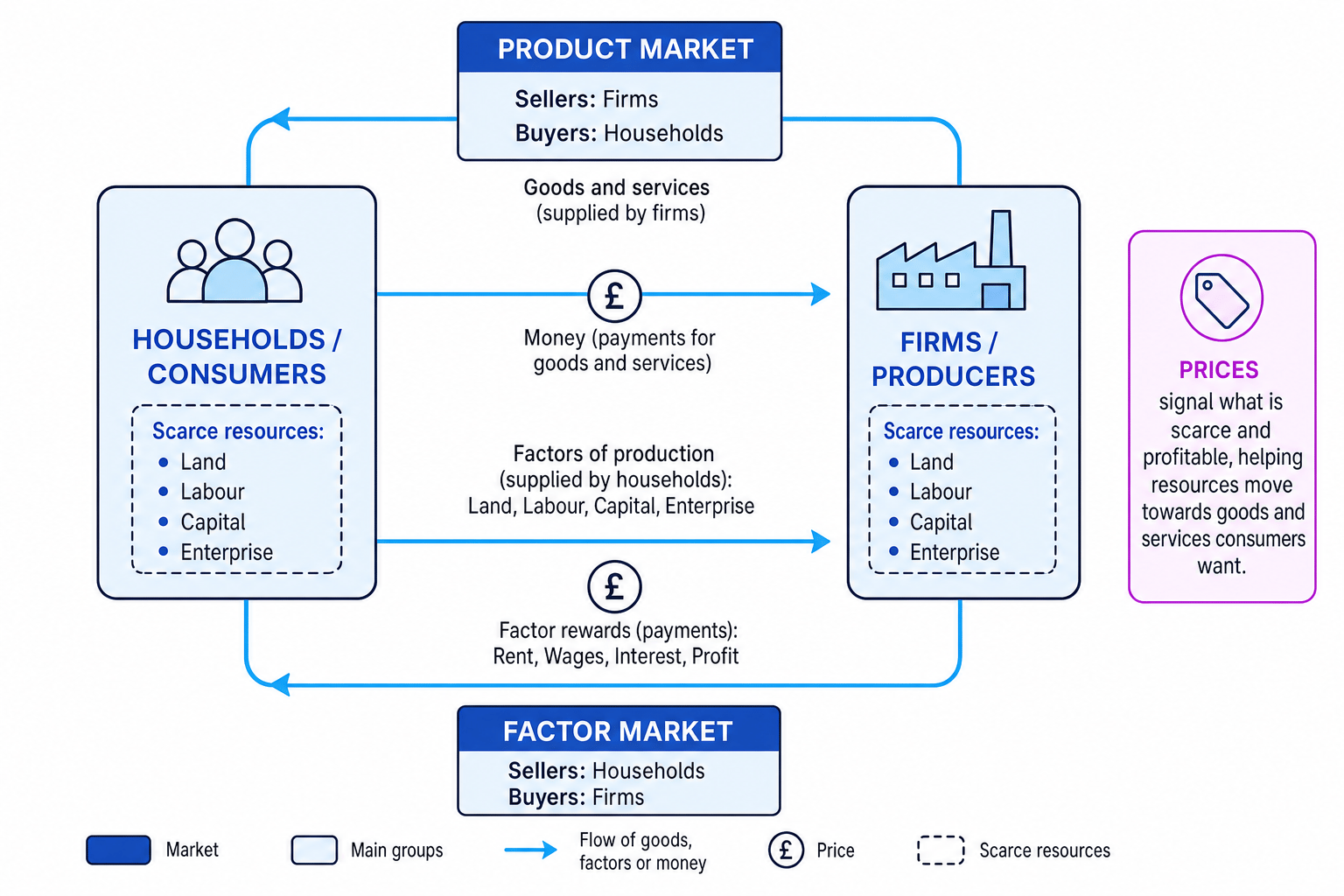
In a product market, firms are often the sellers and consumers are often the buyers. For example, Tesco sells groceries to households, and Greggs sells food to customers.
Factor market
A factor market is a market where the factors of production are bought and sold. The factors of production are the resources used to produce goods and services: land, labour, capital, and enterprise.
The four factors of production are:
- Land: natural resources and physical space, such as farmland, oil, or a shop site.
- Labour: human effort, skills, and time used in production.
- Capital: man-made resources used to produce other goods and services, such as machinery, tools, delivery vans, and computers.
- Enterprise: the willingness and ability to organise production, take risks, and make business decisions.
Capital is not just money
In GCSE Economics, capital usually means man-made productive resources, such as machinery or equipment. Money can help buy capital, but money itself is not usually what the term means here.
The diagram below shows how households and firms can meet in both product markets and factor markets.
Comparing product and factor markets
| Feature | Product market | Factor market |
|---|---|---|
| What is traded? | Finished goods and services | Resources used to make goods and services |
| Typical buyers | Consumers or households | Firms or producers |
| Typical sellers | Firms or producers | Households or owners of resources |
| Example | You buy a meal deal from Tesco | Tesco hires workers or rents a shop site |
| Price paid | Product price, such as £3.50 for a sandwich | Wages, rent, interest, or profit |
Factor markets and product markets are connected. If consumers buy more of a product, firms may need more factors of production to make it. For example, if demand for Greggs sausage rolls rises, Greggs might hire more workers, buy more ovens, use more ingredients, or open more shops.
Classifying factor and product markets
Decide whether each transaction is in a product market or a factor market.
-
You buy a Greggs vegan sausage roll. This is a finished good sold by a firm to a consumer, so it is a product market transaction.
-
Greggs hires a baker for £11.50 per hour. The baker’s labour is being used to produce goods, so this is a factor market transaction. The price of labour is the wage.
-
Greggs rents a shop unit from a landlord. The shop site is a resource used in production, so this is also a factor market transaction. The payment for using the property is rent.
Putting the whole idea together
A market is a way for buyers and sellers to interact and establish a price. That price then influences decisions.
If prices and profits rise in one market, producers may move resources towards it. If demand falls, resources may gradually move away. This is how markets help allocate scarce resources across the economy.
For GCSE Economics, keep your explanation clear and logical:
- consumers express wants through demand
- sellers respond to prices and profit opportunities
- resources move towards goods and services that are more profitable to produce
- but outcomes may not be fair or sustainable for everyone
In the exam
-
Start by defining the market: an opportunity for buyers and sellers to interact to establish price.
-
When explaining resource allocation, use a chain: change in demand or scarcity → price signal → producer incentive → resources move.
-
For factor versus product markets, ask: is this a finished good/service being bought, or a resource being used to produce something else?
Check yourself
- Why can an online platform such as Vinted still be called a market?
- How can a higher price encourage resources to move into producing a particular good?
- In a labour market, who is usually the buyer, who is the seller, and what is the price called?
