

What you'll learn
- What an interest rate is, and why different products have different rates.
- How interest rates affect consumers’ choices to save, borrow or spend.
- How interest rates affect producers’ choices to save, borrow or invest.
- How to calculate simple interest on savings.
3.2.1.1 Interest rates, saving, borrowing, spending and investment
This topic is about choices over time. You can use money now by spending it, or keep it for later by saving it. If you do not have enough money now, you might borrow — but borrowing usually has a cost.
The basic language
Interest rate
An interest rate is the percentage reward paid on savings, or the percentage cost charged on borrowing, usually measured per year.
Saving means not spending part of your income now, so you can use it later.
Borrowing means receiving money now and agreeing to repay it later, normally with interest.
Spending means using money to buy goods and services, such as food, clothes, transport or streaming subscriptions.
Investment, for producers, means spending on capital goods that can help make more goods and services in the future — for example, a bakery buying a new oven, or Tesco installing new self-checkout machines.
Investment does not always mean buying shares
In GCSE Economics, producer investment usually means firms spending on capital equipment, buildings, technology or training to increase future output. It is not mainly about households buying shares.
Calculating interest on savings
When you save money in a bank or building society, the bank may pay you interest. For GCSE Economics, the calculation is usually simple: find the percentage of the amount saved.
A useful formula is:
Annual interest=amount saved×interest rate100\begin{aligned} \text{Annual interest} &= \text{amount saved} \times \frac{\text{interest rate}}{100} \end{aligned}Annual interest=amount saved×100interest rateCalculating interest on savings
A student saves £2,000 in an account paying 3% interest per year. Calculate the interest earned in one year.
-
Use the interest formula, because the question gives an amount saved and an annual percentage rate:
Annual interest=amount saved×interest rate100\begin{aligned} \text{Annual interest} &= \text{amount saved} \times \frac{\text{interest rate}}{100} \end{aligned}Annual interest=amount saved×100interest rate -
Substitute the figures into the formula:
Annual interest=£2,000×3100=£60\begin{aligned} \text{Annual interest} &= \pounds 2{,}000 \times \frac{3}{100} \\ &= \pounds 60 \end{aligned}Annual interest=£2,000×1003=£60 -
If the question asks for the balance after one year, add the interest to the original saving:
£2,000+£60=£2,060\begin{aligned} \pounds 2{,}000 + \pounds 60 &= \pounds 2{,}060 \end{aligned}£2,000+£60=£2,060
Percentage sanity check
3% means £3 for every £100 saved. £2,000 contains twenty lots of £100, so the interest is twenty lots of £3, which is £60.
Why different interest rates exist
Not every borrower or saver gets the same interest rate. A savings account, a mortgage, a personal loan and a credit card can all have different rates.
One important influence is the Bank of England base rate. This is the interest rate set by the Bank of England that helps guide borrowing and saving rates across the economy. After the 2022–23 inflation spike, the Bank of England increased the base rate sharply, which pushed many mortgage and loan rates higher.
Other factors also matter:
- Risk: if a lender thinks a borrower may not repay, it charges a higher interest rate.
- Security: a mortgage is secured against a house, so it is usually lower-risk than an unsecured credit card debt.
- Length of time: borrowing for longer may involve different risks and rates.
- Access to savings: easy-access savings accounts often pay less than fixed-term accounts, because savers can withdraw money more freely.
- Competition: banks may offer better rates to attract customers.
- Inflation expectations: if prices are expected to rise quickly, lenders may want higher interest to protect the value of repayments.
Explaining why two loans have different rates
A bank offers a lower rate on a mortgage than on a credit card. Explain why.
-
Compare the risk to the lender. A mortgage is linked to a house, so if the borrower does not repay, the lender has an asset it may be able to sell.
-
Compare the security. A credit card is usually unsecured, so the lender has less protection if the borrower fails to repay.
-
Reach the economic explanation: the credit card is riskier for the lender, so the lender charges a higher interest rate to compensate for that risk.
Different rates are not random
Interest rates differ because lenders consider the base rate, risk, security, time period, competition and the type of financial product.
How interest rates affect consumers
A consumer is a person or household that buys goods and services.
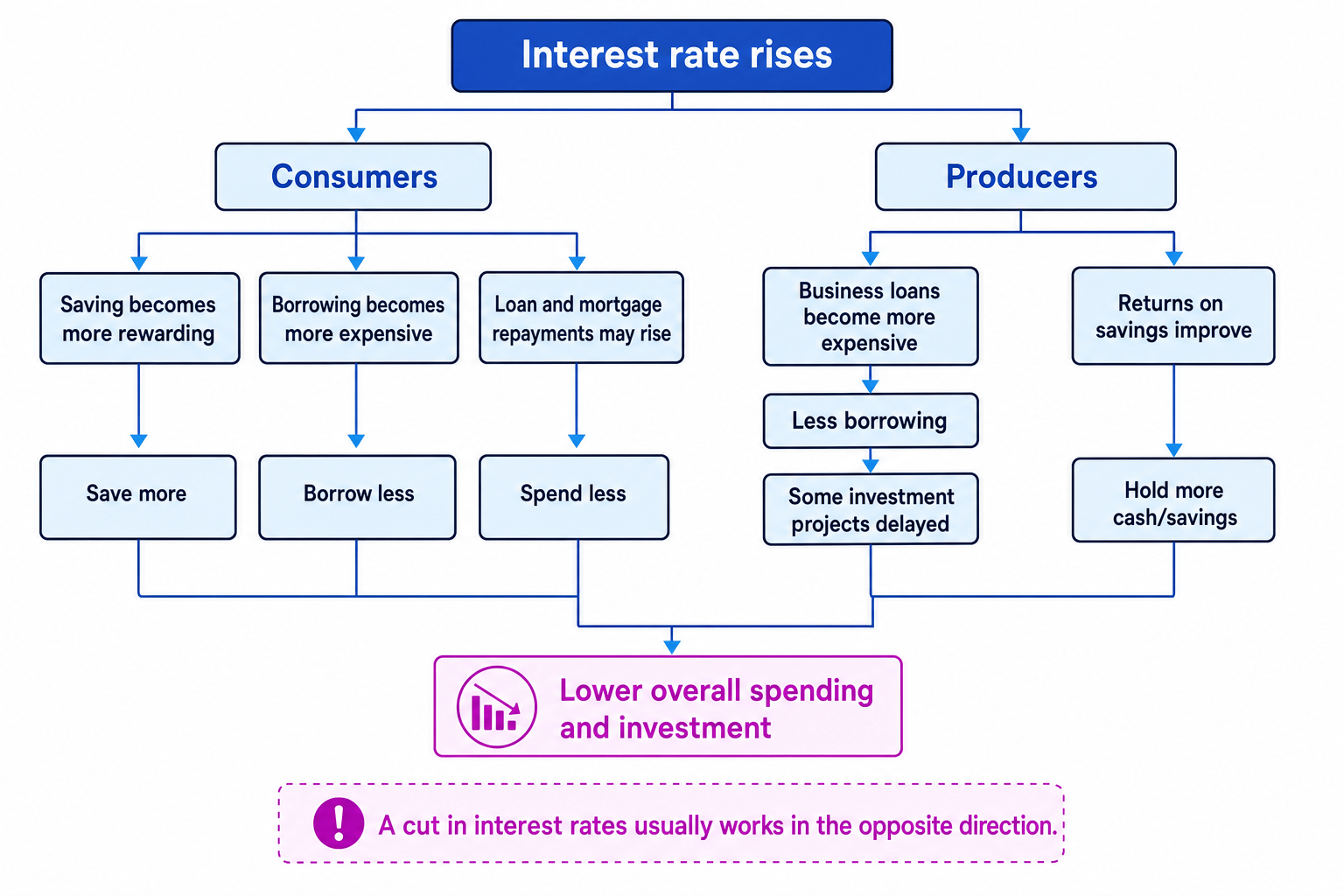
When interest rates rise, saving becomes more attractive because the reward for saving increases. At the same time, borrowing becomes more expensive because loans, overdrafts, credit cards and some mortgages cost more.
This can reduce spending, especially on expensive items often bought with credit, such as cars, furniture, holidays or home improvements. During the UK cost-of-living squeeze, higher mortgage payments also left some households with less money available for other spending.
The flowchart below shows the usual chain of effects for a rise in interest rates. A cut in interest rates normally works in the opposite direction.
Analysing a household budget after a rate rise
A household’s monthly mortgage payment rises from £750 to £900 after interest rates increase. Their monthly income is £2,400 and their other regular spending is £1,300. Analyse the effect on their spending choices.
-
Calculate money left before the mortgage increase:
£2,400−£750−£1,300=£350\begin{aligned} \pounds 2{,}400 - \pounds 750 - \pounds 1{,}300 &= \pounds 350 \end{aligned}£2,400−£750−£1,300=£350 -
Calculate money left after the mortgage increase:
£2,400−£900−£1,300=£200\begin{aligned} \pounds 2{,}400 - \pounds 900 - \pounds 1{,}300 &= \pounds 200 \end{aligned}£2,400−£900−£1,300=£200 -
Compare the two results: the household has £150 less each month, so it may cut non-essential spending, save less, or avoid new borrowing.
Higher interest rates do not affect everyone the same way
A saver with no debt may benefit from higher interest rates, while a borrower with a variable-rate mortgage may be worse off.
How interest rates affect producers
A producer is a business or organisation that makes goods or provides services.
Interest rates affect producers in two main ways.
First, they affect the cost of borrowing. If a firm wants to borrow to buy machinery, open a new shop or upgrade technology, a higher interest rate makes the project more expensive.
Second, they affect the reward for saving. A business holding spare cash may earn more interest when rates rise, so it may choose to save rather than invest immediately.
Higher interest rates can also reduce consumer spending, which may lower expected sales. If a firm expects weaker demand, it may delay investment because the extra output may not be needed.
Producer investment
Producer investment is spending by firms on capital goods, technology, buildings or other resources that can increase future output or efficiency.
Deciding whether a producer should invest
A small bakery considers borrowing £10,000 for a new oven. The oven is expected to increase profit by £900 per year before interest costs. Compare the decision if the loan interest rate is 5% and then 12%.
-
Calculate annual interest at 5%:
£10,000×5100=£500\begin{aligned} \pounds 10{,}000 \times \frac{5}{100} &= \pounds 500 \end{aligned}£10,000×1005=£500The expected gain after interest is:
£900−£500=£400\begin{aligned} \pounds 900 - \pounds 500 &= \pounds 400 \end{aligned}£900−£500=£400 -
Calculate annual interest at 12%:
£10,000×12100=£1,200\begin{aligned} \pounds 10{,}000 \times \frac{12}{100} &= \pounds 1{,}200 \end{aligned}£10,000×10012=£1,200The expected gain after interest is:
£900−£1,200=−£300\begin{aligned} \pounds 900 - \pounds 1{,}200 &= -\pounds 300 \end{aligned}£900−£1,200=−£300 -
Compare the outcomes: at 5%, the project looks profitable after interest, but at 12% it makes a loss after interest, so the bakery may delay or cancel the investment.
The wider economic effect
Interest rates influence the whole national economy because they affect millions of decisions by households and firms.
If interest rates rise:
- consumers are more likely to save and less likely to borrow;
- spending on goods and services may fall;
- producers may borrow less and delay investment;
- inflationary pressure may reduce, but economic growth may slow.
If interest rates fall:
- saving becomes less rewarding;
- borrowing becomes cheaper;
- spending and investment may increase;
- growth may rise, but inflationary pressure could build if demand grows too quickly.
The big link
Interest rates connect financial decisions with the real economy: they influence saving, borrowing, spending, investment, inflation and growth.
Fixed rates change more slowly
Some mortgages and savings products have fixed interest rates. These do not change immediately when the Bank of England base rate changes, but the new rate may matter when the deal ends.
In the exam
- Always state the direction of change clearly: “a rise in interest rates makes borrowing more expensive” or “a fall makes saving less rewarding”.
- Apply your answer to the agent in the question: consumers usually decide about saving, borrowing and spending; producers decide about borrowing, saving and investment.
- Add a balanced point where useful: higher rates hurt borrowers but benefit savers, and the effect depends on whether debts or savings have fixed or variable rates.
Check yourself
- Why might a credit card have a higher interest rate than a mortgage?
- How would a rise in interest rates affect a household planning to buy a car using a loan?
- Why might a business delay buying new machinery when interest rates rise?
