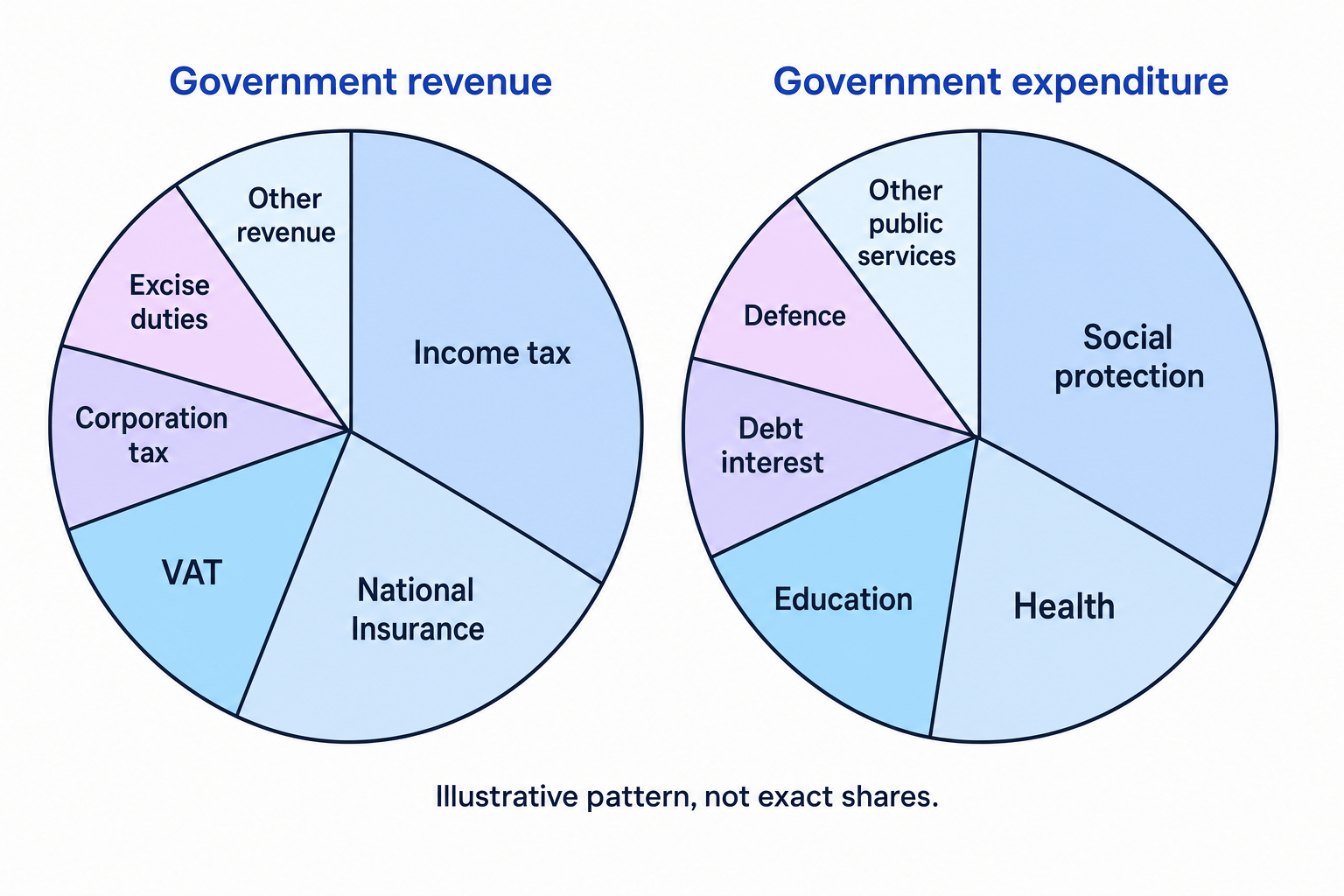
What you'll learn
- The main sources of UK government revenue, such as income tax, National Insurance and VAT.
- The main areas of UK government spending, such as health, education and social protection.
- The difference between direct taxation and indirect taxation.
- Why some taxes are progressive while others can be regressive.
3.2.1.2: Government income and expenditure
The basic idea: government as an economic decision-maker
In the national economy, the government collects money and uses it to provide services, support households and influence economic activity. This includes central government in Westminster and local government such as councils.
The public sector is the part of the economy controlled or funded by the government, such as the NHS and state schools. The private sector is the part run by individuals and firms, such as Tesco, Greggs, Netflix or local businesses.
Government revenue and government expenditure
Government revenue is the income the government receives, mainly from taxes. Government expenditure is the money the government spends on goods, services, benefits, public sector wages and debt interest.
The government has to make choices because money is scarce. Spending more on the NHS, for example, may mean higher taxes, more borrowing, or less spending elsewhere. This is an example of opportunity cost: the next best alternative given up when a choice is made.
The big picture
Government income and spending are linked: taxes fund public services, while spending decisions affect living standards, inequality, businesses and future taxpayers.
Main sources of UK government revenue
Most UK government revenue comes from taxation, which means compulsory payments made to the government. Exact shares change each year, but the main sources are fairly stable.
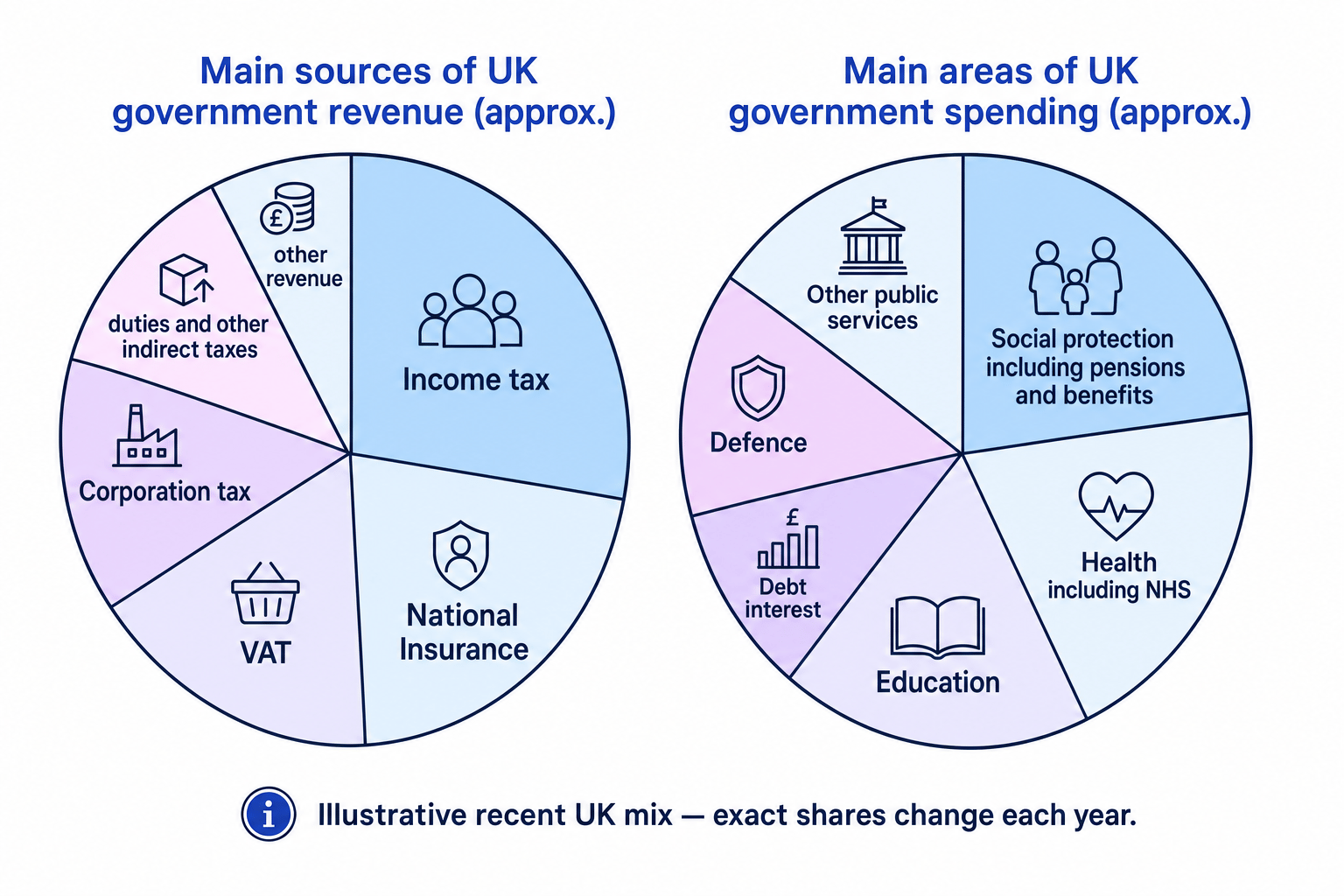
The diagram below shows the broad pattern of UK government revenue and spending. Treat it as an illustrative guide, not something you need to memorise exactly.
Key revenue sources
- Income tax: a tax on income earned by individuals, such as wages, salaries and some pensions.
- National Insurance contributions: payments made by employees, employers and some self-employed workers, based mainly on earnings.
- VAT, or Value Added Tax: a tax added to many goods and services when they are sold.
- Corporation tax: a tax on company profits.
- Excise duties: taxes on particular goods, such as fuel, alcohol and tobacco.
- Other revenue: includes council tax, business rates, stamp duty, customs duties, fines, fees and income from some government-owned assets.
Income tax, National Insurance and VAT are usually among the largest sources of UK government revenue.
Main areas of UK government spending
Government spending is used to provide services and support people. The largest areas usually include:
- Social protection: state pensions, benefits, Universal Credit, disability support and support for people on low incomes.
- Health: the NHS, hospitals, GPs, medicines and public health.
- Education: schools, further education and support for training.
- Debt interest: payments made on money the government has previously borrowed.
- Defence: the armed forces and national security.
- Other public services: transport, policing, courts, local government, housing support and environmental spending.
Recent UK events show why spending can change quickly. During COVID-19, the government spent heavily on furlough, business support and the NHS. During the 2022-23 energy-price shock, support with household and business energy bills also increased spending.
Calculating a government spending gap
Suppose a government receives £900bn in revenue and spends £1,020bn.
-
Compare total spending with total revenue, because the question is asking whether government income covers expenditure.
-
Calculate the gap:
Spending gap=£1,020bn−£900bn=£120bn\text{Spending gap} = \text{£}1{,}020\text{bn} - \text{£}900\text{bn} = \text{£}120\text{bn}Spending gap=£1,020bn−£900bn=£120bn -
Interpret the result: spending is higher than revenue, so the government has a £120bn deficit and would need to borrow, raise more revenue, or reduce spending.
Direct and indirect taxation
Taxes can be grouped into direct taxes and indirect taxes.
Direct and indirect taxation
A direct tax is paid directly to the government by the person or organisation the tax is imposed on, such as income tax or corporation tax. An indirect tax is placed on spending; it is collected by firms when goods or services are sold, such as VAT or fuel duty.
Direct taxes
Examples include:
- Income tax, paid by individuals on income.
- National Insurance, paid by workers and employers.
- Corporation tax, paid by companies on profits.
- Council tax, paid by households to local government.
Direct taxes are often linked to income, profit or ownership.
Indirect taxes
Examples include:
- VAT on many goods and services.
- Fuel duty on petrol and diesel.
- Alcohol and tobacco duties.
- The Soft Drinks Industry Levy, often called the sugar tax, introduced to encourage firms to reduce sugar in drinks.
Indirect taxes can raise prices for consumers. They can also be used to discourage behaviour that creates health, social or environmental costs.
Calculating VAT on a purchase
A streaming service has a pre-tax price of £10. VAT is charged at 20%.
-
Calculate the VAT added to the price:
VAT=£10×20%=£2\text{VAT} = \text{£}10 \times 20\% = \text{£}2VAT=£10×20%=£2 -
Add the VAT to the pre-tax price:
Final price=£10+£2=£12\text{Final price} = \text{£}10 + \text{£}2 = \text{£}12Final price=£10+£2=£12 -
Classify the tax: VAT is an indirect tax because it is added to spending and collected by the seller, even though the consumer usually pays it through the higher price.
Direct does not mean important
Do not write that direct taxes are “main taxes” and indirect taxes are “less important”. The difference is about what is taxed and how it is collected, not how large or useful the tax is.
Progressive and regressive taxation
Taxes also differ in how heavily they affect people on different incomes.
Progressive and regressive taxation
A progressive tax takes a larger percentage of income as income rises. A regressive tax takes a larger percentage of income from lower-income people than from higher-income people.
The key word is percentage. A richer person might pay more tax in cash terms, but that does not automatically prove the tax is progressive. You must compare the tax paid as a proportion of income.
Progressive taxes
UK income tax is designed to be progressive because people with higher taxable incomes face higher tax bands. This links to the ethical idea of ability to pay: those with greater income can usually afford to contribute a higher share.
Comparing average income tax rates
Use this simplified tax system: the first £12,500 of income is tax-free, income from £12,501 to £50,000 is taxed at 20%, and income above £50,000 is taxed at 40%.
-
For someone earning £20,000, only £7,500 is taxed at 20%:
Tax=£7,500×20%=£1,500\text{Tax} = \text{£}7{,}500 \times 20\% = \text{£}1{,}500Tax=£7,500×20%=£1,500 -
Calculate their average tax rate:
£1,500£20,000×100=7.5%\frac{\text{£}1{,}500}{\text{£}20{,}000} \times 100 = 7.5\%£20,000£1,500×100=7.5% -
For someone earning £60,000, they pay 20% on £37,500 and 40% on £10,000:
Tax=(£37,500×20%)+(£10,000×40%)=£11,500\text{Tax} = \left(\text{£}37{,}500 \times 20\%\right) + \left(\text{£}10{,}000 \times 40\%\right) = \text{£}11{,}500Tax=(£37,500×20%)+(£10,000×40%)=£11,500 -
Calculate their average tax rate:
£11,500£60,000×100≈19.2%\frac{\text{£}11{,}500}{\text{£}60{,}000} \times 100 \approx 19.2\%£60,000£11,500×100≈19.2% -
Compare the percentages: 19.2% is higher than 7.5%, so this simplified income tax system is progressive.
Regressive taxes
Indirect taxes such as VAT can be regressive because lower-income households often spend a larger share of their income on everyday goods and services.
Seeing why VAT can be regressive
Two households each pay £20 VAT on the same essential purchase. One household has monthly income of £1,000 and the other has monthly income of £5,000.
-
Calculate the VAT as a share of the lower income:
£20£1,000×100=2%\frac{\text{£}20}{\text{£}1{,}000} \times 100 = 2\%£1,000£20×100=2% -
Calculate the VAT as a share of the higher income:
£20£5,000×100=0.4%\frac{\text{£}20}{\text{£}5{,}000} \times 100 = 0.4\%£5,000£20×100=0.4% -
Compare the burden: the same £20 takes a larger percentage of the lower-income household’s income, so this tax has a regressive effect.
Progressive versus regressive
Always ask: “What percentage of income is paid?” Cash amounts alone are not enough to judge whether a tax is progressive or regressive.
Fairness, incentives and real-world trade-offs
Government tax and spending choices create winners and losers.
Higher progressive taxes may reduce inequality and fund services such as the NHS, but they may reduce disposable income and could affect incentives to work, invest or start a business. Indirect taxes on fuel, tobacco, alcohol or sugary drinks may improve health or sustainability, but they can hit lower-income households harder.
Spending also involves ethical choices. More spending on pensions supports older people, while more spending on education may improve future productivity. Higher debt interest payments, especially after rises in inflation and interest rates, can reduce the money available for public services.
A strong GCSE answer does not just say “tax is good” or “tax is bad”. It explains the trade-off: who benefits, who pays, what the opportunity cost is, and whether the policy seems justified.
In the exam
-
When asked for sources of revenue or areas of spending, give specific examples such as income tax, VAT, health or social protection.
-
For direct versus indirect taxation, explain what is being taxed and how the tax is collected.
-
For progressive or regressive taxation, compare the tax paid as a percentage of income, then link your judgement to fairness and real UK context.
Check yourself
- Name two main sources of UK government revenue and two main areas of UK government spending.
- Explain the difference between income tax and VAT as examples of direct and indirect taxation.
- Why can VAT be described as regressive even if everyone pays the same VAT rate?