What you'll learn
- What an externality is and why it is a type of market failure.
- The difference between private, external and social costs and benefits.
- How to identify positive and negative externalities.
- Why both production and consumption can create negative externalities.
3.1.6.2 Defining externalities
Before we define externalities, remember the basic market idea: a producer makes and sells a good or service, and a consumer buys and uses it.
A market transaction is the exchange between the buyer and seller. For example, you buy a takeaway coffee; the coffee shop receives money, and you receive the drink.
But sometimes the effects of that transaction spread beyond the buyer and seller. Economists call the people outside the transaction third parties.
Externality
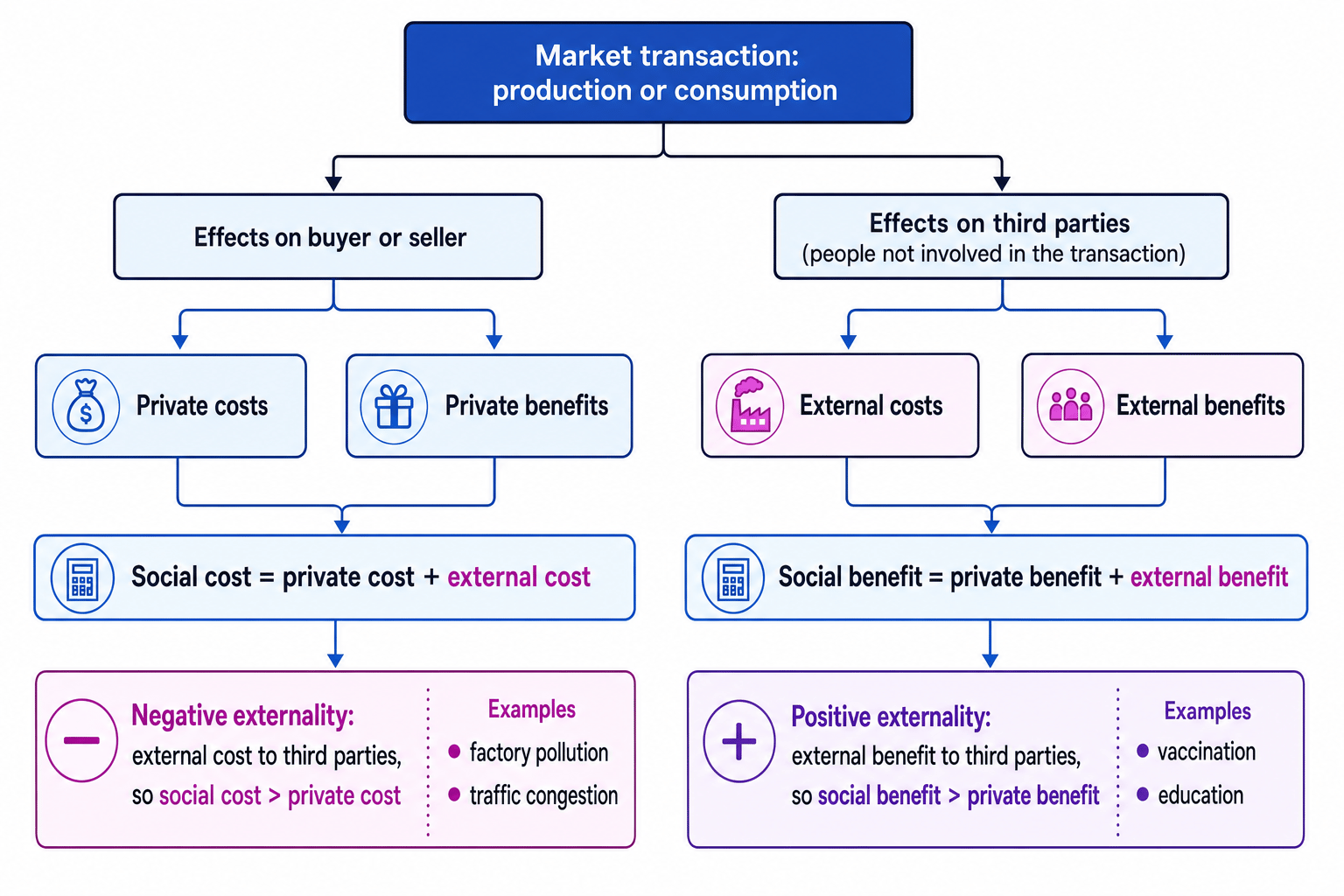
An externality is a cost or benefit caused by production or consumption that affects a third party, so the effect is not fully reflected in the market price.
Externalities matter because they create market failure: this is when the free market does not allocate resources in the best way for society. The market price may only reflect what the buyer and seller care about, not the full effect on everyone else.
Private, external and social effects
To understand externalities, you need three layers: private, external and social.
Private, external and social costs and benefits
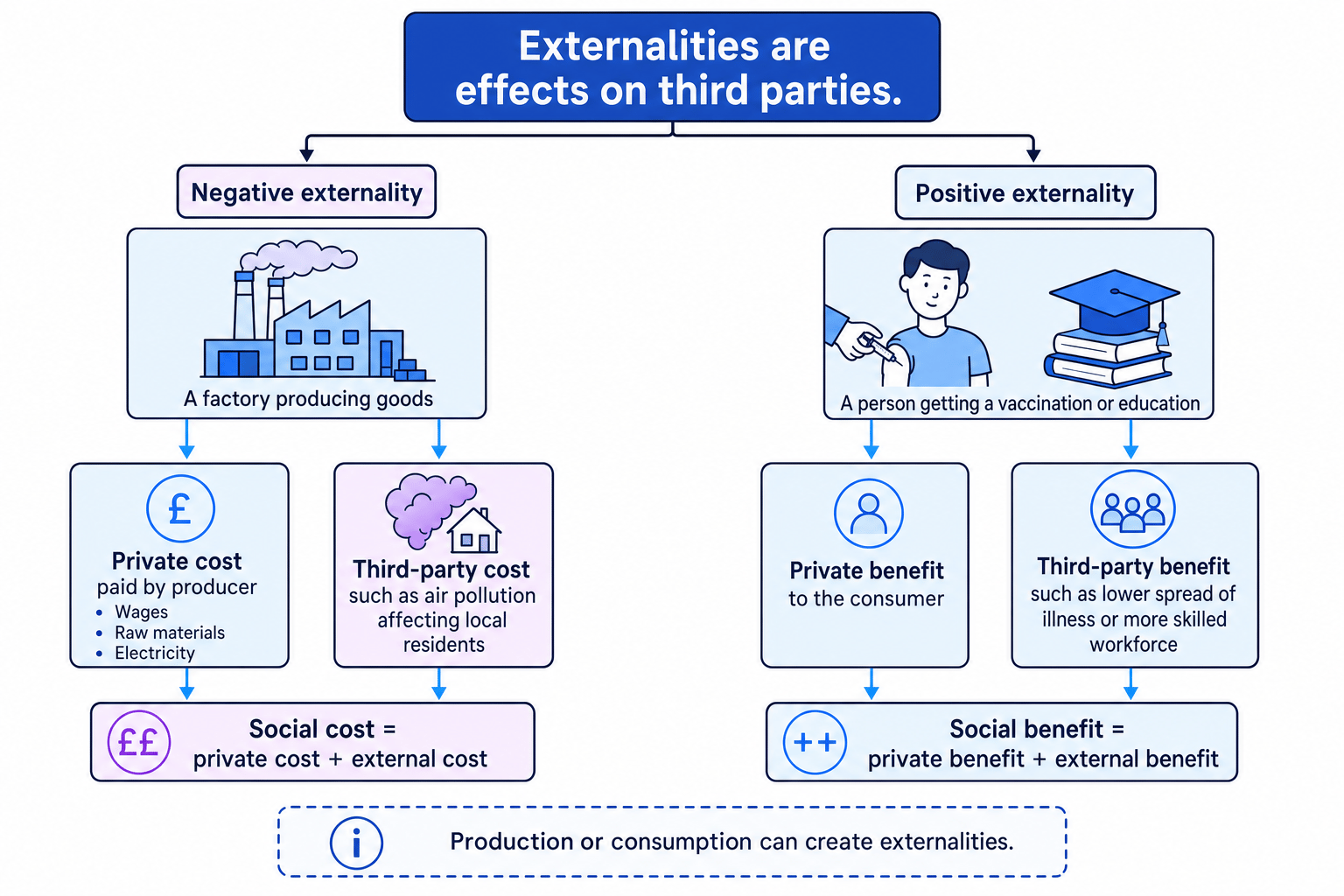
- A private cost is a cost paid by the person or firm directly involved in the activity, such as wages, rent, fuel or raw materials.
- A private benefit is a benefit received by the person or firm directly involved, such as enjoyment from a product or revenue from selling it.
- An external cost is a cost imposed on third parties, such as pollution affecting local residents.
- An external benefit is a benefit gained by third parties, such as other people being less likely to catch a disease after you are vaccinated.
- A social cost is the total cost to society: private cost plus external cost.
- A social benefit is the total benefit to society: private benefit plus external benefit.
The two useful relationships are:
social cost=private cost+external cost\text{social cost} = \text{private cost} + \text{external cost}social cost=private cost+external cost social benefit=private benefit+external benefit\text{social benefit} = \text{private benefit} + \text{external benefit}social benefit=private benefit+external benefitHere is the big picture: externalities are about the gap between what the individual buyer or seller experiences and what society experiences.
Calculating a simple social cost
A small manufacturer produces 500 garden chairs in a week. Its private production costs are £8,000. Local taxpayers face £1,000 of extra clean-up costs because waste from the production process is dumped nearby.
-
Identify the private cost: the manufacturer’s own costs are £8,000 for the week.
-
Identify the external cost: the £1,000 clean-up cost is paid by taxpayers, who are third parties.
-
Add private cost and external cost: £8,000 plus £1,000 gives a social cost of £9,000.
-
Find the external cost per chair if needed: £1,000 ÷ 500 chairs = £2 per chair.
Calling every cost an externality
A cost is not automatically an externality. If a bakery pays more for flour, that is a private cost to the bakery. If the bakery’s delivery vans create air pollution that affects local residents, that is an external cost.
3.1.6.2 The difference between positive and negative externalities
Externalities can be negative or positive. The key question is: does the third party suffer a cost or receive a benefit?
Negative externalities
A negative externality happens when production or consumption creates an external cost for third parties.
In this case, social cost is greater than private cost because society bears extra costs that the buyer or seller may not pay for directly.
Examples include:
- A factory producing smoke that worsens local air quality.
- A nightclub creating noise that disturbs nearby residents.
- Petrol and diesel car use causing congestion and emissions.
- Excessive consumption of sugary drinks increasing pressure on NHS dental and health services, which was one reason behind the UK Soft Drinks Industry Levy introduced in 2018.
Negative externalities
With a negative externality, the person or firm making the decision does not face the full cost of that decision. This can lead to too much of the good or service being produced or consumed from society’s point of view.
Positive externalities
A positive externality happens when production or consumption creates an external benefit for third parties.
In this case, social benefit is greater than private benefit because other people gain, not just the buyer or seller.
Examples include:
- Vaccination: the vaccinated person is protected, but others also benefit because disease is less likely to spread. This was especially visible during COVID-19.
- Education: the student gains qualifications, but society may benefit from a more skilled, productive workforce.
- Home insulation: the household may have lower energy bills, while wider society may benefit from lower carbon emissions.
Positive externalities
With a positive externality, the individual making the decision does not receive all the benefits. This can lead to too little of the good or service being produced or consumed from society’s point of view.
Identifying the type of externality
A person decides to get a COVID-19 vaccination. They reduce their own chance of becoming seriously ill, and they also reduce the chance of passing the virus to other people.
-
Separate the private effect from the third-party effect: the person’s own health protection is a private benefit.
-
Identify the third-party effect: other people are less likely to catch the illness, which benefits people outside the transaction.
-
Decide whether the third-party effect is a cost or a benefit: it is a benefit, so this is a positive externality.
-
Link it to social benefit: the social benefit is greater than the private benefit because the wider community also gains.
Production and consumption can both create negative externalities
Externalities can come from either side of the market.
Production means making goods and services. A production externality happens because of how a product is made, transported or supplied.
Examples of negative externalities from production include:
- A factory releasing pollution while producing chemicals.
- Construction work creating dust and noise for local residents.
- Delivery lorries for a supermarket creating congestion around local roads.
- Energy-intensive manufacturing contributing to carbon emissions.
Consumption means using goods and services. A consumption externality happens because of how a product is used by consumers.
Examples of negative externalities from consumption include:
- Drivers using petrol cars and creating emissions.
- People smoking near others, exposing them to second-hand smoke.
- Litter left after fast food is consumed in a park.
- Excessive alcohol consumption creating costs for emergency services or local communities.
Classifying production and consumption externalities
A fast-food chain expands in a town centre. Its kitchen extractor fans create smells for nearby flats, and some customers leave packaging on the street after eating.
-
Classify the extractor-fan problem: it comes from the firm producing and supplying meals, so it is a production externality.
-
Classify the litter problem: it comes from customers using the product after purchase, so it is a consumption externality.
-
Identify whether the effects are positive or negative: smells and litter create costs for local residents or the council, so both are negative externalities.
Why externalities are a market failure
In a normal market, buyers and sellers respond to prices. But prices often reflect private costs and benefits, not social costs and benefits.
If a firm can pollute without paying for the damage, its costs are lower than the true cost to society. This may make the product cheaper and encourage more production than is socially desirable.
If a consumer gets vaccinated, educated or trained, some benefits go to other people. Because the individual does not receive all the benefits, they may choose less than society would ideally want.
This is why governments may consider policies such as taxes, subsidies, regulation, information campaigns or bans. You will meet these in more detail in later market failure topics.
Quick identification test
Ask: “Who is affected besides the buyer and seller?” If the answer is “nobody significant”, there may be no externality. If third parties are harmed, it is negative. If third parties gain, it is positive.
Moral, ethical and sustainability considerations
Externalities raise fairness questions. If a producer earns profit while local residents suffer pollution, is that fair? If consumers choose cheap products but future generations face environmental damage, who should pay?
Sustainability means meeting present needs without damaging the ability of future generations to meet their own needs. Many environmental externalities, such as carbon emissions and plastic waste, are sustainability issues because costs may be pushed onto people in the future.
Externalities can be hard to measure
It is difficult to put an exact £ value on cleaner air, noise, stress, biodiversity or long-term climate damage. In evaluation, weigh the evidence and recognise uncertainty rather than pretending the judgement is simple.
In the exam
-
Define the externality clearly: say whether it is a cost or benefit affecting a third party.
-
Apply it to the case study: name the specific third party affected, such as residents, taxpayers, nearby firms or future generations.
-
Use the correct chain of reasoning: private cost or benefit differs from social cost or benefit, causing market failure.
-
For evaluation, mention trade-offs: jobs, lower prices and consumer choice may need to be weighed against health, environmental and fairness concerns.
Check yourself
- What is the difference between a private cost and an external cost?
- Why is vaccination usually described as creating a positive externality?
- Give one negative externality from production and one from consumption.