What you'll learn
- The four main economic objectives: full employment, price stability, economic growth and a sound balance of payments.
- Why trying to achieve one objective can make another harder to achieve.
- How other aims, such as reducing inequality and protecting the environment, affect government decisions.
- How to discuss winners, losers and trade-offs in exam answers.
3.2.2.1 Economic objectives of the government
The starting point: governments have targets
The macroeconomy means the economy as a whole: national output, employment, prices and trade with other countries. Governments set broad targets for the macroeconomy because economic conditions affect households, firms and public services.
Economic objective
An economic objective is a target the government wants the economy to achieve. A policy is an action used to move towards that target, such as changing taxes, changing government spending or influencing interest rates.
Governments usually want several things at once. That is the difficult bit: the same policy can help one objective but damage another.
The big picture
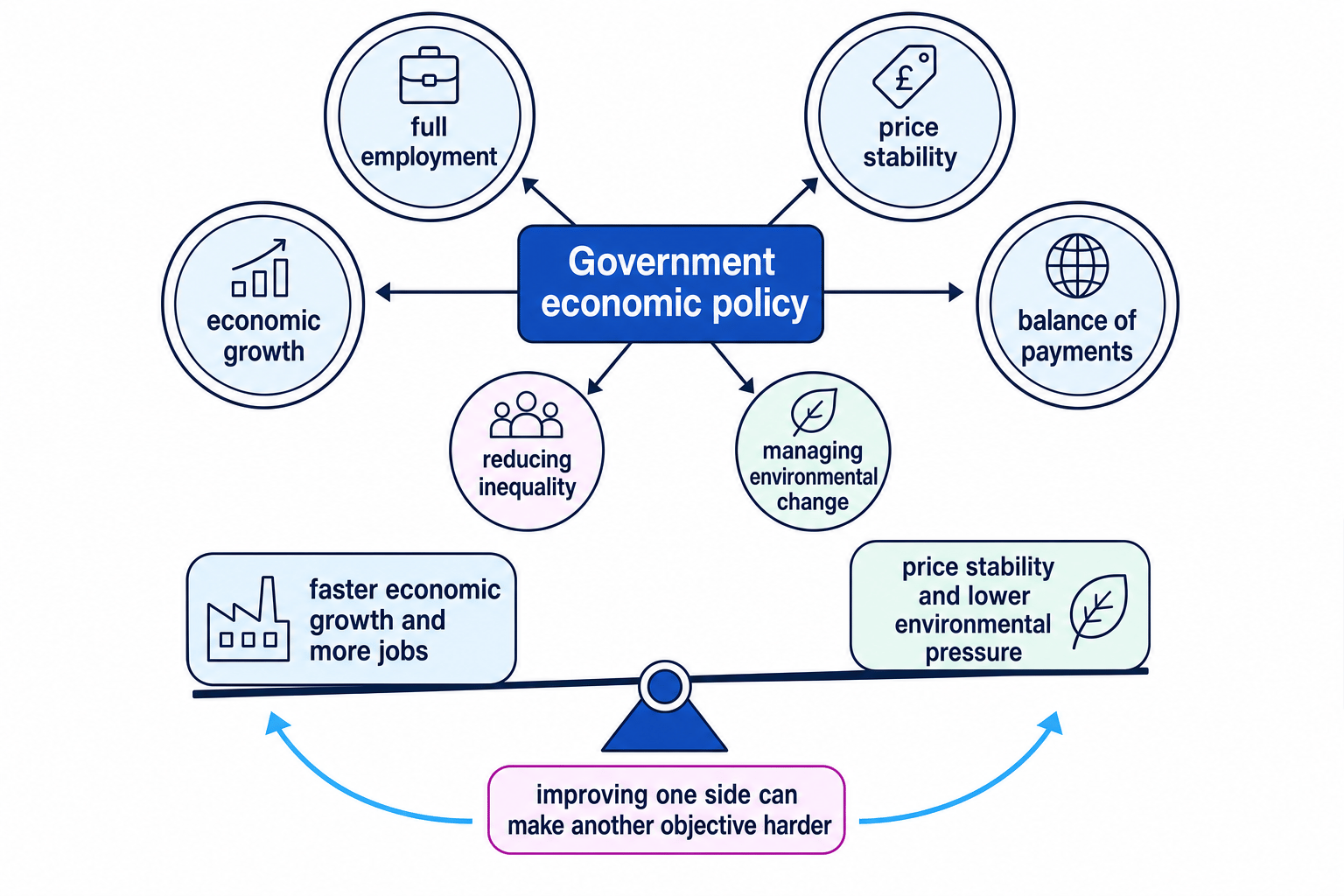
Government economic policy is about balancing priorities. A strong answer explains which objective improves, which objective may worsen, and which groups of people are affected.
The main economic objectives of government policies
1. Maintaining full employment
Full employment means almost everyone who is willing and able to work can find a job. It does not mean unemployment is literally zero, because some people will always be between jobs, moving area, retraining or searching for better work.
Unemployment means people are able and willing to work but cannot find a job.
Full employment matters because more people in work usually means:
- higher household incomes
- more spending in shops and businesses
- more tax revenue for the government
- less need for welfare payments
- better living standards and wellbeing
A UK example is the furlough scheme during COVID-19. The government paid part of many workers’ wages to reduce job losses when firms had to close or reduce activity.
2. Ensuring price stability
Price stability means the average level of prices rises slowly and predictably. The price level is the average price of goods and services across the economy.
Inflation is a rise in the average price level over time. In the UK, inflation is usually measured using the Consumer Prices Index, or CPI, which tracks the price of a basket of common goods and services.
The UK inflation target is 2% CPI inflation. This does not mean every price rises by exactly 2%. Some prices rise faster, some rise more slowly, and some may fall.
Price stability is not falling prices
Price stability does not mean prices should keep falling. Falling prices across the economy, called deflation, can be harmful if consumers delay spending and firms cut output or jobs.
The 2022–23 UK inflation spike, linked to energy prices, food prices and global supply problems, showed why price stability matters. If wages do not rise as fast as prices, people’s real purchasing power falls, creating a cost-of-living squeeze.
3. Achieving economic growth
Economic growth means an increase in the economy’s output over time. Output is usually measured by Gross Domestic Product, or GDP, which is the value of goods and services produced in a country over a period of time.
Real GDP is GDP adjusted for inflation. Economists use real GDP to see whether the economy is genuinely producing more, not just charging higher prices.
Economic growth can improve living standards because firms produce more, workers may earn more, and the government may collect more tax to spend on schools, the NHS and infrastructure.
However, growth is not automatically good for everyone. If growth depends on pollution, long working hours or insecure jobs, there may be moral and sustainability concerns.
Calculating real GDP growth
-
Suppose UK real GDP rises from £2.20 trillion to £2.26 trillion in one year. The increase is £2.26 trillion minus £2.20 trillion = £0.06 trillion.
-
Use the percentage change formula: growth rate=changeoriginal×100\text{growth rate} = \frac{\text{change}}{\text{original}} \times 100growth rate=originalchange×100.
-
Substitute the values: 0.062.20×100≈2.7%\frac{0.06}{2.20} \times 100 \approx 2.7\%2.200.06×100≈2.7%.
-
Real GDP has grown by about 2.7%, meaning the economy produced more after allowing for inflation.
4. Having a balance of payments
The balance of payments is a record of money flowing between the UK and the rest of the world. A key part is trade in goods and services.
An export is a good or service sold to another country. An import is a good or service bought from another country.
Governments usually want to avoid a large, long-lasting balance of payments deficit, where more money leaves the country than enters it through trade and other flows. A deficit is not always a crisis, but a persistent deficit can suggest the country is relying heavily on imports or borrowing from abroad.
Brexit changed trading arrangements with the EU, affecting some UK exporters and importers through extra paperwork, delays and costs. Energy price shocks also matter because the UK imports some energy, so higher global energy prices can worsen the trade position.
Calculating an exports-minus-imports balance
-
Suppose UK export revenue is £850 billion and import spending is £900 billion.
-
Subtract imports from exports: £850 billion minus £900 billion = -£50 billion.
-
The negative figure shows a £50 billion deficit, because import spending is greater than export revenue.
Conflicts arising from government objectives
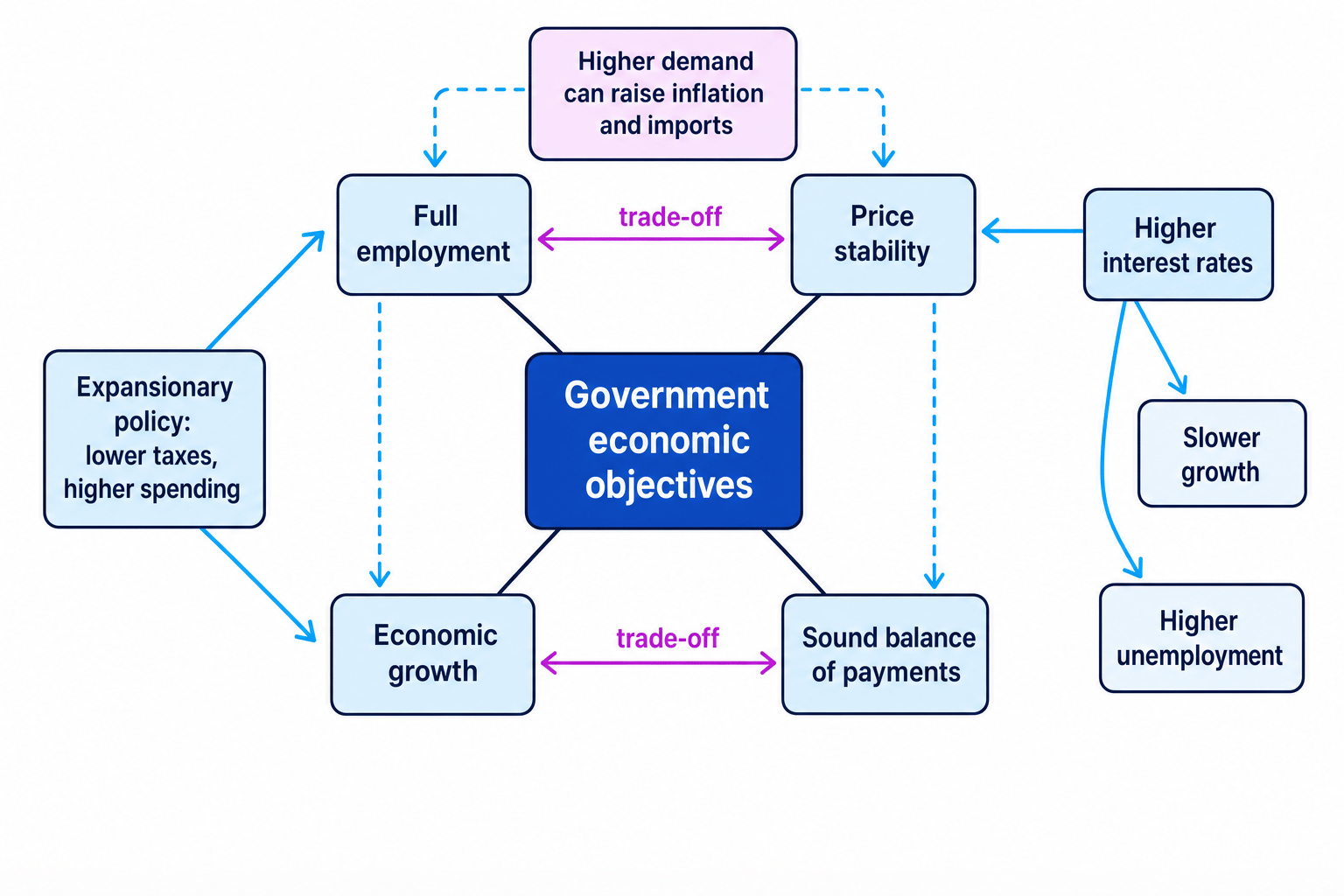
A trade-off happens when improving one objective makes another objective harder to achieve.
For example, policies that increase spending may help growth and employment, but if demand rises faster than firms can increase output, prices may rise too. That helps growth but risks inflation.
The opposite can also happen. Policies to reduce inflation may slow the economy.
Analysing a policy trade-off
-
If inflation is high, the Bank of England may raise the Bank Rate, which is the main interest rate influencing borrowing and saving in the UK.
-
Higher interest rates make borrowing more expensive for households and firms, so spending and investment tend to fall.
-
Lower spending can reduce pressure on prices, helping the objective of price stability.
-
However, lower spending can reduce firms’ sales, so firms may cut output or hiring. This can harm economic growth and full employment.
Think in chains
Use cause-and-effect chains: policy → behaviour changes → objective affected → possible side effect. This helps you move beyond simple one-sentence answers.
Other government objectives
Reducing inequality
Inequality means income or wealth is distributed unevenly between people or groups. Governments may try to reduce inequality through benefits, progressive taxation, education spending, public services and minimum-wage rises.
For example, increases in the National Living Wage can raise incomes for low-paid workers. But firms such as cafés, care homes or supermarkets may face higher wage costs. Some may raise prices, reduce hours or hire fewer workers, especially if demand is weak.
So reducing inequality can support fairness and living standards, but it may conflict with price stability, profits or employment if handled poorly.
Managing environmental change
Environmental change includes issues such as climate change, air pollution, biodiversity loss and resource depletion. Governments may aim to reduce carbon emissions, encourage renewable energy and improve air quality.
Sustainability
Sustainability means using resources in a way that meets people’s needs today without making it harder for future generations to meet their needs.
Environmental policies can create trade-offs. For example, charges on polluting vehicles may improve air quality, but they can be expensive for low-income workers who need a car for work. Green investment can create jobs in renewable energy, but some workers in high-pollution industries may need retraining.
Moral, ethical and sustainability considerations
An ethical consideration is about what society thinks is fair or right, not just what increases GDP.
The pursuit of government objectives can negatively affect groups of people:
- Raising interest rates to reduce inflation can hurt mortgage holders and firms with loans, even though savers may benefit.
- Pursuing rapid growth through airport expansion or road building may create jobs, but local residents may face noise, congestion and pollution.
- Cutting taxes to encourage growth may benefit workers and firms, but it could reduce government revenue for public services.
- Environmental taxes may support sustainability, but they can be unfair if poorer households spend a larger share of income on energy and transport.
Only writing the benefit
Do not stop at “this increases growth” or “this reduces inflation”. For stronger analysis, add the trade-off: another objective may worsen, or a particular group may lose out.
In the exam
-
Name the objective clearly: full employment, price stability, economic growth, balance of payments, reducing inequality or managing environmental change.
-
Explain the chain of effects: show how a policy changes decisions by consumers, firms or workers.
-
Evaluate the trade-off: mention another objective that could be harmed and identify at least one group that gains or loses.
Check yourself
- Why does full employment not mean unemployment is exactly zero?
- Explain one way reducing inflation could conflict with economic growth.
- Choose one environmental policy and identify a group that may lose out in the short run.