Free-trade agreements including the European Union
What you'll learn
- What free trade means and how it differs from protectionism.
- The main arguments for and against free trade.
- Why free-trade agreements matter for consumers, firms and governments.
- How the European Union is a key example, especially in the context of Brexit.
3.2.4.3 Free-trade agreements including the European Union
Before we judge whether free trade is “good” or “bad”, we need the basic vocabulary.
Imports, exports and trade barriers
An import is a good or service bought from another country. For example, the UK imports cars from Germany and fruit from Spain.
An export is a good or service sold to another country. For example, the UK exports financial services, pharmaceuticals and whisky.
A trade barrier is anything that makes it harder or more expensive to trade between countries. Common examples include:
- Tariff: a tax on imports.
- Quota: a limit on the quantity of a good that can be imported.
- Non-tariff barrier: a barrier that is not a tax, such as customs paperwork, product rules, safety checks or delays at borders.
Free trade
Free trade means goods and services can move between countries with few or no trade barriers, such as tariffs or quotas.
The opposite of free trade is protectionism, where a government restricts imports to protect domestic firms and workers.
How a tariff changes the price
A tariff raises the cost of an imported good. That can make foreign goods less attractive and protect domestic producers from competition.
Removing a tariff on imported trainers
-
Suppose a pair of imported trainers costs £50 before tax. The UK government adds a £5 tariff, so the import now costs £55.
-
If a free-trade agreement removes the £5 tariff, the cost of importing the trainers falls back towards £50.
-
Consumers may benefit from lower prices and more choice, but UK trainer producers may face tougher competition because imported trainers are now cheaper.
Trade barriers change incentives
Reducing barriers usually makes imports cheaper and easier to buy. That helps consumers and importing firms, but it can put pressure on domestic producers who now face more foreign competition.
Arguments for free trade
Supporters of free trade argue that it can improve living standards by lowering prices, increasing choice and helping firms sell to larger markets.
Lower prices for consumers
When tariffs and quotas are removed, imported goods may become cheaper. Domestic firms may also cut prices because they face more competition.
For example, if UK supermarkets can import food more easily from the EU, consumers may see lower prices or more stable supply. This mattered during the 2022–23 cost-of-living squeeze, when food price rises put pressure on household budgets.
More choice and quality
Free trade gives consumers access to a wider range of products. Think about phones, streaming services, cars, clothing and food. Many of the goods you use are produced through international trade.
Competition can also push firms to improve quality. If a UK firm knows consumers can easily switch to a German, French or Japanese alternative, it has an incentive to keep prices competitive and quality high.
Specialisation and efficiency
Specialisation means focusing on producing what you are relatively good at. Countries often specialise because they have different natural resources, skills, technology or climates.
For example:
- Spain can produce some fruits more easily because of its climate.
- Germany has a strong car manufacturing industry.
- The UK has strengths in services such as finance, insurance, higher education and creative industries.
Free trade allows countries to specialise and then trade, rather than trying to produce everything themselves.
Larger markets for firms
Free trade can help firms grow because they can sell to more customers overseas. A UK business that sells only in Britain has access to around 67 million people. Selling into the EU gives access to a much larger market.
This can help firms increase output, spread fixed costs over more units and benefit from economies of scale, where average costs fall as output rises.
Analysing a larger export market
-
A UK food producer sells only in the UK and produces 100,000 units per year. Its market is limited, so it may not be able to expand much further.
-
A free-trade agreement makes it easier to sell to customers in France and Ireland. The firm receives more orders and increases output.
-
If the firm can use its factory more efficiently, its average cost may fall. This could allow lower prices, higher profits, or both.
Arguments against free trade
Free trade creates benefits, but those benefits are not shared equally. Some firms, workers and regions may lose out.
Domestic firms may struggle
If imports become cheaper, domestic firms may lose sales. This is especially difficult for firms with higher costs or older technology.
For example, UK steel producers may find it hard to compete with cheaper imported steel. If firms reduce output or close, workers may lose jobs.
Only writing about consumers
Free trade often helps consumers through lower prices and more choice, but exam answers also need producers, workers and government. Always ask: who gains, who loses, and by how much?
Job losses and regional effects
Even if free trade benefits the economy overall, workers in some industries may suffer. A worker who loses a manufacturing job may not easily move into a growing export industry, especially if it requires different skills or is in a different region.
This links to structural unemployment, where workers are unemployed because their skills or location do not match available jobs.
Dependence on other countries
Free trade can make countries dependent on imports. This can be risky if global supply chains are disrupted.
A supply chain is the network of firms and transport links involved in producing and delivering a product. During COVID-19, many supply chains were disrupted by factory closures, shipping delays and border restrictions. Energy price rises after Russia’s invasion of Ukraine also showed how dependence on imported energy can create vulnerability.
Ethical and sustainability concerns
Free trade is not automatically fair or sustainable. Some imported goods may be produced using low wages, poor working conditions or environmentally damaging methods.
At the same time, trade can help lower-income countries grow by selling exports to richer countries. So the ethical judgement is balanced: free trade can create jobs and income, but governments and consumers may still care about labour standards, pollution and carbon emissions from transport.
Free trade creates winners and losers
A strong answer does not say “free trade is good” or “free trade is bad”. It explains the trade-off: lower prices, more choice and export opportunities versus job losses, dependency and ethical concerns.
Free-trade agreements
Free-trade agreement
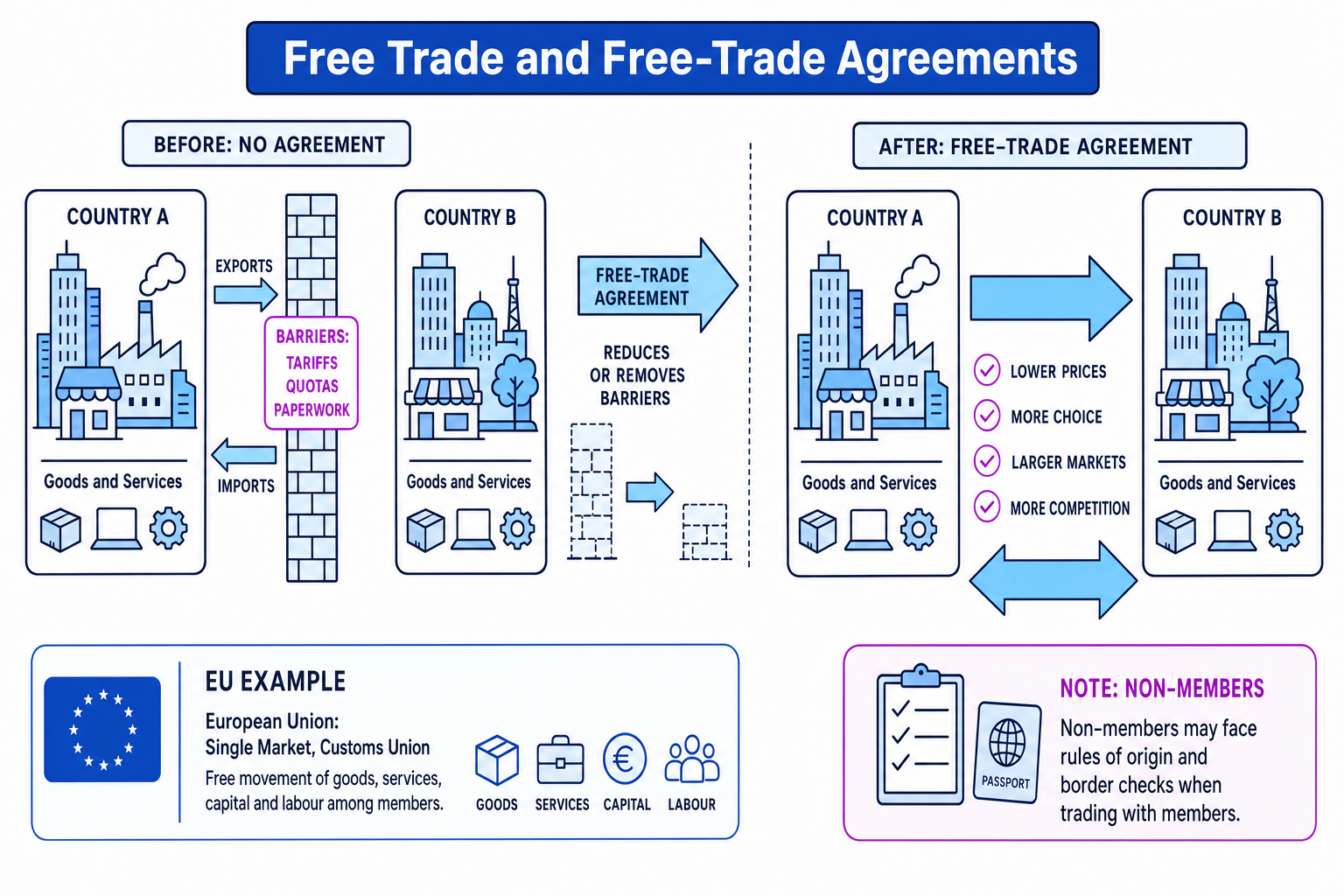
A free-trade agreement is a deal between countries to reduce or remove trade barriers between them.
Free-trade agreements matter because they set the rules for how easily countries can trade. They may cover:
- tariffs and quotas
- customs paperwork
- product standards
- services, investment and government contracts
- rules about where a product was made
A rule of origin is a rule used to decide whether a product counts as being made inside the free-trade area. This matters because only qualifying goods may receive tariff-free access.
Free-trade agreements can be very significant because they influence prices, business costs, supply chains and investment decisions.
Benefits of free-trade agreements
Free-trade agreements can bring several benefits:
| Benefit | How it helps |
|---|---|
| Lower prices | Removing tariffs can reduce import costs. |
| More choice | Consumers can buy a wider range of goods and services. |
| Larger markets | Firms can sell to more customers abroad. |
| More competition | Firms may become more efficient and innovative. |
| More investment | Businesses may invest because they can access a bigger market. |
| Stronger supply chains | Firms can source parts and materials more easily. |
Possible limits of free-trade agreements
A free-trade agreement does not always mean trade is completely frictionless. Firms may still face:
- customs forms
- checks at borders
- rules of origin
- different regulations
- transport costs
- language and legal differences
So in an exam, avoid assuming that “free-trade agreement” means “no barriers at all”.
The European Union as an example
European Union
The European Union, or EU, is a group of European countries with deep economic and political cooperation, including rules designed to make trade between members easier.
The EU is more than a simple free-trade agreement. It includes a Single Market and a customs union.
Single Market
The Single Market aims to allow free movement of goods, services, capital and people between member countries. This reduces non-tariff barriers because countries follow many shared rules and standards.
For firms, this can mean easier access to customers and suppliers across the EU. For consumers, it can mean more choice and competition.
Customs union
A customs union means member countries remove tariffs between themselves and apply a common external tariff to goods from outside the union.
This makes trade inside the EU easier because goods do not usually need tariff checks each time they cross a border between member countries.
Why the EU is significant
The EU is one of the world’s largest trading blocs. A trading bloc is a group of countries that agree to make trade easier between themselves.
The EU matters for the UK because the EU is geographically close and has historically been one of the UK’s largest trading partners. Many UK firms built supply chains around easy UK-EU trade.
For example, a car part might cross borders several times before the final car is sold. If border checks or paperwork increase, costs and delays can rise.
Brexit and UK-EU trade
The UK left the EU in 2020. Since 2021, the UK has traded with the EU under the UK-EU Trade and Cooperation Agreement.
This agreement allows tariff-free and quota-free trade in many goods, but only if rules of origin are met. However, UK-EU trade now involves more paperwork and border checks than when the UK was inside the Single Market and customs union.
Evaluating UK-EU trade after Brexit
-
A UK food exporter sells chilled products to customers in the EU. Under the UK-EU agreement, it may avoid tariffs if the goods meet rules of origin.
-
However, the exporter may still face customs forms, health checks and delays. For chilled food, delays can be especially costly because the product has a short shelf life.
-
The judgement is balanced: the agreement is better for the firm than facing high tariffs, but trade is still less frictionless than EU membership was.
Benefits and costs for the UK
Possible benefits of leaving the EU included more freedom for the UK government to set its own trade policy and negotiate trade deals with non-EU countries.
Possible costs included higher trade friction with the EU, extra administration for firms and reduced access to the Single Market. These costs may affect small businesses more because they have fewer resources to handle paperwork.
A useful evaluation phrase
Try using: “The impact depends on…” For example, the impact of a free-trade agreement depends on the size of the tariff removed, how important the trading partner is, and whether firms can handle the remaining non-tariff barriers.
Overall judgement
Free trade and free-trade agreements can raise living standards by reducing prices, increasing choice and opening larger markets for firms. The EU shows how deep economic integration can make trade much easier.
However, free trade also creates adjustment costs. Some domestic firms may shrink, workers may lose jobs, and countries may become more dependent on global supply chains. Ethical and environmental concerns also matter.
The best GCSE answers weigh these effects rather than treating free trade as automatically good or bad.
In the exam
-
Start by defining the key term, such as free trade, tariff or free-trade agreement.
-
Build a chain of reasoning: fewer barriers → lower costs → lower prices or more trade → effects on consumers, firms, workers and government.
-
Evaluate by considering winners and losers, short-run versus long-run effects, and a real context such as Brexit, COVID-19 supply chains or the cost-of-living squeeze.
Check yourself
- What is the difference between a tariff and a quota?
- Give two arguments for free trade and two arguments against free trade.
- Why is the EU more than a simple free-trade agreement?