

What you'll learn
- How employment and unemployment are measured in the UK.
- The four main types of unemployment: frictional, seasonal, structural and cyclical.
- The consequences of unemployment for workers, firms, government and local communities.
- How governments can reduce unemployment — and why each policy has trade-offs.
3.2.2.3 Employment and unemployment and how they are measured
The labour market
The labour market is where workers offer their labour — human effort and skills used in production — and employers demand labour to produce goods and services.
Governments care about this because one major macroeconomic objective is low unemployment or high employment. However, “low unemployment” does not mean every single person has a job all the time.
Key labour-market terms
- Employment means people are in paid work, including full-time, part-time and self-employed work.
- Unemployment means people are not in work but are available for work and actively seeking work.
- The labour force, also called the economically active population, is everyone who is either employed or unemployed.
- Economically inactive people are not in work and not actively seeking work, such as some students, retired people, carers, or people unable to work due to long-term illness.
A person can be without a job but not counted as unemployed if they are not actively looking for work. For example, someone who has stopped job-searching because they feel discouraged may be classed as economically inactive.
Unemployed is not the same as inactive
Do not describe every person without a job as unemployed. In economics, unemployment requires being available for work and actively looking for work.
How unemployment is measured
The UK mainly uses two measures.
The Labour Force Survey is a survey of households. It follows the international definition: unemployed people are not working, have been looking for work recently, and are available to start work soon.
The Claimant Count counts people claiming unemployment-related benefits. It can differ from the survey measure because not everyone who is unemployed claims benefits, and benefit rules can change.
The key measure is the unemployment rate:
Unemployment rate=number unemployedlabour force×100\text{Unemployment rate} = \frac{\text{number unemployed}}{\text{labour force}} \times 100Unemployment rate=labour forcenumber unemployed×100The employment rate is the percentage of working-age people who are in work, often focusing on ages 16 to 64.
Calculating an unemployment rate
Suppose a country has 31.2 million people employed and 1.3 million people unemployed.
- Find the labour force by adding employed and unemployed people: 31.2 million + 1.3 million = 32.5 million.
- Substitute into the formula: 1.3 million32.5 million×100=4.0%\frac{1.3\text{ million}}{32.5\text{ million}} \times 100 = 4.0\%32.5 million1.3 million×100=4.0%.
- Interpret the answer: 4.0% of the labour force is unemployed, not 4.0% of the whole population.
Two measurements, two stories
If an exam question mentions the Labour Force Survey, think “survey definition”. If it mentions the Claimant Count, think “people claiming unemployment-related benefits”.
Full employment
Full employment means that people who are willing and able to work at the going wage can generally find a job. It does not mean zero unemployment, because some people will always be between jobs or entering the labour market for the first time.
Types, causes and consequences of unemployment
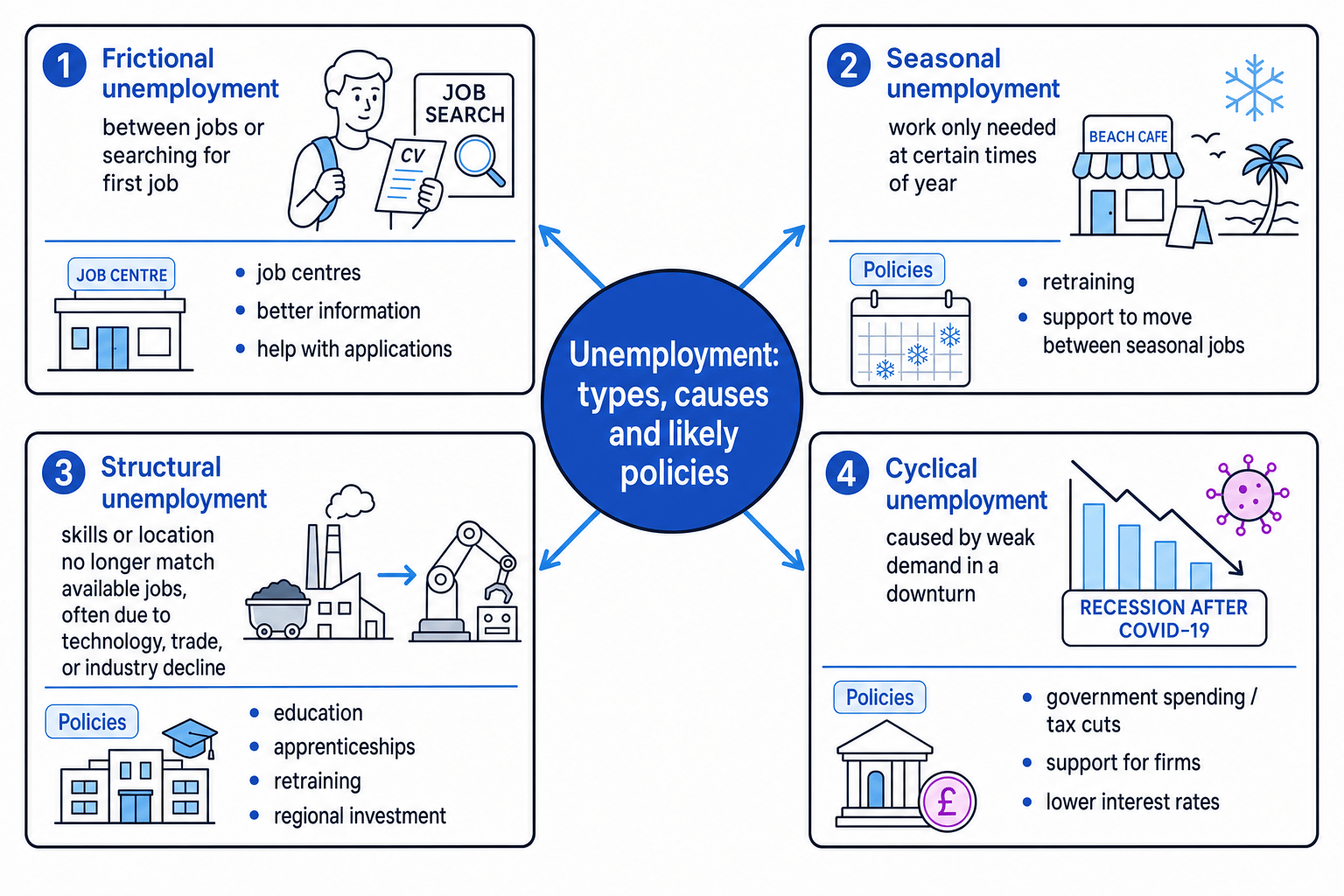
The main types of unemployment have different causes, so they need different policy responses. A policy that helps one type may do very little for another.
Frictional unemployment
Frictional unemployment is short-term unemployment when people are between jobs, entering the labour market, or searching for a better match.
Causes include imperfect information about vacancies, time taken to apply and interview, and people leaving education. A graduate looking for their first job is a typical example.
This is not always a sign of a weak economy. Some frictional unemployment is normal because workers and firms need time to find good matches.
Seasonal unemployment
Seasonal unemployment happens when demand for labour changes predictably at different times of year.
Examples include tourism jobs in seaside towns, agricultural work during harvest periods, and temporary retail jobs around Christmas. The cause is the seasonal pattern of demand for certain goods or services.
Structural unemployment
Structural unemployment occurs when workers’ skills, experience or location no longer match the jobs available.
Causes include new technology, changes in consumer tastes, competition from imports, and long-term decline of particular industries. For example, online shopping has reduced demand for some high-street retail roles while increasing demand for warehouse, delivery and digital skills.
Structural unemployment can be especially damaging because it may last a long time. Workers may need retraining or may need to move location, which can be expensive and difficult.
Cyclical unemployment
Cyclical unemployment, also called demand-deficient unemployment, happens when total spending in the economy falls during a downturn.
If households buy fewer meals out, cafés and restaurants may reduce output and lay off workers. During COVID-19 lockdowns, many firms faced a sudden fall in demand, so the UK government used the furlough scheme to help keep workers attached to their employers.
Structural or cyclical?
If unemployment is caused by a long-term mismatch of skills or industries, it is structural. If it is caused by a short-term fall in total spending during a downturn, it is cyclical.
Classifying unemployment from context
- A student who has finished college and is applying for their first role is unemployed because job search takes time, so this is frictional unemployment.
- A worker at a beach café laid off each winter faces predictable changes in tourism demand, so this is seasonal unemployment.
- A high-street retail worker made redundant because the chain shifts sales online faces a skills or location mismatch, so this is structural unemployment.
- A café cuts staff because households spend less during a downturn; the cause is weak total spending, so this is cyclical unemployment.
Consequences of unemployment for different groups
Workers and households
Unemployment usually reduces household income, which can lower living standards. Families may cut spending on non-essential items, fall behind on bills, or rely more on savings and welfare benefits.
There can also be non-financial costs: stress, lower confidence, worse health, and loss of skills if unemployment lasts a long time. Young people may be especially affected because early unemployment can reduce future earnings and experience.
Firms
For firms, unemployment can reduce demand for goods and services because households have less income to spend. This can lower sales for businesses such as Greggs, Tesco, streaming services or local restaurants.
However, firms may also find recruitment easier if more workers are available. Wage pressure may fall, which can reduce costs for some employers. The overall effect depends on the firm and the industry.
Government
Unemployment affects government finances in two directions. Tax revenue falls because fewer people pay income tax and spend money that generates VAT. At the same time, government spending on welfare benefits may rise.
If government spending is greater than tax revenue, the government has a budget deficit. Higher unemployment can make that deficit worse.
Estimating the effect on government finances
Suppose one unemployed worker would have paid £3,000 in tax this year, and the government pays £4,500 in benefits.
- Work out lost tax revenue: the government receives £3,000 less.
- Work out extra spending: the government pays £4,500 more.
- Add the two effects: £3,000 + £4,500 = £7,500 worsening of the government’s finances.
- Explain the opportunity cost: £7,500 used to support unemployment cannot be spent on another service unless taxes or borrowing rise.
The wider economy and society
Unemployment means labour is not being used to produce output. This can reduce Gross Domestic Product, or GDP, which is the value of goods and services produced in an economy.
It can also increase inequality between regions. A town affected by factory closures may face lower incomes, falling house prices and reduced confidence for local firms. There are moral and ethical issues too: unemployment affects dignity, mental health and people’s life chances, so policy is not just about statistics.
Unemployment is a wasted resource
Unemployment is costly because labour could have been used to produce goods and services, earn income, pay taxes and support communities.
Government policies to reduce unemployment
Match the policy to the cause
Governments should choose policies based on the type of unemployment.
For frictional unemployment, policies include better job information, Jobcentre support, careers advice, help with CVs and interviews, and online vacancy matching.
For seasonal unemployment, policies include retraining workers so they can switch sectors during the off-season, or encouraging local economies to diversify beyond one seasonal industry.
For structural unemployment, governments may use education, apprenticeships, adult retraining, transport improvements, regional investment and support for new businesses. These are often called supply-side policies, because they aim to improve the productive ability of workers and firms.
For cyclical unemployment, governments may try to increase spending in the economy. Fiscal policy means government decisions on spending and taxation. Examples include infrastructure projects, temporary tax cuts, or support for firms to keep workers employed. Monetary policy means changes to interest rates by the Bank of England; lower interest rates can encourage borrowing and spending.
In 2022–23, the Bank of England raised interest rates to reduce inflation, which is a rise in the average price level. This shows a policy trade-off: higher interest rates may help control inflation, but they can also reduce spending and make unemployment more likely.
Choosing policies for a local area
A seaside town has winter job losses in tourism and a former factory where many workers lack IT skills.
- Separate the causes: tourism jobs falling each winter is seasonal, while former factory workers lacking IT skills is structural.
- Match a short-term policy to the seasonal problem: support workers to move into winter retail, care or maintenance jobs, reducing months out of work.
- Match a long-term policy to the structural problem: fund retraining, apprenticeships and transport links so workers can access growing local employers.
- Make a judgement: training is more likely to solve the factory problem than a general tax cut, but it takes time and costs public money.
Policy trade-offs
There is rarely a perfect unemployment policy. Training can be effective but slow; tax cuts can boost demand but reduce government revenue; stricter benefit rules may increase job-search incentives but can create hardship.
In the exam
- Define the key term precisely: unemployed people are actively seeking work, while economically inactive people are not.
- When identifying a type of unemployment, link the cause in the scenario to the correct category.
- For consequences and policies, cover different groups and evaluate: workers, firms, government, taxpayers and local communities.
Check yourself
- Why might the Labour Force Survey and Claimant Count give different unemployment figures?
- For each main type of unemployment, can you give one cause and one suitable policy?
- How does unemployment affect government finances differently from how it affects firms?
