Economic growth
What you'll learn
- What economic growth means and why it is important for an economy.
- How to tell the difference between GDP, real GDP and GDP per capita.
- How to do simple calculations using GDP figures and percentage changes.
- The main causes, benefits, costs and government policies linked to growth.
3.2.2.2 Economic growth: the big idea
Before we talk about growth, remember that an economy uses resources to produce goods and services. These resources are called the factors of production: land, labour, capital and enterprise.
Output means the amount of goods and services produced. When an economy grows, it is producing more output than before.
Economic growth
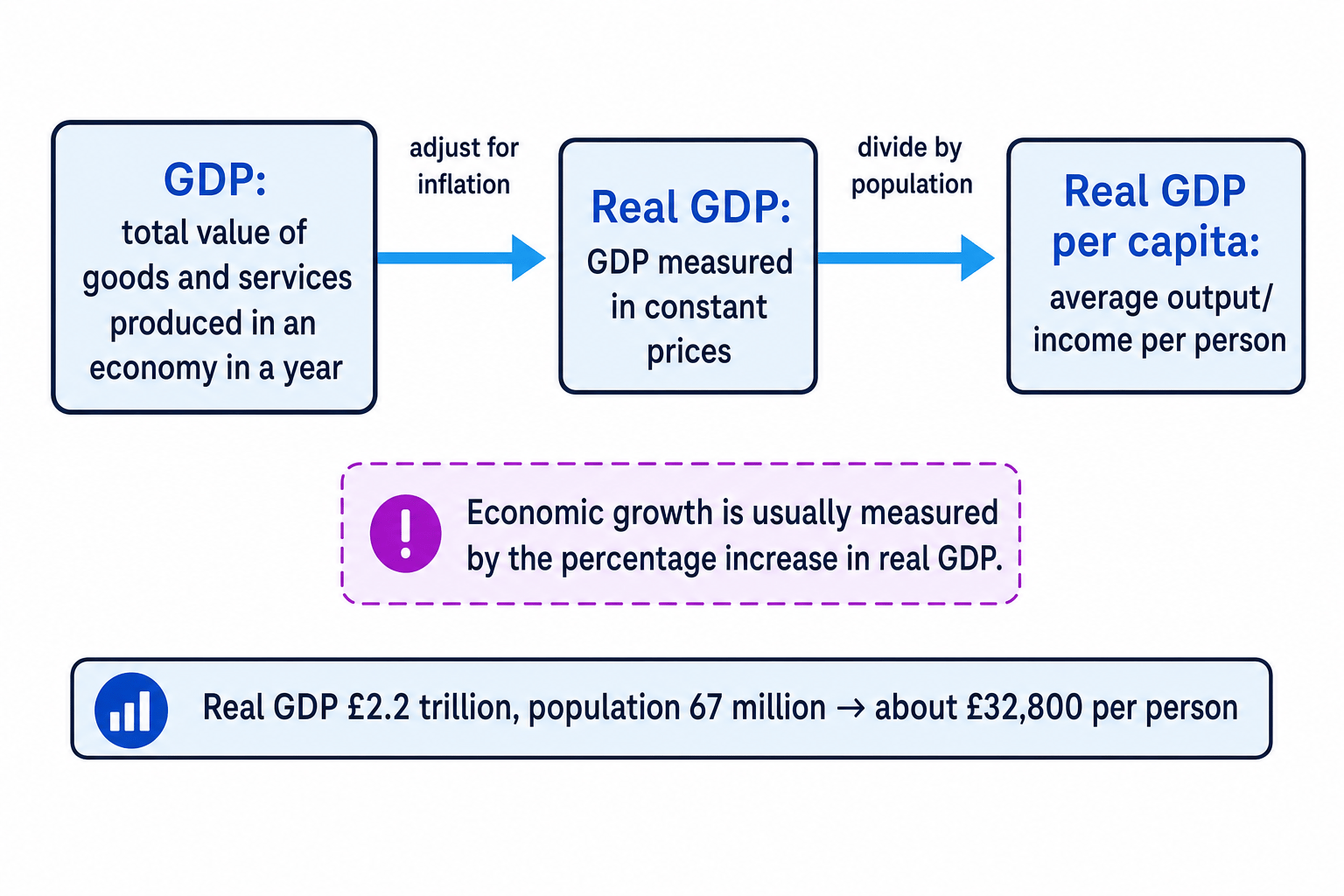
Economic growth is an increase in the amount of goods and services produced in an economy over time. It is usually measured by the percentage increase in real GDP.
Growth is one of the UK government’s main economic objectives because it can improve living standards, create jobs and increase tax revenue. For example, after the COVID-19 lockdowns, the UK economy grew as shops, restaurants, travel and entertainment reopened — but not every household felt better off equally.
Growth is about real output
The most useful measure of economic growth is real GDP, because it shows whether the economy is producing more goods and services, not just charging higher prices.
Calculating economic growth
To calculate a percentage change, use:
percentage change=new value−old valueold value×100\text{percentage change} = \frac{\text{new value} - \text{old value}}{\text{old value}} \times 100percentage change=old valuenew value−old value×100Calculating real GDP growth
- Suppose real GDP rises from £2.0 trillion to £2.1 trillion. The change is £2.1 trillion − £2.0 trillion = £0.1 trillion.
- Use the percentage change formula: 0.12.0×100=5%\frac{0.1}{2.0} \times 100 = 5\%2.00.1×100=5%.
- Interpret the result: real output has increased by 5%, so the economy has grown by 5%.
Measuring growth: GDP, real GDP and GDP per capita
GDP
GDP
Gross Domestic Product, usually shortened to GDP, is the total value of all final goods and services produced in an economy over a period of time, usually one year.
“Final” matters because economists do not want to count the same thing twice. For example, the value of flour should not be counted separately if it is already included in the final price of a loaf of bread.
Real GDP
Real GDP
Real GDP is GDP adjusted for inflation, so it measures output using constant prices.
Inflation
Inflation is a sustained increase in the general price level of goods and services over time.
This difference became especially important during the 2022–23 cost-of-living squeeze. If people spent more pounds in shops because prices rose sharply, GDP in money terms could increase even if the actual quantity of goods and services bought did not rise much.
GDP per capita
GDP per capita
GDP per capita means GDP per person. It is calculated by dividing GDP by the population.
GDP per capita is useful because total GDP can rise simply because the population is larger. If you want to discuss average living standards, GDP per capita is often more helpful than total GDP.
The relationship between the three measures is shown below.
Calculating GDP per capita
- Suppose an economy has real GDP of £2.2 trillion and a population of 67 million.
- Convert £2.2 trillion into £2,200,000 million, so the units match the population measured in millions.
- Divide £2,200,000 million by 67 million = £32,835.82 per person.
- Round sensibly: real GDP per capita is about £32,800 per person.
Assuming GDP growth means everyone is richer
GDP per capita is an average. It can rise even if many people feel worse off, because the extra income may go mainly to higher-income households or profitable firms.
The significance of economic growth
Economic growth matters because it can affect households, firms and the government.
Benefits for households
If firms produce more, they may need more workers. This can reduce unemployment and increase household incomes. Higher incomes can improve living standards because people can afford more goods and services, such as better housing, transport, leisure and healthcare.
Benefits for firms
Growth can increase sales and profits. If Tesco, Greggs or a streaming service sees demand rising, it may invest in new shops, equipment, technology or staff training.
Benefits for the government
When people earn more and firms make more profit, the government often receives more tax revenue. This can help fund public services such as the NHS, schools and transport, or reduce government borrowing.
Linking growth to tax revenue and jobs
- If real GDP rises, firms are producing and selling more goods and services.
- To meet higher output, firms may hire more workers or offer more hours, reducing unemployment.
- More workers paying income tax and more firms paying corporation tax can increase government revenue.
- The government may then have more money to spend on public services without necessarily raising tax rates.
Causes of economic growth
Growth can happen when an economy uses more resources or uses existing resources more efficiently.
More or better factors of production
An economy can grow if it has:
- More workers, perhaps through population growth or higher labour force participation.
- Better-trained workers, through education, apprenticeships and skills training.
- More capital, such as machinery, factories, broadband networks and transport infrastructure.
- More enterprise, where entrepreneurs take risks and start or expand businesses.
Productivity growth
Productivity
Productivity is output per unit of input. For GCSE Economics, it is often easiest to think of it as output per worker or output per hour worked.
If productivity rises, workers can produce more in the same amount of time. This is a key cause of long-term growth because it means the economy can increase output without simply working longer hours.
Examples include firms using better software, automated equipment, improved logistics or staff training. UK productivity has been a major policy concern since the financial crisis and after COVID-19, because weak productivity growth can limit wage growth and living standards.
Explaining productivity-led growth
- Suppose a bakery invests in faster ovens and trains staff to use them efficiently, so each worker produces more items per hour.
- The bakery’s output rises without needing the same increase in workers, so productivity increases.
- If many firms across the economy do this, total output rises and real GDP can increase.
- Whether living standards improve depends on how the gains are shared between workers, consumers and business owners.
Costs and limits of economic growth
Growth is usually desirable, but it can create problems. In exams, strong answers often explain that the quality of growth matters.
Inflationary pressure
If spending grows faster than the economy’s ability to produce goods and services, prices may rise. This can contribute to inflation. During 2022–23, high energy and food prices squeezed household budgets, and the Bank of England raised interest rates partly to control inflation, even though higher interest rates can slow growth.
Environmental costs
Growth may involve more production, transport and energy use. If this relies on fossil fuels, it can increase pollution and carbon emissions. This creates sustainability concerns, especially if current growth damages future living standards.
Inequality
The benefits of growth may be uneven. For example, owners of successful firms or highly skilled workers may gain more than low-paid workers. A country can have rising GDP while some regions or households still struggle with low incomes.
Pressure on infrastructure and services
Fast growth can put pressure on roads, housing, schools and hospitals. If investment in infrastructure does not keep up, congestion and shortages may reduce quality of life.
Growth is not the same as wellbeing
Economic growth can raise living standards, but GDP does not fully measure inequality, unpaid work, environmental damage, health, happiness or quality of public services.
Government policies to achieve economic growth
Governments can try to increase growth using different policies. The best policy depends on the cause of weak growth.
Fiscal policy
Fiscal policy
Fiscal policy means government decisions about taxation and government spending.
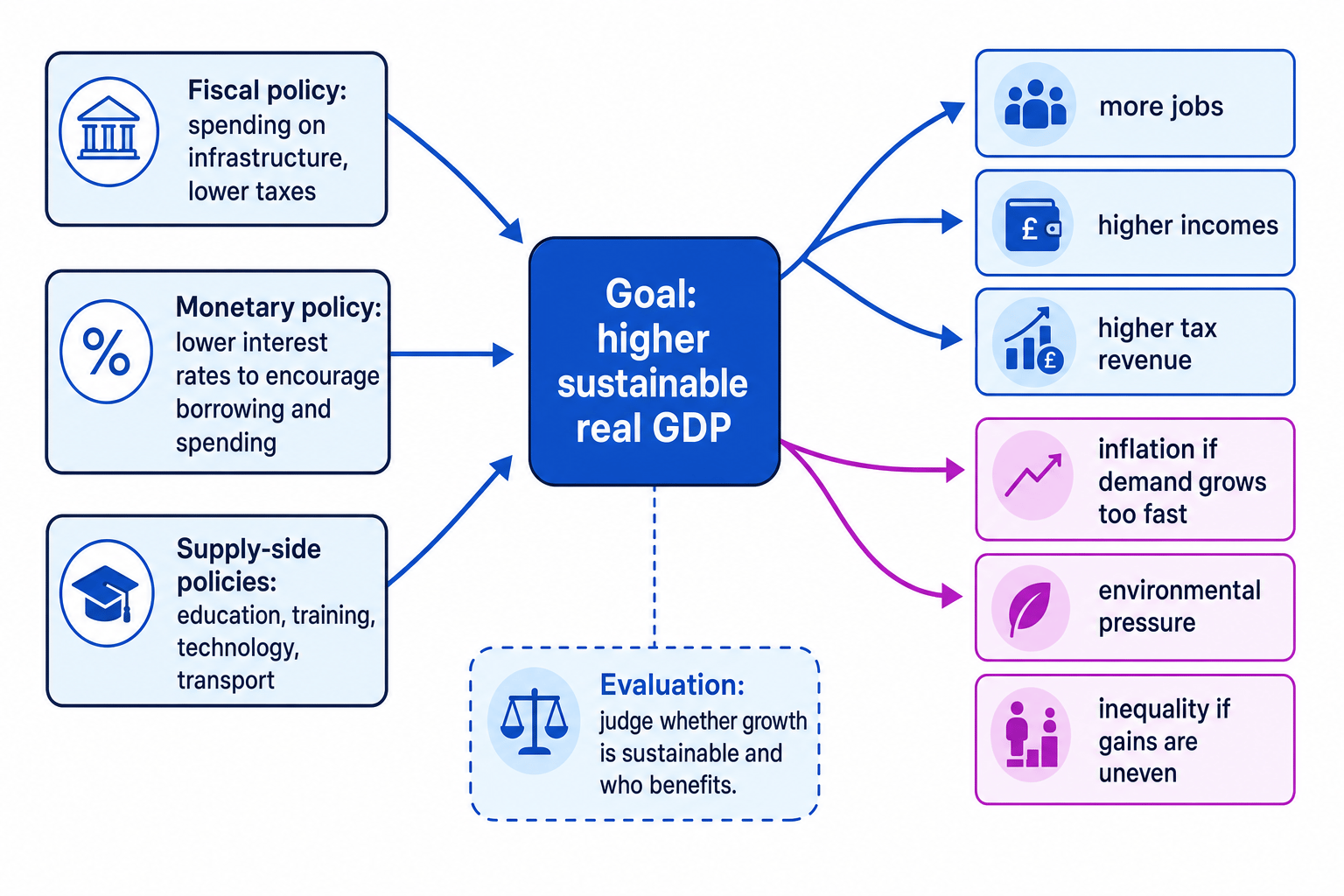
The government might increase spending on infrastructure, such as rail, roads, schools, hospitals and broadband. This can create jobs in the short run and improve productivity in the long run. It might also cut some taxes to encourage households to spend or firms to invest.
Monetary policy
Monetary policy
Monetary policy involves decisions about interest rates and the money supply. In the UK, interest rates are set by the Bank of England.
Lower interest rates can encourage borrowing and spending, which may increase output and growth. However, if inflation is already high, the Bank of England may raise interest rates instead. This can reduce inflationary pressure but may slow economic growth — a clear trade-off between government objectives.
Supply-side policies
Supply-side policies
Supply-side policies aim to increase the economy’s ability to produce goods and services by improving the quantity or quality of resources.
Examples include:
- Improving education, training and apprenticeships.
- Investing in transport, energy and digital infrastructure.
- Encouraging research, innovation and new technology.
- Reducing unnecessary regulation, while still protecting workers, consumers and the environment.
- Supporting business investment, for example through tax incentives.
Government policies can support growth, but they may also create trade-offs.
Evaluating an infrastructure policy
- Suppose the government funds major rail improvements in the North of England. Construction creates jobs and increases spending in the short run.
- Better transport can reduce journey times and business costs, making firms more productive in the long run.
- This may increase real GDP, but the policy could be expensive and may require higher taxes or more government borrowing.
- A balanced judgement would say the policy is more likely to support sustainable growth if it improves productivity, reduces regional inequality and manages environmental damage.
A simple evaluation sentence
Try writing: “This policy may increase economic growth because…, however it depends on…, so the overall impact is likely to be…”. This helps you move from explanation into judgement.
In the exam
- Use real GDP when discussing economic growth, and use GDP per capita when discussing average living standards.
- For calculation questions, write the formula, substitute the figures, include units such as £ or %, and round sensibly.
- For longer answers, balance benefits against costs: jobs, incomes and tax revenue versus inflation, inequality and environmental damage.
Check yourself
- Why is real GDP a better measure of growth than GDP measured only in current prices?
- How do you calculate GDP per capita?
- Give one benefit and one cost of economic growth for the UK economy.