Inflation and price stability
What you'll learn
- What inflation means, and why governments aim for price stability.
- How inflation is measured using the Consumer Price Index (CPI).
- How to calculate the rate of inflation from CPI figures.
- The causes, consequences and policy responses to inflation, using recent UK examples.
3.2.2.4 — Inflation and price stability
Inflation sits under the government objective of price stability. The UK government wants prices to rise slowly and predictably, rather than rapidly or unpredictably.
Price stability
Price stability means keeping inflation low, stable and predictable. In the UK, the inflation target is 2% CPI inflation, set by the government and mainly managed by the Bank of England.
Price stability does not usually mean prices never rise. A small amount of inflation can be normal in a growing economy. The problem is when inflation becomes too high, too low, or unpredictable.
What is inflation?
Inflation
Inflation is a sustained increase in the general price level of goods and services in an economy over time.
The key word is general. If the price of one item rises, such as a Greggs sausage roll or a Netflix subscription, that is not automatically inflation. Inflation means the average level of prices across the economy is rising.
Rate of inflation
The rate of inflation is the percentage increase in the average price level over a period of time, usually one year.
If the inflation rate is 6%, this means average prices are around 6% higher than a year ago.
Interpreting an inflation rate
- Suppose a weekly basket of shopping cost £50 last year.
- If inflation is 6%, the increase in cost is 6% of £50, which is £3.
- The basket now costs £50 + £3 = £53. This does not mean every item rose by exactly 6%, only that the average price level rose by 6%.
Falling inflation is not usually falling prices
If inflation falls from 10% to 4%, prices are still rising, just more slowly. A fall in the general price level is called deflation.
Measures of inflation: CPI
Inflation is measured using a price index. In the UK, the main measure you need for GCSE Economics is the Consumer Price Index, or CPI.
Consumer Price Index
The Consumer Price Index is a measure of the average price of a typical “basket” of goods and services bought by households.
The Office for National Statistics (ONS) collects prices for many goods and services, such as food, clothing, transport, energy bills, restaurant meals and streaming subscriptions. These items are put into a representative basket.
The basket is weighted, meaning items that households spend more money on have a bigger effect on the CPI. For example, housing-related costs and transport matter more than a small item bought rarely.
A CPI figure is an index number. The base period is usually set to 100. If CPI is 120, average prices are 20% higher than in the base period.
The basic CPI calculation is:
CPI=cost of basket in current periodcost of basket in base period×100\text{CPI} = \frac{\text{cost of basket in current period}}{\text{cost of basket in base period}} \times 100CPI=cost of basket in base periodcost of basket in current period×100The inflation rate is calculated from the percentage change in CPI:
rate of inflation=new CPI−old CPIold CPI×100\text{rate of inflation} = \frac{\text{new CPI} - \text{old CPI}}{\text{old CPI}} \times 100rate of inflation=old CPInew CPI−old CPI×100Calculating CPI and the inflation rate
- A representative basket costs £500 in the base period and £540 in the current period. The CPI is:
- This means the average price of the basket is 8% higher than in the base period.
- The next year, CPI rises from 108 to 114. The inflation rate is:
- So average prices rose by about 5.6% over that year.
CPI calculation sanity check
If the CPI number rises, inflation is positive. If CPI rises from 108 to 114, the inflation rate is not 6%; it is 6 as a percentage of the old CPI, 108.
Causes of inflation
There are two main causes you need to know: demand-pull inflation and cost-push inflation.
Demand-pull inflation
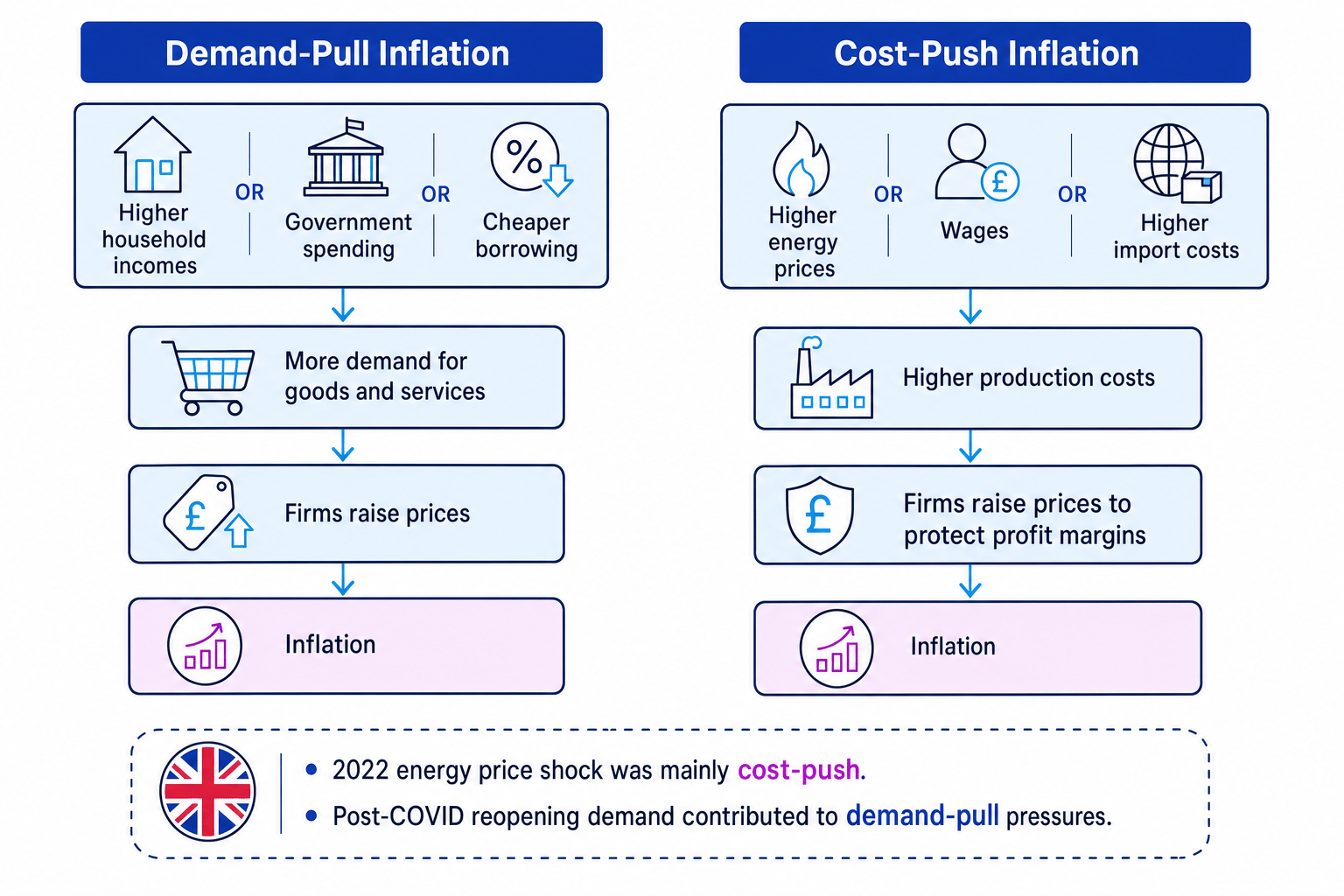
Demand-pull inflation happens when total demand for goods and services rises faster than the economy’s ability to supply them, so firms raise prices.
This can happen when household incomes rise, borrowing becomes cheaper, consumer confidence improves, or government spending increases. For example, after COVID-19 restrictions were lifted, demand for travel, hospitality and goods increased as people started spending again.
Cost-push inflation
Cost-push inflation happens when firms’ costs of production rise, so they increase prices to protect profit margins.
This can be caused by higher wages, higher energy prices, higher raw material prices, or higher import costs. The UK’s 2022–23 inflation spike was strongly affected by rising energy and food prices after Russia’s invasion of Ukraine.
The diagram below compares the two chains of cause and effect.
Spot the starting point
Demand-pull inflation starts with more spending. Cost-push inflation starts with higher production costs. Both can end with firms raising prices.
Classifying an inflation shock
- Suppose energy prices rise sharply, increasing electricity bills for Tesco stores, Greggs ovens and delivery companies.
- The first change is a rise in firms’ production costs, not a rise in customer demand.
- Firms may raise prices to cover these higher costs, so this is mainly cost-push inflation.
- If workers then demand higher wages to cope with higher living costs, firms’ costs may rise again, creating further inflationary pressure.
Consequences of inflation
Inflation affects different groups in different ways. A strong answer should not just say “inflation is bad”; it should explain who is affected and how.
Real income
Real income is income adjusted for inflation. It shows what your money can actually buy.
If your wages rise by less than inflation, your nominal income has gone up, but your real income has fallen. Nominal income means income measured in pounds without adjusting for inflation.
Consumers and workers
High inflation reduces purchasing power if wages, benefits or pensions do not keep up. This was a major issue during the UK cost-of-living squeeze in 2022–23, when food and energy prices rose quickly.
Low-income households are often hit hardest because they spend a larger share of their income on essentials such as heating, rent, transport and food. This raises moral and ethical questions for government: should support be targeted at the poorest households, even if it costs taxpayers more?
Comparing wages with inflation
- A worker earns £400 per week and receives a 5% pay rise, so their pay increases by £20 to £420.
- Prices rise by 9%, so a basket that used to cost £400 now costs £436.
- The worker’s pay has risen in pounds, but it does not cover the new cost of the same basket. Their real income has fallen.
Savers, borrowers and lenders
Inflation can reduce the real value of savings if the interest rate on savings is lower than inflation. For example, if savings earn 3% interest but prices rise by 8%, the saver can buy less than before.
Borrowers may benefit if they have fixed repayments and their wages rise with inflation, because the real value of what they owe falls. However, if interest rates rise, borrowers with mortgages or loans may face higher monthly repayments.
Businesses
Inflation can raise firms’ costs, especially for energy, wages, rent and imported materials. Firms may also face menu costs, which are the costs of changing prices, such as updating labels, websites or catalogues.
High and unpredictable inflation makes planning harder. A business may delay investment because it is unsure what future costs and demand will be. If UK inflation is higher than in other countries, UK exports may become less competitive because their prices rise compared with foreign goods.
Government and the wider economy
Inflation can increase pressure on the government to raise benefits, pensions and public sector wages. It can also increase the cost of government support schemes, such as energy bill support.
But inflation may also increase some tax revenue because people spend more pounds on goods subject to VAT. The overall effect depends on the cause of inflation and the policy response.
Do not assume everyone loses equally
Inflation creates winners and losers. People on fixed incomes often lose, while some borrowers or firms with strong pricing power may be less badly affected.
Government policies to manage inflation
The UK government sets the inflation target, but the Bank of England has the main responsibility for keeping inflation close to target.
Monetary policy
Monetary policy means decisions about interest rates and the money supply, mainly used to influence spending, borrowing and inflation.
The Bank of England can raise the Bank Rate, which is the main interest rate it sets. Higher interest rates usually make borrowing more expensive and saving more attractive. This reduces spending and can reduce demand-pull inflation.
During the 2021–23 period, the Bank of England raised interest rates sharply in response to high inflation. This helped reduce demand, but it also made mortgages and borrowing more expensive for many households and businesses.
How higher interest rates can reduce inflation
- If interest rates rise, households may borrow less for cars, furniture or home improvements, and mortgage payments may increase.
- Lower borrowing and lower disposable income reduce consumer spending.
- With weaker demand, firms find it harder to keep raising prices, so demand-pull inflationary pressure may fall.
- The trade-off is that economic growth may slow and unemployment could rise if firms sell less.
The government can also use fiscal policy, which means changing taxation and government spending. Raising taxes or cutting spending can reduce demand in the economy, but this may be unpopular and can reduce living standards or public services.
For cost-push inflation, demand-reducing policies may be less effective because the original problem is rising costs. The government may use targeted support, such as help with energy bills, or longer-term supply-side policies, such as investment in skills, infrastructure and renewable energy. These can reduce costs or improve productivity, but they often take time.
Policy trade-offs
Reducing inflation can involve sacrifices. Higher interest rates may help price stability, but they can also reduce growth, investment and household spending.
In the exam
- Define inflation as a rise in the general price level, then use CPI and percentage change if figures are given.
- For causes, identify the starting trigger: higher demand means demand-pull; higher costs mean cost-push.
- For consequences or policies, explain winners, losers and trade-offs before reaching a balanced judgement.
Check yourself
- If CPI rises from 125 to 130, how would you calculate the inflation rate?
- Why was the 2022 energy price shock mainly an example of cost-push inflation?
- Name two groups who may lose from high inflation and one group that might benefit.