The importance of market structures on producers and consumers
What you'll learn
- What a market structure is and why markets are not all organised in the same way.
- How to identify market structures using three key factors: number of producers, product differentiation, and ease of entry.
- How different market structures affect consumers through price, choice, quality and innovation.
- How different market structures affect producers through profits, competition, pricing power and barriers to entry.
3.1.5.1 Identifying market structures
Before we compare market structures, start with the word market.
A market is any situation where buyers and sellers come together to exchange goods or services. This does not have to be a physical place: the UK supermarket market, the streaming market, the housing market and the coffee shop market are all markets.
A consumer is a person or household that buys goods and services. A producer is a business or organisation that supplies goods and services.
Market structure
A market structure is the way a market is organised, especially how many producers sell in it, how different their products are, and how easy it is for new producers to enter the market.
Markets sit on a spectrum
Market structures form a range. At one end are very competitive markets with many producers. At the other end are highly concentrated markets, where one or a few producers control a large share of sales.
A competitive market has many producers competing for customers. A concentrated market is one where a small number of producers account for a large proportion of sales.
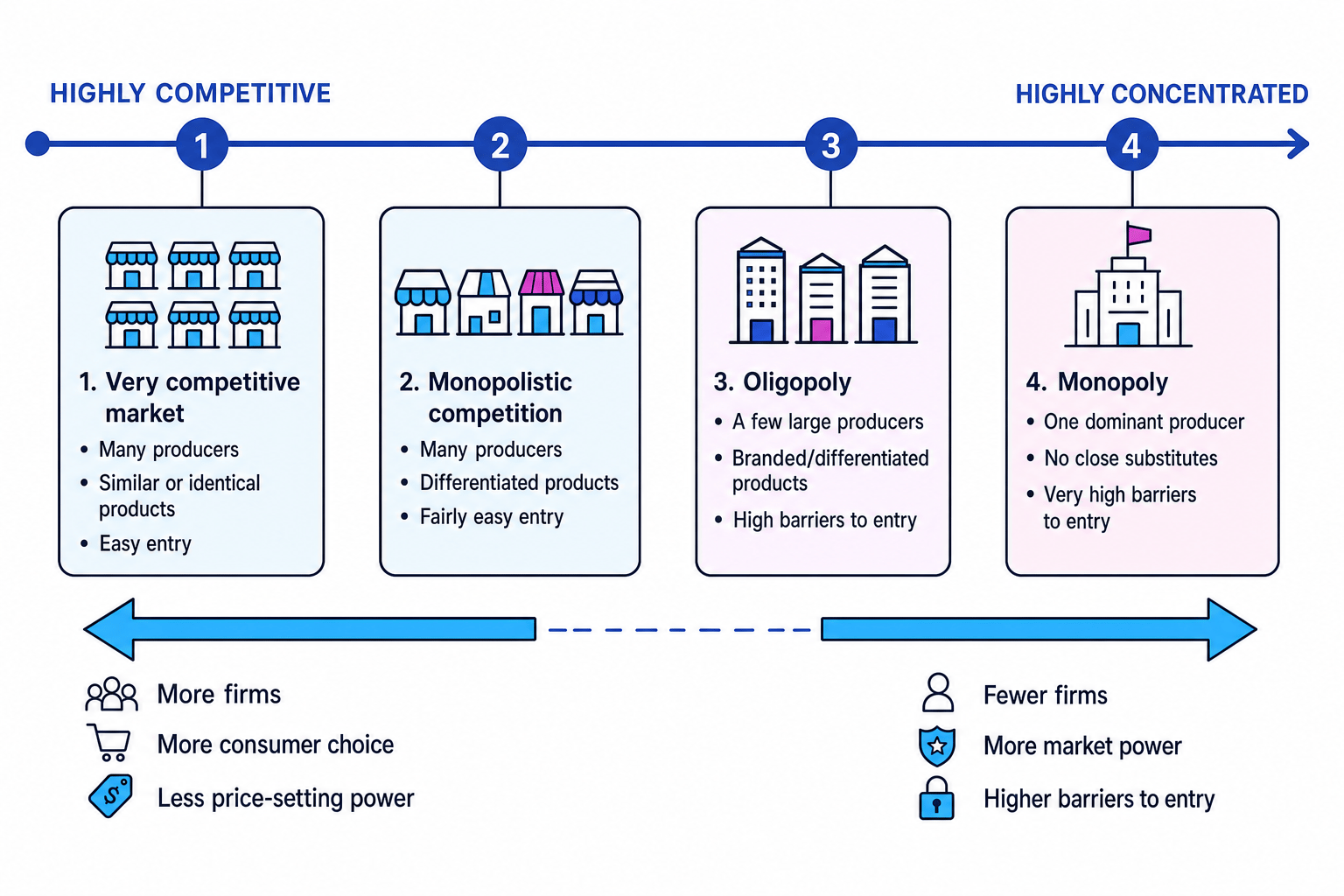
The big picture
The more concentrated a market is, the more market power producers may have. Market power means the ability of a producer to influence price, output, quality or choice rather than simply accepting the market price.
Common positions on the spectrum
You do not need to treat market structures as completely separate boxes. In real life, many markets sit somewhere between the extremes.
| Market structure | Main features | Possible UK examples |
|---|---|---|
| Very competitive market | Many producers, very similar products, easy entry | Some local cleaning services or fruit and vegetable stalls |
| Monopolistic competition | Many producers, differentiated products, fairly easy entry | Cafés, hairdressers, takeaways |
| Oligopoly | A few large producers dominate, strong brands, high barriers to entry | Supermarkets, mobile networks, streaming platforms |
| Monopoly | One dominant producer, no close substitutes, very high barriers to entry | Local rail routes or some utility networks |
A monopoly is a market with one dominant producer. A close substitute is an alternative product that consumers would see as a similar replacement.
Placing a market on the spectrum
A town has 18 barber shops. Each one offers haircuts, but they differ by location, reputation, service and price. A new barber could open, but would need premises, equipment and customers.
-
Check the number of producers. There are 18 barber shops, so this is not a monopoly or a tight oligopoly. There are many producers.
-
Check product differentiation. The service is similar, but not identical: customers may care about the barber’s skill, convenience, atmosphere and brand.
-
Check ease of entry. Entry is possible because a new barber does not need a huge factory or special legal monopoly, although it still needs start-up money and reputation.
-
Classify the structure. This is closest to monopolistic competition: many producers, differentiated services and fairly easy entry.
Factor 1: the number of producers
The first way to identify a market structure is to ask: how many producers are there?
If there are many producers, each individual business usually has less control over price. If one café raises its prices too much, customers may go to another nearby café.
If there are only a few producers, each one may have more power. For example, in the UK supermarket market, large firms such as Tesco, Sainsbury’s, Asda, Aldi and Lidl watch each other closely. A price change by one big supermarket can affect the choices of millions of consumers and the decisions of rival firms.
Counting products, not producers
Do not just count how many brands you can see. Several brands may be owned by the same company. Market structure is about the number and strength of producers, not just the number of product names on shelves.
Factor 2: the degree of product differentiation
Product differentiation means how far consumers see one producer’s product as different from another producer’s product.
Product differentiation
Product differentiation is when producers make their goods or services appear different from competitors’ products through features such as branding, quality, design, location, packaging, customer service or advertising.
Some products are very similar. For example, petrol from different petrol stations may be viewed by many drivers as almost the same. In that case, price and convenience become very important.
Other products are strongly differentiated. A customer may not see Netflix, Disney+, Amazon Prime Video and Apple TV+ as identical because they offer different programmes, brands and bundles. This allows each firm to build customer loyalty.
Product differentiation matters because it can give producers some market power. If consumers strongly prefer one brand, that producer may be able to charge a higher price without losing all its customers.
Think like a consumer
Ask: “Would buyers easily switch if the price rose?” If yes, the products are close substitutes. If no, the products are probably more differentiated.
Factor 3: ease of entry into the market
The third factor is ease of entry.
Barriers to entry
Barriers to entry are obstacles that make it difficult for new producers to enter a market and compete with existing firms.
If entry is easy, new producers can join when they see a chance to make profit. This puts pressure on existing producers to keep prices fair, improve quality and control costs.
If entry is difficult, existing producers face less threat from new competitors. This may allow them to keep prices higher or protect their profits.
Examples of barriers to entry
Barriers to entry can include:
- High start-up costs, such as building a factory or buying specialist technology.
- Legal restrictions, such as licences or regulation.
- Strong brands, where customers already trust existing firms.
- Economies of scale, where large firms have lower average costs because they produce on a bigger scale.
- Access to key resources, such as transport networks, data, land or supplier contracts.
For example, opening a small coffee cart may be relatively easy. Starting a new national mobile network is much harder because it requires expensive infrastructure, technology, licences and advertising.
Identifying barriers to entry
A new business wants to enter the UK streaming market and compete with Netflix, Disney+ and Amazon Prime Video.
-
Consider start-up costs. The new firm would need a platform, technology, customer support and advertising. These costs are likely to be high.
-
Consider product differentiation. Existing firms have exclusive shows, films and strong brands. A new firm would need attractive content to persuade consumers to subscribe.
-
Consider customer switching. Consumers may already pay for several subscriptions, especially after the 2022–23 cost-of-living squeeze when many households reviewed spending. A new service would need to offer clear value.
-
Reach a judgement. Entry is possible, but difficult. The market is likely to be closer to an oligopoly than a very competitive market.
Why market structure matters for consumers
Market structure affects the experience of consumers in several important ways.
Price
In more competitive markets, producers often have to keep prices low because consumers can switch easily. If one takeaway raises prices sharply while nearby rivals do not, it may lose customers.
In more concentrated markets, producers may have more power to raise prices. However, this is not automatic. Large firms may also have lower costs because of economies of scale, and some savings may be passed on to consumers.
Choice
Competitive markets usually give consumers more choice. Differentiated markets can be especially good for choice because firms try to stand out through quality, branding, convenience or service.
In a monopoly, consumers may have little or no choice. This can be a serious issue in essential services such as energy, water or transport, where consumers cannot easily stop buying the service.
Quality and innovation
Competition can push firms to improve quality and innovate. For example, supermarkets compete through delivery services, loyalty schemes, own-brand ranges and price matching.
But large firms in concentrated markets may also have the profits needed to invest in new technology. For example, major streaming platforms can spend heavily on original content and app development.
Consumers may gain or lose
Consumers often benefit from competition through lower prices, more choice and better service. But a large producer is not always bad if it uses its scale to reduce costs, improve reliability or invest in innovation.
Why market structure matters for producers
Market structure also shapes the decisions and rewards of producers.
Pricing power and profit
In a competitive market, producers have limited pricing power. If they charge too much, customers may switch. This can reduce profit margins.
In a concentrated market, producers may have more pricing power. If barriers to entry are high, existing firms may be protected from new rivals, allowing them to earn higher profits.
Pressure to improve
Competition creates pressure. Producers may need to:
- reduce costs
- improve quality
- advertise more effectively
- innovate
- offer better customer service
- respond quickly to rivals
For example, UK supermarkets have had to respond to the growth of Aldi and Lidl by cutting prices, promoting value ranges and using loyalty-card discounts.
Ethical and sustainability issues
Market power brings responsibility. If a firm has strong market power in an essential market, high prices can create fairness concerns for consumers, especially low-income households.
During the 2022–23 inflation spike and cost-of-living squeeze, many households faced higher food and energy bills. Producers also faced higher costs for energy, transport and wages. A good evaluation recognises both sides: some price rises reflected genuine cost increases, but consumers and regulators may still question whether powerful firms are treating customers fairly.
Analysing a concentrated market
Suppose a local area has only one rail operator on a key commuter route. Many workers need the train to get to work, and driving is much slower.
-
Identify the structure. There is one main producer on this route, so the market is highly concentrated and close to a monopoly for those commuters.
-
Analyse the consumer impact. Consumers have limited choice. If fares rise or service quality falls, many passengers cannot easily switch to another provider.
-
Analyse the producer impact. The rail operator may have more secure demand because commuters rely on the service. This can give it more market power than a firm in a highly competitive market.
-
Evaluate the judgement. The impact depends on regulation and performance targets. A monopoly may be acceptable if it provides reliable service at regulated prices, but harmful if it uses market power to charge high fares or offer poor service.
How to identify market structures in an exam
Use the three-question test:
-
How many producers are there?
Many producers suggest a more competitive market. One or a few producers suggest a more concentrated market. -
How differentiated are the products?
Very similar products create stronger price competition. Differentiated products may give firms more pricing power. -
How easy is entry?
Easy entry increases competitive pressure. High barriers to entry protect existing firms.
Three-factor method
For identification questions, write about number of producers, product differentiation and ease of entry. These are the three factors AQA expects you to use.
In the exam
-
Start by classifying the market using evidence from the question: number of firms, product differences and barriers to entry.
-
Separate the effects on consumers and producers. Consumers usually care about price, choice and quality; producers usually care about profits, costs and market power.
-
For evaluation, avoid saying “competition is always good” or “monopoly is always bad”. Judge the actual case: consider prices, innovation, reliability, regulation and fairness.
Check yourself
- What three factors can you use to distinguish between different market structures?
- Why might product differentiation give a producer more market power?
- How could a concentrated market harm consumers but benefit producers?