What you'll learn
- The difference between the balance of trade, the balance of payments, and the current account.
- How to calculate a simple current account balance using exports, imports and other figures.
- What a current account deficit or surplus means for the UK economy.
- Why governments may try to influence the balance of payments, and the trade-offs involved.
Balance of trade and balance of payments
Start with international trade
International trade means buying and selling goods and services between countries.
A good is a physical product, such as a car, phone, medicine or food. A service is an activity people pay for, such as banking, tourism, insurance, streaming or education.
Exports and imports
Exports are goods and services sold to other countries. Imports are goods and services bought from other countries.
For example, if a UK games company sells software to customers in the USA, that is a UK export. If a UK supermarket such as Tesco buys fruit from Spain, that is a UK import.
Balance of trade
Balance of trade
The balance of trade is the value of exports minus the value of imports over a period of time.
If exports are greater than imports, the balance is positive. If imports are greater than exports, the balance is negative.
Calculating a trade balance
- Suppose the UK exports £120bn of goods and imports £150bn of goods.
- Subtract imports from exports: £120bn - £150bn = -£30bn.
- The negative result means a trade deficit of £30bn, because the UK spent £30bn more on imported goods than it earned from exported goods.
Balance of payments
Balance of payments
The balance of payments is a record of money flowing between residents of one country and the rest of the world over a period of time.
At GCSE, the key part is the current account.
Current account
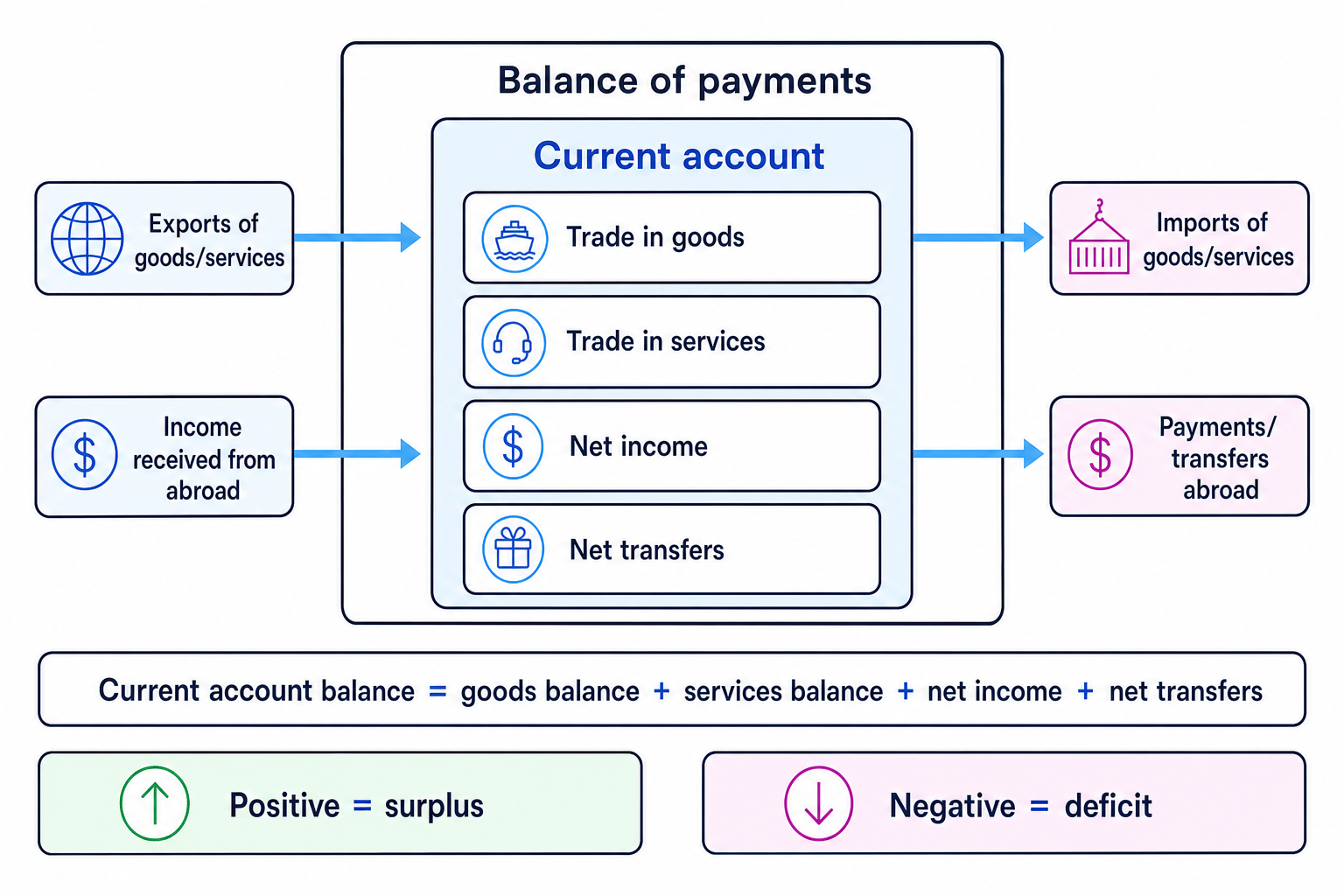
The current account records trade in goods and services, plus flows of income and transfers between the UK and other countries.
The current account includes:
- Trade in goods: physical products, such as cars, oil, clothing and food.
- Trade in services: services such as banking, tourism, insurance and education.
- Net income: income received from abroad minus income paid abroad, such as profits, interest and wages.
- Net transfers: one-way payments, such as overseas aid or money sent by workers to family abroad.
Think of the current account as the UK’s regular earning and spending with other countries.
Sign check
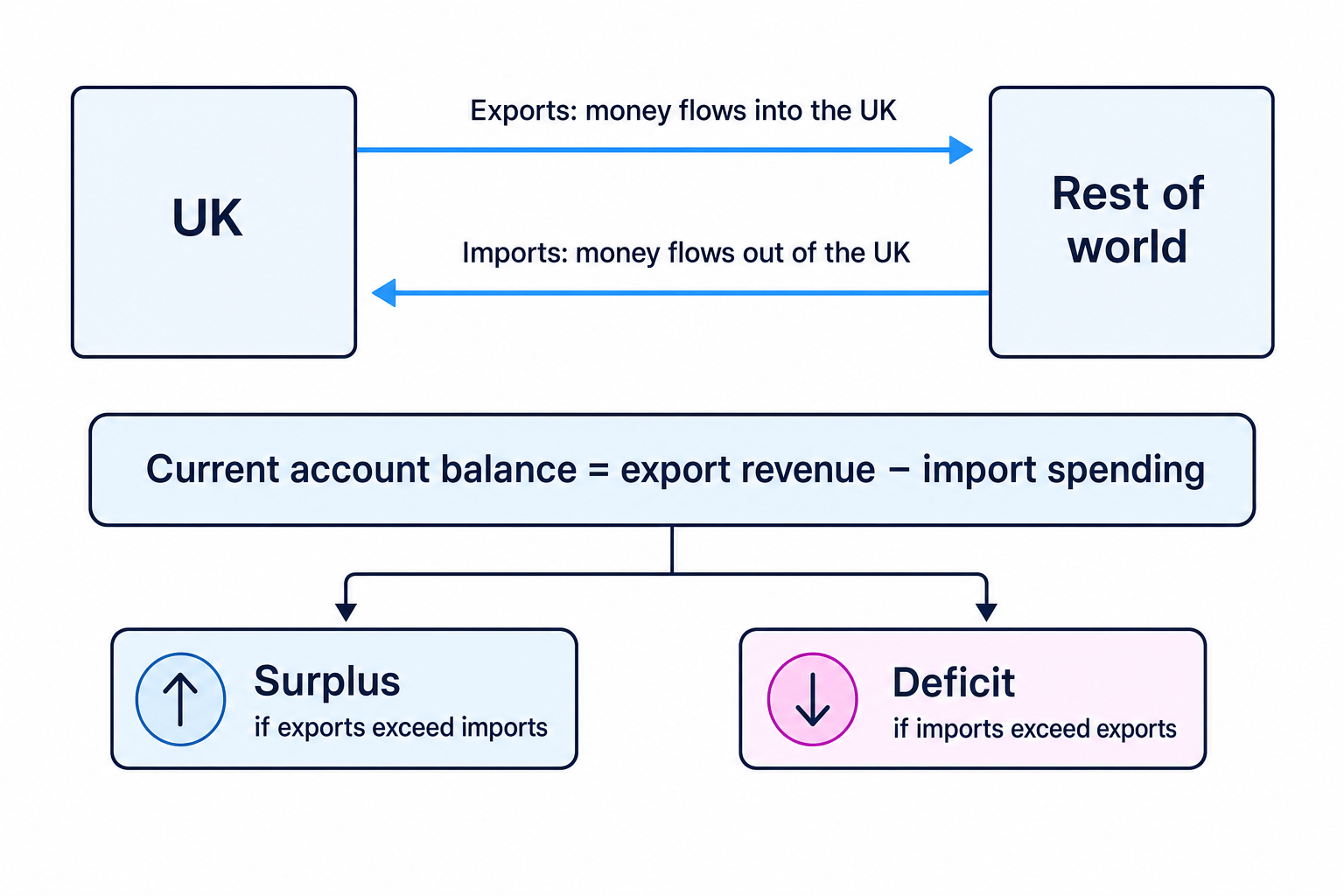
A positive current account balance means a surplus. A negative current account balance means a deficit.
Not the government budget
A current account deficit is not the same as a government budget deficit. The current account is about trade and international payments; the government budget is about tax revenue and public spending.
Balance of payments surpluses and deficits on the current account
Calculating the current account balance
A simple current account calculation can be built from several parts:
Current account balance=goods balance+services balance+net income+net transfers\text{Current account balance}=\text{goods balance}+\text{services balance}+\text{net income}+\text{net transfers}Current account balance=goods balance+services balance+net income+net transfersA goods balance is goods exports minus goods imports. A services balance is services exports minus services imports.
Calculating the current account balance
- Calculate the goods balance: goods exports are £360bn and goods imports are £520bn, so £360bn - £520bn = -£160bn.
- Calculate the services balance: services exports are £400bn and services imports are £300bn, so £400bn - £300bn = £100bn.
- Add the current account items: -£160bn + £100bn + £10bn - £20bn = -£70bn.
- The result is negative, so the current account is in deficit by £70bn.
What a current account deficit means
Current account deficit
A current account deficit means the value of imports and other outgoing payments is greater than the value of exports and other incoming payments.
A deficit is not automatically “bad”. It may happen because UK households and firms are wealthy enough to buy lots of imported goods, such as cars, electronics and food. Firms may also import machinery to increase future output.
However, a large and persistent deficit can be significant because:
- UK firms may be losing sales to overseas competitors.
- Some domestic jobs may be at risk in industries facing strong import competition.
- More money is flowing out for imports than coming in from exports.
- It may put downward pressure on the pound, making imports more expensive.
- It can make the UK more vulnerable to global shocks, such as the 2022-23 energy price spike.
Deficits need judgement
A current account deficit matters most when it is large, long-lasting, and caused by weak competitiveness rather than temporary factors.
What a current account surplus means
Current account surplus
A current account surplus means the value of exports and other incoming payments is greater than the value of imports and other outgoing payments.
A surplus can support output and jobs in exporting industries. For example, strong demand for UK financial services, pharmaceuticals or creative industries can bring money into the UK.
But a surplus is not always perfect. It could also reflect weak domestic spending, where households and firms are not buying much, including imports. Very large surpluses can also create tension with trading partners.
Reasons for a deficit or surplus on the current account
1. Price competitiveness
Price competitiveness means how attractive a country’s goods and services are compared with foreign alternatives based on price.
If UK inflation is higher than inflation abroad, UK exports may become relatively expensive. At the same time, imports may look cheaper to UK consumers. This can worsen the current account.
2. Non-price competitiveness
Non-price competitiveness means factors other than price, such as quality, design, reliability, branding and after-sales service.
For example, UK universities, financial services and creative industries can attract overseas customers even if they are not the cheapest, because quality and reputation matter.
3. Exchange rates
Exchange rate
An exchange rate is the price of one currency in terms of another currency, such as the value of the pound against the euro or US dollar.
If the pound becomes stronger, imports become cheaper for UK buyers, but UK exports become more expensive for overseas buyers. This can worsen the current account.
If the pound becomes weaker, exports become cheaper to foreign customers, while imports become more expensive for UK consumers. This may improve the current account, but it can also raise living costs if imported food, fuel or materials become dearer.
4. Growth and incomes
When UK incomes rise, households may buy more imported goods, such as phones, cars and holidays abroad. This can increase imports.
If other countries are growing quickly, their consumers and firms may buy more UK exports. This can improve the UK current account.
5. Global shocks and trade barriers
Recent examples matter. COVID-19 reduced international travel, affecting tourism and airline services. Brexit increased paperwork for some UK-EU trade. The 2022-23 energy price shock increased the cost of imported gas and oil for many countries, including the UK.
Explaining a larger deficit after an energy-price shock
- The UK imports some of its energy, so a rise in global gas and oil prices increases the value of imports.
- Import spending can rise even if the physical amount of energy imported does not rise much.
- Unless UK exports increase by the same amount, the current account balance becomes more negative.
- The deficit may be harder to reduce because higher energy costs can also raise costs for UK producers, making exports less competitive.
Government policies to influence the balance of payments
Governments may want to reduce a current account deficit, but they must consider other objectives too: growth, low unemployment, low inflation and fair living standards.
Supply-side policies
Supply-side policies aim to improve the ability of firms to produce goods and services efficiently.
Examples include better education and training, improved transport infrastructure, support for research and development, and help for exporters. These can improve competitiveness, making UK exports more attractive and reducing reliance on imports.
The drawback is timing: these policies can take years to work and may cost the government money.
Demand-side policies
Demand-side policies influence total spending in the economy.
For example, higher taxes or higher interest rates can reduce consumer spending. If people buy fewer goods overall, they may buy fewer imports. This could reduce a current account deficit.
The trade-off is that lower spending can reduce sales for UK firms too, slowing growth and increasing unemployment.
Protectionist policies
Protectionism means using policies to reduce imports and protect domestic firms.
A tariff is a tax on imports. A quota is a limit on the quantity of imports allowed. These can reduce imports by making foreign goods more expensive or less available.
However, protectionism has serious costs:
- Consumers face higher prices and less choice.
- Other countries may retaliate with their own trade barriers.
- Domestic firms may become less efficient if they face less competition.
- It may harm producers in poorer countries who rely on selling goods to the UK.
Ethical trade-offs
Reducing imports may protect some UK jobs, but it can raise prices for UK households and reduce incomes for overseas workers who depend on trade.
Choosing a policy to reduce a deficit
- If the deficit is caused by weak UK competitiveness, supply-side policies such as skills training and infrastructure investment target the underlying problem.
- If the deficit is caused by a temporary surge in consumer spending on imports, higher taxes or interest rates could reduce import demand, but may also reduce growth.
- If the government uses tariffs, imports may fall, but consumers pay higher prices and trade partners may retaliate.
- A strong judgement would usually favour improving competitiveness in the long run, while recognising that it is slower than restricting imports.
In the exam
- Always state whether the figure is a surplus or deficit, and use the sign correctly.
- Link causes to the current account clearly: explain what happens to exports, imports, or both.
- When evaluating policy, weigh benefits against costs for consumers, firms, workers and the government.
Check yourself
- If exports are £500bn and imports are £560bn, is the trade balance a surplus or deficit, and by how much?
- Give two reasons why the UK might have a current account deficit.
- Why might a tariff reduce imports but still make consumers worse off?