Question 4
FDiamond and graphite are both forms of pure carbon.
The diagrams show the structures of diamond and graphite. Each circle represents a carbon atom.
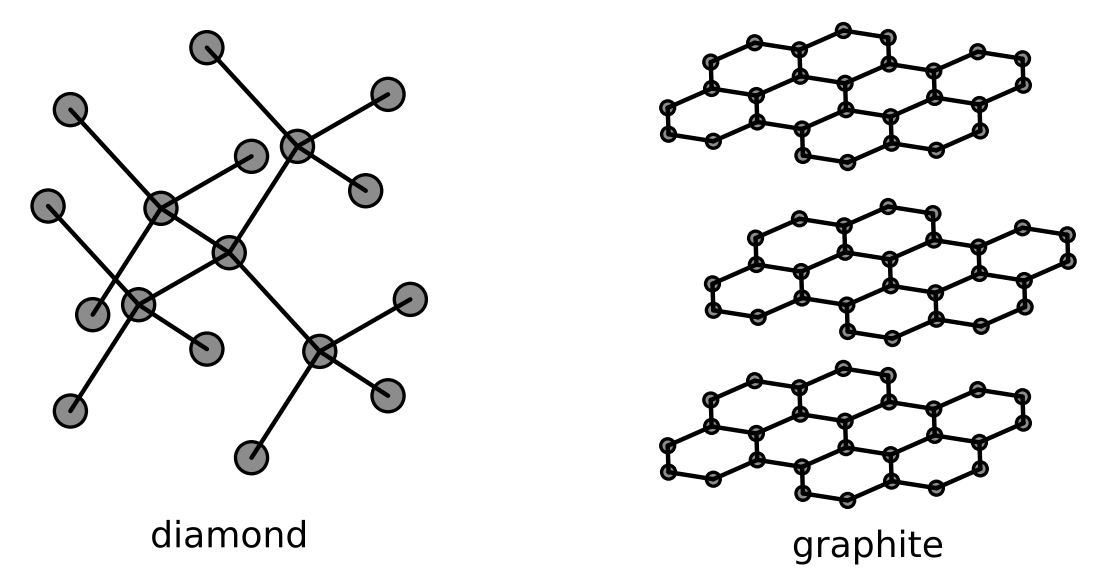
a.
[2]
The table shows some statements.
| Statement | Diamond, graphite or both? |
|---|---|
| each carbon atom forms four covalent bonds | ? |
| it conducts electricity | ? |
| it has a very high melting point | ? |
| it is made of layers of carbon atoms | ? |
Complete the table. Write diamond, graphite or both in each row.
b.[2]
Graphite is used in pencils because it is soft and slippery.
Explain why graphite is soft and slippery.
c.[2]
Graphite conducts electricity but diamond does not.
Explain why.
d.[1]
Graphene is a single layer of graphite.
Give one property of graphene.
e.[1]
Fullerenes are another form of carbon.
Give one use of fullerenes.
2.3 Properties of materials Questions
60 exam-style questions on OCR GCSE Chemistry 2.3 Properties of materials, covering 2.3.1 Carbon bonding and the variety of organic compounds, 2.3.2 Diamond, graphite, fullerenes and graphene, 2.3.3 Bond strength, changes of state and predicting states, 2.3.4 Bulk properties and types of bonding, and 2.3.5 Nanoparticles: scale, surface area, uses and risks. Each one has a worked solution and a mark scheme showing where the marks go.