Question 6
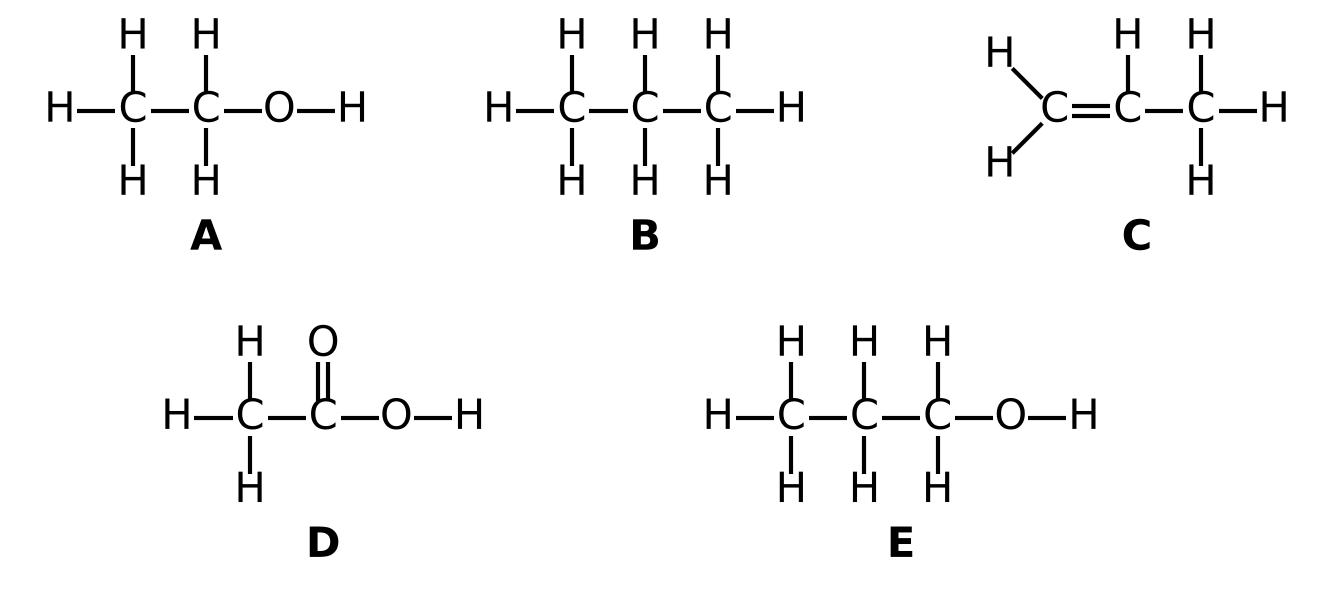
FThe diagram shows the displayed formulae of five organic compounds, A, B, C, D and E.
a.[1]
Which two compounds are members of the same homologous series?
Write the letters.
b.
[4]
Complete the table for compounds C and D.
| Compound | Homologous series | Functional group |
|---|---|---|
| C | ? | ? |
| D | ? | ? |
Write your answers in the table.
c.[2]
Name compound B and compound D.
d.[1]
Members of the same homologous series react in similar ways.
Explain why.
e.
[3]
Polymers are also made by living things.
The table shows three natural polymers.
| Natural polymer | Monomer |
|---|---|
| DNA | ? |
| protein | ? |
| starch | ? |
Use words from the list: amino acids, ethene, nucleotides, propene, sugars
Complete the table.
6.2 Organic chemistry Questions
63 exam-style questions on OCR GCSE Chemistry 6.2 Organic chemistry, covering 6.2.1 Crude oil and fractional distillation, 6.2.2 Cracking and dependence on hydrocarbons, 6.2.3 Functional groups and homologous series, 6.2.4 Reactions of alkanes, alkenes and alcohols, 6.2.5 Addition polymerisation and repeat units, 6.2.6 Naturally occurring polymers, 6.2.7 Chemical cells and fuel cells, and 6.2.8 Condensation polymerisation and how to make one. Each one has a worked solution and a mark scheme showing where the marks go.