Question 4
FMetals are extracted from their ores. The method used depends on how reactive the metal is.
a.
[2]
The table shows some elements in order of reactivity. The most reactive element is at the top. Carbon is included for comparison.
| Element | Method used to extract the metal from its ore |
|---|---|
| potassium | electrolysis |
| aluminium | ? |
| carbon | (non-metal) |
| zinc | heating with carbon |
| iron | ? |
| lead | heating with carbon |
Complete the table. Write electrolysis or heating with carbon in each empty box.
b.[2]
Explain why zinc can be extracted by heating with carbon but aluminium cannot.
c.i.[1]
Zinc is extracted by heating zinc oxide with carbon in a furnace.
Complete the word equation for the reaction.
zinc oxide + carbon → \rightarrow\,→ zinc + ......
c.ii.[2]
Which substance is reduced in this reaction?
Give a reason for your answer.
d.i.[1]
Aluminium is extracted by the electrolysis of aluminium oxide.
The diagram shows the electrolysis cell.
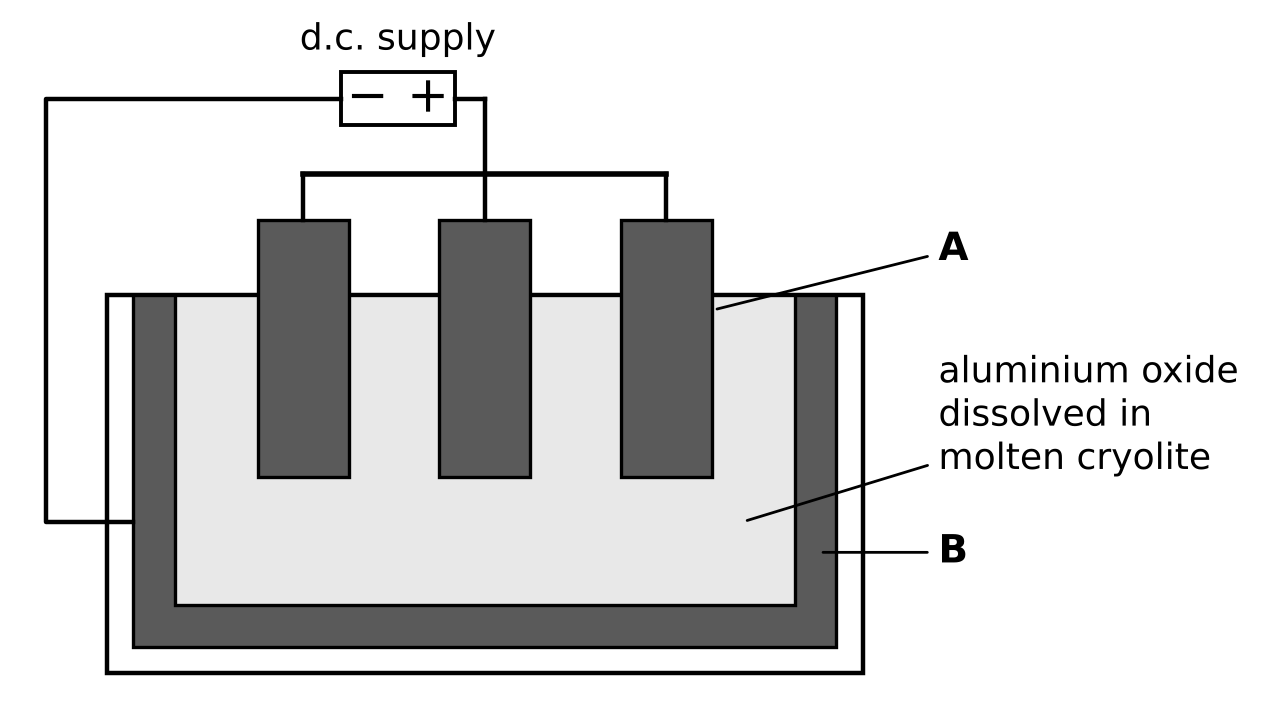
Explain why the aluminium oxide must be molten before electrolysis can happen.
d.ii.[1]
Aluminium oxide has a very high melting point. It is dissolved in molten cryolite instead of being melted on its own.
Suggest why.
d.iii.[1]
At which electrode, A or B, does aluminium form?
Write the letter.
6.1 Improving processes and products Questions
61 exam-style questions on OCR GCSE Chemistry 6.1 Improving processes and products, covering 6.1.1 Extracting metals industrially and by electrolysis, 6.1.2 Life cycle assessment and recycling, 6.1.3 Biological methods of metal extraction, 6.1.4 The Haber process and the production of fertilisers, 6.1.5 Alloys and their uses, 6.1.6 Corrosion and its prevention, 6.1.7 Comparing and selecting materials, and 6.1.8 Industrial conditions, rate and position of equilibrium. Each one has a worked solution and a mark scheme showing where the marks go.